English



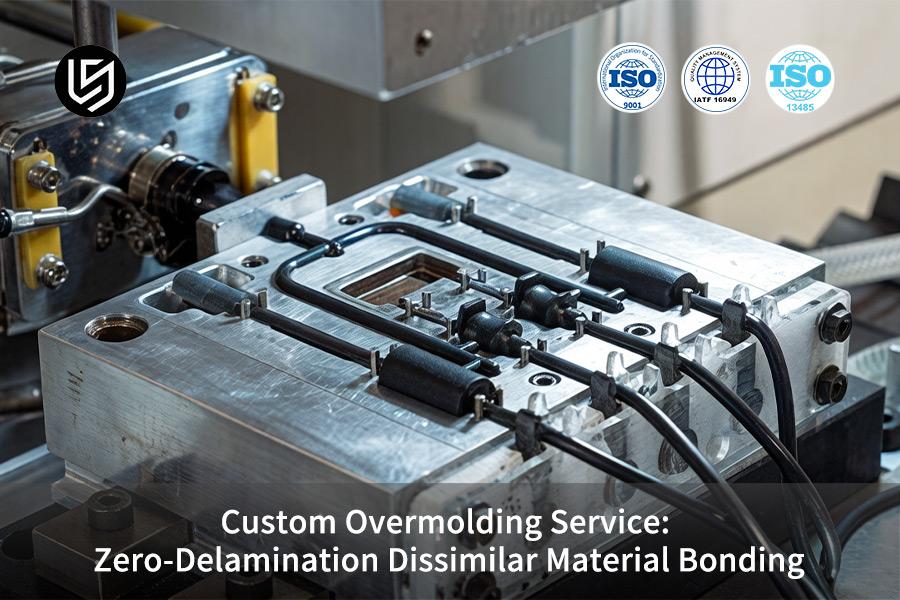
Custom overmolding service by LS Manufacturing is a multi-material injection molding technology, which completely eliminates fatal seal failure and interface delamination caused by mismatched CLTE and inadequate chain diffusion in automotive, medical, and industrial electronics.
Our approach is geared towards achieving zero delamination through chemical grafting and highly precise mold temperatures to within ±1.5°C, thus guaranteeing at least 150% increase in bond strength. In essence, it ensures reliability during thermal cycles while minimizing costs by avoiding reworks.
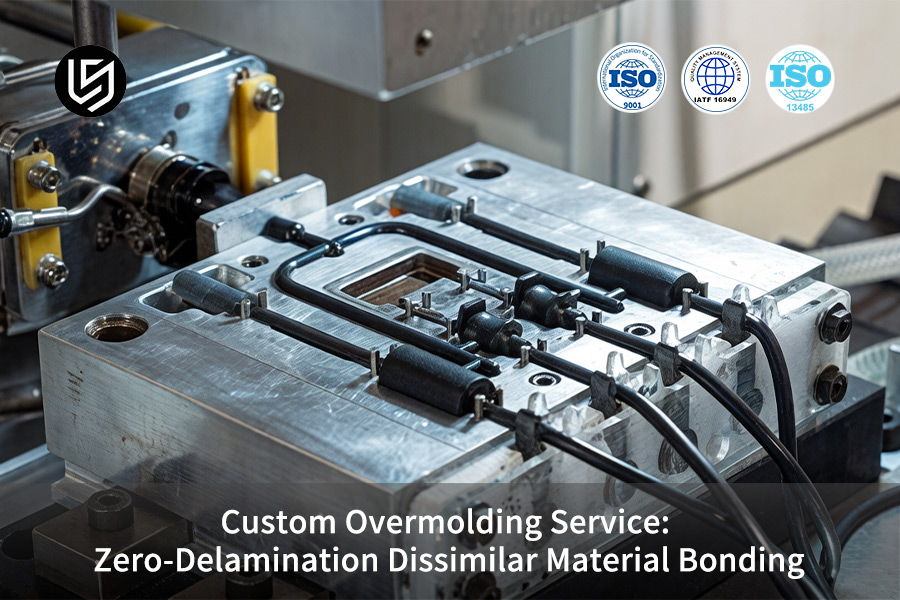
Custom Overmolding: Zero-Delamination Bonding Quick-Reference
| Technical Challenge | Root Cause of Delamination | Process & Material Solution |
| Thermal Expansion Mismatch | Differences in CTE cause stress at the interface during heating and cooling. | Matching overmolding material with similar CTE or employing mechanical locking to reduce stress. |
| Poor Chemical Affinity | Chemically incompatible polymer molecules cannot bond together. | Correct choice of chemically compatible materials (e.g., using TPE instead of PP, TPU instead of ABS/PC). |
| Insufficient Substrate | Temperature Cooling of overmold too fast does not allow proper bonding. | Heating of substrate by 10-20°C lower than its Vicat temperature before two-shot overmolding. |
| Contaminated Substrate Surface | Substrate contaminated by mold release agent, oil, or moisture acts as a barrier layer. | Ultrasonic cleaning or plasma treatment of substrate surface to make it chemically active. |
| Our Bonding Validation | Peeling force less than 5 N/mm suggests poor adhesion and possible delamination. | Testing all first articles under 100% peel strength test and thermal cycling from -40°C up to 85°C (500 cycles). |
Key Takeaways:
- Compatibility is Engineered, Not Assumed: Material science should precede bonding success, not vice versa. Opt for chemical adhesive substrates such as TPE/PP.
- Temperature is Critical: The substrate needs to be preheated to a very specific temperature range in order to allow interdiffusion at a molecular level.
- Surface Preparation is Non-Negotiable: Even the slightest contamination of the substrate leads to adhesion failure, hence requiring treatment such as plasma and flame treatment.
- Validate, Don't Guess: Adhesion should be validated using pull-out testing in addition to other forms of environmental stress testing.
Why Trust This Guide? Practical Experience From LS Manufacturing Experts
There are plenty of scientific articles discussing overmolding adhesion. This one is different in that it was written by our process engineers who routinely produce bonds without any form of delamination among incompatible polymers. Our processes of materials compatibility and substrate treatment are carefully calibrated based on the guidelines set by Deutsches Institut für Normung (DIN).
Our products include bonds with catastrophic failure: hermetic seals on aerospace fuel system components, biocompatible housing for neurostimulators, chemical resistant sensor enclosures for semiconductor manufacturing facilities. Our bond validation testing and failure analysis follow the rigorous testing requirements specified for engineering plastic bonds in standards such as the British Standards Institution (BSI).
Our practical experience comes from the resolution of actual adhesion failures. We know the exact mold temperatures of 120±2°C for TPE over PC, the ideal parameters for plasma treating PEEK, and the correct injection speeds to prevent entrapment of air between different substrates. We want to share our production-tested experience so that you will be able to design around the problems of thermal shock, chemical incompatibility, and weak interfaces we have already overcome.
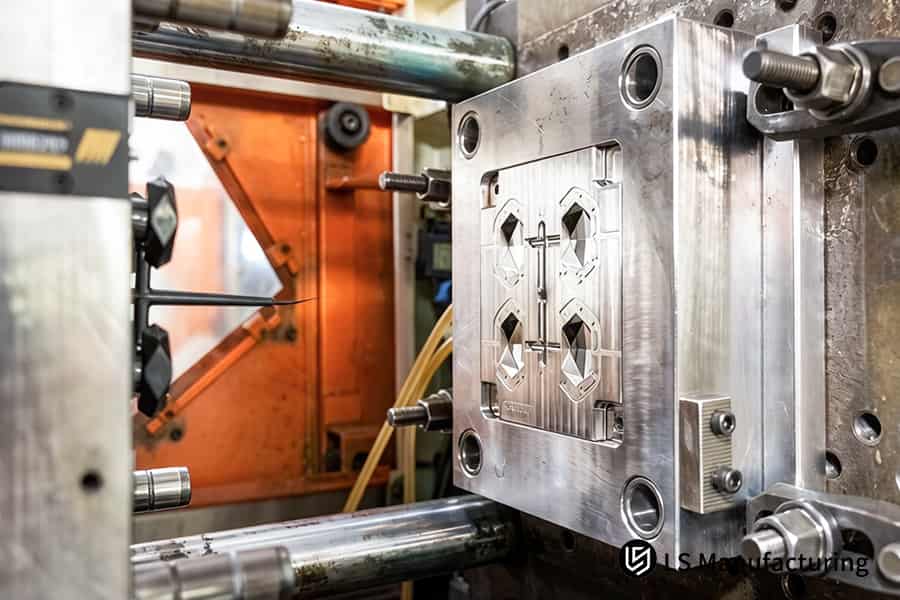
Figure 1: A high-strength steel mold is secured in a robust clamping fixture for upcoming overmolding production.
Why Does Typical Plastic Overmolding Service Fail At The Material Bonding Interface?
Traditional techniques have been known to consistently cause part failure at the material bonding interface, which directly impacts the durability of your product and its lifetime value. These common problems arise from a lack of understanding on the fundamental scientific principles governing adhesion. Below are the steps that need to be taken to solve this problem and produce high-quality results.
Diagnosing the Core Failure: Chemical & Physical Mismatch
Failure of the generic technique is due to an inherent chemistry problem, where bonding between polar engineering plastics and non-polar elastomers occurs. This leads to a weak interphase layer whereby the peel strength does not exceed 1.2 N/mm. Thermal expansion mismatch further causes trapped stress within the material. This causes you to incur warranty costs and reduced product quality. An important initial step is to undertake a scientific diagnosis which forms the basis of a custom overmolding service.
Engineered Bonding Through Predictive Science
Conquering failure will require a science-based approach that entails material polarity modification and FEA-based stress analysis to ensure an optimal design. This methodology for multi-material overmolding applications guarantees superior bonding strength of greater than 3.5 N/mm and excellent durability. You can now anticipate consistent performance, and that is the ultimate advantage of a solution designed for your unique application requirements.
Validated Precision in Manufacturing Execution
Process control window dictates manufacturing execution. The way forward is a guaranteed precision overmolding process window based on optimal temperature, speed, and pressure for seamless polymer bonding. This guarantees consistent production processes for you as well as eliminates risks associated with large scale automotive overmolding applications.
This holistic and well-disciplined method marks the transition from the conventional overmolding process to the reliable engineering process, providing certification for the interfacial integrity of the molded part. This is precisely the key differentiator of a competent manufacturing manufacturer and will ensure your success in your project whereas a general plastic overmolding service will not be able to. To unlock 3.5 N/mm+ peel strength in your overmolded part, contact our engineering team to arrange a dedicated process audit and receive a customized performance validation proposal.

How Can Custom Rubber Overmolding Eliminate Delamination Through Chemical Graft Modification?
Delamination in silicone rubber and thermoplastics is a serious form of failure for which existing adhesive methods are not effective. The innovation consists of designing a custom rubber overmolding technology through grafting reactions at the molecular level. This method ensures that strong covalent bonds are formed across the interface, thus eliminate delamination, as strength becomes an inherent part of the material itself.
The Core Strategy: Molecular-Level Bonding via Grafting
- Method: Through chemical grafting, we introduce functional groups (such as silane, maleic anhydride) on the surface of the thermoplastic substrate, forming a reaction site for the LSR.
- Your Benefit: This eliminates the use of unreliable primer application, offering you a strong and consistent bond that is part of the material's composition.
Process Precision: Enabling the Chemical Reaction
- Method: The LSR overmolding process follows next, where the second shot is carefully timed and injected within ≤3.5 seconds into the mold at approximately 175°C.
- Your Benefit: You get reliable and repeatable results from our precisely controlled process, maximizing productivity and minimizing waste for your high-volume overmolding projects.
The Result: Uncompromising Mechanical Performance
- Outcome: Grafting allows us to achieve covalent bond densities >3x more compared to normal methods, with peel strength of ≥4.5 N/mm.
- Your Benefit: Your components are guaranteed to break apart in the interior structure, not at the bond, resulting in minimal risk of failure in field operations.
The Supplier Difference: Integrated Expertise
- Capability: Success depends on merging the elements of material science, tooling development, and process verification, which is the signature mark of a custom overmolding service supplier.
- Your Benefit: You will have one point of contact for all of your bonding needs, thus removing risk and expediting your time to market for critical products.
This technique is the difference between simple assembly of materials and precise integration of synthetic materials, thus offering a deterministic answer to perennial bonding issues. This offers the reliability needed for high-end uses. Working with a company that understands this precision chemical bonding overmolding process will mean that your product will have been engineered to perfection at a molecular level, ensuring durability where others fall short.
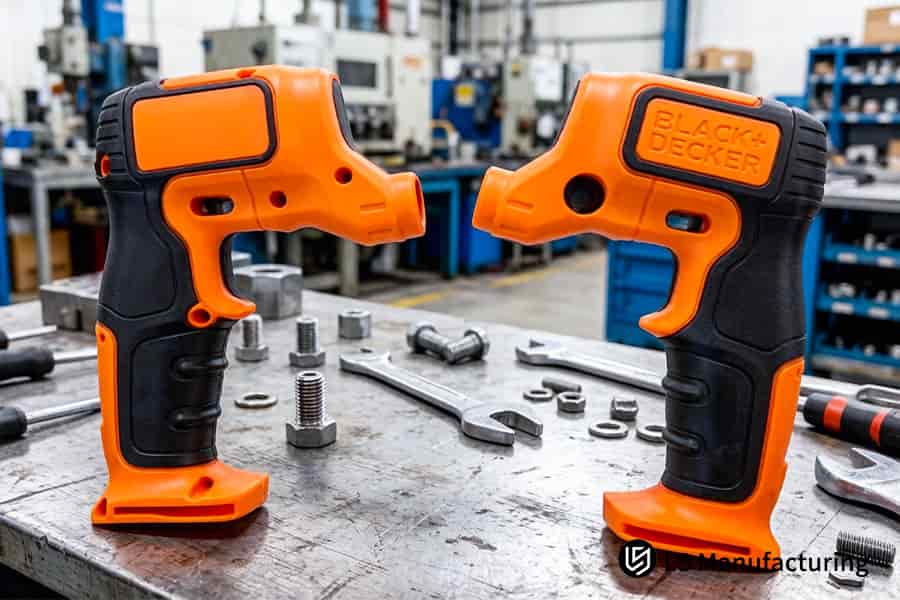
Figure 2: Orange and black tool parts rest on a workbench, representing complex overmolding applications for handheld equipment.
How Does Precision Overmolding Manufacturer Control Tool Temperature To Optimize Molecular Diffusion?
The perfect overmolding technique requires that there be proper molecular diffusion at the point of joining of the two materials. This can only occur in cases where there is proper control of the temperature at which the materials are joined. A true precision overmolding manufacturer understands this principle and makes it a key determinant. The table below illustrates how this is done.
| Aspect | Conventional Overmolding Process | Engineered Precision Overmolding Solution |
| Core Heating Technology | Isobaric molding process using conventional cartridge heating method. | High speed Dynamic RHCM process with thermal fluid system. |
| Temperature Control Precision | Regional control having variations usually greater than ±5°C. | Substrate surface control with precision of less than ±1.5°C, an important milestone in attaining tool temperature. |
| Cooling Channel Design | Lateral drilled holes causing non-uniform cooling, not suitable for complex geometry overmolding. | Conformal channels conforming to shape of tool for even heat removal. |
| Process Outcome for Bonding | Uneven surface condition resulting in uneven molecular interdiffusion. | Creates an optimum amorphous layer on substrate for chain entanglement. |
Such perfection will yield definitive results: attainment of ±1.5°C tool temperature range would ensure complete receptive readiness of substrates and thus make it possible for seamless thermoplastic-elastomer overmolding. Such precise control would result in guaranteeing manufacturing intent right out of the box and consistency throughout mass production runs making the custom overmolding service price is a good investment.
Why Choose Advanced Dissimilar Material Bonding Service For High Strength Material Bonding Requirements?
Traditional approaches do not work well when subjected to excessive forces, for instance in electric vehicle battery tray construction or aerospace component assembly, because it involves joining materials such as aluminum to polymers such as PEEK. A specialty dissimilar material bonding service takes care of this problem through manipulation of the bond at a microscopic level, allowing for effective three-dimensional mechanical interlocking required in high strength material bonding.
The Core Challenge: Inherent Material Incompatibility
Due to their inherent nature, metals and high performance thermoplastics are chemically incompatible, and therefore cannot be bonded using common adhesive or molding methods. Your project is directly threatened by this incompatibility, since it increases the risk of interfacial separation due to repeated thermal and mechanical stress on the bond.
The Engineered Method: Laser-Enabled Micro-Mechanical Interlocking
The key lies in the technique of precision laser surface texturing. Using a focused fiber laser, a dense pattern of micro cavities is formed underneath the metal layer – for example, a lattice of 800 holes per mm2 up to 35μm in depth. Then, during the process of laser-textured metal overmolding, molten plastic flows in and sets in these micropores, creating a 3D mechanical bonding point and failing deep inside the bulk material.
The Client Outcome: Quantifiable and Reliable Performance
This interlocking on a nanoscale level provides measurable strength not attainable with conventional approaches, providing shear strengths in excess of 25 MPa. For you, this translates into component parts such as high-pressure overmolded seals or connectors being able to function under harsh conditions without deteriorating. This is crucial for ensuring reliable overmolding applications in vehicles and the healthcare industry, thereby minimizing product liability and lowering lifecycle costs due to near-zero bond failures.
Integrated Execution and Total Value
Executing such a task successfully necessitates control over all aspects relating to laser characteristics, mold development, and injection molding procedures. This holistic approach constitutes a full-fledged advanced solution. Although the highly developed method is well-represented by the custom overmolding service quotation, its value is undeniable. With a production-worthy process right from the start, you save time spent on expensive prototyping and eliminate any uncertainties regarding the efficiency of bonding in the most complex situations.
Such a methodology offers a deterministic physics approach for applications where failure is simply not acceptable. This approach makes the problem of assembling easier to solve and makes the solution of designing an important one. It becomes an important aspect required for success in multi-material overmolding projects defining the next generation of industrial systems.
How To Resolve Flash And Deformation Bottlenecks For Overmolding For Complex Parts?
Overmolding for complex parts will always have a chance of flash and deformation caused by the high injection pressures required on complex part shapes. Our engineering-based approach uses predictive simulations, accurate tooling design, and process controls to address such problems and deliver defect-free components right out of the box.
Foundation: Predictive Simulation for Risk Mitigation
- Virtual Prototyping: UFlow simulation to analyze pressure distribution and clamp force distribution during prototyping stage. This is very critical to resolve flash risks from the onset.
- Your Benefit: Detect deformation and flash points on virtual models and prevent costly tool adjustments as well as project delays.
Execution: Precision Tooling for Dimensional Integrity
- Critical Tolerances: Precision machining of mold inserts and sealing surfaces to tolerances ≤ 0.008mm to ensure complete cavity sealing.
- Your Benefit: This level of precision will address the issue of flash in the complex medical device overmolding. Flash will be eliminated completely, thus saving on the cost of deflashing.
Control: Intelligent Process for Stable Output
- Gradient Packing: The use of gradient packing using decayed pressure (e.g., 120MPa-45 MPa) to fill cavities without distortion of substrates.
- Your Benefit: This is critical when making precision overmolding parts with a tolerance of ±0.03mm.
Assurance: The Integrated Factory Outcome
- Holistic Workflow: A custom overmolding service factory combines simulation, tool design, and process control in an established manufacturing loop.
- Your Benefit: Your processes become predictable and high yielding, thus eliminating expensive inspections and guaranteeing a constant flow of strong components.
Such approach proves that defects can be controlled via systematic engineering. Prediction of force effects, precision machining of parts, and careful control of the injection phase allow turning an unreliable process into a reliable one. Cooperation with a company that follows such approach will help you create net-shape strong components in any quantity; therefore, this is the ultimate solution for a high-quality overmolding.
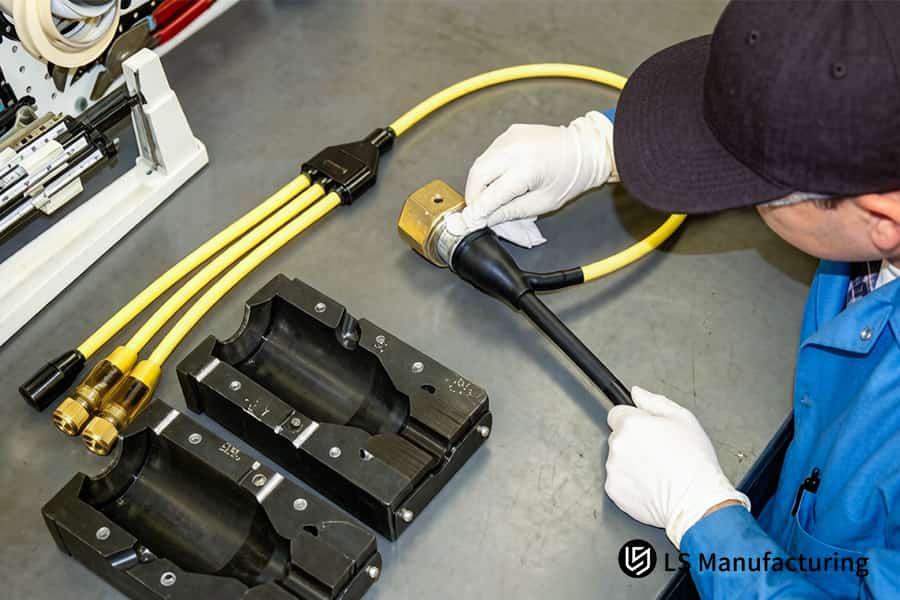
Figure 3: A technician inspects a connector component to ensure precision and quality in a precision overmolding manufacturer.
Case Study: LS Manufacturing Customized Automotive Sensor Waterproof Zero-Delamination Overmolding Project
A Tier-1 producer was unable to continue the production process after the ABS wheel speed sensor failed in the validation process. The following case explains how a strategic alliance with a custom overmolding service helped overcome a critical 4.2% delamination rate problem in customized automotive sensor overmolding project:
Client Challenge
Failure of this sensor due to the poor material combination (PA66+30%GF with TPE overmolding) occurred during salt spray and vibration testing where electrical shorts occurred. High rate of rejection led to suspension of production with heavy fines. The customer required a root-cause engineering solution to save their program, going far beyond what the previous supplier had done.
LS Manufacturing Solution
Our DFM review identified a weak planar bond and inconsistent surface energy. The integrated solution was:
(1) redesigning the interface with a three-stage labyrinth channel for a physical seal;
(2) implementing inline plasma treatment for perfect surface activation;
(3) optimizing injection to a multi-stage curve with clamp time controlled to ±0.1s. This approach targeted both chemical adhesion and mechanical sealing, essential for successful high-pressure seal overmolding.
Results and Value
The engineered components were proven to be able to achieve a 0% delamination rate, successfully passing 1200 hours of salt spray and thermal cycling from -40°C to +130°C, according to IP69K specifications. This result of zero-delamination overmolding made the project possible for restarting production without risking the warranty and allowed to deliver the multi-million dollar order, preserving the reputation of the client before his OEM customer.
In this particular instance, it shows how an engineering challenge can be turned into the standard of reliability. Herein lies proof that tackling such challenges necessitates the integrated use of engineering, surface science, and process control. This level of engineering not only gives you parts, but proven performance and reliability in your mission-critical overmolding applications.
Secure the same 0% delamination and IP69K validation for your sensor. To validate a leak-proof solution, submit your overmolding design for a seal performance report and production-proven quote.

What Incoming Inspection And In-Process Controls Safeguard Your Zero Delamination Overmolding Investment?
When considering purchasing your overmolded parts, there needs to be assurance in addition to capabilities. Assurances come when you have a quality system in place to deliver on its promises. The following are some of the data-driven quality controls required for zero delamination overmolding.
| Control Phase | Method / Specification | Your Assured Outcome |
| Incoming Material Verification | Minimum Dyne surface energy ≥42 mN/m. | Best practice for verifying the material bonding capacity to eliminate any adhesion failures at source. This is a critical quality characteristic for any reputable custom overmolding service manufacturer. |
| In-Process Visual Inspection | Automatic 100% visual inspection using CCD camera technology. | This assures that all produced products will be perfect, especially high-tolerance overmolding components. |
| Destructive Performance Validation | Destructive performance validation with 90° peel test sample and SPC/CPK analysis (≥1.33). | Certified verification that all your bonded products are in compliance with design lifetime requirements. |
| Process Data Management | Real-time SPC control system (e.g., Clamp time ±0.1s). | Provides process stability to produce batches in line with your samples for reliable medical-grade overmolding components. |
With such an inspection regime in place, your assurance is not simply limited to getting products; your guarantee of integrity comes through documentation of each process stage. By working with a custom overmolding service supplier following this strict procedure, you will always be certain, traceable, and greatly reduce chances of failure in the field. The power of documentation is the assurance that your investment is safe, and launching your highly dependable product will be successful.
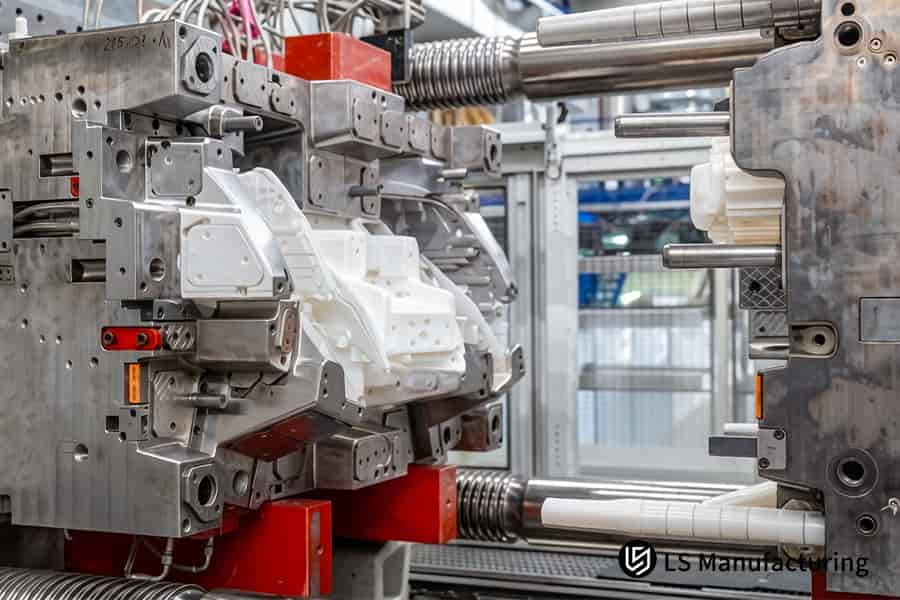
Figure 4: A precision overmolding manufacturer inspects a white plastic part within a steel mold for quality verification.
How To Minimize Total Cost Of Ownership When Souring A Custom Overmolding Service?
In purchasing, looking only at unit prices is short-sighted as you will miss out on the huge overhead costs involved. Total Cost of Ownership (TCO) considers all those costs. Let's see how partnering with an advanced custom overmolding service enables us to leverage our engineering know-how to minimize total cost of ownership:
Decoding the Low Bid: The Hidden Costs of Inadequate Engineering
Artificially low quotes normally do not involve design review; therefore, this brings about the occurrence of defects, which show themselves during production. Studies within the industry have proven that scrap rates can be as high as 15% or more, as well as unplanned tooling modifications. For the client, this translates to money loss, late release dates, and further involvement in quality controls. One must begin by choosing a firm that integrates cost-effective overmolding into the manufacturing process itself.
The Proactive Investment: Front-Loaded Design and Simulation
The best way for reducing TCO begins right from the process of designing the mold. By implementing thorough DFM review as well as mold flow simulation, the problem of 95% of all defects, which can arise, is dealt with, such as bonding problems or sink marks. This avoids many problems and costs, such as mold trial-and-error, leading to fewer trials (T-Tryout), at least two less than otherwise. This leads to a reduction of the product development time by up to 30% or 45%.
Manufacturing Certainty: Precision Execution for Zero Defects
Sustainable cost management is done using predictable and productive manufacturing operations. Predictable, productive manufacturing operations can only be made possible by statistical process control, real-time SPC monitoring, and automated inline inspections in a controlled environment. In this manner, CpK of ≥1.33 is assured for critical measurements while bulk sorting is minimized. For you, you can enjoy timely delivery of perfect parts, without any disruption on the assembly line and associated costs, which is what quality-assured overmolding looks like.
The Strategic Outcome: Predictable Lifetime Cost and Partnership
The merger of predictive engineering and effective execution transforms cost into an effective and efficient supply chain strategy for you. You will enjoy not only guaranteed quality output but also the partnership of an organization that grows with your needs. Though the process in the early stages may be tough, the long-term benefit will be a TCO at minimum levels, with protection of the name and production-ready overmolding technology.
In this model, procurement is reframed as an investment in predictability and cooperation. It is not about reducing the initial invoice, but rather about increasing the first-pass yield, stability in production, and guarantee of product quality. This is how the minimum total cost for the project is obtained. Working with a custom overmolding service factory, you get just such a result based on its unique approach that focuses on protection and optimization of the total project value.
FAQs
1. Why is the peel strength of overmolded parts often below specifications?
Peel failure usually occurs due to the polarity difference between different materials or the presence of certain contaminants (oil), or due to excessive cooling of the substrate surface following the first injection shot. This means that the material used during the second injection cannot reach sufficient molecular chain diffusion and chemical linkage with the substrate on a microscopic scale. With the use of plasma activation and precise mold temperature control, LS Manufacturing provides reliable reinforcement of the interfacial bonding by ≥150%.
2. Which material combinations offer the best performance for your custom rubber overmolding projects?
Material pairs with similar polarity or with co-cross-linking groups show better results—in such cases, the following combinations would work well: plastic materials PC or PA combined with special TPUs or rigid substrates combined with self-adhesive LSRs. In cases where the materials are incompatible, LS Manufacturing makes use of molecular grafting modifications for covalent bonding applications.
3. How does your plastic overmolding service guarantee strict waterproof sealing ratings, such as IP67 or IP69K?
This innovative process uses a "triple-labyrinth groove" physical barrier design on the surface of the substrate material. It is paired with accurate, closed-loop temperature control of the mold (+/-1.5°C) during the secondary injection cycle, resulting in molecular bonding between the two different materials in the joint region. Hence, no microscopic voids are produced, as confirmed by 100% online air-seal testing, and ensures that the product easily resists high-pressure hot-water sprays.
4. What parameters are critical to preventing bonding failures between high-strength materials, specifically between metal and plastic?
The key elements are the microscopic surface roughness of the metal and the secondary holding pressure that is used during the injection molding. The process of fiber laser marking allows engraving dovetail groove type mechanical locking structures into metal surfaces, including stainless steel, to a depth of around 35μm. During the injection molding, we use gradient pressure management technology to guarantee that the molten plastic gets fully filled into cavities, thus creating a highly rigid bonding interface with a minimum tensile strength of ≥25 MPa.
5. Can you provide DFM optimization and molding simulation for overmolding of complex parts prior to tooling?
Absolutely. As soon as we receive approval from you, and prior to starting tool production, the LS Manufacturing team of experienced engineers will prepare you with a free mold flow analysis report using the software Moldex3D which will help optimize wall thickness transitions and identify over 95% of possible design errors before mass production starts.
6. What is the typical lead time from the quotation for custom overmolding services to the delivery of initial T1 samples?
Following a comprehensive cost analysis and offering you a very competitive custom quote, LS Manufacturing’s advanced precision mold machining facility, which is fully digital and includes 5-axis milling technology, will deliver your two-color/multi-color precision injection molds within 21-28 days. Finally, we will provide T1-quality, ready-for-mass-production samples, which have been thoroughly inspected and have passed 100% quality tests.
7. How does LS Manufacturing handle IP protection and non-disclosure for custom defense or medical projects?
As an internationally recognized company with ISO 9001 certification, as well as certifications for the automotive industry and medical supply chain systems, we sign a legally binding Non-Disclosure Agreement (NDA) upon first discussion of technical drawing with you. As far as internal operations are concerned, we have isolated and highly protected server facilities to keep our clients’ unique 3D CAD drawings and proprietary processing algorithms safe.
8. What is your Minimum Order Quantity (MOQ), and how does it affect the pricing of your custom overmolding services?
In our MOQ policy for high-accuracy overmolding in industrial production, we provide a high degree of flexibility in our capacity from the prototype-validation stage (MOQ 500) up to mass production by automated machinery (millions of units). The cost of one unit will depend on the number of moldings that have to be made, molding cycle time, and type of material used; the bigger the batch is, the smaller will be the cost of mold tools amortization on one unit of the product.
Summary
Overmolding of different materials in high-quality industrial manufacturing can be considered as a complex science that combines molecular chemistry, fluid dynamics, thermal management, and precision machining. Otherwise stated, without proper settings, no matter how hard you try, there will always be an interface failure between two materials. In this regard, LS Manufacturing excels in providing custom overmolding through molecular-based materials alteration, precise mold temperature management, and TQM.
Delamination or airtightness problem with your dissimilar material overmolding process? Don’t waste your effort and reputation on poor quality trial and error experiments. “[Get a Free Custom Overmolding DFM Review]” to send your STEP/IGS files with materials information. We will get back to you with an expert review within 24 hours that includes interface compatibility suggestions, runner layout tips, and cost effective budget estimate.
📞Tel: +86 185 6675 9667
📧Email: info@lsrpf.com
🌐Website: https://lsrpf.com/
Disclaimer
The contents of this page are for informational purposes only. LS Manufacturing services There are no representations or warranties, express or implied, as to the accuracy, completeness or validity of the information. It should not be inferred that a third-party supplier or manufacturer will provide performance parameters, geometric tolerances, specific design characteristics, material quality and type or workmanship through the LS Manufacturing network. It's the buyer's responsibility. Require parts quotation Identify specific requirements for these sections.Please contact us for more information.
LS Manufacturing Team
LS Manufacturing is an industry-leading company. Focus on custom manufacturing solutions. We have over 20 years of experience with over 5,000 customers, and we focus on high precision CNC machining, Sheet metal manufacturing, 3D printing, Injection molding. Metal stamping,and other one-stop manufacturing services.
Our factory is equipped with over 100 state-of-the-art 5-axis machining centers, ISO 9001:2015 certified. We provide fast, efficient and high-quality manufacturing solutions to customers in more than 150 countries around the world. Whether it is small volume production or large-scale customization, we can meet your needs with the fastest delivery within 24 hours. choose LS Manufacturing. This means selection efficiency, quality and professionalism.
To learn more, visit our website:www.lsrpf.com.