English




Precision overmolding service addresses the requirements of engineers who need information on how does overmolding work in addressing sealing problems in multi-component products. In traditional practices, leakage occurs even in extreme environments due to inadequate chemical bonding and poor design features such as micro-voids that do not allow for proper sealing.
This example proves how LS Manufacturing has used high pressure multi-physical simulation techniques and patent bonding to develop their IP68 waterproofing zero leakage overmolding technology. This is achieved by addressing the problems that arise due to inadequate chemical bonding or mold design. In the following sections, the principles behind achieving optimum sealings via precise secondary molding will be explained.
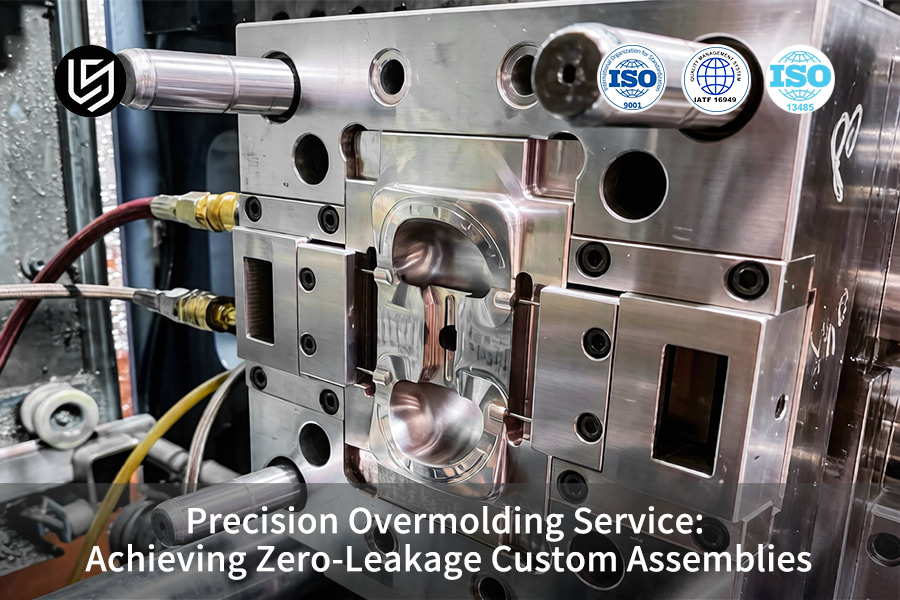
Precision Overmolding: Zero-Leakage Assemblies Quick-Reference
| Technical Challenge | Sealing Solution for Overmolding | Application Reliability |
| Material Bonding Integrity | Choosing substrate and overmolding materials with chemical compatibility for molecular bonding. | Binds into an inseparable bond that cannot allow liquid or gas entry through the bond line. |
| Encapsulation & Void Elimination | Injection speed and pressure optimized with proper mold venting design. | 100% encapsulation of substrate is ensured without any air voids or bubbles. |
| Thermal Stress Management | Melt and mold temperature control to minimize differential shrinkage at the bond line. | Micro-cracks or voids caused by thermal expansion mismatch are avoided. |
| Bond Line Design & Geometry | Designing mechanical features like undercut, groove, or interlocking joints on the substrate surface. | Enhances mechanical bonding and increases tortuosity of the leak path. |
| Our Process Validation | Performs helium leak testing, pressure decay testing, or burst testing on pilot runs. | Provides certified and quantified test data that proves the assembly passes the leak rate requirement (for example, less than 1x10^-6 cc/sec). |
| Result: Hermetic & Reliable Seal | Supply a pressure/vacuum-ready assembly with an integrated seal. | No additional sealing material such as O-ring, gasket, or adhesive is needed. |
Key Takeaways:
- Bonding is Fundamental: An actual bond between materials is essential for achieving a zero-leak seal.
- Process Drives Perfection: Overmolding design need to be optimized to prevent void formation, which is the main source of leaks.
- Design for the Seal: Geometry of the substrate needs to be optimized to improve bonding at both a physical and chemical level.
- Test, Don't Assume: Hermeticity needs to be confirmed objectively with quantitative leak testing.
Why Trust This Guide? Practical Experience From LS Manufacturing Experts
There is an abundance of papers available online that discuss theoretical aspects of overmolding bonding processes. This guide stands apart because it is based on hands-on experience from our own production lines, where creating a seamless bond between two different materials is a top priority. Our process development and validation procedures strictly comply with the international standards set by SAE International.
We create encapsulated systems where there is no room for error: implantable drug dispensers, aircraft fuel line connectors, and high-voltage battery enclosures for electric vehicles. The high standards of these industries push us to follow the exacting procedures set forth by Global Electronics Association (IPC) for hermetically sealing and encapsulating parts.
Our knowledge has been acquired through ten years' experience in molding runs, whether they have gone perfectly without any problems or incurred costly seal failures. We know exactly what surfaces need to be treated for proper adhesion, what gate design prevents knit lines in seal regions, and how to mold seals so as to avoid voids and stress. We will pass on our painstakingly acquired knowledge to help you avoid pitfalls in design and molding to ensure robust, leak-free assemblies right from your first production run.
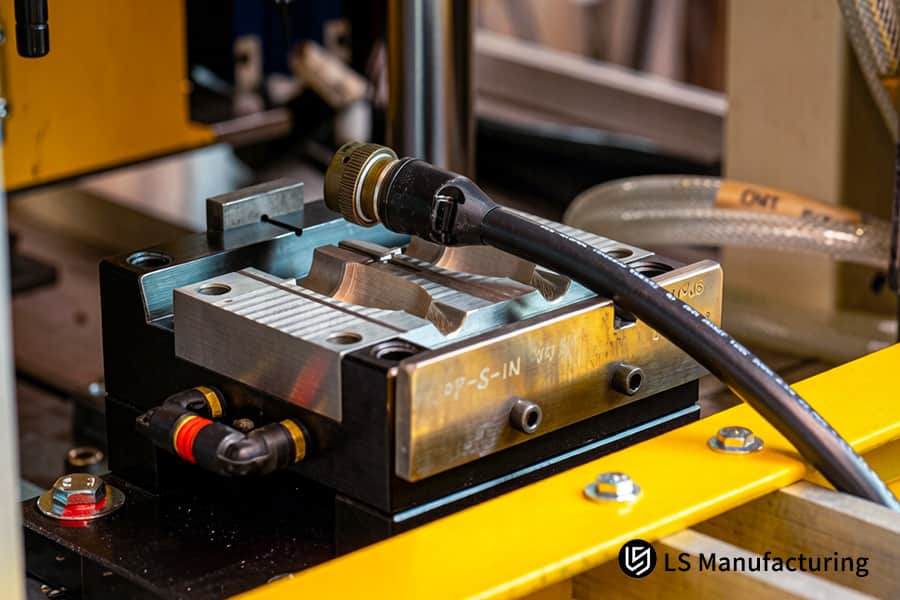
Figure 1: Pressure-regulated fluid flows through black tubes to ensure tight seals during the overmolding cycle.
Why Is Precision Overmolding Service Essential For Preventing Fluid Leakage In Complex Assemblies?
The prevention of fluid flow out of intricate machinery would thus involve much more than simply ensuring proper seal interface. This approach eliminates tolerance problems and ensures hermetic sealing by joining the elastomeric seals to the substrate at the molecular level via the precision overmolding service:
Achieving Molecular-Level Fusion in Hostile Environments
The core of the issue would be forming a bond between two separate polymers under conditions such as extreme operating conditions like prolonged heat exposure above 150°C in its liquid state. The invention of the custom overmolding service begins with choosing proper materials and controlling the multi-material overmolding process. Temperatures must rise above 180°C to allow for cross-linking agents to join the elastomer and the substrate.
Mastering Complex Geometries and Material Interfaces
Sealing of microfluidic channels in a unique assembly through custom assemblies and shot control, ensuring that no air bubble forms within the microfluidic channel and allowing for maximum fluid flow. This process can be completed efficiently through the utilization of validated overmolding protocols, where we predict the weaknesses that might emerge when we attempt to seal the assembly through flow and curing simulations.
Integrating Sealing as a Primary Structural Function
In contrast with using an extra gasket, the overmolded seal itself becomes a core component of the assembly. In designing the rigid component, together with the texture patterns, the objective is to create the largest bonding surface possible. The structural overmolding approach will help guarantee that the seal is capable of withstanding the pressure and shear force cycles. The molecular bonding strength will be verified through testing, showing that it exceeds 5 MPa.
Validating Performance Through Predictive and Physical Testing
This is made possible by correlating the material information with predictive models. Every single batch of products is tested using a destructive peel test to confirm that bonding has been done effectively. The proof of the pudding lies in testing the prototypes through the use of aggressive thermal cycling and fluid immersion test; the high-pressure overmolding validation is used in this.
In the above study, a methodology for the prevention of leakages during overmolding is presented. Our competence in engineering comes out clearly in our scientific approach, where we ensure that materials are bonded together at the molecular level and are validated at extreme conditions. This is the reason why we are competitive as a company due to the zero leakage of custom assemblies.

How To Ensure Chemical Bonding Integrity For Zero Leakage Overmolding With Dissimilar Materials?
In the event of creating a hermetic seal in overmolding involving two dissimilar materials, it becomes necessary to go beyond merely achieving physical bonding and instead create a molecular bond. In the following paper, we will look into the step-by-step overmolding process of obtaining chemical bonding which is important in ensuring good seal:
Scientific Material Pair Selection
- Compatibility Analysis: Solubility parameter calculation to establish best material compatibility.
- Substrate Surface Activation: Plasma activation to increase surface energy of substrates for bonding.
- Precise Thermal Conditioning: Pre-heating substrates up to ±2°C to optimize polymer interface.
Precision-Controlled Bonding Process
- Process Design for Fusion: Molds and gates designed for overmolding bonding process.
- In-Mold Promotion: Designing primers in mold for complex material combinations for bonding.
- Parameter Validation: Determination of parameters through DOE analysis for high precision overmolding.
Validation Through Testing
- Quantitative Adhesion Tests: Conduct peel tests to demonstrate the efficiency of chemical bonding.
- Accelerated Life Testing: Subject prototypes to over 3000 thermal and liquid immersion cycles.
- Failure Analysis: Identify the reason behind the bond breakage in order to optimize overmolding validation protocol.
Ensuring End-Use Reliability
- Seal Integrity Verification: Conduct helium leak test to ensure zero leakage overmolding.
- Production Lot Monitoring: Implement Statistical Process Control for bonding parameters.
- Protocol Documentation: Establishing an overmolding production standard procedure to achieve consistency.
With such a systematic procedure, zero leakage overmolding becomes a provable outcome. Technical expertise is reflected in our scientific material compatibility, exacting interface design, and validation, which guarantees long-term seal effectiveness for fluid delivery systems. Prove the chemical bond for your critical assembly. Validate a zero-leakage seal with our testing protocol. Upload your material specs to initiate a bonding analysis and secure a production quotation.
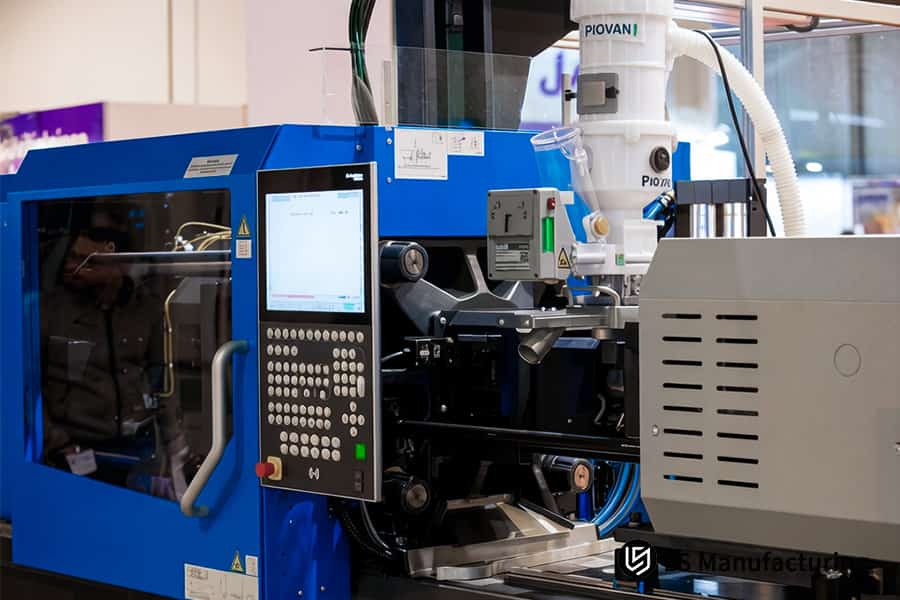
Figure 2: A Piovan dryer feeds dehumidified material to the machine injecting TPE onto a POM substrate at 230°C.
What Mold Design Optimization Techniques Can Guarantee Leak Proof Overmolded Assemblies?
Effective performance of overmolded parts in a way that prevents leaks necessitates the mold design optimization that can effectively eliminate sources of leaks, such as air trap and tolerance. The simulation-driven overmolding technique is important in achieving reliable sealing due to its ability to make seal reliability a deterministic parameter using the following design optimization technique:
| Optimization Technique | Primary Leak-Prevention Function |
| Balanced Runner System with Sequential Valve Gates | Maintains balanced flow of material into the mold to avoid any formation of weld lines on seals. |
| Micro-Precision Venting Design (0.005-0.01mm depth) | Makes micro-venting overmolding achievable by eliminating air without forming flash. |
| Conformal Cooling Channel Design | Maintains consistent cooling process needed to prevent differential shrinkages and stress on seals. |
| Dimensional Control for Cpk ≥ 1.67 | Maintains statistical process control of seal properties. |
| Integrated Alignment & Nesting Features | Micron-level accuracy for insert placement guarantees proper alignment of the elastomer. |
| Advanced Flow and Cooling Simulation | Highlights potential problems related to air traps and imbalance flows in advance. |
The only way to achieve leak proof overmolded assemblies is through the validated overmolding protocol. This method integrates simulation in the early design stage with rigorous process control during production. The advanced overmolding technique makes sure that all necessary parameters for sealing effectiveness are made using Cpk ≥ 1.67. This guarantees that sampling-based verification is not needed. The high precision overmolding technology will help OEMs build confidence about the assembly’s efficiency.
How Does LS Manufacturing Control Micro-Tolerance For High Precision Overmolding Projects?
High precision overmolding requires strict tolerances regarding their functionality, yet they cannot be accomplished without dealing with material shrinkage, thermodynamics, and machine variability. To tackle this problem, we rely on process control and 100% inspection automation. Our high precision overmolding process is detailed below:
Closed-Loop Process Control for Dimensional Stability
This next level in which we improve upon is in the use of our precision tolerance control. We use servo-electric micro-molding presses that offer ±1μm repeatability, while cavity pressure and nozzle temperatures are tracked in real-time (less than 0.5% variation), allowing us to make immediate adjustments where needed. This way we compensate for the variations in viscosity to make sure that there is a uniform wall thickness with no flash.
Automated Metrology and 100% In-Line Verification
Sampling after production will not help in achieving the zero defect criterion. The solution to this lies in using vision-based and laser scanning systems on the press in order to verify the sealing features at 100%. Automated overmolding inspection ensures that all important sealing specifications such as bond line width and seal groove depth fall within the tolerance range of ±0.02mm. All defects are immediately recognized, and the results are sent back into the machine control system.
Scientific Process Development and Validation
The scientific nature of any process starts with a well-designed process development phase. In each custom precision overmolding project, we conduct a series of experiments to identify the exact correlation between process variables (e.g., pressure and cooling time) and resulting part dimensions. Once the optimal process parameters are defined, the process is entered into the machine's controller, thus ensuring that a validated overmolding process window has been achieved. This way, the process capability can be guaranteed (Cpk ≥ 1.67).
It is through such a methodology that precision becomes quantifiable and controllable. Competitive advantage in this regard is achieved through the flawless blending of deterministic process control, 100% automation, and data-driven process windows. LS Manufacturing ensures our clients' high precision overmolding success when critical dimensions are at stake to avoid any functionality issues and qualification challenges in complex micro-component assemblies.
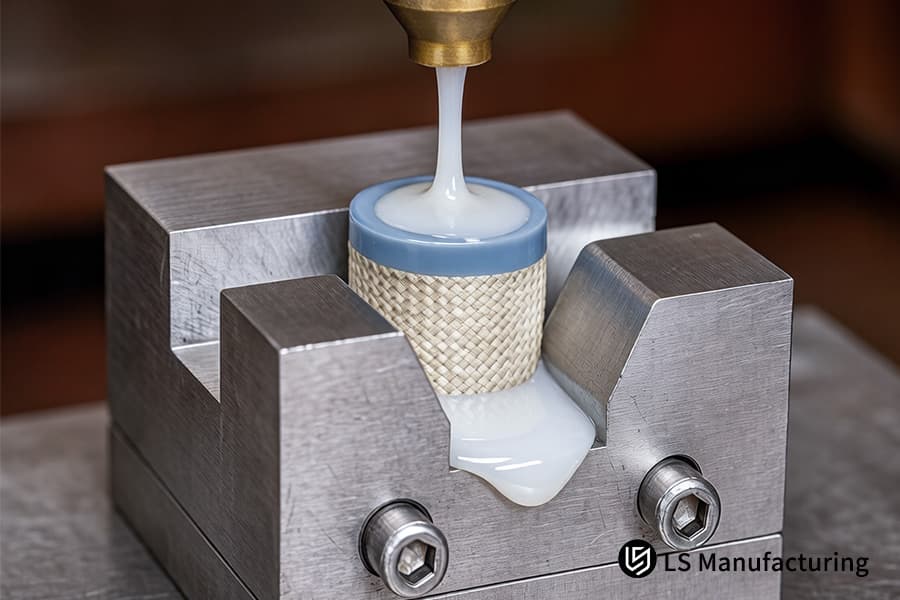
Figure 3: Molten white plastic material pours from a nozzle into the open cavity of a precision metal tool.
Can LS Manufacturing Reduce Production Costs Through OEM Overmolding Service Optimization?
Cost-effective overmolding services without loss of performance, reliability, and quality cannot be accomplished at the expense of the integrity of the product. This is the basis of our approach to overmolding services as an OEM overmolding service provider by means of optimizing the process and design to minimize waste, effort, and secondary operations in order to maximize savings for our clients. Here’s how we accomplish it:
Design-Led Efficiency: Early-Stage Intervention
- Proactive DFM Analysis: We undertake proactive DFM analysis in the conceptual design stage, finding ways to streamline assembly, omit unnecessary components, and improve manufacturing.
- Process Integration: We suggest designing for a multi-shot overmolding process, when possible, combining multiple manufacturing steps and multiple parts into one automated molding cycle, which dramatically lowers labor.
- Tooling Strategy: In cases of medium and high volumes, we design multi-cavity or family molds, allowing us to optimize machine cycles and lower the unit cost of the tool.
Process and Material Optimization
- Scientific Processing: We apply molding simulations to optimize gate placement and flow, saving more than 15% on material usage and lowering cycle time without compromising quality.
- Material Selection Guidance: As experts in custom overmolding service, we suggest grades of materials that strike the best balance between performance and cost, including commercial equivalents that will satisfy all requirements while costing less.
- Automated Production: Our production lines are configured to run unattended, incorporating robots for handling, inspecting, and packing parts to save on labor.
Value-Stream Re-engineering
- Secondary Operation Elimination: One approach to cost reduction involves designing features that do away with any post-molding activities. The approach entails designing living hinges, seals and snap-fits as part of the direct-injection overmolding process.
- Supply Chain Simplification: By providing a sub-assembly solution ready to use, we simplify the supply chain for our customers through the reduction of costs associated with procurement, logistics, and quality assurance.
- Lifecycle Cost Modeling: We offer comprehensive total-cost overmolding models that enable us to demonstrate the full cost saving of our system versus the standard multi-piece assemblies approach, taking into account labor, scrap and warranty savings.
This paper is based on the concept of using an engineering-based approach to achieve effective cost reduction. The reason we compete effectively is not by offering low prices, but through making use of detailed DFM analysis, OEM overmolding service integration and process science to create cheaper components from scratch.
Case Study: LS Manufacturing Medical Device Connector Custom Overmolding Project
The following LS Manufacturing case study project where the sealing of an important medical instrument was absolutely essential. The customer was facing problems of leakage and reliability with a multi-component assembly. We designed a solution using monolithic overmolding for zero leakage, proving that design integration and advanced manufacturing can solve basic performance issues.
Client Challenge
The maker of dialysis equipment was having problems with an existing fluid connector made from polycarbonate. Due to the need for a separate silicone gasket in its assembly, sealing inconsistencies occurred, leading to a 15% failure rate on site, which posed dangers to patients' health, thus requiring costly product recalls. The OEM needed certified overmolding process for reliable manufacturing of critical custom assemblies.
LS Manufacturing Solution
Our design evolved to incorporate two-shot molding. In one step, the rigid substrate made out of PEEK was injection molded with built-in locking undercuts. In the next step, without requiring any manual assembly or bonding steps, a medical-grade LSR seal was over-molded on top. Precise thermal control of the direct-bond overmolding process allowed filling of the micro-grooves to create an unbreakable seal.
Results and Value
The resulting monolithic connector design had a 0% failure rate under stringent leak test protocol, including 5,000 cycle pressure fatigue tests. As a result, there were no more field returns. Our solution resulted in reducing the cost to manufacture and assemble the connector by 18% for our client. High-yield overmolding process provided a reliable and repeatable way of producing the critical component.
This is an example of the effectiveness of material science working together with precision medical overmolding. All of this was accomplished by a careful process of transformation that converted a leaking assembly into a consistent monolithic structure. The approach proposed above guarantees performance right from the beginning by tackling key reliability concerns and offering a definite advantage over competitors.
Stop tolerating preventable leakage and costly recalls. To begin securing 0% failure and 18% cost savings, send your connector design now for a validated sealing report and detailed savings audit.

What Advanced Testing Protocols Ensure The Reliability Of Overmolding For Zero Leakage?
The verification process for seal durability entails replicating and accelerating potential failures in order to predict its performance. The document below contains information on testing protocols whose results provide a basis for quality assurance for reliable overmolding. Facts replace assumptions with scientific approach to proving reliability.
| Test Protocol | Key Execution & Acceptance Criteria |
| Helium Mass Spectrometry Leak Testing | Provides proof against leaks as low as 1x10⁻⁹ atm·cc/sec, defining the gold standard for overmolding for zero leakage. |
| High-Pressure Bubble Immersion Testing | Subjected to 2 to 5 times their operating pressure inside a fluid medium; an easy and guaranteed way of leakage testing procedure. |
| Destructive Peel Strength Testing | Evaluates bonding strength per batch to meet the tested overmolding material specification (e.g., >5 MPa). |
| Thermal Shock Cycling (-40°C to +120°C) | Concludes seal integrity despite severe stress to the polymer; leakage testing is conducted in the final cycle. |
| Long-Term Fluid Immersion Testing | Tests for chemical compatibility and physical degradation, a cornerstone of long-term reliability testing. |
| Infrared Thermal Interface Analysis | Non-destructive testing to map thermal conductivity, which helps determine voids and delaminations in the bond line. |
The complete battery of tests will provide you with a forensic data package that mitigates risks in integration and procurement. Our solution addresses the problem of uncertainty with proof-of-process capability, delivering leak-proof overmolding products. The validated overmolding methodology gives engineers the concrete proof they need in their component specification to support aerospace, medical, and automotive applications.
Figure 4: The injection unit fills the mold cavity with plastic to encapsulate a metal insert for an automotive sensor.
Why Choosing LS Manufacturing As Your High Precision Overmolding Partner Drives Business Growth?
Selecting the right manufacturer is a significant step, as it may determine the dependability, development time, and efficiency of vital components. In addition to our precision manufacturing partner, LS Manufacturing offers expert engineering capabilities that further distinguish us from others. This is how partnering with LS Manufacturing will assist your business in growing and overcoming several technical challenges:
Proactive Design Integration for Cost and Performance Optimization
Our contribution in the conceptual stage is through design for overmolding analysis where we analyze material flow, stress areas, and heat distribution in order to give suggestions on design changes for enhanced manufacturability and fewer part numbers. Due to our application-led overmolding partnership right from the beginning of the product development cycle, we are able to optimize costs, lower product weight, and develop more reliable products with a lower per unit cost.
Vertical Integration of Precision Tooling and Process Control
High precision overmolding depends on tight control over the tooling and processes used. Our tooling is entirely designed and manufactured by us with micromachining of venting channels, conformal cooling, and automated handling of inserts. The integrated overmolding process control allows us to have tight control over all the parameters including insert preheat temperature and injection profiles. This ensures a perfectly bonded material with accurate dimensions (Cpk ≥ 1.67) on every single component.
Automated Production for Uncompromising Consistency
The cells that have been designed for use in overmolding applications are completely automated. The handling of parts, the inspection and packing process is conducted by the robot from within the cell itself. Automated overmolding so that there are no changes introduced into the finished part based on human interaction. This is important as it allows the tenth thousand component produced to be identical to the first component.
Risk Mitigation Through Proven Expertise and Stable Systems
Our expert engineering has been developed based on more than 15 years of experience in material database and ISO 9001 certified overmolding quality process. The company controls the entire chain starting from procurement of polymers till the last phase of testing, thus making your project immune to any external factors. With help of our accumulated experience in handling various projects and our failure mode library we can anticipate any possible problem that may arise during manufacturing and thus deliver parts on time.
Collaboration with LS Manufacturing entails having an expert precision manufacturing partner as an integral part of your team. We help you grow by taking up the responsibility of the technical challenge posed by high precision overmolding, enabling you to receive not only parts, but guarantees—guarantees of reliability, availability, and predictability of costs, leaving you the freedom to develop innovations and expand your reach.
FAQs
1. What is the typical tolerance for your high precision overmolding service?
In our high precision overmolding operations, we can typically hold and maintain extremely tight tolerances of ±0.02mm for key sealing surfaces and dimensions. Our process control systems are designed around high precision mold tools coupled with real-time closed loop controls to achieve optimal tolerances.
2. How does LS Manufacturing ensure zero Leakage between hard plastic and soft rubber?
LS Manufacturing ensures zero leakage by employing the chemistry of molecular bonds with mechanical lock features incorporated into the part designs. In some cases, plasma surface treatments are applied to the substrates to ensure maximum surface energies for permanent inseparability between different materials.
3. Can you provide an OEM overmolding service for low-volume medical-grade components?
Yes, we specialize in cost-effective, low-volume production for medical devices. We employ flexible tooling solutions like MUD (Master Unit Die) systems, which dramatically lower upfront costs and make high-precision, medical-grade custom overmolding viable for pilot runs and niche products.
4. What materials are best for achieving leak proof overmolded assemblies?
Material selection is application-specific. For demanding, leak-proof assemblies, we commonly optimize proven combinations like PA (Nylon) with TPE for chemical resistance or PC with Liquid Silicone Rubber (LSR) for extreme temperature stability, ensuring reliable seals under pressure.
5. Do you offer free DFM analysis for new precision overmolding service inquiries?
Absolutely. We provide a complimentary, detailed DFM report within 24-48 hours for all new inquiries. This analysis identifies potential leakage, stress, or manufacturability issues early in the design phase, preventing costly tooling revisions and ensuring part success.
6. How do you verify the seal integrity of custom precision overmolding parts?
We verify seal integrity using customized, automated test rigs. Every part can undergo rigorous pressure decay testing, vacuum leak detection, or helium mass spectrometry based on your specific IP67, IP68, or other stringent leakage requirements for complete quality assurance.
7. What information is needed for a precision overmolding service quote?
To provide an accurate and comprehensive quote, we require your 3D CAD files (STEP/IGES format), detailed material specifications, estimated annual production volume, and any specific industry leakage or performance standards (e.g., IP ratings, FDA, USP Class VI) the final assembly must meet.
8. How does LS Manufacturing handle IP protection for custom overmolding designs?
We protect your IP by executing comprehensive NDA agreements and maintaining strict internal data silos with access controls. This ensures all your proprietary designs, material formulas, and assembly techniques remain completely confidential and secure throughout our partnership.
Summary
In the realm of industrial manufacturing—where the pursuit of peak performance is paramount—precision overmolding represents a profound integration of materials, design, and manufacturing precision. Through our "zero-leakage" overmolding technology, LS Manufacturing effectively resolves critical failure issues associated with core components. From risk mitigation via Design for Manufacturability (DFM) to rigorous testing protocols, we ensure that every product delivered sets the benchmark for high reliability.
Are you currently facing leakage challenges or seeking a more competitive quotation? Click the "Get Quote" button below to upload your design drawings. The expert team at LS Manufacturing will provide you with a complimentary DFM assessment and a precise solution within 24 hours, helping your product make a rapid leap from prototyping to mass production.
📞Tel: +86 185 6675 9667
📧Email: info@lsrpf.com
🌐Website: https://lsrpf.com/
Disclaimer
The contents of this page are for informational purposes only. LS Manufacturing services There are no representations or warranties, express or implied, as to the accuracy, completeness or validity of the information. It should not be inferred that a third-party supplier or manufacturer will provide performance parameters, geometric tolerances, specific design characteristics, material quality and type or workmanship through the LS Manufacturing network. It's the buyer's responsibility. Require parts quotation Identify specific requirements for these sections.Please contact us for more information.
LS Manufacturing Team
LS Manufacturing is an industry-leading company. Focus on custom manufacturing solutions. We have over 20 years of experience with over 5,000 customers, and we focus on high precision CNC machining, Sheet metal manufacturing, 3D printing, Injection molding. Metal stamping,and other one-stop manufacturing services.
Our factory is equipped with over 100 state-of-the-art 5-axis machining centers, ISO 9001:2015 certified. We provide fast, efficient and high-quality manufacturing solutions to customers in more than 150 countries around the world. Whether it is small volume production or large-scale customization, we can meet your needs with the fastest delivery within 24 hours. choose LS Manufacturing. This means selection efficiency, quality and professionalism.
To learn more, visit our website:www.lsrpf.com.