English



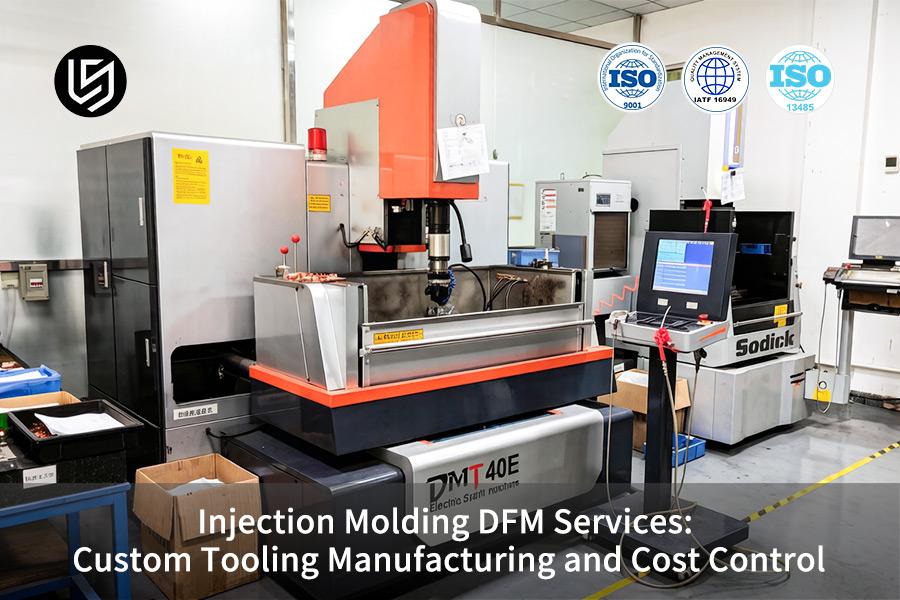
Injection molding DFM services tackle the costly transition of going from prototyping to production, where the sample is perfect but mass production becomes a nightmare because of warping caused by inconsistent wall thickness and cooling process. The reality, where average warp is more than ±0.2mm, causes a stop in production and costly modifications of the tooling process since regular tools have no engineering analysis of the shear rate, packing curve, and cooling process.
The proposed solution lies in our analysis of the gates and cooling circuit to make sure that no defects are created during the manufacturing process using our unique database of over 1500 custom injection molds. With the help of such analysis, you are sure to produce parts of superior quality with minimum number of design changes that are only about 15%. You will save a significant portion of your budget by reducing TPC by 25%.
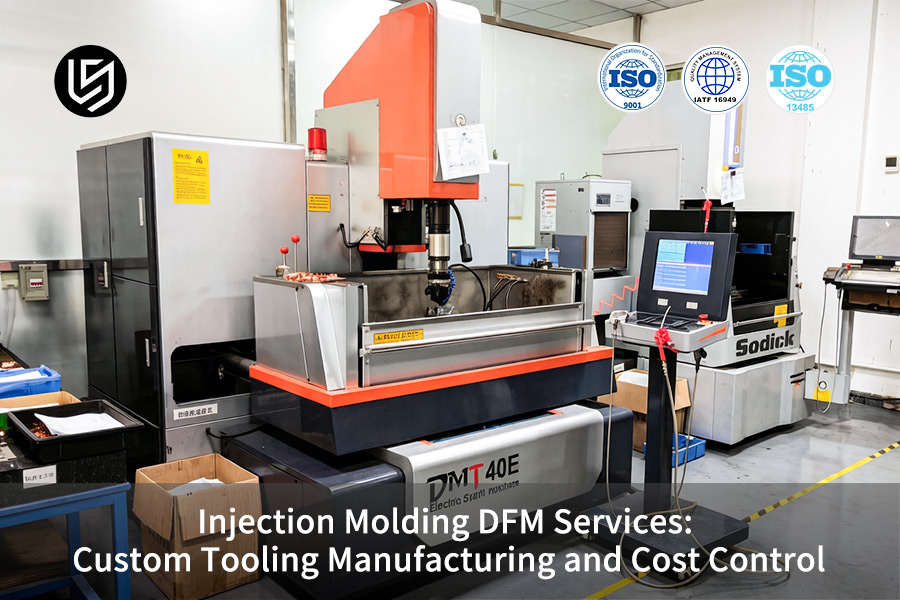
Injection Molding DFM Services: Tooling Cost Control Quick-Reference
| DFM Principle | DFM Solution for Cost Control |
| Draft Angles | Apply ≥1° draft on all vertical walls to ensure reliable part ejection and mold longevity. |
| Wall Thickness | Ensure uniform wall thickness (1.5-3.0mm) with no more than 10% variation to avoid sink, warp, and lengthy cycle times. |
| Undercuts | Design should be altered to avoid undercuts; if required, apply simple undercuts for low-production runs. |
| Rib Design | Ensure that ribs are 50-60% of the adjacent wall thickness in order to increase strength without developing sink marks. |
| Tolerances |
Set real tolerances, but apply commercially available (±0.25mm) tolerances for non-critical dimensions. |
| Our DFM Service | Get our full injection molding DFM report to ensure that the design will be the most cost-efficient for your project. |
Key Takeaways:
- DFM is Proactive Cost Control: Early identification will prevent the need for costly mold adjustments and problems during production.
- Simplicity Saves Money: Two plates is always the least-costly option and should be used to save money.
- Uniformity is Free Quality: Uniform wall thickness is an effective means to reduce defects without additional costs.
- Tolerances Have a Price: Only apply tolerances of ±0.1mm where necessary for functionality.
Why Trust This Guide? Practical Experience From LS Manufacturing Experts
Numerous resources exist that provide excellent general introductions to injection molding. What makes this resource unique? It is written by our process engineers and machine operators who know what it takes to tune up a 500-ton press on a daily basis. We rely upon the standards for plastics processes and machinery laid down by Plastics Industry Association (SPI).
Our work environment involves markets in which process error means losing the whole batch. These include medical devices that need particle-free manufacturing, automotive components with special optical requirements, and high-frequency connectors with exacting dielectric characteristics. The selection and qualification of materials according to the testing methods required by ASTM International ensure a solid foundation for our manufacturing process.
We've gained our expertise one shot at a time. Our experience encompasses designing the drying process to avoid splaying in hygroscopic polymers, cooling passage geometry to ensure that the cycle time remains below 30 seconds, and optimal screw speed to ensure that there’s no degradation from shear. We leverage this proven, cost-saving insight to assist you in specifying molded parts that work without falling victim to the errors associated with bad gate design, improper fill pattern, and unnecessary tool wear.
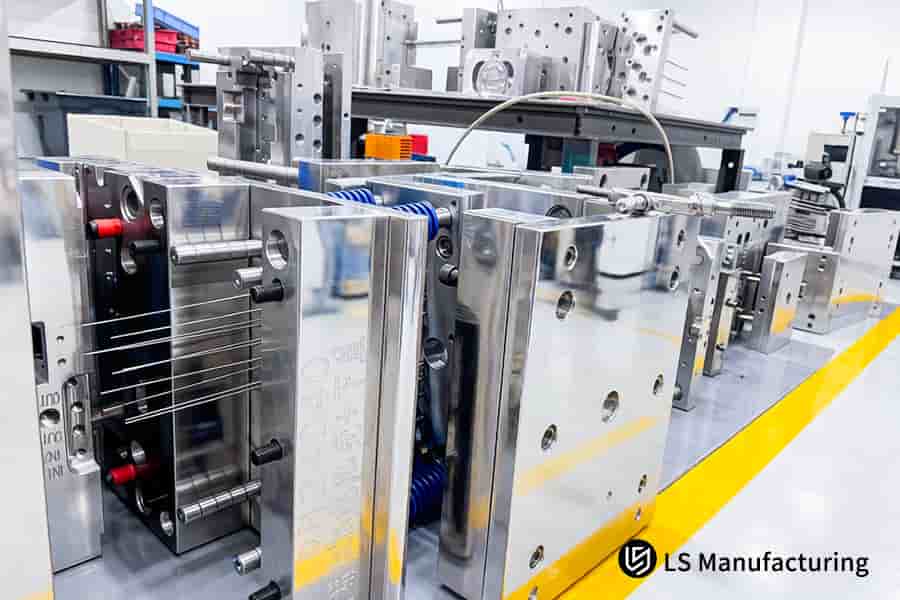
Figure 1: Rows of precision steel mold bases demonstrate injection molding cost control through standardized, reusable tooling.
Why Is A Regular Engineering Review Insufficient For Custom Injection Mold Tooling Injection Molding?
In case of custom injection mold tooling projects, the conventional drawing analysis cannot help in overcoming technical and monetary risks associated with the process. It usually does not include the quantitative analysis required for manufacturability. This article brings out the key difference between a routine drawing check and the more comprehensive injection molding DFM services process.
| Aspect | Standard Engineering Review | Professional DFM & Analysis |
| Flow Analysis | Does not provide calculations for crucial L/T ratio. | Utilizes injection molding process optimization principles for verification of complete filling. |
| Gate Design | Ignores gate shear stress evaluation in quantitative manner. | Evaluates gate shear stress to keep it below material requirements; essential for precision injection molding. |
| Process Simulation | Unable to simulate molten material flow (220°C–260°C). | Useful for mold flow analysis to analyze filling and pressure. |
| Defect Prediction | Does not detect air trapping or weld lines integrity. | Detects air vents and evaluates weld line strength using simulations. |
| Cost Focus | Cannot estimate future expenses for corrective actions. | Avoids costly mold modifications, which are required for injection molding cost control. |
Compliance review is a compliance action; while precision injection molding DFM services is an investment for mitigating risks. What makes the difference is the use of predictive simulation data. In this way, our cost control for customized injection mold tooling will no longer be a variable but become a strategically locked-in parameter, ensuring the value and avoiding unnecessary tool modification.

How Can Precision Injection Molding DFM Optimization Address Specific Plastic Warpage Issues?
Warpage caused by improper heat distribution and different shrinkage rates during plastic cooling is especially problematic in cases when thin walls (less than 0.8mm thick) are used. Precision injection molding DFM technique specifically targets these underlying reasons and helps deal with them in a smart manner through the following actions:
Strategic Wall Thickness Optimization for Balanced Shrinkage
We design wall thickness and transitions in advance to control the localized cooling rates. We need to examine the geometry of the part in order to add appropriate ribs or change the fillet radius, to have even distribution of thermal mass, thus overcoming the differential shrinking, leading to twisting or bending of the parts – the major issue in injection molding warpage control.
Conformal and Asymmetric Cooling Circuit Design
The conventional symmetrical cooling circuit is inadequate for complex geometries. In accordance with our DFM for injection molding principles, the use of conformal or asymmetric cooling circuits or baffles is mandatory. Thus, the designed asymmetry in the cooling system compensates the natural imbalance in the heat removal rate of the part, bringing the mold cavity into equilibrium at the same ejection temperature.
Differential Shrinkage Compensation for Reinforced Materials
In the case of material such as PA66 containing 30% glass fibers, we employ directional shrinkage compensation. We go beyond using a single isotropic number such as 0.5% to account for the different shrinkage values (parallel, 0.3% and perpendicular, 0.8%) in our tool steel compensation process. This is necessary to ensure that we can maintain close as-molded tolerances of ±0.02mm without resorting to any secondary machining operations in our high-volume injection molding process.
This systematic methodology—integrating geometry refinement, asymmetric cooling, and anisotropic shrinkage compensation—constitutes a true engineering solution for warpage. It transcends generic guidelines, providing a deterministic path to dimensional stability. This depth of analysis directly translates to reduced scrap, eliminated rework, and robust injection molding cost control for production, ensuring predictable injection molding process stability from the first shot.
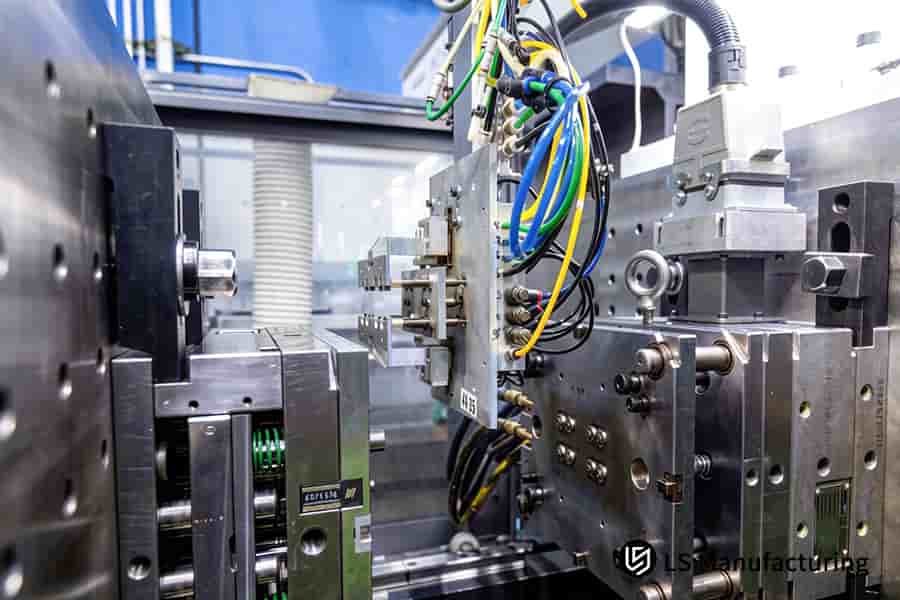
Figure 2: Custom tooling manufacturing involves a steel mold connected to colored hoses for cooling and hydraulic functions.
What Parameters Dictate An Optimized Custom Tooling Manufacturing Process For Medical Components?
The process of custom tooling manufacturing for medical parts requires absolute dedication to accuracy, repeatability, and traceability. For consistent manufacturing results in medical injection molding, it is essential to have the process under strict control, characterized by well-defined and measurable criteria. Consistency is attained from the rigid implementation of the following pillars:
Material Selection & High-Precision Machining
- Core Strategy: The use of hardened steels such as S136 with hardness HRC 52+ for longevity and surface finishes Ra ≤ 0.05μm.
- Implementation: Use of 5-axis milling with mirror EDM within the scope of custom injection mold tooling processes to hold form tolerances to ±0.005mm.
Closed-Loop Process Monitoring & Control
- Core Strategy: Inclusion of sensors that measure and control the pressure of cavities up to 80-100 MPa.
- Outcome: Taking advantage of the real-time information obtained as the master input for process setting, which is absolutely necessary for tight-tolerance injection molding.
Quality Management & Statistical Validation
- Core Strategy: Controlling the entire process flow in line with ISO 13485 & IATF 16949 standards.
- Validation Metric: Defining the capability of the manufacturing process that achieves Cpk ≥ 1.33 for critical dimension, proving statistical validity of our process.
Optimization of medical tooling is based on numerical parameters. Our approach combines high-strength tool steel, micro-machining technology, and sensor-driven process control. This precise engineering forms the basis of our injection molding DFM services and allows us to achieve high dimensional accuracy and compliance with requirements of even the most complex multi-cavity injection molding applications.
Which Elements In Cost Effective Mold Design Directly Lower The Per Part Price?
In injection molding cost control, reducing the per-part cost is always achieved through good engineering. The real savings are built into the mold. This paper examines the individual elements of cost effective mold design, which provide a clear reduction in production costs that result in a definite competitive advantage over custom tooling manufacturing.
| Design Strategy | Direct Impact on Cost |
| Adopting Hot Runner Systems | Prevents any amount of runner regrind and reduces cycle time by 35% (such as from 28s to 18s). |
| Designing for Automated Demolding | Automated injection molding to cut labor costs and cycle time while limiting mishandling. |
| Optimizing Cooling for Fast Cycling | Conformal cooling reduces cooling time, the largest component of the cycle time, increasing output. |
| Increasing Cavity Count Strategically | Sets up for high-cavitation molding to spread machine and labor costs over more parts per cycle. |
| Standardizing Components | Molds with standard base and standard parts to reduce cost upfront and facilitate easier maintenance. |
Injection molding cost control can be achieved by smart system design rather than cheap parts. The solution to cost per part involves designing molds that are fast, automatic, and waste-free. Our cost effective mold design strategy delivers the facts behind why your business should choose custom tooling manufacturing to ensure high-efficiency injection molding production.
How Does Injection Molding Tooling Optimization Prevent Critical Flashing And Short Shot Defects?
Flashing and short shots are more than just process problems; they are results of poor tooling design, thus making production less stable and productive. Avoiding flashing and short shots can only be achieved through a systematic methodology regarding vents and flows, which must be built into our custom injection mold tooling. This document describes the methods and processes that we use to avoid such problems.
Material-Specific Venting Design for Flashing Prevention
We do not have a uniform vent depth. In materials like POM and PA where flashes are possible due to their crystalline nature, vent depth should be kept strictly within the range of 0.01mm-0.015mm. Vent depths for amorphous materials like PC/ABS can be increased to 0.03mm-0.04mm since they are not as sensitive. These precise specifications for specific materials are critical in attaining flash-free injection molding by ensuring that the gases escape efficiently without any melting leaking from the vent area.
Balanced Multi-Cavity Runner Systems for Uniform Filling
To avoid short shots on one side of the cavity and flashing on the other, we design runner systems such that we obtain a hydraulic balance between all cavities. Through advanced flow simulation analysis, we will design runner systems to give us a variation of the fill balance of ≤2% between all cavities. This way, we will avoid any possible imbalance that may lead to defects by creating a balanced and stable injection molding process.
Systematic Validation via Process Window Verification
Optimized tooling must be proven under production conditions. We define and validate a stable process window (e.g., packing pressure range, melt temperature limits) for the specific material and geometry. This empirical verification, a key deliverable of our DFM for injection molding service, confirms the tool performs robustly across normal variations, securing long-term production reliability and minimizing unexpected downtime.
The approach for defect prevention is engineered, not adapted. The problem with flashing and short shots is solved by properly venting with respect to materials being used and balancing cavities to ensure only a 2% difference in fill. The resulting injection molding tooling optimization that produce consistent outputs without wastage, guaranteeing throughputs and offering clients the benefits of an inherently risk-free production resource.
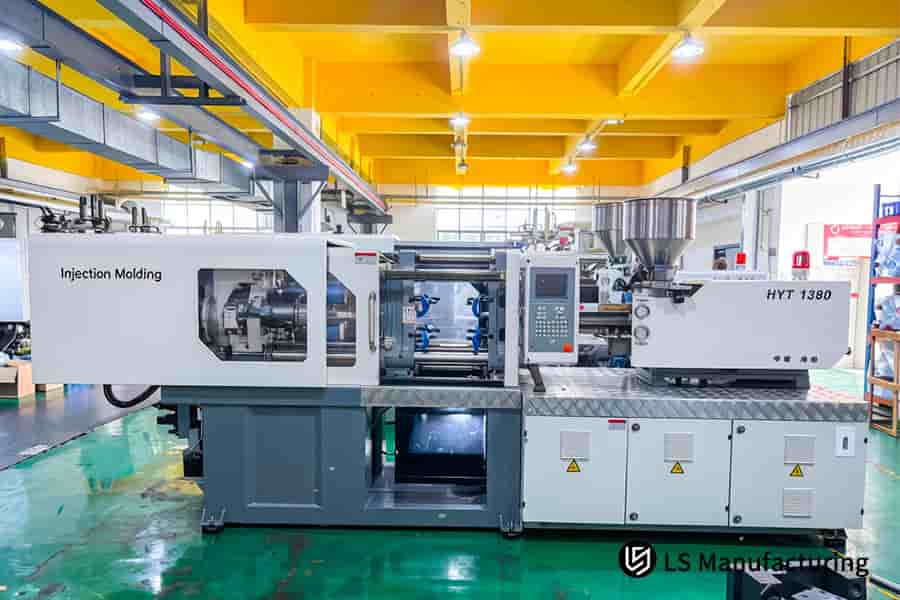
Figure 3: The HYT 1380 machine with a digital display operates custom injection mold tooling in the LS Manufacturing facility.
What Criteria Should A Professional Supplier Utilize For High Cavity Tool Alignment?
Alignment in the tool is critical when talking about high cavitation tools such as 1X32 to ensure there is part consistency, longevity in tools, and sustainability in the process. This misalignment causes the problem of core shifting, variations in wall thicknesses, and flashing. Below is an explanation of the engineering needs required for custom tooling manufacturing for advanced injection molding applications:
Ultra-Precise Guide Pin & Bushing Fit
- Core Specification: Ensuring that the guide pins and bushings maintain a tolerance of less than 0.005mm.
- Purpose: The reason behind ensuring sub-micron accuracy is to eliminate any form of side movement due to the fast cycle speed of the machine.
Use of Advanced Self-Lubricating Materials
- Core Specification: Making use of bushings that are either coated or impregnated with graphite.
- Purpose: This self-lubricating quality ensures that there is no galling of the material during the million cycles of advanced injection molding operations.
Machining with 5-Axis Technology
- Core Specification: Use of 5-axis CNC machining on deep cavity cores and ejector housing.
- Purpose: This feature helps overcome the challenge posed by deflection in 3-axis machining to achieve perfect perpendicularity and alignment of cores in deep drawings for complex injection molding parts.
Systematic Clamp Force & Parallelism Verification
- Core Specification: It entails the verification of the parallelism of platens and applying the appropriate amount of clamp force.
- Purpose: In order to ensure even mold closure in all cavities and avoid stress and flashing.
Achieving perfect alignment requires an engineered result, which can be quantified. The resolution of the basic shift/wear phenomenon will be achieved by specifying clearance tolerances of ≤0.005mm, self-lubricating components, and the use of 5-axis machining. All these principles, forming an integral component of our injection molding DFM services and precision injection molding DFM approach, ensure that high cavity molds become reliable investments generating profits through quality products at lower costs of ownership.
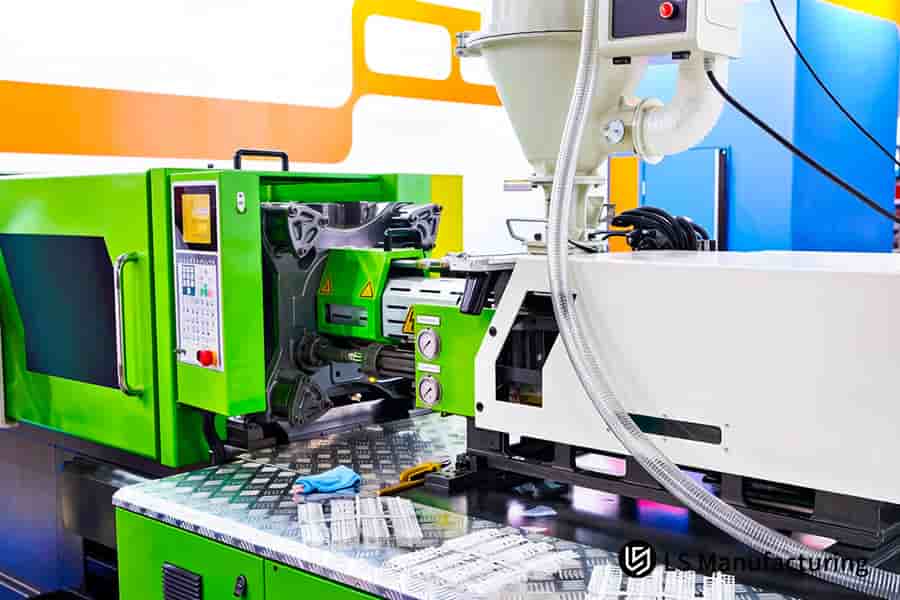
Figure 4: Injection molding DFM services ensure precise control as the green HYT machine injects molten thermoplastic.
Case Study: How LS Manufacturing Saved 32% Cost On A Custom Medical Device Housing Project
This case study outlines the situation in which LS Manufacturing managed to save the medical device launch with a warping problem, demonstrating the effect of advanced injection molding DFM services directly. The specific task dealt with precision required for the tight-tolerance injection molding of a portable dialysis unit housing.
Client Challenge
An OEM involved in the medical industry within the US found itself facing an issue of warpage, which resulted in scrap of 3.5% of its production. In fact, they had consulted their previous supplier on four occasions to fix the mold but nothing could be done about it. This resulted in inconsistent mold release and a delay of three months before going to market with the product.
LS Manufacturing Solution
We started a full redesign of our system with a focus on the heat aspect, where we increased the rib thickness to 60% of the main wall to avoid any sink marks, changed submarine gates to a balanced valve-gate hot runner, and incorporated conformal cooling. These changes allowed us to keep cavity surface temperature variance below ±2°C and helped us directly address the differential shrinkage issues with custom injection mold tooling to do precision plastic injection molding.
Results and Value
Optimizing the tooling achieved a decrease in cycle time by 42% (from 45 seconds to 26 seconds) resulting in fast cycle injection molding along with stabilizing the warpage at 0.08mm. We successfully produced 100,000 parts with no errors while reducing the client’s total applied part cost by 32%. The results helped our client avoid any sorting and reworking, guaranteed their time to market, and provided a template for future efficiency.
This is a classic example of how resolving critical technological problems brings about ultimate business results. LS Manufacturing excels in providing such system-wide solutions that can save crucial projects and guarantee successful and secured production. This ensures definite injection molding cost control.
If you're facing similar warpage and cost overruns, achieve the same 32% savings and cycle time reduction. Submit your housing design for a warpage analysis and a cost-saving quote.

FAQs
1. What is the typical lead time for custom injection mold tooling development at LS Manufacturing?
With the help of an integrated in-house precision machining center and full-scale DFM services, we are able to offer first-article (T1) parts in 21–25 days. The fast delivery is made possible by concurrent engineering, simulations of the digital twin, and coordinated efforts of the design team and production team.
2. How do your injection molding DFM services improve cost-effective mold design for automotive parts?
Our DFM services are helpful in minimizing the cost of mold design through flow and cooling analyses and proper adjustment of runner systems, along with compensations of shrinkage of each material type used. The upfront analysis allows us to minimize waste and optimize use of materials by 15%.
3. Can your injection molding tooling optimization resolve severe cosmetic issues like sink marks and weld lines?
Without a doubt. Our mold design is optimized through simulation to accurately model filling patterns, gate locations, and pressures. This results in the creation of molds where there are no surface imperfections, such as sink marks and weld lines, for 100% of all mass-produced parts.
4. What steel grades do you recommend to achieve cost control in injection molding for high-volume production runs?
In order to achieve cost control in injection molding processes that involve production volumes larger than 500,000 cycles, it is required that only top-of-the-line foreign-made steels, such as H13 and 718H be used. These provide greater wear resistance, higher hardness, and superior thermal stability, which ensures proper operation throughout many years of service.
5. How do you verify the dimensional tolerances of parts manufactured using precision injection molding DFM?
Verification of tolerances is conducted using a quality system that includes fully automated Coordinate Measuring Machines (CMMs). That allows for 100% in-process tolerance verification of critical dimensions by comparison with the data provided by the digital twin generated in the DFM stage to assure perfect adherence to all dimensions specified in the design optimization stage.
6. What is the Minimum Order Quantity (MOQ) required for your custom tooling manufacturing services?
We are very flexible and support the manufacture of small batches. The minimum order quantity in our custom mold manufacturing services starts at 500 parts specifically tailored to serve your needs in new product R&D and testing stages without the need to place orders for an excessive amount of goods.
7. Do you provide standard IP protection protocols during your upfront DFM reviews for injection molding?
Certainly, we provide full-scale IP protection protocols for our customers. The non-disclosure agreement is always signed first, and then all DFM and other reviews are conducted strictly within a highly secured internal network to ensure the safety of your 3D designs and other relevant data.
8. Why should global procurement managers choose LS Manufacturing as their supplier for custom injection mold tooling?
The global manager must consider LS Manufacturing due to our unique combination of leading technologies for mold optimization together with scientific molding techniques and highly competitive "Made in China" pricing. LS Manufacturing provides a complete package from DFM to robust tooling and reliable mass production for an excellent return on investment from the quality of parts produced. Leverage our integrated solution to lock in your ROI. Request a comprehensive project proposal with a detailed, competitive quotation to begin.
Summary
In order to obtain precise and cost-efficient results during injection molding, DFM must be implemented in the very early stages of production rather than attempting post-production modification. Draft angle design, wall-thickness ratio, hot runner shear rate and conformal cooling optimization at LS Manufacturing connect the dots between your 3D CAD drawings and successful molding results without risks during mold fabrication.
Make sure that your next injection molding is free from rework and cost-ineffective operations. Upload your initial injection molding 3D design files (STEP/IGS/X_T formats) and "Get a Real-Time, Free DFM Review and Project Quotation" within 24 hours. Our top-class engineers will provide you with a comprehensive report including filling results, wall-thickness risks, and multi-level cost optimization.
📞Tel: +86 185 6675 9667
📧Email: info@lsrpf.com
🌐Website: https://lsrpf.com/
Disclaimer
The contents of this page are for informational purposes only. LS Manufacturing services There are no representations or warranties, express or implied, as to the accuracy, completeness or validity of the information. It should not be inferred that a third-party supplier or manufacturer will provide performance parameters, geometric tolerances, specific design characteristics, material quality and type or workmanship through the LS Manufacturing network. It's the buyer's responsibility. Require parts quotation Identify specific requirements for these sections.Please contact us for more information.
LS Manufacturing Team
LS Manufacturing is an industry-leading company. Focus on custom manufacturing solutions. We have over 20 years of experience with over 5,000 customers, and we focus on high precision CNC machining, Sheet metal manufacturing, 3D printing, Injection molding. Metal stamping,and other one-stop manufacturing services.
Our factory is equipped with over 100 state-of-the-art 5-axis machining centers, ISO 9001:2015 certified. We provide fast, efficient and high-quality manufacturing solutions to customers in more than 150 countries around the world. Whether it is small volume production or large-scale customization, we can meet your needs with the fastest delivery within 24 hours. choose LS Manufacturing. This means selection efficiency, quality and professionalism.
To learn more, visit our website:www.lsrpf.com