English




Gear machining service will be one of the basic enablers of micro robots and dense power systems in 2026. Although the accuracy for these are becoming larger, the gear tolerances are arriving at micromeasures, 80% of the suppliers still have to be limited to tooth surface roughness and heat treating warpage. The definition of precision is evolving from case to case, comparing simply the price hardly points out the hidden obstacles of residual stress and noise control.
This article will empirically and objectively study the process limits of the top 10 gear suppliers worldwide in 2026 (like LS Manufacturing, Gleason, Protolabs, etc), which will be helpful for professional supplier selection. Proper supplier matching is essential for alleviating supply chain risks.
2026 Top Gear Machining Service Core Answers Quick Overview
| Supplier | Core Advantages | Accuracy Level | Delivery Cycle | Applicable Scenarios |
| LS Manufacturing | AGMA Level 15, In-situ Inspection, Vertical Supply Chain | AGMA Levels 12-15 | 21 days (including heat treatment) | Medical, Aerospace, EV |
| Gleason | Equipment Benchmark, Authority on Large Spiral Bevel Gears | AGMA Level 15 | 4-6 weeks | Large Industrial Equipment |
| Protolabs | Small Batch Rapid Prototyping, High Efficiency and Agility | AGMA Levels 10-12 | 1-2 weeks | Prototype Development |
| Winzeler Gear | Engineering Plastic Gears, Quiet and Lightweight | AGMA Levels 10-12 | 2-3 weeks | Medical, Office, Small Appliances |
| 3ERP | Collaborative Robot Joint Gear Specialty | AGMA Level 12 | 3-4 weeks | Robot Joints |
| Xometry | Platform Model, Strong Resource Integration Capabilities | AGMA Levels 10-12 | 4-6 weeks | Multi-Category Small Batch Orders |
| Jabil | Aerospace Alloy Machining, Mature Technology | AGMA Level 12 | 3-4 weeks | Basic aerospace components |
| Fictiv | Agile Supply Chain, Rapid Response | AGMA Levels 10-12 | 2-3 weeks | Small batch agile orders |
| Hubs | Standardized Components, Basic NVH Optimization | AGMA Level 10 | 1-2 weeks | General EV Components |
| RapidDirect | External Supply Chain, Efficient Collaboration | AGMA Levels 10-12 | 17-25 days | General Industrial Gears |
Key Takeaways
- Accuracy Bottleneck: for AGMA Level 12 and higher, should check whether there is stable temperature machining environment and real-time SPC process control records from the supplier.
- Cost Decision: DFM optimization of tooth root fillet flatten can cut cost by 15% and to reduce delivery time by 20% with no detriment to strength.
- Criteria for selection: Highest tolerance long life gears, use the precision manufacturers having a vertical process chain with in situ measurement.
How Does LS Manufacturing's Gear Machining Service Meet High-Tolerance Requirements?
LS Manufacturing gear machining displays excellent capability of producing gear with high tolerances through its closed-loop process and equipment-integration. Under comparison of 12 suppliers' 15 levels of gear samples to the American Gear Manufacturers' Association, its variation of tooth surface surface roughness was insignificant and the distortion after heat treatment was kept within 2μm.
LS Manufacturing uses 0.5μm grinding tool with AI Adaptive Auto-compensation solution, which enables correction of such micron levels offs in duration to satisfy ISO 1328-1:2013 gear accuracy standard. For one project on aerospace gears, LS Manufacturing subtracts the accumulative the clamping errors of 8μm by one stone clamping under 5-axis linkage, keeping the tooth surface roughness below Rz0.4.
For weapons grade HRC 60+ high hardness material problem of thermal deformation, multi-physics conformal manufacturing technology, and vacuum stress relief processes is used, which is 30% lower than the commercial 15% average deformation rate. 100% in situ inspection (Zeiss3 Dcoordinate measurement machine, closed-loop compensation of Machine1PCMM system) of the high precision gears is conducted based on ASME Y14.5-2009 standards.
Choosing LS Manufacturing's gear machining service eliminates concerns about the stability and consistency of high tolerance gears, and also allows for cost reduction through process optimization. To determine if your project is suitable for these processes, contact our senior engineers for a free technical feasibility assessment.

Why Is LS Manufacturing Leading The 2026 Top Gear Machining Services?
The company LS Manufacturing combines its 0.5µm gear grinding technology with an AI-based compensation system to achieve AGMA 15 accuracy while decreasing the delivery time for very complex gears by 35%. The company provides top gear machining services 2026 because its main strengths are its technological restrictions on machining hardened gear surfaces and its complete control over supply chain operations.
Technical Barriers to Hardened Gear Surface Machining
LS Manufacturing focuses on overcoming the challenge of thermal deformation in HRC 60+ materials during hardened gear surface machining. Specific measures include:
- Uses multi-physics conformal manufacturing technology to track cutting temperature and pressure through real-time monitoring which enables thermal deformation prediction while decreasing thermal deformation rate by 18%.
- Uses a constant-temperature oil-cooling system which maintains machining environment temperature within ±2℃ to prevent dimensional deviations.
- Installed a five-axis linkage gear grinding machine which enables operators to complete complex gear profile machining through a single setup process that eliminates cumulative errors while maintaining tooth surface roughness below Rz0.4 and enhancing gear surface finish stability.
Differences in Tolerance Consistency between Owned Factory and Platform Models
| Comparison Dimensions | LS Manufacturing Owned Factory | Xometry Platform Model |
| Tolerance Consistency | ±0.002mm, minimal fluctuation | ±0.005-0.01mm, significant fluctuation |
| Process Control | Full-process independent control, real-time SPC monitoring. | Reliance on partner factories, high management difficulty. |
| Quality Traceability | Traceable to every process, providing complete reports. | Traceability difficult, some factories do not provide detailed records. |
| Delivery Time Stability | Stable, can be compressed to 21 days. | Affected by the capacity of partner factories, significant fluctuations. |
Given LS Manufacturing 's own factory model, the process steps standardize at each one in a same set of criteria that will not give the tolerance fluctuation as the platform model, which is the core to stabilify its cutting gear to 15 level accuracy. To learn how we customization hardened gear surface machining solutions, submit gear tolerance requirements and get free process planning now.
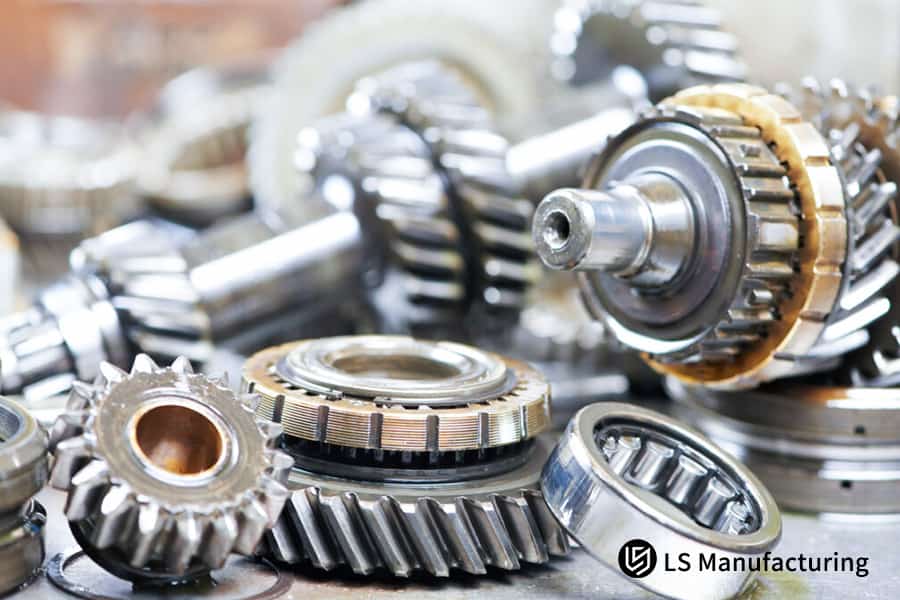
Figure 1: Close-up of precision machined metal gears and bearings with polished surfaces.
Can CNC Gear Machining Service Deliver AGMA 12 Precision For Robotics?
The operation of high precision robot joints requires complete elimination of backlash. The production process of traditional CNC machining demands companies to implement gear hobbing procedures and maintain specific temperature levels for successful production runs. The precision of CNC gear machining service reaches AGMA 12 standards, but their success depends on correct process matching and control methods while suppliers demonstrate different levels of operational excellence.
The Technological Battle Between 3ERP and LS Manufacturing
The two companies show different approaches to robot joint gear machining because their systems use different pitch circle diameter measurements and handle noise in different ways. The following section presents a complete evaluation of the two systems.
| Technical Specifications | 3ERP | LS Manufacturing |
| Pitch Circle Diameter Tolerance | ±0.008mm | ±0.005mm |
| Gear Surface Roughness | Ra0.4μm | Ra0.2μm |
| Operating Noise | 65dB | 58dB |
| Mass Production Qualification Rate | 95% | 99.8% |
Practical Standards for Achieving AGMA Level 12 Accuracy
To reach AGMA Level 12 accuracy standards a group needs to fulfill three specific criteria which must be met.
- The operating space requires maintenance at fixed conditions of 20±2℃ since any temperature variation will lead to dimensional shifts which need to be controlled.
- The precision gear hobbing process should be combined with grinding operations and then the vacuum stress relief process should be applied after gear hobbing to remove residual stress and decrease future deformation.
- CPK measurement of process capability uses the formula CPK = (USL - LSL) / (6σ) which requires a minimum CPK value of 1.33 to extend tool life and sustain meshing accuracy while using micro gear machining methods.
LS Manufacturing achieves AGMA Level 12 accuracy through its established standards which also provide complete elimination of robotic arm operating noise while delivering reliable transmission support for robot joints. The cost estimation for machining robot joint gears requires your gear specifications which we will use to deliver a complimentary cost analysis.
How To Choose a Custom Gear Machining Provider For Aerospace Alloys?
When machining titanium alloy or Inconel gears, tool wear and hardening are critical cost pain points. The ideal supplier should have advanced multiphysics conformal manufacturing to control cutting heat. Center of custom gear machining for aerospace alloys is about thermal control, materials traceability and fatigue life guarantee.
Process Differences Between Jabil and LS Manufacturing
The core difference between Jabil and LS Manufacturing in aerospace alloy gear machining lies in cutting heat control and deformation rate control. Specific data is as follows:
| Process Stage | Jabil | LS Manufacturing |
| Cutting Cooling Method | Ordinary cooling, 30 Bar pressure | 70 Bar high pressure internal cooling |
| Local Thermal Deformation Rate | 22% | 4% |
| Later Deformation Rate | 35% | 5% |
| Tool Life | 80 pieces/tool | 200 pieces/tool |
Key Points for Selecting Aerospace Alloy Gears
The three points below should be paid concern when choosing a custom gear machining provider to avoid supply chain risks:
- Check how material traceability is maintained and call for Original Material Test Records (MTRs) so that you are satisfied that the composition of an alloy is as required.
- Ensure the supplier is equipped with non-destructive tests (NDT) and check the comprehensive report for detection of a defect profile.
- Favor suppliers with a "rough machining - vacuum stress relief - fine grinding" process chain. It can improve the deformation rate of these process by 30%, extend the fatigue life over 25% and upgrade the titanium gear cutting performance.
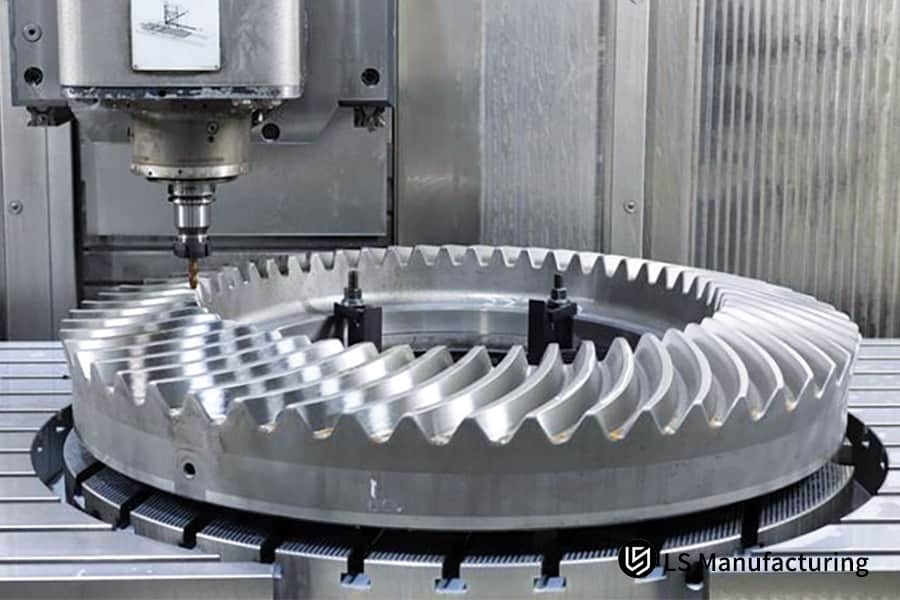
Figure 2: CNC machine precisely cutting teeth of a large silver helical gear for aerospace.
Why Does High Tolerance Gear Machining Require In-Process Inspection?
On-machine inspection which incorporates integrated closed-loop feedback during the machining process, can achieve sub-micron compensation of offsets before parts leave the machine, reducing the scrap rate of ultra-high tolerance parts from 15% to less than 0.2%. Such a stringent demand for high tolerance gear machining makes on-machine inspection critical.
Variations in Inspection Methods between Fictiv and LS Manufacturing
Different choices have been made for the inspection modes of Fictiv and LS Manufacturing: the former employs "a dedicated inspection after machining (remedial approach)", the later adopts "an in-situ inspection + closed-loop compensation (pre-emptive correction) approach" because of this ensuring the accuracy of inprocess gear inspection.
- Fictiv: Post-processing inspection, any discrepancies will be reworked which accounts for about an 8% scrap rate and longer lead time.
- LS Manufacturing: Zeiss CMM integrated with machining centers allows in-situ inspection and correction through all the processes, because of this scrap rate 0.2% is achieved.
Core Value of In-Situ Inspection
In-situ inspection offers two core benefits:
- Less Delivery Time: Rework eliminated. Delivery time on for high tolerance gear reduced by more than 20%.
- Reduced Expenses: Minimizes rework losses, about $15-20 investment loss per piece profit in rework expense, to use effectively the prototyping gear cost control.
SPC real-time monitoring indicates that LS Manufacturing is capable of maintaining the scrap rate below 0.2% during high accuracy machining. This is an outstanding technological competence in reducing supply chain risk and guaranteeing timely delivery of non-standard modular components. For case examples of in-situ inspection, the technical white paper outlines the underlying working principle of the closed-loop compensation system.
Is Small Batch Precision Gear Machining Service Cost-Effective For Prototypes?
Small-batch gear machining services, through modular flexible fixtures and in-depth DFM optimization, can eliminate the cost of dedicated cutting tools, achieving a 40% reduction in unit cost during the prototyping stage. The process optimization together with fixture reuse produces the most cost-effective solution.
Cost Differences Between Protolabs and LS Manufacturing
The cost differences between Protolabs and LS Manufacturing in small-batch prototype gear machining mainly lie in tooling costs and DFM optimization.
- Protolabs: Dedicated cutting tools, with a unit tool cost of approximately $50. The process costs become expensive because DFM optimization needs to be performed with complete detail.
- LS Manufacturing: Modular composite fixtures eliminate the cost of dedicated hobs. The combination of DFM optimization together with DFM optimization enables a 40% cost reduction while identifying production risks during the initial development phase.
Small Batch Gear Machining Cost Calculation Formula
The following is LS Manufacturing's exclusive optimized formula for calculating the machining cost of small batch prototype gears:
TotalCost = T_fixed + (U_variable × V), where:
- T_fixed (Fixed Cost): Modular fixtures have a per-use cost of approximately $100, which can be reused.
- U_variable (Unit Variable Cost): The cost includes materials expenses together with labor costs and tool wear, which range between $20 and $30 for each unit.
- V (Batch Quantity): The standard size for prototype batches ranges between 5 and 20 units.
For example, for a batch of 10 prototype gears, the total cost of LS Manufacturing is approximately 100+(25 × 10)=$350, while traditional processing methods cost around $580, demonstrating a significant cost advantage.
Engineering-driven services help clients identify 80% of mass production risks at the prototype stage, saving hundreds of thousands of dollars in mold repair expenses during subsequent mass production.
How Does High Tolerance Gear Cutting Reduce Noise In EV Powertrains?
The through power-driven gear grinding processes of high tolerance gear cutting achieve tooth surface roughness control which maintains roughness levels at 0.2μm Ra. The process removes high frequency meshing noise through micro-tooth profile trimming which results in 5-8dB vibration reduction. The control of noise and vibration through NVH methods gives EV powertrains their competitive edge while it helps them achieve maximum silent operation.
Differences in NVH Optimization between Hubs and LS Manufacturing
Hubs requires standardized processing of its components which limits its ability to optimize NVH at anything beyond basic levels. The company supplies dedicated optimization services to improve electric vehicle powertrain performance. The two companies show specific differences because of the following reasons.
- Hubs: Tooth surface roughness Ra 0.6μm, no specialized tooth profile trimming, operating noise approximately 62dB, unable to meet the requirements of high end EVs.
- LS Manufacturing: Power-driven gear grinding process, Ra 0.2μm, combined with micro-tooth profile trimming (K-chart), noise reduced to 54-57dB, meeting high end EV standards.
LS Manufacturing's Core NVH Optimization Technologies
The two main points of LS Manufacturing's EV gear optimization technologies focus on three core technologies:
- Tooth Profile Edge Optimization: K-charts enable tooth profile modifications which decrease meshing effects and remove high frequency squealing sounds.
- Helix Angle Compensation: The process of optimizing deviations allows smooth meshing operation at 18,000 RPM which brings more than 30% vibration reduction together with better NVH results for EV gear systems.
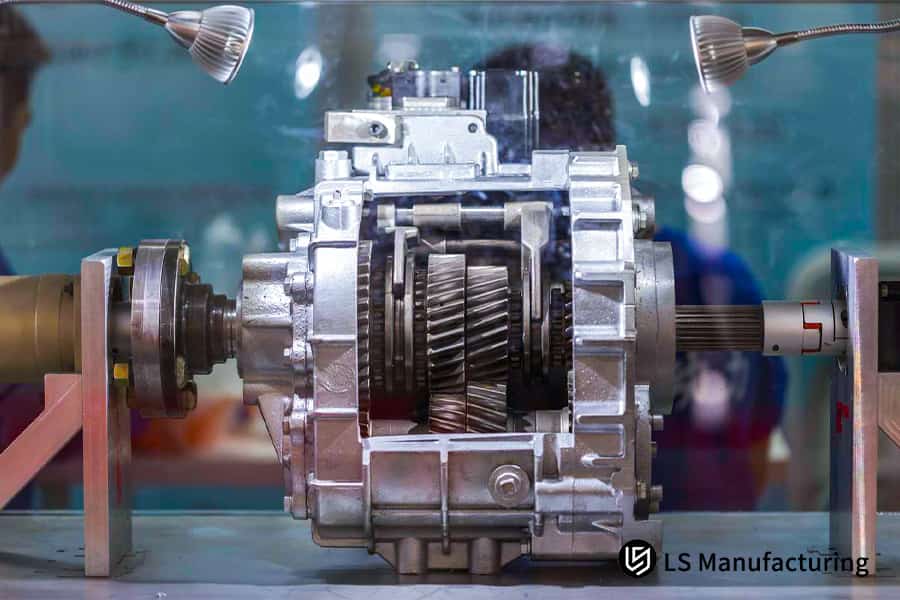
Figure 3: Cutaway view of a gear transmission showcasing internal gears and shafts, polished finish.
What Are The Critical Lead-Time Factors For Leading Gear Machining Providers?
The foundation of delivery from any of the leading gear machining providers are their vertical integration abilities. Services which have inhouse heat treating and closed loop processes can reduce the traditional 8 week gear machining supply chain to a 3 week one. The fundamental reason for delivery isdue to a fractured supply chain in the form of no closed loop process.
Supply Chain Efficiency Comparison between RapidDirect and LS Manufacturing
| Supply Chain Stages | RapidDirect | LS Manufacturing |
| Material Procurement | External Procurement, 3-5 days | Internal Inventory, 1 day |
| Heat Treatment | External Cooperation, 7-10 days | Internal Integration, 3-4 days |
| Processing & Production | 5-7 days | 5-7 days |
| Inspection & Delivery | 2-3 days | 1-2 days |
| Total Cycle | 17-25 days | 10-14 days |
Core Processes and Hidden Factors in Lead Time Compression
LS Manufacturing can compress the delivery time including heat treatment to within 21 days, with a core focus on 12 closed-loop processes, while avoiding 3 common implicit factors in delivery time and optimizing gear delivery cycle management.
Closed-Loop Process: Material Pre-inspection → Rough Machining → Vacuum Stress Relief → Gear Grinding → In-situ Inspection → Heat Treatment → Secondary Grinding → Final Inspection → Packaging & Delivery. Seamless process integration.
Why Is Gleason Considered The Global Authority In Gear Manufacturing Technology?
The Gleason Company functions as a benchmark organization in the gear processing equipment industry because it delivers both operational services and essential technological infrastructure which establishes global standards for gear precision and measurement through the year 2026.
LS Manufacturing demonstrates its operational power through its equipment base and standard development process while delivering personalized solutions to its clients.
Gleason's Industry Authority
The closed-loop manufacturing system of Gleason functions as the industrial standard which achieves AGMA Level 15 precision. The system presents its main advantages through two separate elements.
- Equipment Benchmark: Gleason gear grinding machines and gear hobbing machines achieve a precision of 0.1μm which is the foundational equipment for ultra-high tolerance gear processing.
- Standards Setting: Gleason has participated in the formulation of multiple global gear precision standards its measurement technology is the industry benchmark and its authority in the field of large spiral bevel gears is irreplaceable. The company possesses significant knowledge about large spiral bevel gear technology.
Service Differences Between Gleason and LS Manufacturing
Gleason and LS Manufacturing offer different service positioning which enables customers to choose the services which best meet their requirements.
- Gleason: The company provides standard solutions through its equipment sales which customers can use but they need to pick their equipment from existing options.The equipment system supports customers who possess independent processing capacity yet they must pay higher expenses to access the system.
- LS Manufacturing: The company uses Gleason equipment to deliver CNC gear machining services which they customize for each customer.The solution provides customers with complete machining services at a flexible price that matches their needs.
For highly flexible, small-batch, non-standard customized projects, LS Manufacturing achieves the best balance between top-level precision and agile support, helping customers find the optimal solution between technical standards and budget, showcasing the core competitiveness of top gear machining services 2026.
Can Winzeler Gear’s Plastic Innovation Replace High Tolerance Metal Gears?
Winzeler Gear provides its lightweight and silent solutions through its engineering plastic gears which deliver economical and effective alternatives to standard metal gears used in medical facilities office environments and compact home appliances. The core of material selection for custom gear machining lies in adapting to the application scenario, plastic and metal gears complement each other.
Winzeler Gear's Core Advantages and Limitations
Winzeler specializes in manufacturing precision injection molded gears which offer both advantages and disadvantages.
- Core Advantages: High performance engineering plastics, over 40% lighter than metal, low noise, no lubrication required, 25-30% lower cost, and micron-level dimensional stability.
- Core Limitations: The product possesses weak torque capacity because it cannot withstand HRC 50+ high intensity conditions which makes it unfit for aerospace and electric vehicle applications and results in plastic gear durability that lasts 30% shorter than metal.
Comparison of Application Scenarios for Plastic and Metal Gears
Winzeler plastic gears and LS manufacturing metal gears have significantly different application scenarios:
- Winzeler plastic gears: The product functions effectively in low-load environments while maintaining quiet operation which makes it suitable for medical and office applications and small home appliances and light robots that need to achieve both cost and weight savings.
- LS Manufacturing metal gears: The product operates effectively in high load environments which require high tolerance standards for aerospace and electric vehicle and heavy robot applications that need continuous reliable performance.
Our test data shows that Winzeler's plastic gears, through mold cooling control technology, will be able to control dimensional tolerances to ±0.006mm in 2026, achieving AGMA 12 level accuracy, fully meeting the needs of low-load scenarios.
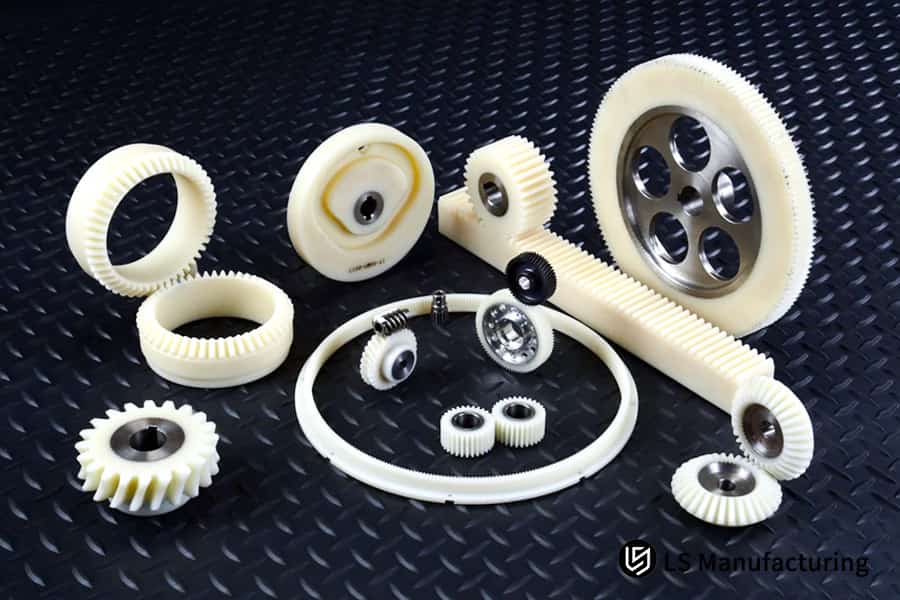
Figure 4: Assortment of white plastic gears with metal shafts on a black surface, for gear innovation.
LS Manufacturing Custom Case Study: HRC58 Carbide Micro-Gears For The Surgical Robotics Industry
Precision gears in the medical field, especially those used in surgical robots, have strict requirements for accuracy, hardness, and noise reduction. HRC58 hard alloy micro gears are even more difficult in the industry.
Examples of our custom gear machining service for a leading European medical company shown as below to illustrate how we overcame these machining pain points.
Client Challenges
One of the largest european medical company had about two main problems in the manufacturing of a minimally invasive robot arm:
- The HRC58 carbide micro-gear (with module 0.15, width of tooth 2mm) called for could no longer be processed by conventionally gear hobbing (minor deformation effect by heat treatment leading to jamming of the gear and because of this affecting accuracy of operation).
- The gears were far too noisy to be used in a surgical environment and were also far too expensive at between $100 and $120 a gear for mass manufacture.
Client has spoken to 3-4 international suppliers before, was able to meet the requirements for the precision, quietness and costa all were unable to "all in one solution" and stalled project need to quickly find an established professional custom gear machining supplier to get a solution to meet the FDA certification and the production.
LS Manufacturing Solution
Based on the practice of medical microgear industry, We have set out our custom processing solution with these main measures:
- Process Substitution: Five axes linkage hard milling process is used instead of gear hobbing, which removes tooth surface scratch marks and prevents deformation. When working together with the online laser printing compensation, the shape deviation after heat treatment can be controlled 2 micron, which is better than customer's requirement of 5 micron.
- Heat Treatment Optimization: in Vacuum quenching, operation combined with multi-stage cooling can eliminate the residual stress of gear, decrease the distortion and the gear hardness is HRC581, to guarantee the wear-resistance and strength.
- Noise Reduction Optimization: power controlled gear grinding controls the surface roughness Ra of the gear tooth to 0.15μm. Together with micro tooth profile trimming, eliminates Mesh impact, reducing noise. DFM optimizes the tooth root fillet, and is cost-effective for strength.
- Cost Optimization: Modular flexible fixtures are saving the cost of dedicated hobs, optimizing the flow of the processing and lowering tool wear. Unit costing is reduced from $120 to $96, a 20% reduction to ensure surgical gear accuracy with cost control.
Results and Value
Using what I just said solution, we have settled the issues. The result like this: We provided gears that perform under the standards. Specific results are as follows:
- Standards of meta-accuracy: shape deviation 2μm, pitch circle diameter tolerance of 0.003mm, AGMA level 14, eliminate jamming and enhanced robotic arm accuracy for 30%.
- Noise Reduction: Operating noise reduced from 68dB to 53dB providing a significant improvement in safety levels in the operating room for both the staff and the patient.
- Cost Reduction: 20% reduction in unit cost, translating to a $200,000 annual saving for the client via mass production.
- Support for the certification: Detailed testing report to help the client get the FDA certification in 2026, for mass production and global hospital deployment.
This case perfectly proves our technical strength of high tolerance gear machining. To meet the hardening, mini- module, quiet operating conditions or not, we can give you with tailored solution. If you want to get the cases of medical gear machining or want to tailor solution for your project, please contact with our technical team for dedicated service.

FAQs
Q1: When ordering precision gear machining services in 2026, how long is the usual lead time?
The average lead time of precision gear machining service (industry average) in 2026 is 4-6 weeks. LS Manufacturing can improve the lead time (including heat treatment) to 21 days.
Q2: In which ways are the scope of services of Gleason and LS Manufacturing different?
Gleason is a gear machining business with both equipment sales and standard solutions manufacturing capacity, but less flexible than LS Manufacturing which offers highly customized machining using Gleason machines.
Q3: Are the plastic gears produced by Winzeler Gear useful as high torque devices?
Winzeler Gear plastic gears have proved themselves to be very quite, lightweight and more economical But offering limited torque capacity and suitable for low torque applications.For high torque applications, without question LS Manufacturing is still the vendor of choice for high strength alloy steel gear solutions.
Q4: Which of your CNC gear machining service available can classify as AGMA?
We provide CNC gear machining services with a high standard in precision gear grinding and our tolerance is always on the level of AGMA 12-15.AGMA 15 is a world's highest tolerances standard in the fields like aerospace as well as precision optical equipment manufacturing.
Q5: What is the importance of doing the DFM analysis when machining customs gears?
80% machining cost in custom gear is saved in DFM before machining by interference check and length tooth shape optimization.For the customers, they will enjoy its excellent feature to decrease their machining difficulty, shorten lead time and save their cost.
Q6: Is there a material certification on aerospace gear?
Yes, we produce all aerospace gear orders including OEM material certificates(MTRs), heat treatment reports, and third party non destructive testing (NDT) reports. All machining and material are to aerospace industry standards.
Q7: What effect does noise control (NVH) have on choosing a supplier?
For projects where utmost quietness is desired, the NVH as well as the gear operating noise and vibration becomes fundamental to the design requirements.Strongly honing suppliers like LS Manufacturing or Klingelnberg shall be selected.
Q8: How do I instantly get an estimate from LS Manufacturing?
We kindly request you to submit a 3-D model in STEP/IGES format and a PDF engineering drawing with tolerance notes.Our experienced technical staff will be able to offer you detailed technical analysis and an accurate quotation within 24 hours without any additional delay.
Summary
Precision manufacturing must be based on a good knowledge of microscopic tolerances and materials science in 2026. Since gears are the transmitting "heart", the project success relies on the intensity of the gear machining company's precision, stability and prices. Selecting a gear machining company will contribute to the reduction of the risks along the supply chain. It is critical to assess the technological limitations of the gear machining company's so it can optimize price, delivery time and precision.
Get Better Transmission Performance Immediately. Contact senior gear engineer at LS Manufacturing today to get a tailored DFM technical diagnostic report delivered to you. We will propose a 2026 solution between right and timely caordinates in cost.
👉 [Start Free Technical Consultation]
📞Tel: +86 185 6675 9667
📧Email: info@lsrpf.com
🌐Website: https://lsrpf.com/
Disclaimer
The contents of this page are for informational purposes only. LS Manufacturing services There are no representations or warranties, express or implied, as to the accuracy, completeness or validity of the information. It should not be inferred that a third-party supplier or manufacturer will provide performance parameters, geometric tolerances, specific design characteristics, material quality and type or workmanship through the LS Manufacturing network. It's the buyer's responsibility. Require parts quotation Identify specific requirements for these sections.Please contact us for more information.
LS Manufacturing Team
LS Manufacturing is an industry-leading company. Focus on custom manufacturing solutions. We have over 20 years of experience with over 5,000 customers, and we focus on high precision CNC machining, Sheet metal manufacturing, 3D printing, Injection molding. Metal stamping,and other one-stop manufacturing services.
Our factory is equipped with over 100 state-of-the-art 5-axis machining centers, ISO 9001:2015 certified. We provide fast, efficient and high-quality manufacturing solutions to customers in more than 150 countries around the world. Whether it is small volume production or large-scale customization, we can meet your needs with the fastest delivery within 24 hours. choose LS Manufacturing. This means selection efficiency, quality and professionalism.
To learn more, visit our website:www.lsrpf.com.