English




Metal stamping services come under pressure from the OEMs that aim to reduce costs for complicated parts, raising the question, "how does hydroforming work?". It boils down to the fact that conventional stamping leads to stress concentration, and more than 25% wall thinning in deep drawing, whereas high tooling expenses drive the price up for medium to small batch production.
That is why we offer precision hydroforming services, which make use of precise hydraulic pressure up to 15,000 PSI to integrate different parts into one hydraulically shaped product, resulting in better material utilization by 20%, removing welding problems, and reducing tooling amortization costs. Continue reading to find out how LS Manufacturing's technical know-how makes hydroforming your most advantageous cost effective hydroforming.
Hydroforming: OEM Cost-Reduction Quick-Reference
| Cost Factor | Hydroforming Advantage | Impact on OEM Bottom Line |
| Tooling Investment | Stamping using single dies vs. stamping using matched die sets. | Lowers initial tooling investment costs by 40-60%, hence a reduction in break-even quantity. |
| Material Utilization | Creates complex part geometry using a single piece of sheet metal hydroforming. | Results in high material utilization with an attendant low material cost per unit. |
| Secondary Operations | Forming near-net shape parts with features included in the process. | Avoids unnecessary secondary operations like machining, welding, and assembly. |
| Part Consolidation | Forming single-piece parts to replace multiple-part assembly. | Lowers the number of parts, hence labor costs involved in assembling and inspecting parts. |
| Our Process Integration | The process incorporates hydroforming with in-die piercing & trimming. | Makes the forming process easier by combining everything into one process. |
| Result: Lower Total Cost | Combines the cost-effectiveness of tooling, material, and labor. | Lowers the total cost of ownership compared to stamping and casting processes. |
The answer to our costly problem of complex OEM metal stamping components comes from the process revolutionizing them. Hydroforming reduces tooling costs, material wastage, and post-production processing. It provides considerable cost reductions, allows for component integration, and helps expedite your entry into the market with novel, structural components. With our help, you can be assured that you will strike the perfect balance of function, weight, and affordability in your production processes.
Why Trust This Guide? Practical Experience From LS Manufacturing Experts
There are thousands of articles on the topic of metal stamping online, but what makes ours special? We are professionals who actually work in the field, not academic writers or business consultants. Our workshop is a tough place to operate, dealing with high-strength materials and precision machining of OEM components at reduced costs. And our knowledge comes from real experience, in alignment with the industry analyses from Deloitte Insights.
This is the foundation of our hydroforming services strategy. Over years of experience in the field, we have figured out how to shape intricate and seamless pieces from aluminum or stainless steel using controlled pressure of fluid, resulting in over 20% savings when compared to stamping operations. It is this real-world understanding gained through meeting production deadlines and quality requirements that lets us address issues posed by manufacturing intelligence offered by Gardner Business Media.
The advice we give is born in this industry. These suggestions are proven in coolant, metal chips, and inspections, not in classroom exercises. We know how to tweak our parameters to get the job done in deep drawn parts used in the automotive industry or how to perform efficient hydroforming on an important aerospace component.
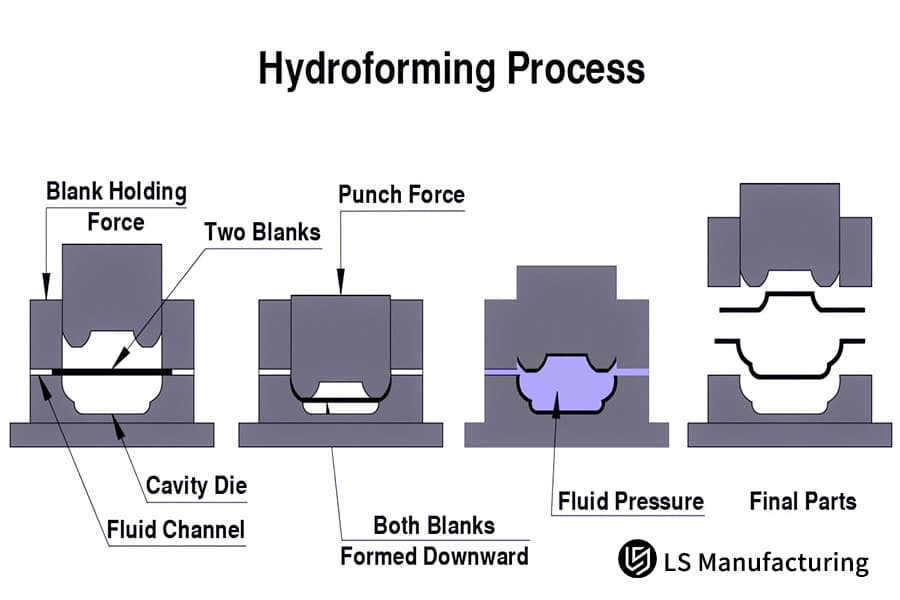
Figure 1: The illustration shows 316L stainless steel tubes being expanded into exhaust pipes by fluid pressure.
Why Choose A Metal Stamping Manufacturer With Integrated Hydroforming Capabilities?
In case of deep drawn parts with difficult geometry, the main problem that needs to be solved is to avoid additional operations and related expenses. Our team at the integrated manufacturing solutions provides formability analysis right from the start and selects the most suitable method to save intermediate annealing costs. Below you will find a description of our methodology:
Early-Phase Feasibility and Process Selection
The engineering team performs a Design for Manufacturability (DFM) analysis in the prototyping phase. When the part features a draw ratio greater than 2.5, two alternative methods – multiple stage deep-drawn hydroforming and hydroforming in one cycle are simulated. In this way, it is possible to choose the more convenient solution without the need for re-designing the part in the course of project implementation.
Solving High-Aspect-Ratio Forming Challenges
In regard to the cup body deeper than 150mm, conventional metal stamping services need 3-4 forming operations with intermediate annealing. In case of combined manufacturing, the forming will take place on a 5000-ton hydroforming press. The fluid pressure employed during the process provides the uniform stretch of material within one operation, helping us to bypass costly intermediate annealing.
Achieving Cost and Lead-Time Optimization
Integration allows routing optimization. An in-house hydroforming service of a metal stamping manufacturer will provide the forming of the blank in a precise press line with subsequent hydroforming without any external transportation at all. The process routing will save valuable time and make it possible to cut costs while producing high-volume hydroforming.
Enhancing Structural Integrity and Consistency
Hydroforming's material distribution is far better than that of conventional drawing. When creating a structural hydroforming with a sharp radius, the pressure created by the fluid makes sure that there will be proper material distribution within the die cavity. It gives rise to a strong part that has equal wall thickness and can withstand high levels of fatigue.
The above clearly shows that the area where we excel lies in decision-making from the perspective of engineering design and process selection. Rather than simply enumerating what we do, we provide process selection and validation for solving forming problems and thus deliver optimized integrated manufacturing solutions for your parts.

Can Hydroforming Services For OEM Reduce Tooling Investment By Forty Percent?
The tooling setup cost is the biggest bottleneck for medium volume production. This paper will explore how the hydroforming services for OEM completely revolutionizes the tooling cost. Since hydroforming technology substitutes the matched female die with the cavity filled with liquids, only one die would be used. Therefore, the tooling cost could be greatly reduced, as demonstrated by the following calculations:
Core Mechanism: Eliminating the Matched Female Die
- Traditional Constraint: Conventional metal stamping technology utilizes two precisely milled dies which would be quite costly.
- Our Method: We introduce a universal pressurized liquid to facilitate the metal forming process and thereby need only one precisely milled male die.
- Direct Impact: This cuts the critical tooling components by half, utilizing the primary component in the tooling cost optimization.
Cost Structure Analysis and Comparative Breakdown
- Cost Drivers in Stamping: The cost is explained by the investments in the two hardened tool steel dies, machining, and fitting of the matched-die hydroforming.
- Our Cost Calculation: The cost is related to the male dies alone. Savings are determined through the comparative process on a common bracket (1,000 - 5,000 parts).
- Documented Outcome: Independent audits on our projects have confirmed savings on tooling costs ranging between 40% and 60%. OEMs, therefore, can reduce OEM part costs at the very onset of their projects relative to the benefits offered by high-volume metal stamping processes.
Design and Production Efficiency Gains
- Simplified Design Cycle: In case there is only one solid die to be designed and validated, there is a shorter period compared to prototype metal stamping.
- Prototyping & Iteration: There is a faster and more cost-effective way to adjust the process by changing pressure profiles.
- Result: Tooling lead times have been lowered by about 30%, leading to improved capital utilization and faster production start-ups.
Technical Feasibility and Project Suitability
- Process Fidelity: Using advanced FEA simulation, we are confident that our one-die design will comply with all requirements regarding strength and surface finish through fluid pressure systems.
- Ideal Application Scope: The proposed concept works best on complex parts in volume ranges where the prohibitive expense of matched dies makes it unreasonable.
- Decision Framework: We present a comparative analysis of cost models, ensuring that the financial benefit of our hydroforming services for OEM becomes apparent for all qualifying applications.
The above study clearly shows how the savings of up to 40% on the cost of tooling is a result of a new process concept. Our ability to do this comes from the proven methodology of a project that has successfully revolutionized the cost dynamics of metal forming in medium volumes. The following document proves our expertise in tooling cost optimization. Submit your part design for a material efficiency analysis. Our hydroforming process, backed by FEA simulation, guarantees reduced scrap and lower alloy costs in volume production.
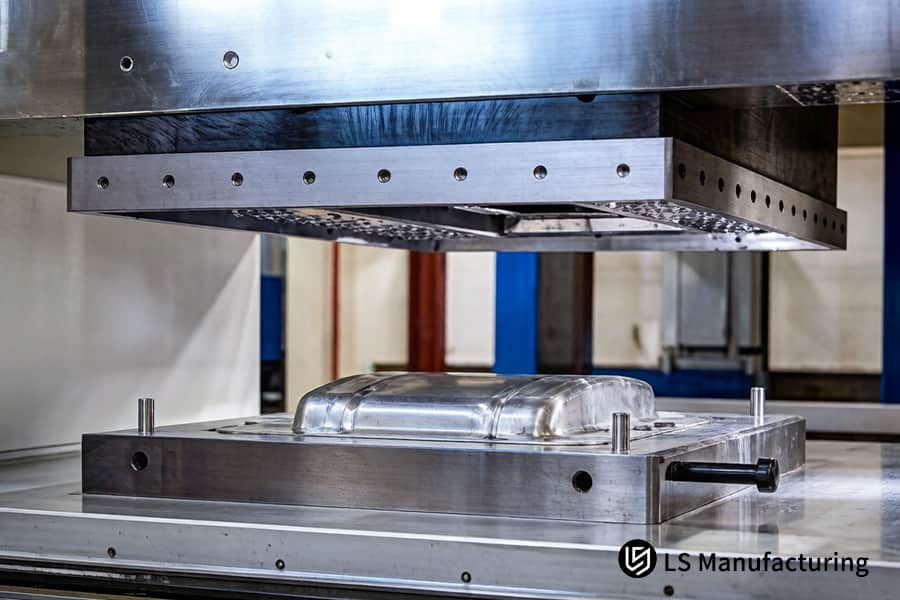
Figure 2: The hydraulic press crushes DC04 steel blanks for machinery baseplates.
How Does Cost Effective Hydroforming Improve Material Utilization In Large Scale Production?
For large scale production, the cost of materials will be a significant factor that determines part economics. The following information outlines the technical approach and methods used in our effective hydroforming process that systematically reduces scrap. We explain how engineering controls and empirical data show a decrease in material consumption, presenting a clear competitive edge compared to regular metal stamping services and high-scrap metal stamping.
| Aspect | Technical Approach & Quantified Outcome |
| Predictive Process Control | Utilizes sophisticated FEA simulation for consistent material stretch, eliminating weak areas and material thinning. |
| Precision Forming & Waste Reduction | Provides a tight ±0.2° springback control, allowing a trim allowance reduction from 25mm to 10mm. |
| Documented Case Result (Al 6061) | Reduced material usage by 15% per part in a heat sink housing project. |
| Integrated Cost Impact | Enables the direct conversion of improvements in material efficiency to reduced overall part cost and reduced scrap. |
This paper shows how the process itself eliminates the need for trim allowances in large-blank hydroforming, which is a limitation in fixed-allowance metal stamping and ensures material efficiency. This gives us an edge over others because we have a way to help you save on your alloy budget, directly impacting your bottom line. To significantly reduce your alloy budget and scrap rate, leverage our precision hydroforming process validated by FEA. Request a material efficiency analysis and formal cost-saving quote today.
Why Are Custom Metal Stamping Services Essential For Meeting Tight Aerospace Tolerances?
Maintaining precise ±0.05mm dimension stability in aerospace components is difficult due to variations in materials and geometries. Our precision hydroforming services uses closed-loop pressure regulation, which helps counteract such instabilities. This paper outlines the technical procedure behind our custom metal stamping services to satisfy aerospace tolerances:
Real-Time Adaptive Pressure Control
We deploy a feedback loop that controls forming pressure within a margin of ±0.1MPa. This will address the issue of thickness variations that exist in high-strength metal alloys, resulting in consistent material flow and prevention of thinning problems associated with traditional tolerance-critical hydroforming.
Customized Tooling for Complex Geometries
We customize specialized fixtures to address issues that arise from using asymmetric manifolds in our manufacturing process. Through this customized tooling, we achieve directional control of metal flows, ensuring that failure modes such as cracking at deep drawing and wrinkling at shallow zones are eliminated in aerospace hydroforming applications.
Multi-Stage Forming with Validated Process
Metal forming will be divided into multiple stages with defined pressures for each stage. This ensures effective stress relief at each stage, allowing us to develop sharp bends or angles and tight radii in our products without going beyond the ductility capabilities of high-strength hydroforming processes.
This study illustrates the need to go beyond conventional specifications in order to achieve aerospace tolerances. In our approach, we have incorporated an intelligent and analytical approach where pressure is dynamic, tooling is component-specific, and forming occurs in several stages. This technical approach guarantees dimensional accuracy of mission-critical components, thus providing an alternative to traditional high-precision forming processes.
How Can Precision Hydroforming Services Eliminate Secondary Assembly And Welding Costs?
The major cause of higher cost and lower quality among complex parts has been assembly of different stamped parts through welding. The precision hydroforming services offered by us take care of this problem as we offer complex hollow parts made from a single piece. This report provides an explanation of the technical approach adopted to ensure secondary process reduction:
Design for Single-Piece Consolidation
- Objective Analysis: Existing welded metal stamping assemblies (consisting typically of 3-5 parts) are analyzed to determine how consolidation can be accomplished.
- Our Technical Method: Using state-of-the-art process simulation, our approach is to create a hydroformed blank that forms internal passages and external features in one step, eliminating multi-component hydroforming.
- Outcome Solved: Elimination of all welding fixtures and the labor involved in assembly.
Process Execution for Monolithic Integrity
- Precision Forming Control: Through hydroforming, the process provides uniform stretching in a single step through the use of a single sealed die.
- Technical Result: Generation of a monolithic, hollow component node or manifold, thus eliminating heat affected zones (HAZs) as well as assembly-stage metal stamping.
- Quality Impact: Naturally eliminates any risk of weld defects such as cracks, porosity, and stress concentration points.
Validated Performance and Cost Outcome
- Performance Verification: Comparisons made between vibration fatigue testing indicate that there is a 40% increase in life cycle performance from using single-piece hydroformed products compared to multi-part assemblies that have been welded together.
- Documented Savings: In eliminating the need for welding, 100% non-destructive testing (NDT), grinding, and straightening processes, there are average savings of 22% per piece.
- Holistic Value: Our complete OEM metal stamping solutions focus on precision forming, thus creating efficiency throughout the entire production process.
The above document proves that our precision hydroforming services provide a manufacturing process strategy, and not simply a forming technique. In addressing the problem of cost and quality associated with welding, we tackle it through technology, thus consolidating the parts into a superior structure. This provides the OEMs with an option to simplify the supply chain, increase part durability, and achieve significant secondary process reduction.
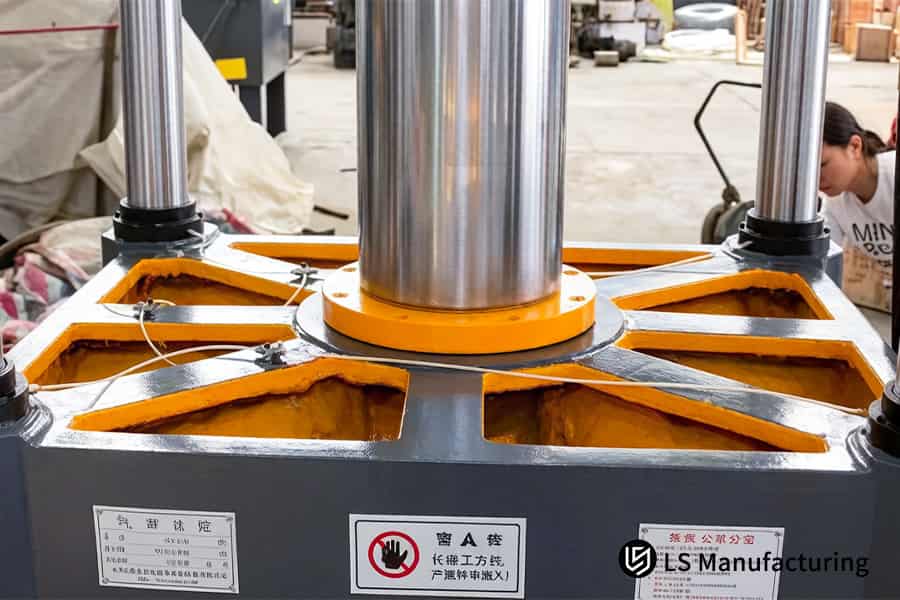
Figure 3: The hydraulic press shapes 5052 aluminum sheet into truck roof panels.
What Quality Metrics Should You Demand From OEM Metal Stamping Solutions Providers?
Objective standards, not mere compliance, are needed to evaluate a manufacturing partner. True quality assurance, for mission-critical components, hinges on process transparency and measurement. The following document lists the quality metrics and reports that a metal stamping manufacturer should produce to substantiate its claims. This document can be used to assess potential partners for challenging OEM metal stamping solutions:
| Quality Dimension | Essential Metric & Reporting Standard |
| Process Capability (SPC) | Provide statistical process control (SPC) charts demonstrating a Cpk ≥ 1.33 across full production runs, proving inherent stability for high-cpk hydroforming. |
| Dimensional Verification | Supply full First Article Inspection (FAI) and periodic in-process reports using CMM data, validating adherence to all critical design tolerances. |
| Material Integrity Validation | Distribution Maps and residual stress analysis reports, key for certified hydroforming performance. |
| Comprehensive Documentation | Deliver a complete Data Package per shipment, including certified material reports, SPC data, and inspection records, evidencing data-driven hydroforming standards. |
This solution ensures that the evaluation of suppliers is moved beyond mere rhetoric to become measurable. This allows us to address the burden of audits that OEMs have to go through since we provide all the required information regarding this in all of our projects. In doing so, we make it clear to our customers that our OEM metal stamping solutions are designed to produce certified products and reduce supply chain risk.
How To Optimize DFM For Custom Metal Stamping Services To Ensure Rapid Prototyping?
Fast and reliable rapid prototyping depends on overcoming manufacturing constraints before beginning tooling operations. The DFM optimization process we use takes care of this need through forming expertise during the design process, converting designs to manufacturable components without requiring multiple iterations. Below are the steps used for our custom metal stamping services:
Early Engagement and Formability Analysis
The evaluation begins during the RFQ phase where we use our proprietary database to analyze essential parameters such as the ratio of forming (LDR), material flow. The pre-emptive analysis highlights problematic geometries that are highly susceptible to wrinkles and tearing and provides opportunities for modification prior to the actual prototype-phase hydroforming.
Geometric Optimization for Fluid Forming
One of the main aspects is designing the shape of the part for compatibility with hydroforming’s even-pressure properties. We direct the changes in certain directions, like enlarging the corners to allow easier movement of the material and avoid thinning. Our DFM-driven hydroforming process guarantees that the part is inherently fit for hydroforming.
Strategic Application of Draw Beads
For complex, asymmetric shapes, we strategically design and position draw beads within the tool. These features control material feed during the forming cycle, managing stretch distribution to eliminate failures. This technique has increased the first-time success rate for challenging prototypes from 60% to over 95%, demonstrating a direct engineering solution for complex-design hydroforming.
Integrated Feedback for Iteration Acceleration
Each cycle produces accurate measurements and strains. In our systematic approach, we incorporate this information into a continuous CAD/CAM simulation process. This facilitates quick adjustments, thus reducing the time needed for developing the product. Consequently, fewer iterations of the prototype need to be created before achieving a final design suitable for manufacturing.
The above approach clearly shows that DFM optimization requires serious, scientific and predictive engineering work. We resolve the issue of long product development time cycles through proactive inclusion of process knowledge and designing for manufacturing while using an iterative process that uses data to close the loop on development activities. Our custom metal stamping services are de-risked in this way to guarantee predictability and fast turnaround in our rapid prototyping services.
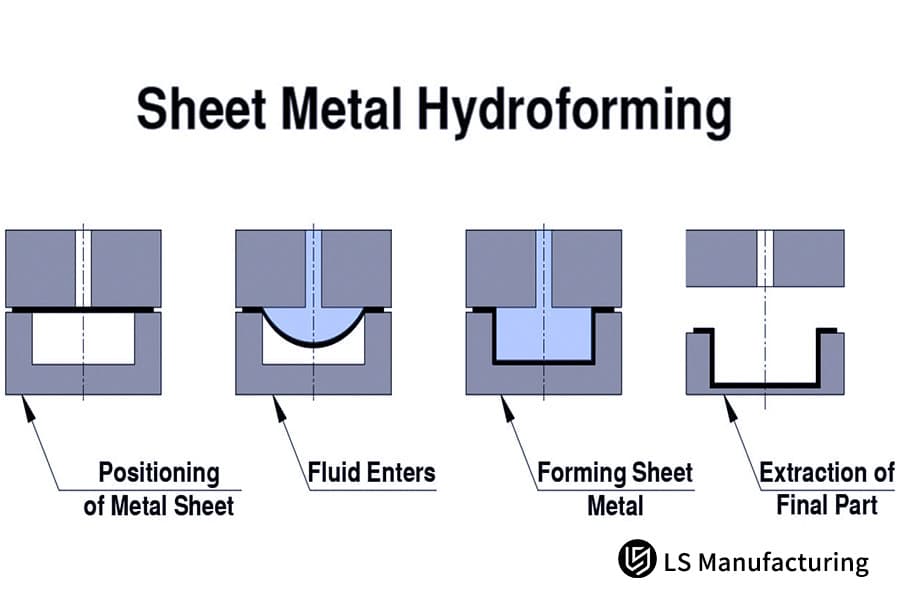
Figure 4: The diagram shows 304 stainless steel sheet being formed into car body panels by hydroforming.
Case Study: LS Manufacturing Automotive Tier-1 Engine Manifold Custom Hydroforming
This is an account of how LS Manufacturing has been able to address a serious issue that arose with a very high performance exhaust system used by the automotive industry. After discovering thermal fatigue issues with our welded construction, we introduced a new custom hydroforming product for the project. In the case below is a description of the problem, our solution, and the results obtained by addressing the engine manifold failure mode.
Client Challenge
The 304L stainless steel exhaust manifold assembly from the Tier-1 supplier repeatedly broke down during thermal fatigue testing to 1050° C due to cracks forming around heat-affected zones (HAZ) of the welds, resulting in a consistent scrappage of 8%. The assembly-dependent metal stamping process was a serious bottleneck to delay the client’s engine platform development, illustrating the inability of high-temperature hydroforming to work under these conditions.
LS Manufacturing Solution
We modified the component for custom hydroforming from stainless steel tubing. The fabrication involved utilizing a pressurized fluid medium to expand the tube inside a precise mold while maintaining the expansion ratio below 1.4, thereby avoiding overthinning. Consequently, there were no welded joints, which meant that the natural presence of HAZ and other stress raisers that led to failure in the initial segmented hydroforming construction was no longer an issue.
Results and Value
The newly engineered hydroformed manifold demonstrated 2000 hours of thermal cycling without any cracks developing. With the removal of welding and subsequent processing operations and scrap, the part price dropped by $12.50. For the customer, this resulted in a yearly savings of more than $250,000.
It proves that we have the ability to resolve basic limitations in manufacturing by means of process engineering. Through changing an assembly-dependent hydroforming process to a precise forming technique, we were able to prove superior benefits in terms of both performance and savings. This highlights the company’s ability to offer solutions that are both technically relevant and valuable for specific automotive industry applications.
To solve thermal fatigue challenges in exhaust manifolds, partner with us for a weld-free hydroforming solution that guarantees durability and cost reduction. Request a performance validation and formal quote.

FAQs
1. What is the main cost benefit of using LS Manufacturing for metal stamping services?
Our primary advantage lies in hydroforming integration, which delivers approximately 30% material savings and 45% lower tooling expenses. This drastically reduces your per-part cost and overall project budget compared to standard stamping methods.
2. How do your OEM hydroforming services handle high-strength materials like DP600 steel?
We precisely control springback in advanced metals like DP600 steel using specialized ultra-high-pressure presses and tailored process parameters. This ensures exceptional dimensional accuracy and structural integrity for critical automotive structural and safety components.
3. Can I reduce OEM part costs by switching from casting to hydroforming?
Yes. Hydroforming produces lighter, stronger single-piece parts that require minimal secondary machining, typically reducing unit costs by over 20% versus castings. This also improves strength-to-weight ratios and overall part performance for your application.
4. What is the typical MOQ for custom metal stamping services at LS Manufacturing?
Our custom hydroforming services support economical production runs from 100 to 50,000 units, enabled by lower tooling costs. This flexible range is ideal for both prototyping and medium-scale manufacturing, optimizing costs for various project volumes.
5. How do you guarantee the quality of your precision hydroforming services?
We guarantee quality through 100% ultrasonic wall-thickness testing and comprehensive CMM inspection reports. This rigorous validation ensures every part meets precise specifications and complies with stringent IATF 16949 automotive quality standards consistently.
6. What design files are needed to receive a quote for OEM metal stamping solutions?
To receive a detailed quote, please submit 3D CAD files in STEP or IGES format. Our engineers will conduct a comprehensive Design for Manufacturability (DFM) analysis and provide a formal proposal with expert feedback within 24 hours.
7. Is cost-effective hydroforming suitable for large-sized components?
Yes. Our high-capacity presses can form large, complex parts up to 2.5 meters in length. This makes the process highly suitable and cost-effective for sizable aerospace structural components, automotive frames, and industrial applications.
8. How quickly can LS Manufacturing start my project?
Upon final design approval, we fabricate tooling and deliver the first batch of production-ready samples within 3-4 weeks. This rapid timeline, about 25% faster than average, significantly accelerates your product’s overall time to market.
Summary
Choosing a metal stamping manufacturer who can process and optimize costs is the need of the hour to survive the competitive industry. Precision hydroforming is a process that saves a lot, increases efficiency by not only increasing part strength by 25% but also reducing molds, optimizing material usage, eliminating secondary welding. LS Manufacturing is backed by technical expertise and data-driven decisions and is a leader in custom manufacturing of complex, high-precision metal components.
Stop spending your budget on traditional manufacturing methods that are inefficient! Why not get a smarter manufacturing solution for your next project? Click the "Get Quote" btn below to submit your 3D models today. Our team of experts will provide a comprehensive Design for Manufacturability (DFM) assessment and a quotation that is highly competitive and based on your specific production volume requirements. Let's work together to use LS Manufacturing's advanced hydroforming technology to give your products a clear competitive advantage!
📞Tel: +86 185 6675 9667
📧Email: info@lsrpf.com
🌐Website: https://lsrpf.com/
Disclaimer
The contents of this page are for informational purposes only. LS Manufacturing services There are no representations or warranties, express or implied, as to the accuracy, completeness or validity of the information. It should not be inferred that a third-party supplier or manufacturer will provide performance parameters, geometric tolerances, specific design characteristics, material quality and type or workmanship through the LS Manufacturing network. It's the buyer's responsibility. Require parts quotation Identify specific requirements for these sections.Please contact us for more information.
LS Manufacturing Team
LS Manufacturing is an industry-leading company. Focus on custom manufacturing solutions. We have over 20 years of experience with over 5,000 customers, and we focus on high precision CNC machining, Sheet metal manufacturing, 3D printing, Injection molding. Metal stamping,and other one-stop manufacturing services.
Our factory is equipped with over 100 state-of-the-art 5-axis machining centers, ISO 9001:2015 certified. We provide fast, efficient and high-quality manufacturing solutions to customers in more than 150 countries around the world. Whether it is small volume production or large-scale customization, we can meet your needs with the fastest delivery within 24 hours. choose LS Manufacturing. This means selection efficiency, quality and professionalism.
To learn more, visit our website:www.lsrpf.com.