English




Custom injection molding service tackles the pain points of the OEM supply chain, where procurement managers who understand the question how does injection molding work still encounter dimensional errors, batch inconsistency, and late reactions. When it comes to precision medical and electrical parts, even the smallest mistake causes expensive delays because the majority of manufacturers do not conduct any mold flow analysis and cannot control CPK levels, thus employing unreliable processes.
With our DFM-based upfront optimization and closed-loop real-time tracking, LS Manufacturing provides complete custom injection molding service. By tackling precision to ±0.01mm through multi-physics simulation of material rheology alongside clear pricing information and mold lifetime management, we can help you to forget about any procurement-related troubles. Discover what LS Manufacturing can do in manufacturing to give you the competitive advantage on the market.
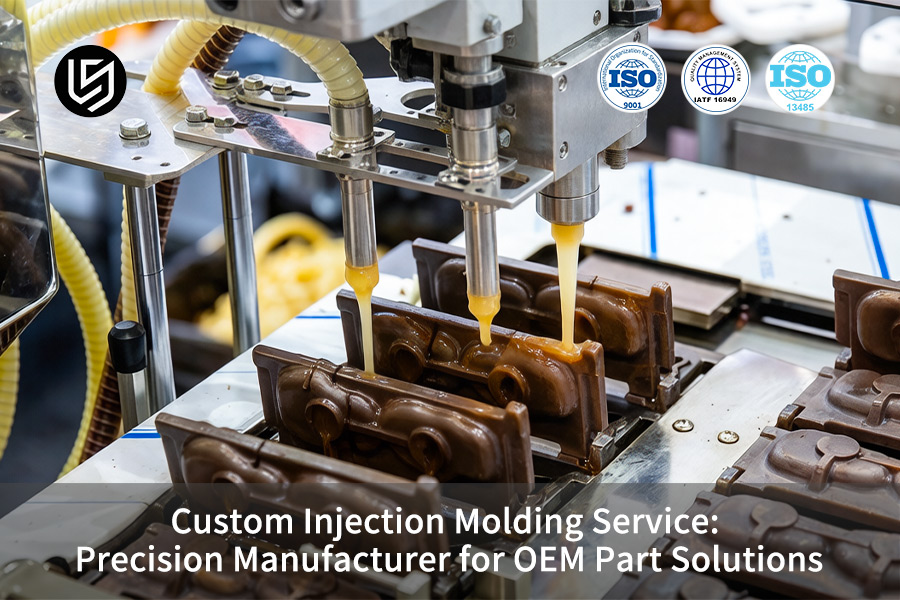
Custom Injection Molding: OEM Solutions Quick-Reference
| Process Stage | OEM Manufacturing Focus | Critical Outcome |
| Mold Design | Optimization of cavities, cycling times, and part ejection. | Durable molds that produce millions of parts consistently. |
| Material Selection | Evaluation of polymer attributes (strength, thermal stability, chemical stability) with respect to part use. | Injection molding parts that will perform effectively in the environment where they will be used. |
| Process Control | Concise control of temperature, pressure, and cooling times in every process cycle. | Consistent dimensional stability with minimal part distortion and repeatable mechanical properties. |
| Automation Integration | Employment of robots to remove parts, cut off sprues, and even mold-label or assemble. | Greater production capability with lower costs for labor and less risk for handling damage. |
| Our Quality Protocol | In-process control and statistical process control (SPC) for critical dimensions. | Highly repeatable part quality to OEM standards with fewer assembly problems. |
| Result: Cost-Effective Volume | Lowest per-piece cost is attained through cycle optimization and high yield rates. | Affordable manufacturing of consumer, automotive, and electronic parts on a massive scale. |
Key Takeaways:
- Volume is Built on Robust Tooling: High-cavitation, durable mold design is the foundation for millions of consistent cycles.
- Material Science is Applied: Selecting the right polymer for the environment is as critical as the injection molding process itself.
- Automation Drives Economics: Robotic integration is key to achieving the lowest sustainable per-part cost and quality.
- Quality is Systemic: In-process SPC and monitoring prevent defects, ensuring parts meet OEM specs from the first shot to the last.
Why Trust This Guide? Practical Experience From LS Manufacturing Experts
Numerous sources about injection molding can be found on the Internet, but the thing which sets our guide apart from others is its practicality, which stems from the experience we gained on the factory floor, rather than in class. We are professionals whose actions cannot afford to lack precision. Everything we do, including the work with sophisticated materials and tooling, adheres to the principles of the Society of Manufacturing Engineers (SME) and International Aerospace Quality Group (IAQG) organizations.
Our competence is gained piece by piece. Whether it is assuring the dimensional stability of the miniature biomedical connector that will have to integrate perfectly with the machine, or the mechanical robustness of an automotive underhood sensor housing, subject to thermal cycling. The more we do, the more we learn – whether it is how to work some specific filled nylon grades so that they do not exhibit any anisotropic tendencies, or how to design a cooling channel, avoiding void formation in a thick section.
The expertise we pass on comes directly from this hands-on experience. We know which steel grade maximizes tool longevity in the case of abrasive-filled composites; we understand when to adjust packing pressures to ensure tight tolerances of ±0.01 mm on a guide rail; we know how to compromise between cycle time and crystallization in the case of PEEK parts.
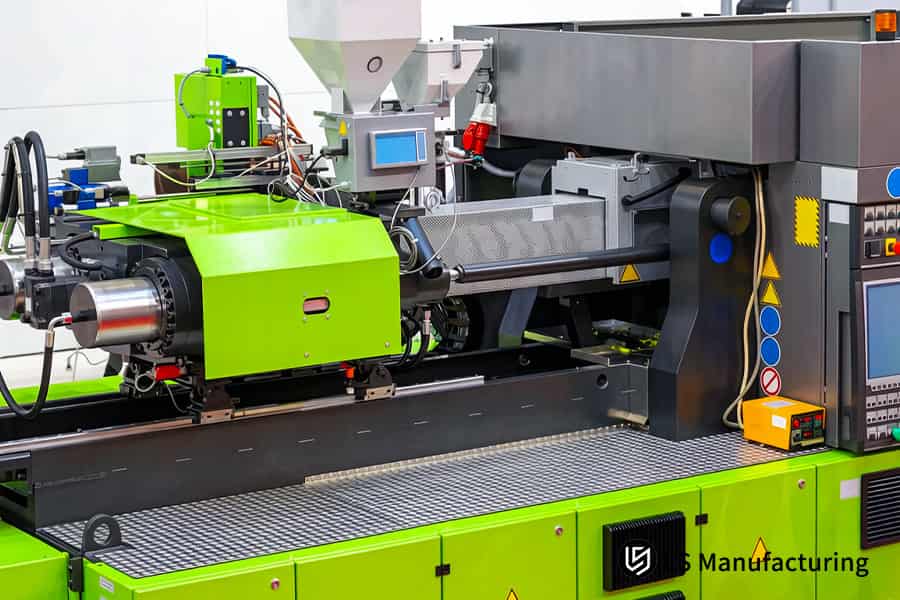
Figure 1: The injection machine processes clear polycarbonate into durable electronic housings with tight tolerances.
Why Is Choosing A Professional Custom Injection Molding Service Critical For Complex OEM Projects?
For complicated OEM work, being able to deliver predictable results and protect the investment you have made requires a proactive approach to solve all manufacturability problems early. This paper explains how our proactive analysis makes it possible for part failures to become manageable processes in manufacture:
Proactive Risk Mitigation via DFM Optimization
In this case, we start the process with an analysis of DFM optimization of your 3D model, where we can detect all possible manufacturability obstacles. Using simulations of materials' flow, we will make necessary adjustments such as equalization of walls' thickness to avoid having to change anything in the molds later.
System Engineering for Consistent Results
The entire melting and heat transfer mechanism is designed based on efficiency. With an analysis, we determine the gate positions and the precise injection molding process parameters to ensure balanced filling and production. This is important for ensuring the tolerance required for OEM precision parts.
Precision Processing for Final Compliance
Compliance for the final product is guaranteed through optimizing each stage of the process according to the characteristics of the material. We adjust the packing profile and cooling process to manage crystallization and shrinkage and focus on dimensions. This careful management of the injection molding cycle time and processing parameters is the main reason for cost saving.
The above points clearly show that our custom injection molding service stand out since we turn engineering anticipation into guaranteed success. Our methodology, illustrated with practical technical procedures, offers a risk-free path for difficult projects that require reliability throughout the entire chain from designing to the delivery of perfect tight-tolerance injection molding parts.

How Can Precision Injection Molding For OEM Ensure Zero Defect Delivery For High Precision Parts?
Achieving defect-free transport of mission-critical parts is ensured through micro-repeatability, at the level of performing the procedure millions of times. The problem herein is that of reducing variations so that exact dimensions and functions can be assured. Below is a technical solution to this problem:
Engineered Process Stability via a Closed-Loop Control System
The starting point in our technique towards high accuracy molding is ensuring the stability of the process through the use of deterministic closed-loop injection molding.
- Core Mechanism: Using a hydraulic servo valve to control both injection speed and injection holding pressure.
- Key Implementation: By moving from open loop techniques to closed loop techniques involving pressure transducers that make error correction in under two milliseconds.
- Solved Challenge: It solves the problem of packing pressure drift in the industry, leading to variability in part size and weight.
Real-Time Process Interrogation with a Multi-Point Sensor Network
The in-mold data is the only measure of part quality that truly counts. The in-mold sensor injection molding technique employs piezoelectric sensors placed strategically within the mold.
- Data Acquisition: Every single sensor produces its unique pressure profile with a rate of 1000 Hz, creating a unique digital signature for every cavity.
- Actionable Insight: The system recognizes subtle variances in the position of the flow front, which is an indication that a void or a short shot is forming.
- Enabler for Standards: This detailed, cavity-wise data stream is used to determine and sustain CPK standards higher than 1.33.
Proactive Compensation Through Dynamic Pressure Profile Adjustment
Process monitoring is not enough; corrective action must follow. We use adaptive-process injection molding algorithms.
- Decision Logic: If there are indications from pressure readings that the variance is outside the 0.5% range, the controller will make the required compensation adjustments for the next cycle.
- Case Example: For the production of microfluidic chip, the approach constantly compensated for viscosity differences in the regrind material, and maintained a tolerance of the channel depth to within ±5 microns.
From Data to Demonstrable Quality: The Closed-Loop Quality Record
In every production cycle, there will be validation data records created; thus, quality control is not just sampling but rather completely digitized.
- Deliverable: There is an output document in each batch showing the actual pressure curve vs. master curve, and all autonomous interventions made in production.
- Client Value: For OEMs involved in precision injection molding for OEM projects, this is the documentation of process control proving that there are no defects.
This concept exceeds traditional molding because validation and correction become part of the processing itself. This occurs through a combination of technical processes whereby the sensors feed information to the control process, which adjusts the processing, all of which is recorded in a completely traceable manner. Our solution for zero-defect injection molding is here explained as our response to the core issue of how we turn an uncertain process into a certain one.
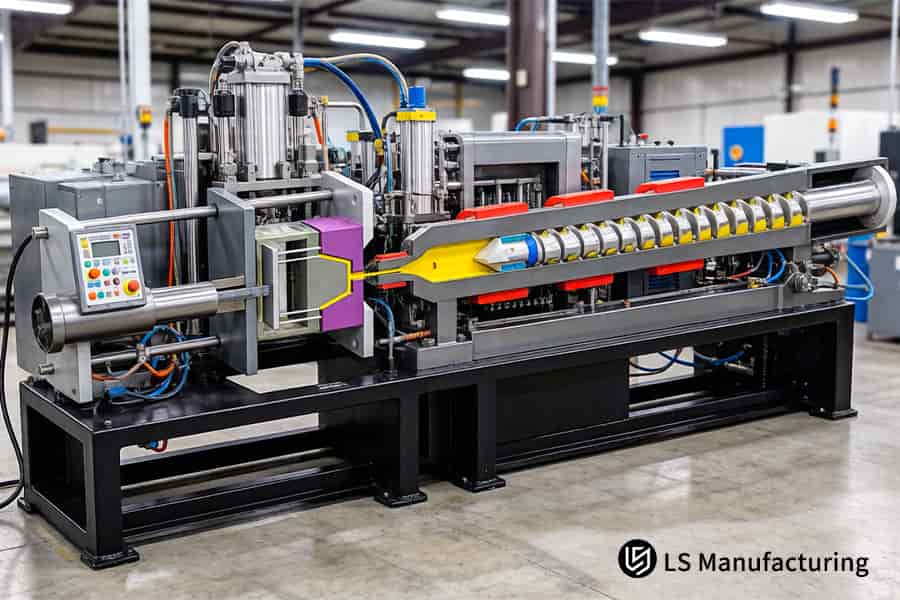
Figure 2: The hydraulic press injects HDPE into precision molds to form consumer goods components with 0.01mm tolerance.
What Strategies Does LS Manufacturing Use To Optimize Material Utilization In Custom Plastic Injection Molding?
Cost for materials is one of the main things to consider in getting a competitive quote. In cases where custom plastic injection molding becomes a must, it does not just become necessary to save money, but even for engineering considerations. Below is a list of techniques in engineering that can be considered when making a change towards material efficiency, thus decreasing costs in production.
| Strategy | Technical Implementation | Quantified Outcome |
| Eliminating Runner Waste | Implementing hot runner with a hot runner injection molding system, ensuring the material remains molten in the feed passages. | Avoids up to 15-30% of wasted material as no solidified sprue and runner occur. |
| Ensuring Cavity Consistency | Implementing balanced-fill injection molding with hot runners, optimizing with CFD analysis. | Prevents any material waste because the cavities will always remain balanced while filling them. |
| Optimizing Part Weight | Implementing scientific molding technique with reduced hold time, combined with precision-clamping injection molding. | Keeps tolerance limit below 0.5% for the weight of the parts. |
| Providing Financial Justification | Conducting a strict Total Cost of Ownership (TCO) study, comparing the cost of the project with total savings throughout the process. | Typically guarantees full return on investment of premium products within 12 to 18 months. Relevant for mid-range to high volume production. |
From the diagram above, it is clear that our solution strategy targets the core issue of minimizing unit production cost, which when solved would allow us to address the problem. Our firm gives our clients scientific methods of improving material efficiency rather than making vague promises. Partner with us to optimize your entire molding system for material efficiency and fast ROI. Contact us to schedule a manufacturing audit and receive a strategic proposal.
Why Is LS Manufacturing Recognized As A Top Tier OEM Injection Molding Service Provider Globally?
The prestige associated with being viewed as experts in the field of OEM injection molding service by many people worldwide comes from meeting three main challenges. They include handling advanced materials, micron tolerance, and process precision. The uniqueness of our firm compared to other firms is that we focus on how we can solve the problem using our engineering capabilities instead of focusing on certifications and equipment.
Conquering Advanced Material Inconsistency
This is what will be discussed in this research paper regarding the issue of natural inconsistency in high performance plastics such as PEEK. With the help of advanced-material injection molding, we are able to gain consistency by using hard tooling, custom screw and closed loop heat controls in each area to create stable melts. We do this to avoid deterioration, ensuring that our products retain high-quality standards.
Guaranteeing Precision in Complex Geometries
To maintain tolerance control during manufacturing of components that have intricate designs, it is imperative to have a manufacturing procedure that cannot be affected by anything. Besides using all-electric presses, we ensure high precision injection molding using cavity pressure control techniques in combination with conformal cooling and inline CMM inspection.
Systematizing Quality for Zero-Defect Output
Certification is the bare minimum. Being capable of managing the system actively is the hallmark of the fully qualified supplier. Our full-vertical injection molding approach utilizes Advanced Process Control software that automatically maintains the parameter settings. The digital lineage for each batch of components includes everything - starting from the material batch used to the inspection process.
Accelerating Development with Production-Fidelity
Our company ensures that gaps between prototypes and production are bridged using an integrated-system injection molding design approach. Our tools are developed to support production-ready systems from the outset, and we have a range of machines that make scaling easy while utilizing the same tools throughout. We help OEMs expedite market readiness through our high-end manufacturer.
The cooperation itself is founded upon a scientific methodology that eliminates any variance from the manufacturing process. It should be noted that we are confident that material science, sensor-controlled process monitoring, and quality assurance management will guarantee the consistency and reliability of the entire cycle of our product development process towards large-scale production. Thus, we have a strong basis for our global reputation in the technical sphere.
How Does A Precision Custom Molding Manufacturer Reduce Lead Time For Mission Critical Components?
For a precision custom molding manufacturer, having a short lead time for complex parts is essential for its competitiveness. The biggest problem for this industry is to shorten the long process that takes place in a sequence of designing molds and qualifying the process. This report describes a well-designed engineering methodology that ensures reducing development time by 40-50% through effective tooling design, manufacturing, and process discipline:
Strategic Tooling Design for Manufacturability and Durability
The first step in our process of minimizing lead time begins at the very beginning of our product life cycle design process.
- Material Selection Logic: Using pre-hardened steel mold materials such as S136 is one of the strategies implemented. No further hardening is required in this case; therefore, the machining process begins immediately after receiving the material.
- Design for Machinability: Our preferred design would be that which will fit into 5-axis machining technology and avoid the need for complex EDM operations. This is vital for meeting the objective of mold-in-one-week injection molding for the most intricate part molds.
Vertical Integration of High-Speed Mold Fabrication
The control of production resources is vital in ensuring minimum critical path. Our state-of-the-art machine shop facility is crucial to this end.
- Simultaneous Machining: Several 5-axis CNC machines work concurrently on different mold parts.
- Integrated Finishing: Using our own equipment for finishing guarantees seamless operation without any issues related to logistics. Vertical integration is key to a high-availability injection molding production line.
Process Optimization via SMED and Pre-Validation
The mold is considered qualified and not developed after pre-preparation and standardization.
- SMED Implementation: Standardized clamps, runners, and connections are incorporated into all molds to allow quick-turn mold making and changeover, minimizing machine idle time from hours to mere minutes.
- Process Pre-Setting: Parameters are pre-simulated using past experience from previous molds to optimize the trial run, resulting in a production-capable component within the first few shots.
The resolution of the lead time issue lies in the implementation of parallelism and predictability in all stages of the manufacturing process. Our resolution leads to the creation of a short lead time not by speed, but rather because there is no waiting at all thanks to clever materials, vertical integration, and optimization of the processes. In this way, our precision custom molding manufacturer becomes an accelerant that helps our customers attain predictable, technical lead times in delivering key parts.
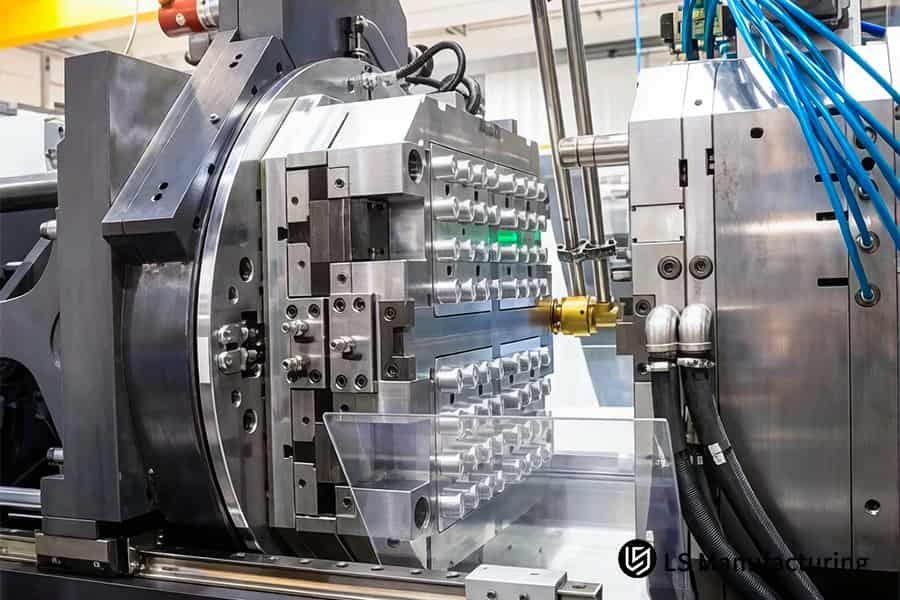
Figure 3: The complex 24-cavity mold with cooling channels forms precise components from engineered polymer for automotive applications.
What Technical Factors Drive The Structural Integrity Of High Performance Injection Molded OEM Parts?
The durability of injection molded OEM parts lies in their ability to retain structural integrity, which can be undermined due to various weaknesses present within them. Below, we will discuss a process that takes care of potential reasons for failure in advance.
| Challenge | Solution | Outcome |
| Stress Concentrations | FEA simulation of designs to identify and deal with any stress concentration points, such as adding radii and ribs. | Avoids any part failures and usually increases the lifespan of parts by more than 30% relative to designs without simulations. |
| Uncontrolled Fiber Orientation | Adopting a process-controlled approach using optimal gating strategy for alignment of fibers with primary stresses while filling. | Yields improved anisotropy, with structural strength of up to 40% higher in directional loads. |
| Weak Weld Lines | The use of weld-line-managed injection molding technique through flow simulation and thermal optimization. | Cures material fragility in high-stress locations. |
| Gas Traps and Voids | Vent-optimized injection molding using multi-physics modeling to design a cavity ventilation system for complete gas evacuation. | Prevents defects causing failure and guarantees 100% part density and mechanical strength. |
This technology addresses the underlying issue of inconsistent component performance by designing integrity into the component itself. We ensure certainty by proactively controlling internal geometry and removing defects using simulations and molding techniques. Thus we turn the uncertainty surrounding injection molded OEM parts into certainty, giving you the technological confidence needed for mission critical applications.
How Can Custom Molding Solutions Simplify Your Assembly Process Through Structural Integration?
Assembly is primarily about dealing with complexities in terms of multiple parts, many fasteners, and accumulated tolerances that affect reliability and cost. This paper explains the benefits of our custom molding solutions by integrating multiple pieces into one piece with diverse capabilities. The outcome is improved product reliability, quality, and assembly efficiency:
Design for Manufacture (DFM) Guided Part Consolidation
The first phase involves analyzing the whole sub-assembly and identifying only those parts that function for structure and attachment purposes. In the collaborative DFM meetings, the whole assembly system is transformed into a single complex shape featuring snaps, living hinges, and bosses molded right away. No screws, adhesives, and alignment devices will be required anymore; thus, fewer costs will be incurred.
Ensuring Robust Material and Mechanical Bonds
Another important aspect is creating robust and durable joints both mechanically and material-wise. For multi-material injection molding, polymers with high compatibility in chemical and thermal aspects are employed. Regarding insert molding, geometrical designs that feature undercuts and holes that facilitate the locking of plastic onto metal or ceramic inserts are considered. The challenge of poor joints is therefore mitigated.
Precision Process Control in Multi-Stage Molding
Process precision is required when it comes to part integration. In terms of overmolding, we achieve precise control over the temperature of the mold and the speed of injection to allow the ideal attachment between the substrate and overmold layers without any compromise on the materials employed. Two-shot injection molding is a typical application of the mentioned process control wherein robotics are employed to ensure insert or substrate positioning before the second injection phase.
Mold Engineering for Complex, Integrated Geometries
For the construction of a unified part design, the designs for molds should be done in a manner that allows the creation of a form that incorporates undercuts and internal shapes. Such an operation forms an essential component of the complex-geometry injection molding process, which can only be accomplished using structural-component injection molding.
The issue of assembly complexity is addressed by the process of integrating different components into one efficient component using current technologies like insert molding. This method increases the quality and assembly efficiency process directly due to its simplicity. This method definitely provides us with a competitive advantage since we can provide more than just manufacturing parts.
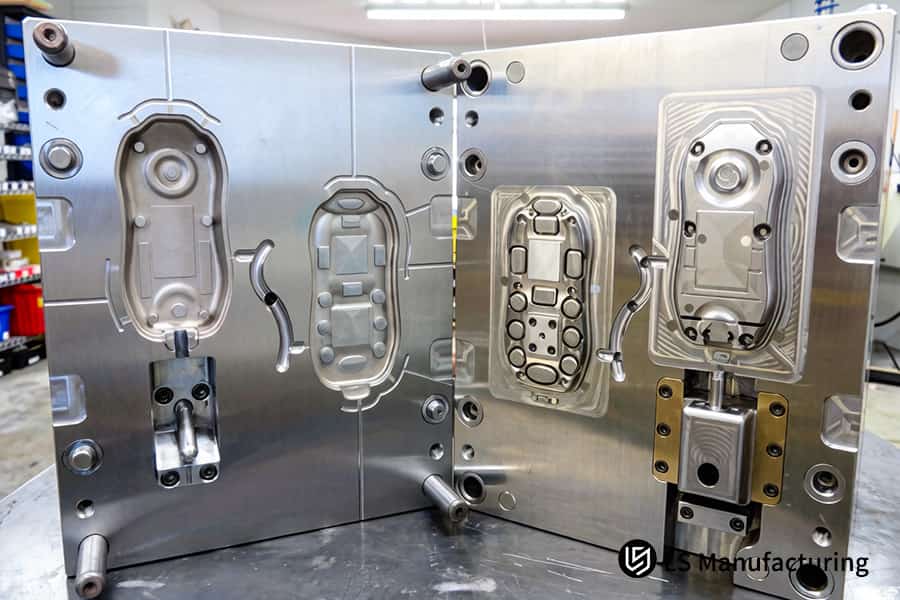
Figure 4: The precision steel mold with four cavities forms medical device parts from clear polycarbonate sheet.
Case Study: LS Manufacturing Medical Industry Precision PEEK Valve Custom Injection Molding
LS Manufacturing case study is about how our group was able to solve an urgent manufacturing problem on the fabrication of a medical device component. Specifically, we were able to find a custom solution in the PEEK injection molding of a valve body, which could not be manufactured before due to its high precision requirement.
Client Challenge
A global company that is a manufacturer of medical devices had trouble in producing a valve body using PEEK at high temperature with an important dimensional tolerance of ±0.010mm resulting in a high scrap percentage of 25%. The use of the traditional method of high-temperature injection molding resulted in non-uniform shrinkage and consequently dimensional tolerance.
LS Manufacturing Solution
A precision-valve injection molding approach based on scientific molding was designed. A unique cascading temperature control system, which ensured a precise temperature range of 300°C to 320°C, was incorporated in the mold in order to accommodate the extreme thermal behavior of PEEK. Moldflow analysis was used to accurately predict anisotropic shrinkage, which enabled the creation of molds with compensated geometry, along with the optimization of a multi-step injection procedure.
Results and Value
The custom solution that was employed delivered revolutionary results, with part yield increasing from 75% to 99.7%. The crucial bore diameter was maintained with ±0.008mm tolerance, surpassing the initial requirements. By implementing a PEEK injection molding process, without any scrap material, the actual price per part was cut down by 22%. With regard to process stability, the manufacturer was able to generate reliable, traceable information necessary for FDA clinical trials.
This is an example of our systematic and data-oriented approach that addresses challenging material and precision requirements typical of medical device. By going beyond traditional methodologies towards a first principles engineering solution, we provide more than components but also a process that is stable, validated and cost-effective. This ability is key to our cooperation in high risk areas where product performance must be guaranteed.
Achieve FDA-ready traceability and 22% cost reduction with our precision PEEK molding. Share your valve specifications to receive a feasibility study and a compliance-focused quotation.

Why Do Engineers Prefer Our High Precision Injection Molding For Complex Micro Electronics?
The relentless drive for miniaturization in micro electronics imposes extreme manufacturing demands: achieving micron-level accuracy in sub-millimeter features, reliably filling ultra-thin sections, and ensuring material integrity for sensitive components. This document details how our high precision injection molding methodology solves these specific, interconnected problems to enable reliable, high-yield production of complex micro-parts:
Mastering Micro-Feature Replication and Dimensional Stability
The problem here lies in the creation of the smallest geometric shapes such as pins, connectors, and cavities.
- Solution: We employ micro-feature injection molding with specific machine techniques.
- Technical Approach: Utilization of the high speed of injection and vacuum molding helps us attain complete filling and accurate reproductions of even the smallest features (down to 0.1mm).
- Problem Solved: This allows us to overcome the issue of having short shots in micro-molding and predict the shrinkage rate in interconnects precisely.
Ensuring Complete Filling and Structural Integrity in Thin Walls
The thin-wall molding process causes major flow and packing issues that create weaknesses in the parts.
- Solution: We develop a thin-wall optimized injection molding process using sophisticated controls.
- Technical Approach: Our process employs a high pressure high speed injection and accurate variotherm mold temperature control to ensure proper flow.
- Problem Solved: This results in complete filling and sufficient packing pressures, even for cavities as thin as 0.3mm to prevent voids and achieve proper strength.
Selecting and Processing Specialized Functional Materials
There may be requirements for specific materials that do not meet the standards of ordinary resins in electronics applications.
- Solution: We provide assistance with high-flow material molding and material science.
- Technical Approach: We offer specialized polymers, such as dissipative types, as well as optimize their processes based on their unusual flow characteristics.
- Problem Solved: Gate freeze-off is avoided, color/conductivity consistency is ensured, and parts that satisfy mechanical as well as functional requirements are created.
Implementing Microscopic, 100% Dimensional Verification
Traditional sampling methods are inadequate for components where a difference of one micron can mean the difference between success and failure.
- Solution: Microscopic-inspection injection molding quality control is implemented as a matter of course.
- Technical Approach: A full First Article Inspection (FAI) with 100% inspection of critical dimensions is conducted with optical measuring equipment at magnification.
- Problem Solved: This achieves dimensionally correct certification of each production run, without any possibility of escapees, and meets the requirements of high reliability operations.
We address the core issues associated with filling, forming and verification in micro manufacturing. The solution involves special equipment, materials knowledge, and ultra precise measurements to convert complex micro electronic designs into reliable and cost-effective production runs. We provide comprehensive control over the entire high precision injection molding process so that complexity does not preclude quality and manufacturability for micro electronics customers.
FAQs
1. What is the typical lead time for a custom injection molding service project at LS Manufacturing?
Leveraging our in-house mold fabrication, we deliver first-article samples within 15–20 business days. Mass production then commences within one week of your approval, ensuring a rapid and reliable transition to full-scale manufacturing for your schedule.
2. How do you maintain tolerance in precision injection molding for OEM?
We achieve consistent ±0.01mm tolerances using RJG closed-loop control for real-time pressure and temperature adjustments. This precise system ensures critical dimensions are maintained throughout the entire high-volume production run.
3. Can you help with material selection for custom plastic injection molding?
Yes. Our engineering team provides expert material selection from over 500 engineering-grade resins, analyzing your specific needs for mechanical strength, thermal/chemical resistance, color matching, and compliance with industry regulations to ensure optimal part performance and longevity.
4. What is the MOQ for your OEM injection molding service?
We support highly flexible production volumes, from small-batch prototyping starting at 500 units to fully automated mass production exceeding one million parts. Our scalable processes efficiently accommodate your project's entire lifecycle from design validation to full commercial launch.
5. Why should I choose LS Manufacturing as my precision custom molding manufacturer?
Choose us for our partnership approach, which includes complimentary DFM analysis and a full-lifecycle mold warranty. This strategy is designed to minimize your long-term Total Cost of Ownership and ensure reliable, high-quality production from initial concept through final delivery.
6. Do you offer post-processing for injection molded OEM parts?
Yes. We provide a complete suite of post-processing services, including ultrasonic welding, screen printing, vacuum metallization (PVD), and precision assembly. This delivers fully finished, ready-to-integrate components directly to your production line, streamlining your supply chain.
7. How do your custom molding solutions protect my Intellectual Property (IP)?
We protect your IP with strictly enforced NDAs, by storing all design data on physically isolated secure servers, and by assigning unique digital tracking tags to each mold for complete lifecycle control and access management.
8. How can I get a quote for high-precision injection molding today?
Upload your 3D files (STEP/IGES) via our secure portal for a detailed quote and comprehensive manufacturability (DFM) analysis within 24 hours. Our team provides a complete cost breakdown and project feasibility assessment to launch your work promptly.
Summary
In today’s competitive OEM landscape, choosing a custom injection molding partner that offers both technical depth and predictable results is key to success. LS Manufacturing leverages high-precision molding, transparent data-driven processes, and expert DFM intervention to eliminate hurdles from design to mass production. As our case studies show, we enhance part performance and reduce cost through process innovation—keeping your products ahead in medical, automotive, and electronics sectors.
Stop tolerating inconsistent quality and late deliveries. Contact LS Manufacturing for your tailored manufacturing roadmap. Click “Get Instant Quote” to upload your 3D files for a free DFM assessment. We guarantee a precise cost estimate and an optimization report within 24 hours—making your precision parts manufacturing safe, reliable, and efficient.
📞Tel: +86 185 6675 9667
📧Email: info@lsrpf.com
🌐Website: https://lsrpf.com/
Disclaimer
The contents of this page are for informational purposes only. LS Manufacturing services There are no representations or warranties, express or implied, as to the accuracy, completeness or validity of the information. It should not be inferred that a third-party supplier or manufacturer will provide performance parameters, geometric tolerances, specific design characteristics, material quality and type or workmanship through the LS Manufacturing network. It's the buyer's responsibility. Require parts quotation Identify specific requirements for these sections.Please contact us for more information.
LS Manufacturing Team
LS Manufacturing is an industry-leading company. Focus on custom manufacturing solutions. We have over 20 years of experience with over 5,000 customers, and we focus on high precision CNC machining, Sheet metal manufacturing, 3D printing, Injection molding. Metal stamping,and other one-stop manufacturing services.
Our factory is equipped with over 100 state-of-the-art 5-axis machining centers, ISO 9001:2015 certified. We provide fast, efficient and high-quality manufacturing solutions to customers in more than 150 countries around the world. Whether it is small volume production or large-scale customization, we can meet your needs with the fastest delivery within 24 hours. choose LS Manufacturing. This means selection efficiency, quality and professionalism.
To learn more, visit our website:www.lsrpf.com.