English




Precision metal bending is a central process in precision metal components production for low to medium batch. It helps solve many pain points of the buyer who would move from prototype into mass production, by reducing the upfront investment and offering a faster delivery time. Many buyers, once having moved away from prototype would experience delay on mass production order due to heavy mold pricing or parts warping due to thermal stress resulting from wrong process choice.
This guide will tell you: bending for few components batches, and stamping for high ones, but this misses how much your long-term ROI will be seriously impacted by your ability to control material springback and feature complexity. In this paper, we will go into detail on technical benefits of the precision metal bending and provide a cost accounting formula based on internal measured data of LS Manufacturing, assisting you to find an optimal combination of cost and technical feasibility. You will see how the custom metal bending service is used to arrive at a more competitive manufacturing solution through key metrics and real life examples in the below series.
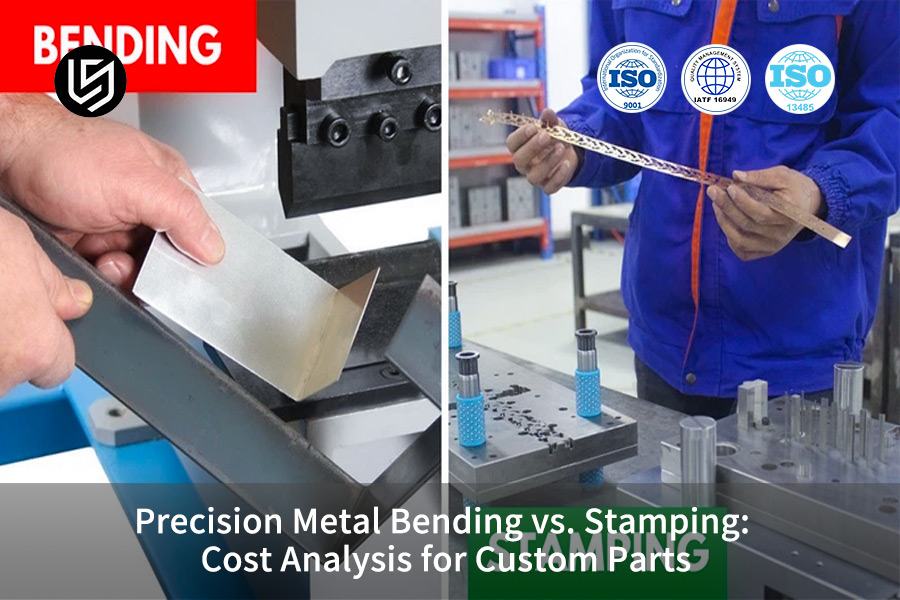
Precision Metal Bending Core Answers Overview
| Core Dimensions | Precision Metal Bending Key Data | Advantages Compared to Stamping | Applicable Scenarios |
| Die Cost | ≤2500 pieces: Saves 65% on initial investment | No need for large die design and manufacturing costs | Small to medium batch (1-5000 pieces) |
| Precision Control | Tolerance stable within ±0.15mm | Real-time compensation, low cumulative tolerance | Medical, aerospace parts |
| Delivery Cycle | Delivery within as short as 12 days | Eliminates die manufacturing cycle | Parts with rapid design changes |
| Cost Control | Optimized unit cost can be reduced by 22% | Supports zero-cost dimensional fine-tuning | Customized complex parts |
Key Takeaways
- Die Cost: When the number of parts is less than 2500, our multi axes bend can save up to 65% on initial investment than stamping.
- Precision Control: The bending tolerance is kept stable at 0.15mm under the real-time angle compensation to reach the precision requirement of medical, aerospace, and other related parts.
- Decision-Making Criteria: If feature spacing <2p or complex 3D stretching is needed, stamping,otherwise bending is cheaper.
How Does LS Manufacturing's Custom Metal Bending Service Achieve Cost-Effectiveness?
We have been in the metal bending area more than 20 years, we know the buyers' "cost reduction, high quality, high efficiency" needs. Tested that, multi axis bending process for 4mm thickness 6061-T6 aluminum alloy parts, the investment of the mold savings 65% and the delivery time shorten 73% than stamping.
But many customer still choose stamping at first without considering the pressure of small batch molds. All cost-effectiveness boils down to two things: flexible production, avoiding costly special tooling while enabling short run production of 1-5000 pieces following ISO 13920:2023 and end-to-end process optimization.
As part of an aerospace project, a bending sequence optimization saved 20% working time, savings of 15% on scrap-metric utilization, and these metal bending cost savings. Our industry acknowledged cost control has carried us to the publish ASTM B117-21 salt spray test for resistance to corrosion, avoiding rework costs and employing our own formula to current customers' advantage as a prediction of costs.
By selecting our custom metal bending service, customers can save the risks from mold lines, yet receive continuous, precision machining quality, which would be very suitable for the less-than and medium batch productions of customized parts.
For a quick calculation of your part bending costs, contact our engineers for a free cost assessment report and unlock customized cost reduction solutions.

Why Is Precision Metal Bending Often More Cost-Effective Than Stamping In High Precision Demand?
Precision metal bending removes the costly mold design & manufacturing cycle. So, decreasing the initial NRE investment by 80+ percent on production runs of 1-5000 pieces, with a high repeatability accuracy of +/- 0.005'', that means increasing the return on investment in high-precision, short-cycle products, that tend to iterate quickly.
Detail Cost Comparison on Bending and Stamping
Bending cost mainly come from the existing machine and the tool manufacture.
In the stage of production design, if the costs of stamping are higher than bending, then bending would a preferable choice. Cost variations of two methods lies on the initial investment for plant and its modifications.
| Production Batch (pieces) | Precision Metal Bending Total Cost (USD) | Stamping Total Cost (USD) | Cost Difference (USD) | Percentage of Cost Advantage for Bending |
| 500 | 1200 | 3500 | 2300 | 65.7% |
| 1500 | 2800 | 5200 | 2400 | 46.2% |
| 3000 | 5100 | 6800 | 1700 | 25.0% |
| 5000 | 8200 | 7900 | -300 | -3.8% |
For small lot sizes less than 3,000 pieces, precision metal bending has a cost advantage, while for large lot sizes over 5,000 pieces, the unit costs favor stamping, dimensional adjustments incurred after stamping involve mold repair costs of $1,000 to $5 000 whereas precision metal bending incurs zero-cost adjustment, which is the reason for higher profitability margins.
How Multi-Axis Bending Reduces Cumulative Tolerance Risk
The main pain point for high-precision parts is that one would go over the cumulative tolerance range. We put into effect the technological benefits of our 5-axis bending centre like:
- Shorter Clamping Time: multi-angle bending of 5-axisbending center can be performed on one clamping, and the clamping times is reduced from 4-6 to 1-2. So it can prevent the clamping error, which is absolute difficult to be occurred in custom partstamping processing.
- Real-time angle compensation: using a high-precision grating scale and hydraulic compensation system, real-time compensation for material internal stress changes occurred in angle errors, so the tolerance remains maintained at 0.15mm.
- Precise Calibration of Neutral Layer Factor: using the SolidWorks module simulated-neutral layer K-factor for different materials is accurate calibration, during bending without dimensional deviation, is in particular applicable to processing special alloy.
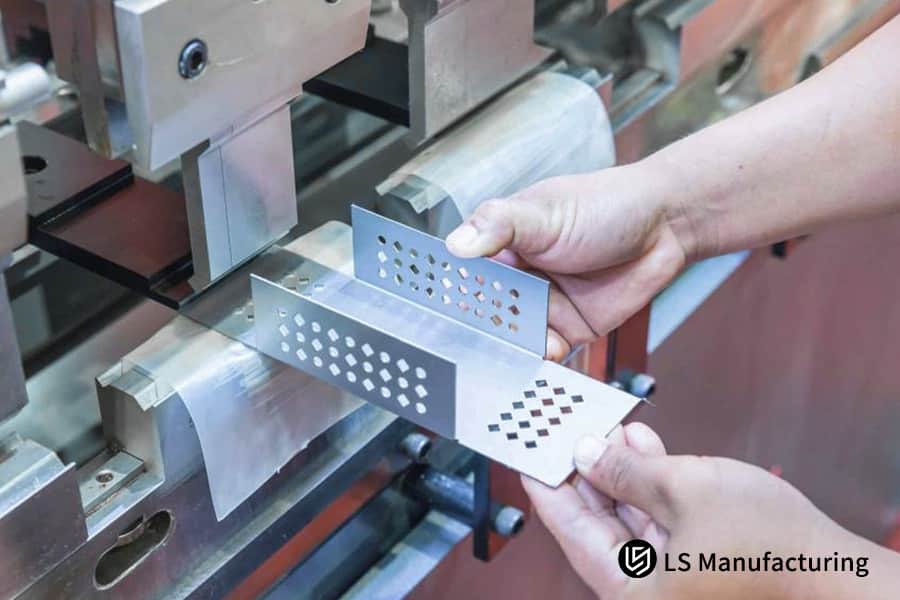
Figure 1: Worker operating a precision metal bending press on a factory floor.
How Does Bending Technology Overcome Stamping Limits in Custom Parts Metal Bending?
Custom parts metal bending when using segmented dies can attain ultra-have from edge bending and reverse flatten which otherwise is difficult by stamping process. In additional, this feature is also needed for heavy parts with thickness > 6mm because of inflexibility of the stamping dies.
Advantages of Bending in High-Strength Material Processing
Stamping these high-strength materials, SUS316L stainless steel and aluminum, used for aerospace was leading to crack and burr. Our high precision bending service will completely eliminate this kind of problem. Specific data is as follows:
| Material Type | Material Thickness (mm) | Precision Metal Bending | Stamping | Bending Advantages |
| SUS316L Stainless Steel | 8 | 0.3% | 8.7% | No cracks, smooth edges |
| Aerospace-grade Aluminum | 6 | 0.2% | 6.2% | No material thinning, stable precision |
| 6061-T6 Aluminum Alloy | 4 | 0.2% | 30% | Uniform stress release, flatness meets standards |
Our Springback Compensation Model is capable of predicting the springback in advance and This way enabling us to avoid several hallmark stamping failures like cracking, thinning etc. While working on an aerospace project, we found that 8mm thick SUS316L parts could be bent instead of stamped, and at the same time lowered the rework cost by 96%.
A Non-Consensus Insight into the Impact of Material Crystal Orientation on Bending Accuracy
Many suppliers have failed to consider crystal orientation of the material which largely affects the accuracy of bend, resulting in the inconsistencies that we have found. Our practical know-how is:
- Parallel Bending: Metals have various crystal porientations. Parallel bending is characterized as having good toughness, low springback and good stability of the accuracy, which can used on 6061-T6 aluminum alloys and can avoid breakage, this important point is usually ignored when bending high precision parts.
- Crystal Orientation Inspection: Conduct crystal orientation inspection to the material before process.The bending direction and angle would be adjusted per the inspection result to make sure no deviation would occur and reach the standard. Thanks to this, our bending accuracy is higher than the average level.
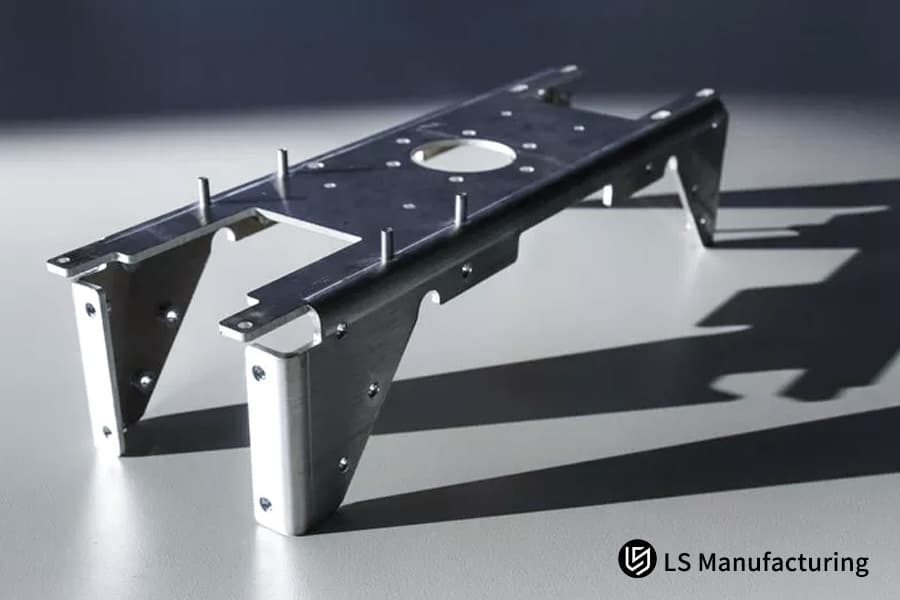
Figure 2: A finished, complex-shaped metal part with holes and notches, produced by custom bending.
Does Your Supplier Have The Ability To Control The Core Variable Accounting Of Metal Bending Cost?
The main method which companies use to control their metal bending cost requires them to decrease bending work through DFM optimization while they should increase their manufacturing output through their automated systems. Most customers believe that "the lower the unit price, the more cost-effective", it is which leads them to overlook the actual expenses that come from processing materials and generating waste.
LS Manufacturing Exclusive Cost Calculation Formula Analysis
We present an exclusive formula for calculating metal bending cost which enables our clients to determine complete expenses while identifying all hidden costs.
The formula Total Cost = S + (Op × R × Q) establishes the total cost calculation method.
The program setup fee which ranges from S to S150 represents S while customers pay for operations through the hourly rate of R which costs S65 and they will receive Q units. Our primary method for controlling expenses depends on two factors which include decreasing operational needs and expanding production quantity.
The DFM optimization process resulted in a custom part's bending procedure being cut down from six required steps to four necessary steps. The total cost for 1000 units dropped from $3200 to $2300 which resulted in a 28% decrease in cost per unit. The method for bending cost control cannot produce this specific outcome.
Two Core Measures to Reduce Metal Bending Cost
We achieve metal bending cost reduction through complete process optimization. The organization has established specific methods which include:
- Optimizing the Bending Sequence: Rationally planning the bending sequence reduces clamping and the number of operations, which leads to a 20% reduction in working hours and decreases labor expenses while preventing inefficient work activities from occurring.
- Improve scrap utilization: The layout utilizes cut and nesting overlap with high accuracy which results in a scrap rate utilization that exceeds 85% while most factories achieve between 60% and 70%. For 4mm thick, 100mm wide carbon steel, this is a saving of $300 per thousand.
How To Choose The Processing Technology Based On Annual Demand When Comparing Bending vs Stamping?
The bending vs stamping of the steel crosses are roughly tapered at 3000-5000pcs. For electronic items where the design changes rapidly, bending has the advantage over stamping, there are no costs of scrapped moulds and this way savings to the customer.
Bending vs Stamping Core Parameter Comparison
The following internal test comparison table helps you quickly determine the suitable scenarios for the two processes:
| Comparison Parameters | Precision Metal Bending | Stamping | Advantageous Process (by Batch) |
| Delivery Cycle (days) | 12-20 | 30-45 | ≤5000 pieces: Bending |
| Part Consistency | ±0.15mm | ±0.10mm | ≥5000 pieces: Stamping |
| Die Maintenance Cost (USD/Year) | 500-800 | 3000-5000 | ≤5000 pieces: Bending |
| Design Change Cost (USD) | 0 | 1000-5000 | Fast Design Changes: Bending |
| Unit Cost (USD/Piece) | 2.5-5.0 | 1.2-2.0 | ≥5000 pieces: Stamping |
Process Selection Logic for Annual Demand Requirements
The following results comparison shows different annual demand requirements together with their corresponding process selection recommendations.
- Precision metal needs to serve as the production material for all manufacturing activities when the annual production volume reaches 3000 pieces or less. Bending offers a cost advantage over stamping small batch production because it eliminates mold costs while handling design modifications.
- Production requires basic components to use stamping while advanced components need bending because they require frequent design updates.
- Stamping becomes the most cost-effective production method when annual demand reaches 5000 pieces because it enables companies to produce standardized products with only necessary slight changes. The manufacturer needs to know the mold payback period before they can start production.
The selection process requires organizations to find a balance between operational expenses and operational capabilities. Cost waste and delivery delays result from choosing the wrong production method. You can download our "2026 Metal Forming Process ROI Comparison White Paper" to find detailed selection guidance for your annual demand requirements.
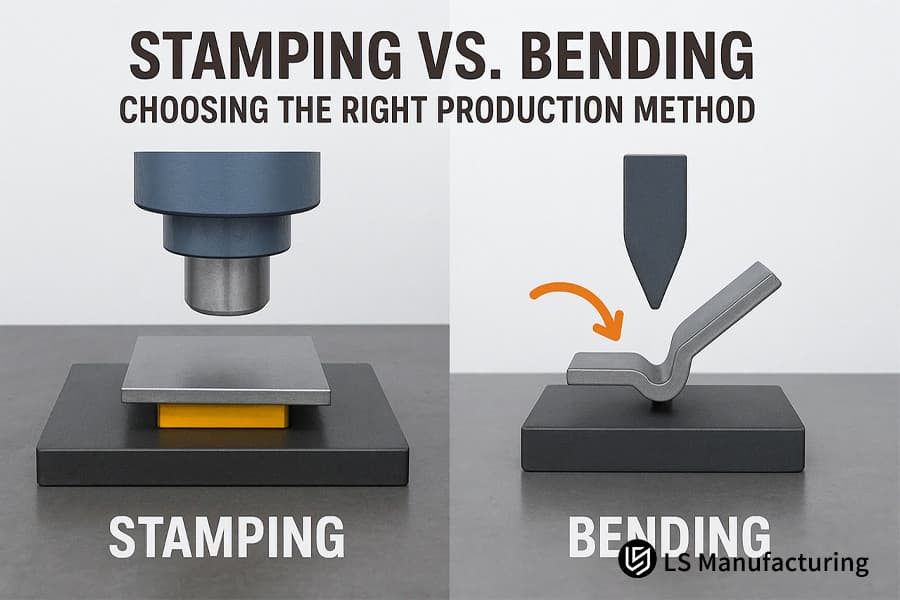
Figure 3: Diagram comparing stamping and bending processes for manufacturing method selection.
What Value-Added Services Are Included in Bending Cost for Custom Parts?
The bending cost for custom parts quotation includes processing fees and 100% First Inspection Report (FAI) assessment of crucial dimensions and online angle monitoring and non-marking bending protection methods.
Detailed Explanation of Core Hidden Value-Added Services
The complete process of our bending cost for custom parts quote includes value-added services which we provide at no additional charge.
- 100% First Inspection Report (FAI): The Zeiss CMM in Germany provides precise measurement capabilities which produce an inspection report that meets ISO 2768-m standards for the first piece of each batch.
- Online Angle Monitoring: The system provides continuous angle change tracking during the bending process. The system uses automatic compensation to correct any angle deviation which enables all parts to stay within the angle tolerance range of ±0.15mm and thus removes the necessity for customer re-inspection.
- Scratch-Free Bending Protection Process: The use of polymer gaskets creates a protective barrier that prevents mold indentations from reaching medical devices and high-end electronic components and exterior parts which must remain free from any surface scratches to meet high-end product surface inspection requirements.
Practical Application of Scratch-Free Bending Technology
The process of manufacturing medical devices becomes impossible when their exterior parts develop scratches. Our scratch-free bending technology provides an effective solution for this issue. The practical process is as follows:
- Choose a compatible polymer gasket which protects against friction damage for the specific part material.
- The gasket requires surface bonding which should not interfere with the bending process so adjust the mold pressure and speed accordingly.
- Clean and inspect after bending to ensure the surface is free of scratches and indentations, achieving a 100% pass rate.
Why is LS Manufacturing’s Multi-Axis Solution Best for Complex Custom Metal Bending Service?
LS Manufacturing has developed an advanced 7-axis CNC electro-hydraulic servo bending system which enables operators to execute multi-angle compound bending operations from a single start point. This innovation delivers better custom metal bending service while enabling factories to create complex custom components.
Dual Guarantee of Hardware Strength and Software Simulation
Our multi-axis bending solution is the optimal solution because of the dual guarantee of hardware and software, with the following specific advantages:
- Advanced Hardware Equipment: A 500-ton-class 7-axis bending system can stably handle 20mm thick carbon steel and 12mm thick stainless steel custom parts, with a processing range and precision far exceeding traditional bending machines.
- Professional Software Simulation: Interference checks are performed using a SolidWorks plugin before cutting, preventing 100% of the collision risk, avoiding part damage and die wear. The software enables users to simulate the bending process which enables them to forecast springback effects while adjusting bending parameters.
Advantages of Precise Calibration of Neutral Layer Factor (K-factor)
Accurate bending of complex custom parts requires precise measurement of the neutral layer factor (K-factor) because this measurement enables accurate bending results. Different materials and thicknesses have different K-factors, inaccurate calibration will lead to dimensional deviations.
Our organization has developed a complete material database which we used to determine the K-factor of various materials which meets accuracy standards. Internal testing shows that after precise calibration, the bending dimensional deviation is ≤±0.05mm, better than the industry average level.
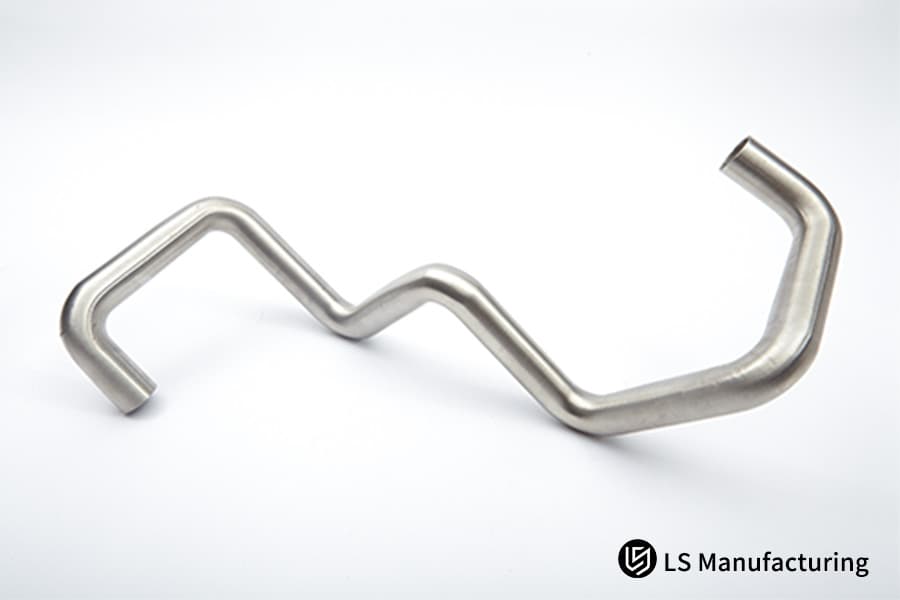
Figure 4: A stainless steel part with multiple smooth, complex bends, highlighting advanced bending capability.
LS Manufacturing Customer Case: Solving The Bending And Deformation Problem Of 5G Base Station Bracket For a Certain Aviation Communication Enterprise
The complex custom bending parts are easy to be deformed. After a lot of research work, we find that the deformation problem of thick and high strength parts is difficult to be solved with stamping.
But our high precision bending service can be achieved through the technology optimization. The case below show the solving of the deformation problem of 5G base station brackets for the aviation and communications corporation.
Customer Challenges
The 5G base station bracket for the company was made from 4mm thick 6061-T6 Aluminum alloy, with flatness which tolerates to 0.5mm and an annual demand rate of 2,000.
The initial stamping solution encountered 2 significant issues:
- An excessive flatness of 30% parts remained after heat treatment, resulting in poor defect rate.
- The week long delivery cycle of up to 45 days of progressive die led to project stagnation.
The customer contacted multiple service providers without success and ultimately chose us, hoping to solve the problem using the precision metal bending process.
LS Manufacturing Solution
The analysis discovered that the fundamental reasons for deformation occurred because stamping construction had insufficient rigidity and stress release happened without control. The company switched to a high precision bending service after testing stamping which produced the following results.
- Laser Online Angle Compensation Technology: The CNC system uses a high-precision laser angle meter that provides real-time monitoring to correct springback deformation which causes bending deformation.
- Stepped Stress Relief Process: Bending starts after stepped annealing has released internal stress while low-temperature aging maintains stable dimensions which prevent excessive flatness.
- Optimized Bending Sequence and Parameters: SolidWorks plug-in simulation optimization reduced the number of processes from 6 to 4 and precise K-factor calibration ensured accuracy.
Results and Value
The client received substantial advantages after solution implementation which resulted in the following benefits.
- The flatness deviation rate decreased from 30% to below 0.2% which reduced rework costs by $5,000 per month and the production pass rate reached 99.8%.
- The company achieved significant cost savings through mold repair expenses which amounted to $3,000 with monthly costs for repairs and unit cost decreased by 22% which resulted in yearly savings of about $10,560.
- The delivery cycle experienced a reduction from 45 days down to 12 days which allowed the company to handle urgent delivery requests while preventing project losses.
- The client established a long-term partnership which resulted in them giving all future custom parts orders to us because they were highly satisfied with our services leading to annual business worth over $500,000.
This case fully proved that our high-precision bending service is feasible for complex custom part bending deform solution can be efficiently helping the customers to save the cost, enhance quality and get higher efficiency.If you also face similar parts processing challenges, please view our complete case details and contact our technical experts for customized solutions.

What 3 Standards Must Be Verified When Selecting a Metal Bending Service Supplier?
The metal bending service requires evaluation of three factors which include automated programming capacity and real-time compensation system and dedicated material process database. The three criteria establish the degree of bending precision which impacts operational efficiency and total expenses.
Detailed Explanation of the Three Core Technical Standards
The following standards enable purchasing engineers to assess supplier performance because they help engineers verify vendor compliance with their purchase requirements.
- Automated Programming Capabilities: The supplier must possess automated programming software and professional engineers capable of importing drawings to automatically generate and optimize programs, shortening processing time. This is critical in bending service supplier selection. Our system can reduce programming time by 60% with 100% accuracy.
- Real-time Compensation System: The bending machine must be equipped with a high-precision linear scale and hydraulic compensation system to compensate for internal stress fluctuations in real time. Our equipment can stabilize tolerances within ±0.15mm.
- Specific Material Process Database: The supplier must possess process data for materials such as titanium alloys and aerospace-grade aluminum, enabling rapid matching of optimal parameters. With over 20 years of experience and a comprehensive database, we can handle various complex materials.
Supplier Screening Checklist
The following checklist can be used directly to verify supplier qualifications:
- Do you have SPC data to prove mass production stability? Can you provide accuracy reports for the past 3 months?
- Is your mold library comprehensive? Can you support small radius bending (R≤0.5T)?
- Do you provide DFM reports to proactively optimize part structures and reduce metal bending costs?
- Can you provide processing cases for similar complex, high-precision parts?
- Can you provide DFM assessment and quotation within 24 hours?
FAQs
Q1: How is that your bending accuracy can be 0.1mm, while normal factory is only 0.5mm?
LS Manufacturing uses CNC bending machines equipped with high-precision grating rulers and hydraulic compensation systems, which can real-time offset the angle error caused by internal stress fluctuations in materials, and accurately calibrate the neutral layer coefficient to ensure accuracy far beyond ordinary factories.
Q2: 50 bending features in my part, is it better to blank it or to bend?
For many features with high density, Stamping has a big benefit on one-time forming. If the annual order quantity is less than 1000 sets, the amortized mold cost of stamping will make the unit price not acceptable.You should contact LS Manufacturing to do process breakdown and optimize to get the best cost.
Q3: Aluminum alloy 6061 can be broken in bend. How do the LS Manufacturing do?
Because we take strict control of the minimum bending radius ( R 1.5T) and the elasticity, employing para-gravimetric bending and the local annealing, it results in 90-degree accurate forming without influences on the mechanical properties of the aluminum. The bending breakage is end up.
Q4: Will mold creases formed upon bending be visible on the anodised surface?
Not at all.We use a type of film and mold that do not have scratches on the surface of exterior parts and totally meet the surface inspection standards of high-end consumer electronic products and medical products, does not affect next dyeing and other surface treatments.
Q5: What is the highest bending thickness you are capable of?
We have a 500 ton bending center, which can consistently for custom parts with carbon steel at 20 mm thick and stainless steel at 12mm thick, keep perpendicularity tolerance for the thick part and satisfy the heavy-duty parts process.
Q6: Why does the price of a bent parts varied form batch to batch?
Raw material cost changes and batch order quantity mainly affect this. For example, LS Manufacturing has the sliding fee.The more batch order quantity is, the lower cost per die change will be, so the metal bending cost is more cost efficient. And it offsets unit price change effectively.
Q7: DBM do free DFM(Design for Manufacturing) assessment for bend parts?
Yes. After you submit the drawings, our senior engineers will do analysis for you and offer some optimization recommendations to drive down manufacturing difficulty and cost like combine two or more bending surfaces, optimize cut way, etc. free of charge.
Q8: Will you send me inspection report (SGS / TUV) for third-party after the order is finished?
Of course, we put the strict ISO quality management system in place. All shipped parts will pack with material certificate and CMM dimension inspection report from Zeiss. If you also want the third-party test reports, please tell us in advance. We will do our best to assist.
Summary
Deciding between Precision Metal Bending and stamping is a trade-off of high initial capital investment versus low unit cost, once the equipment is purchased. For small to medium run jobs of medium-to-high accuracy custom parts that need fast iteration, our multi axis bending technology is the ideal solution.
Using DFM optimization and total process quality assurance, we guarantee perfect part assembly. Don't allow uncertain manufacturing planning to delay your project.
Seeking the best offer? Send us your Step/Dwg drawings at this moment and the experienced team of LS Manufacturing will deliver you free DFM study as well as quotation report within 24 hrs.
Not convinced on the costs yet? Get in touch with our engineers so they can provide you with the "2026 Metal Forming Process ROI Comparison White Paper" for the best possible market data support.
[Click to initiate inquiry now - schedule a 1-on-1 technical expert consultation]
📞Tel: +86 185 6675 9667
📧Email: info@lsrpf.com
🌐Website: https://lsrpf.com/
Disclaimer
The contents of this page are for informational purposes only. LS Manufacturing services There are no representations or warranties, express or implied, as to the accuracy, completeness or validity of the information. It should not be inferred that a third-party supplier or manufacturer will provide performance parameters, geometric tolerances, specific design characteristics, material quality and type or workmanship through the LS Manufacturing network. It's the buyer's responsibility. Require parts quotation Identify specific requirements for these sections.Please contact us for more information.
LS Manufacturing Team
LS Manufacturing is an industry-leading company. Focus on custom manufacturing solutions. We have over 20 years of experience with over 5,000 customers, and we focus on high precision CNC machining, Sheet metal manufacturing, 3D printing, Injection molding. Metal stamping,and other one-stop manufacturing services.
Our factory is equipped with over 100 state-of-the-art 5-axis machining centers, ISO 9001:2015 certified. We provide fast, efficient and high-quality manufacturing solutions to customers in more than 150 countries around the world. Whether it is small volume production or large-scale customization, we can meet your needs with the fastest delivery within 24 hours. choose LS Manufacturing. This means selection efficiency, quality and professionalism.
To learn more, visit our website:www.lsrpf.com.