English



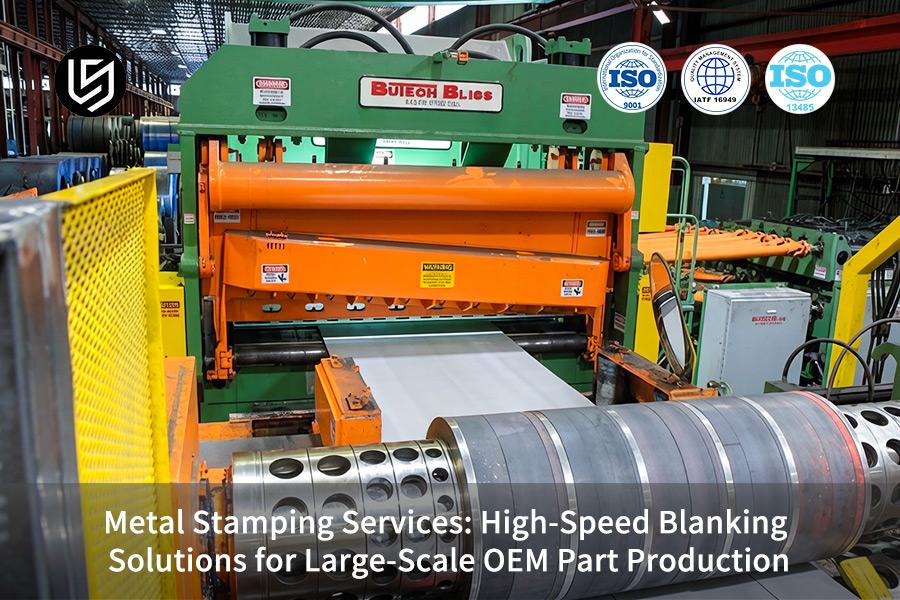
Metal stamping services are becoming indispensable to modern manufacturing processes, however, the OEMs experience shortcomings when adopting the conventional approaches. As such, in their efforts to discover what is blanking, they come up empty-handed, neglecting the high unit costs due to low stroke per minute (SPM) when undertaking mass production. This is because the precision level of the molds is not sufficient enough to cope with heat deformations at high speeds; moreover, it becomes difficult to strike the balance between the material utilization and stamping speed.
We overcome these problems by coupling the high speed blanking solutions with precision metal stamping services, leveraging multi-station progressive dies and dynamic monitoring to ensure that we achieve ±0.02mm tolerance in addition to minimizing the production cost at million level. We further discuss technical aspects, cost management and practical experiences in the subsequent chapters below.
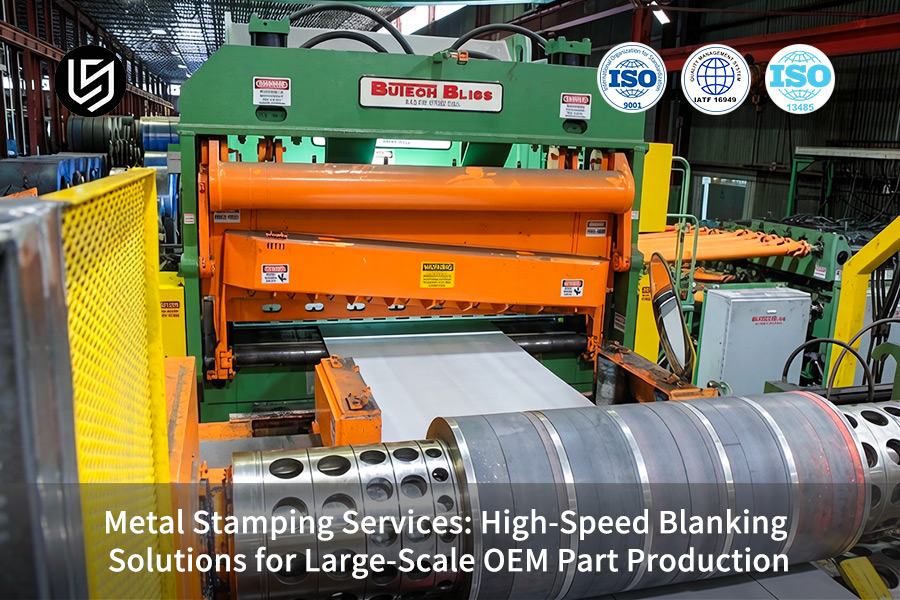
Metal Stamping: High-Speed Blanking Quick-Reference
| Key Parameter | Technical Solution for Large-Scale Production | Production Benefit |
| Press Speed & Tonnage | We utilize high-speed mechanical presses (600-1500 SPM) with precise tonnage control. | Optimizes throughput while delivering superior part consistency in high-speed operation. |
| Die Design & Durability | Utilization of progressive dies made from hardened tool steel with built-in wear sensors. | Enhances tool longevity, minimizes downtime, and ensures dimensional integrity even after millions of cycles. |
| Material Feeding & Coil Handling | Integration of automatic servo feeders and coil cradles to ensure accurate material feeding. | Avoids feeding mistakes, limits waste, and allows uninterrupted operations. |
| Part Ejection & Scrap Management | Synchronizes automated part conveyor systems with scrap shredding in the press line. | Preserves an open die area, avoids part damage, and facilitates material recycling. |
| Our In-Process Quality Control | Use of vision-based inspection systems and load detectors for real-time analysis. | Identifies issues immediately and stops producing entire batches of defective parts. |
| Result: Lowest Cost Per Part | Converges maximum speed, minimal waste, and minimal downtime for optimal cost per piece. | Reaches necessary economies of scale to deliver competitive OEM pricing on parts. |
| Result: Just-in-Time Production Reliability | Steady production aligns perfectly with lean OEM production schedules. | It gives you a reliable supply of parts that will fit seamlessly into your production schedule. |
We provide the solution to the problem of large-scale production for OEM stamped parts. High-speed blanking machines enable you to produce large quantities of parts consistently and at an affordable price. You can be sure that your parts will not only conform to all quality requirements, but they will also be able to withstand production pressures while being assembled with ease.
Why Trust This Guide? Practical Experience From LS Manufacturing Experts
The number of writings about metal forming is innumerable; however, this writing is different since our experience with metal stamping services stems from actual combat on a production floor dealing with tough alloys in tough conditions. Unlike the others who merely talk about the procedure, we use our rich and practical experience to meet all the performance and safety requirements of our customers in tough industrial sectors.
This writing seeks to solve real production challenges through our integration of high speed blanking solutions and metal stamping services. Through our state-of-the-art die making and live monitoring systems, we deliver our products within ±0.02mm tolerances with high SPM, directly addressing the two major problems of cost and quality in mass production. Our methodology is based on both Robotic Industries Association standards and Machine Design concepts.
With more than 15 years of accumulated experience in manufacturing parts in the aerospace and medical device industries, our team learned that a single mistake can lead to a catastrophic result, especially when working with highly accurate components. It taught us what techniques to apply depending on the type of material and how to find the right balance between efficiency and strict quality standards for mass orders.
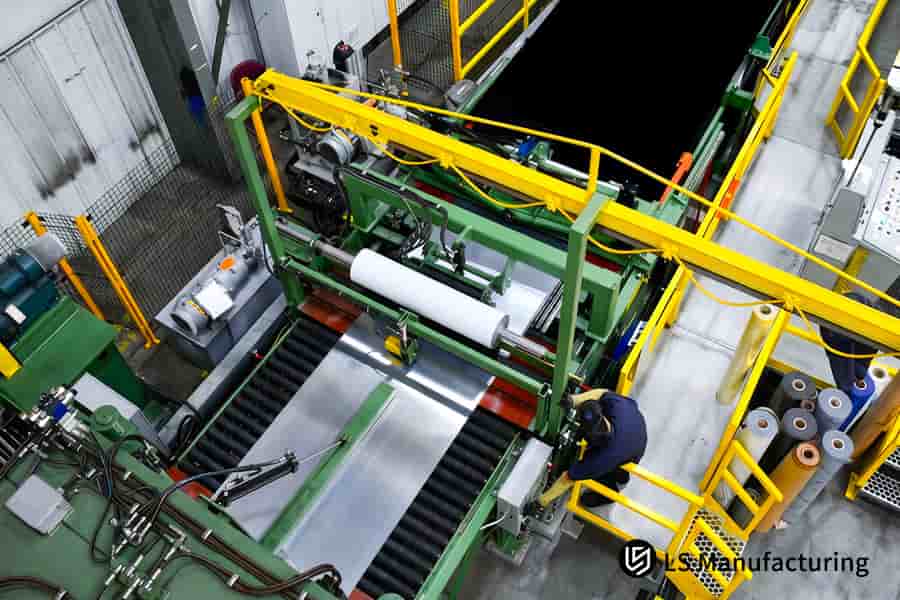
Figure 1: An operator monitors the blanking machine processing 5052 aluminum sheet for large scale electronic component manufacturing.
Why Choose LS Manufacturing As Your Professional Metal Stamping Services Partner?
Our company attracts leading OEMs due to its ability to fundamentally mitigate risks and speed up innovation. Our unique approach lies in combining our expertise in deep stamping engineering with the ability to produce in large volumes, translating innovative ideas into practical products. Our key value proposition lies in proactively collaborating on technical issues and providing predictable performance.
Concurrent Engineering for Design Optimization
Our engagement takes place in the design phase in order to prevent any manufacturing issues that may arise in terms of cost and other constraints. Through the potential provided by formability simulation technology, we provide thorough evaluation of material flow, stress analysis, and spring-back evaluation for complex geometries. This collaborative effort allows us to optimize critical part properties and ensure successful high-volume precision blanking, turning potential roadblocks into a smooth manufacturing process prior to tooling.
Expertise in Advanced Material Forming
The partnership we offer features specialty expertise in working difficult materials such as advanced high strength steels (AHSS) and lightweight alloys. Metal stamping services include carefully controlled metal stamping processes that account for material thinning and spring-back using tonnage profiling techniques. Such engineering ensures optimal part performance which is key to demanding blanking applications.
Scalable, High-Availability Production Execution
It should be noted that the reliability of your program will be provided by our strong manufacturing capacity. Press lines starting from 125 tons up to 600 tons are operated automatically and provide us with around-the-clock production of custom blanking solutions with process controls to guarantee constant flow and punctuality. This, in turn, highlights our role as your professional metal stamping partner.
In this document, the idea of forming a business partnership in terms of problem solving rather than production capabilities is proposed. The key aspect of our company's work is in our ability to solve the most complicated questions arising during working with automated blnking process – from material science breakthroughs to mass production solutions. As such, we work for you as an extended part of your organization under technical management.

How Can High Speed Blanking Solutions Significantly Reduce Your Unit Cost?
Traditional methods of blanking volume parts come with limitations of speed and wastage, creating a limitation in terms of costs that such a process can generate. By using our advanced high speed blanking solutions, we ensure optimization of stroke-per-minute and efficient use of material, focusing on the two main cost factors of production of parts, namely time and material. The outcome is significant unit cost reduction:
Maximizing Press Output and Asset Utilization
- Operational Tempo: As compared to traditional blanking processes (30-60 SPM), our process of high speed blanking increases the rate of production per press to 300-500 SPM, which results in lowered machine hour per part costs.
- High Volume Production Efficiency: With such a rhythm of operation, our fixed cost becomes a positive factor for us as it leads to superior economies of scale and fast lead times for massive projects.
Diluting Tooling Amortization Through Volume Velocity
- Amortization Strategy: Costs related to precise progressive dies in stamping tooling are distributed over a much larger number of parts in a substantially reduced timeframe.
- Technical Enabler: Ultra-high-speed presses paired with strong tool steel along with coatings facilitate tight-tolerance operations at maximum speed, which guarantees that savings on tooling costs per part will definitely be more than 35%, according to tested results.
Precision Feed Technology for Optimal Material Yield
- Waste Minimization: Highly accurate and tightly controlled servo feeding provides micron accuracy feed advancement, making waste minimal in the skeleton of the part.
- Cost Impact: Accurate feeding is an absolute requirement for our high-speed precision blanking process. It is capable of minimizing scrap loss under 5% in raw materials like high-carbon steel, hence lowering raw material costs per unit.
This scenario definitely demonstrates how our cost advantage is intentional and not accidental, based on the strategic combination of extremely fast presses, durable precision metal stamping dies, and servo-driven feeds. In essence, we provide you with the means for achieving a cost advantage through our process and its execution, setting the standard for complex blanking applications.
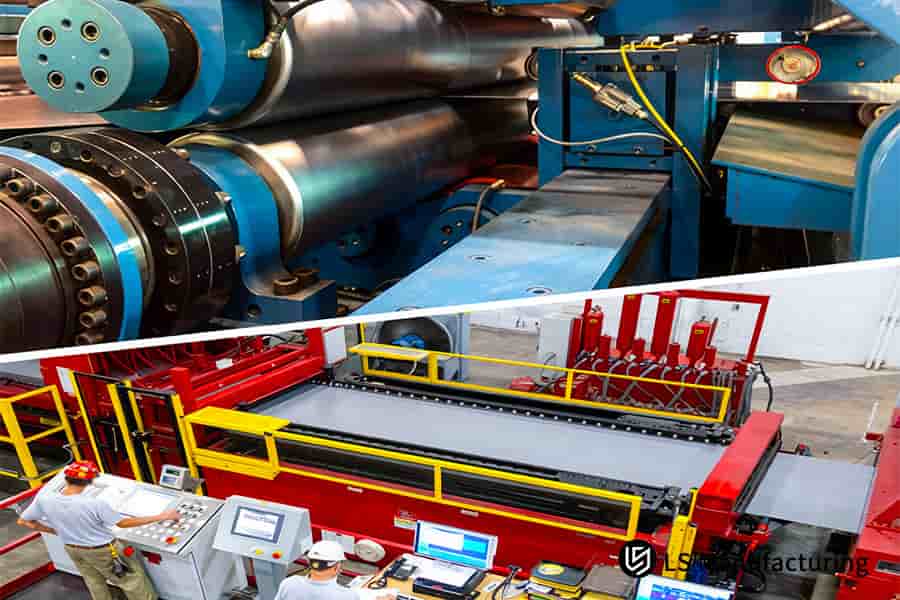
Figure 2: Engineers inspect freshly blanked 316L stainless steel sheets for critical aerospace component applications in the factory.
What Technical Factors Ensure Precision Metal Stamping Services In Large Scale OEM Production?
Micron-level accuracy over millions of repetitions is the technical challenge that needs to be addressed when large scale OEM metal stamping. There are two factors responsible for variation in dimensions caused by thermal and dynamic deflections, which negatively impact the uniformity and fit of the parts. This paper describes our approach towards controlling technical parameters.
| Technical Factor | Core Function & Solution | Quantifiable Outcome |
| Dynamic Bottom Dead Center (BDC) Control | Feedback from real-time linear scales with servo adjustment corrects press deflections. | Holds forming depth to within ±0.01mm in consistent high-precision progressive stamping. |
| Active Die Temperature Management | Multi-zone cooling channels managed by thermal model predictions adjust tool growth. | Ensures die temperature stability (±3°C) through more than 500,000 cycles, avoiding dimensional changes. |
| Multi-Physics Simulation (FEA/CFD) | Stamping cycle virtual modeling allows for optimizing cooling and predicting thermal expansion. | Avoids more than 90% of potential failures due to temperature in complex precision metal stamping tools. |
| In-Process Monitoring & SPC | Automated laser gauging in-process verifies parts against OEM specifications. | Enables real-time SPC data (Cp/Cpk) for certified precision metal stamping services. |
Precision metal stamping services for large scale OEM metal stamping are sustained by actively managing critical technical parameters. We solve the core problems of unit cost escalation and quality risk by preventing dimensional drift through predictive simulation and closed-loop process controls. This engineered methodology ensures part-to-part consistency, establishing the technical authority required for mission-critical blanking applications.
Why Is Custom Metal Stamping For OEM Projects More Reliable With DFM Analysis?
The greatest danger to any project reliability and budget usually comes from an unmanufacturable design. In cases where we provide custom metal stamping for OEM projects, we carry out a DFM analysis in order to detect and address any manufacturability constraint in the early stages of manufacturing. This helps us transform theoretical designs into reliable products:
Optimizing Material Utilization and Grain Direction
Our engineers consider the part geometry to suggest optimal orientations of parts that will maximize the use of the coil materials. Importantly, our process entails orienting the forming bends parallel to the grain direction of the material to avoid cracking of the part. This advanced preparation done at the prototype blanking stage helps reduce waste and failure rates and lowers costs associated with raw materials.
Specifying Precision Clearance for Material Hardening
Die clearance specifications are calculated based on exact material grade and thickness used. For high-strength materials, a higher clearance value reduces work hardening and galling in the shearing area. This precise calculation done through the stamping DFM analysis process helps achieve clean cuts and preserve the cutting edge, thereby laying a basis for long tool life during demanding metal stamping operations.
Designing for Formability and Tool Protection
We optimize problematic design elements, such as the presence of sharp corners or insufficient radii, which cause material tears or require unstable, easily damaged tools. Using radius increases or providing relief notches, we ensure smooth metal flow and avoid any potential problem in the complex structural stamping process that could result in early tool failure.
Our DFM analysis offers a distinct reliability edge. We mitigate production issues such as poor consistency, increased scrap rate, or tool failure through effective engineering at the design phase itself. It is only through this approach that we can consider our custom metal stamping for OEM partner by ensuring mold life optimization beyond one million cycles. Submit your OEM stamping design for a DFM analysis that prevents tool failure, controls cost, and ensures reliable production of over one million cycles.
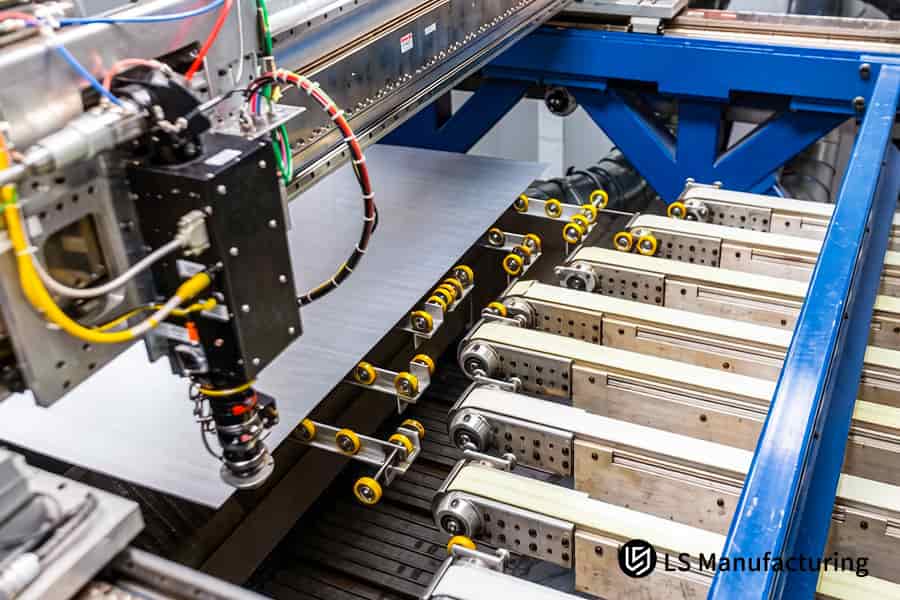
Figure 3: The robotic arm precisely picks up blanked 430 stainless steel blanks from the conveyor for appliance production.
How Does High Volume Blanking Service Maintain 100% Quality Consistency?
The task of delivering consistently perfect quality products from high volume blanking service is a statistical and process control problem rather than just a mere inspection issue. Consistency issues will inevitably arise without proper statistical intervention. Our approach combines real-time sensing and statistical precision to proactively prevent inconsistencies, guaranteeing that each piece adheres to specifications from the first piece to the one-millionth through closed-loop process management:
In-Line Process Monitoring for Instant Anomaly Detection
- Sensing Redundancy: Use of redundant sensing technologies (inductive, photoelectric) to observe feed length, material presence, and slug discharge in real-time.
- Automated Halt: The system automatically halts the automated sheet metal stamping process upon detection of anomalies, avoiding the manufacture of defective products.
Infrared Vision for Dimensional & Surface Integrity
- Non-Contact Measurement: High-speed IR cameras conduct 100% dimensional inspection and shear edge quality control in-line.
- Data Feedback: The images are examined to identify burrs, edge rollover, or dimensional drifting, which is used to generate data that is fed directly into the SPC monitoring system for analysis.
Statistical Process Control (SPC) for Predictive Quality
- Real-Time Charting: Significant variables (such as blank dimension and burr height) are monitored through real-time X-bar and R charts for precision blanking production.
- Proactive Adjustment: Analysis of trends helps determine how to maintain a Cpk value above 1.67 in order to make process variable corrections prior to exceeding tolerances.
Closed-Loop Correction for Sustained Precision
- Automated Compensation: The SPC monitoring system is integrated with press and feeder controller for fine-tuning to automatically compensate for drifting.
- Outcome: This feedback loop guarantees that the high-volume blanking process remains self-correcting, ensuring quality consistency during mass production.
We have achieved quality by design, not luck. We have addressed the inherent risk of variability and assembly issues in the end product by shifting from inspection at the end to prevention in the process. This has been done using in-process sensor technology, full automation in measuring, and predictive SPC monitoring that controls the high volume blanking service. This technology provides proven and data-driven consistency in parts, setting a standard benchmark for efficient mass manufacturing.
Case Study: How LS Manufacturing Optimized Custom Automotive Heat Shield Stamping For A Tier-1 Supplier?
LS Manufacturing’s custom stamping case study highlights their approach towards addressing essential production roadblocks faced by a Tier-1 supplier. The case focuses on the development of a complex stainless steel automotive heat shield that was plagued by severe springback and poor yields. The situation necessitated an entirely new approach to the high-volume stamping process:
Client Challenge
The part was made from 0.8mm thick 304 stainless steel exhaust heat shield, which needed precise flatness tolerance of ±0.15mm. With the old one-stage manufacturing process, only producing 40 strokes per minute (SPM), the client struggled with non-uniform material flow, significant springback and ultimately had an 8% rejection rate with 20% late deliveries, putting the company in jeopardy with regard to their Just-In-Sequence agreements with the OEM assembly line.
LS Manufacturing Solution
We proposed the process improvement using 12-station progressive die along with implementing a servomotor press, which enables precise control over the profile of ram stroke thus optimizing its velocity and dwell time. Key forming stations were outfitted with the proprietary low friction PVD coating technology. By employing such an advanced automotive blanking process optimization, we successfully solved the issues with springback and galling and achieved high-speed precision metal stamping process at 120 SPM.
Results and Value
The effectiveness of the proposed solution helped achieve a 22% reduction in materials waste thanks to improved nesting and formability of the parts produced. Also, lead times were shortened from 6 weeks to 3 weeks. Importantly, 100% of the parts made passed automated optical inspection for flatness and burr requirements, allowing for defect-free assembly of the vehicle. As a result of demonstrated precision automotive blanking operations, we have obtained a 3-year sole supplier agreement for our client.
This is a clear example of how we tackle manufacturing restrictions using precise engineering techniques. LS Manufacturing provided a solution that revolutionized yield, time, and quality, going beyond mere part manufacturing to innovate the whole process. It is evident from the above that we can be relied upon in addressing advanced metal stamping issues by virtue of technical expertise translating into procurement certainty and commercial gain.
To eliminate delays and scrap in your stamping production, submit your design for a servo-press solution that guarantees speed, consistency, and long-term supply security.

What Are The Current Market Pricing Factors For Metal Stamping For Large Production?
Accurately forecasting costs for metal stamping for large production is critical for procurement and budget planning in competitive manufacturing. This document provides a transparent framework for metal stamping pricing, analyzing the primary cost factors that influence final quotes. By quantifying the impact of material volatility, tooling complexity, and volume economics, we empower clients to achieve predictable expenditure and optimized total cost of ownership for their high-volume metal stamping projects.
| Pricing Factor | Impact Description | Quantifiable Example |
| Raw Material Costs | There will be fluctuations in material cost in the form of commodities such as aluminum or steel and affect the blanking cost which usually accounts for 40-60% of the total cost of production of the stamped parts. | A 10% rise in the price of the coil stock leads to a 4-6% rise in the price of the finished product. |
| Tooling Complexity & Amortization | Dies will be relatively expensive compared to other types of dies, but they will have reduced per-piece costs because of amortization with high-volume production. | Costs of tooling for complicated blanks will be 3-5 times higher than easy blanks, but per-piece costs will fall dramatically after 50,000 pieces. |
| Production Volume Tiers | Economies of scale will lower fixed costs per piece in blanking, therefore giving certain price breaks when certain volume thresholds are reached. | The per-piece cost can be reduced by 15-25% after 100,000 orders. |
| Secondary & Finishing Operations | All additional operations require extra work, thus causing additional costs. | Zinc plating finishing costs can be estimated to be 20-30% above the base production metal stamping cost. |
| Precision & Quality Requirements | Better accuracy and surface quality will cause higher prices due to additional tooling and SPC processes. | Higher accuracy of ±0.05mm vs. ±0.1mm can increase costs up to 10-15%. |
It can be seen from this case study that proper metal stamping pricing should involve the active handling of dynamic cost elements. By taking away the element of guesswork in budgeting for procurement managers, we bring transparency and reliable financial planning into complex metal stamping for large production, creating a basis of technological expertise in industrial metal stamping.
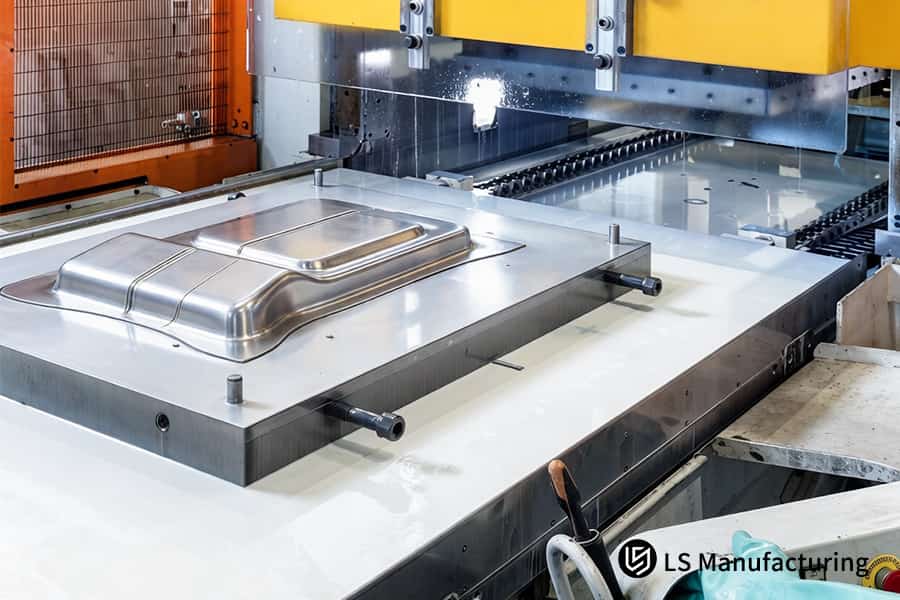
Figure 4: The hydraulic press forms a DC04 steel battery tray in a CNC guided blanking operation for automotive use.
How To Find A Reliable OEM Part Stamping Services Supplier In China?
Searching for OEM part stamping services in China means navigating around a tricky scenario where risk of sourcing and quality control problems arise. What follows below is a structured three-dimensional analysis of the crucial elements needed in locating a reliable China metal stamping supplier, going far beyond just comparing prices and assessing simple capabilities:
Certification & Quality Management Systems
The basis for all types of certifications is that the company has process-based IATF 16949 certification, which is intended to ensure constant improvement and failure prevention throughout the process of manufacturing. It is carried out by process audit and FMEA for every new project. Such an approach will help to solve the core problem of low quality, and guarantee that every batch of manufactured products will be top-class according to the automotive/industrial products criteria.
Vertical Integration & In-House Process Control
True reliability requires management of the entire process chain. Our factory integrates precision blanking services with designing tools, CNC machining, and post-process operations like plating. By doing this, we reduce coordination issues between various participants of the process chain. We could easily correct our dies while producing a prototype metal stamping for our client in one case. The process of prototype approval took us only 10 days rather than 4 weeks.
Comprehensive Inspection & Data Transparency
Having a China metal stamping supplier implies being backed up with data, not guarantees. We provide our clients with comprehensive reports on the inspections we have performed on FAIRs as well as layouts of our dimensional data with Cpk statistics, material certificates. With regard to our recent project, involving custom metal stamping on an exceptionally large scale, our SPC reports provided us with engineering teams with a complete chain of responsibility, allowing our customer to increase the order by 30% each year without additional audits.
In such a way, the purchasing decision is no longer viewed as an exchange transaction but rather as a technical partnership decision process. By focusing on the aspects of systems certification, integrated manufacturing, and visibility of data, we solve the critical challenges of risk management, scheduling, and quality assurance facing international procurement groups. Our dedication gives us the ability to be deemed a reliable supplier selection in terms of metal stamping solutions.
FAQs
1. What tolerance standards can LS Manufacturing achieve with its high-speed stamping?
Tolerances for dimensional precision are maintained at ±0.02mm for stamped parts, and extremely precise tolerances of ±0.01mm can be achieved for critical electronic parts. High standards of precision are guaranteed by excellent tooling and stringent control systems.
2. Which materials do you support for custom OEM metal stamping?
Cold rolled steel, stainless steel (Type 304 & Type 316), aluminum alloy (5052 & 6061), phosphor bronze, and sheet metals are typical materials. The suitable material is determined according to the necessary mechanical strength, corrosion resistance, electrical conductivity, and finish quality.
3. How are tooling costs typically calculated for large-volume orders?
Tooling is a one-time charge dependent on the complexity of the part. When customers reach a particular minimum order quantity annually, we have rebates or depreciation strategies that reduce the cost per piece, allowing for a mutually beneficial relationship.
4. How do you ensure on-time delivery for large-scale production runs?
We ensure reliable on-time delivery by operating 20+ independent stamping lines and maintaining a strategic inventory of critical tooling spare parts. This robust setup provides ample production capacity and strategic buffer capacity to seamlessly handle urgent orders, demand surges, and schedule fluctuations.
5. What documents do I need to prepare before submitting an inquiry?
To accelerate the quoting process, please provide detailed 2D/3D drawings (STEP/DWG format), complete material specifications, your estimated annual usage (EAU), and defined key quality control points. This information allows for a precise and comprehensive initial project assessment.
6. Can you provide post-stamping surface finishing services?
Yes, we offer comprehensive finishing including anodizing, electroplating, powder coating, heat treatment, and ultrasonic cleaning. Our in-house capabilities ensure consistent quality, controlled lead times, and surfaces tailored for corrosion resistance, wear resistance, and aesthetics.
7. How do you safeguard the intellectual property (IP) of our products?
We protect your IP through a mandatory, rigorous NDA signing protocol and a physically isolated, access-controlled data management system. Your designs are used exclusively for your production runs, ensuring total confidentiality and security throughout the manufacturing lifecycle.
8. How specifically does high-speed stamping improve material utilization?
Our specialized nesting optimization software reduces the spacing between parts to just 0.8 times the material thickness. This advanced nesting can improve material utilization by 10% to 15% compared to conventional methods, maximizing sheet yield and minimizing scrap.
Summary
Choosing efficient blanking is not just about speed—it balances precision, cost, and supply chain stability. This article examines high-speed stamping advantages, LS Manufacturing’s specialized DFM optimization, and how mass production drives significant cost and efficiency gains. As an experienced OEM manufacturer, we understand the impact every 0.01mm of deviation and every second of downtime has on your business.
Ready to supercharge your production efficiency? Click the “Get a Free Technical Assessment & Quote” button below right now to upload your product drawings. Our team of senior engineers will provide you with an in-depth DFM review and our most competitive tiered pricing within just 24 hours. Stop worrying about high unit costs and delayed delivery times; let LS Manufacturing become your China blanking supplier.
📞Tel: +86 185 6675 9667
📧Email: info@lsrpf.com
🌐Website: https://lsrpf.com/
Disclaimer
The contents of this page are for informational purposes only. LS Manufacturing services There are no representations or warranties, express or implied, as to the accuracy, completeness or validity of the information. It should not be inferred that a third-party supplier or manufacturer will provide performance parameters, geometric tolerances, specific design characteristics, material quality and type or workmanship through the LS Manufacturing network. It's the buyer's responsibility. Require parts quotation Identify specific requirements for these sections.Please contact us for more information.
LS Manufacturing Team
LS Manufacturing is an industry-leading company. Focus on custom manufacturing solutions. We have over 20 years of experience with over 5,000 customers, and we focus on high precision CNC machining, Sheet metal manufacturing, 3D printing, Injection molding. Metal stamping,and other one-stop manufacturing services.
Our factory is equipped with over 100 state-of-the-art 5-axis machining centers, ISO 9001:2015 certified. We provide fast, efficient and high-quality manufacturing solutions to customers in more than 150 countries around the world. Whether it is small volume production or large-scale customization, we can meet your needs with the fastest delivery within 24 hours. choose LS Manufacturing. This means selection efficiency, quality and professionalism.
To learn more, visit our website:www.lsrpf.com.