English



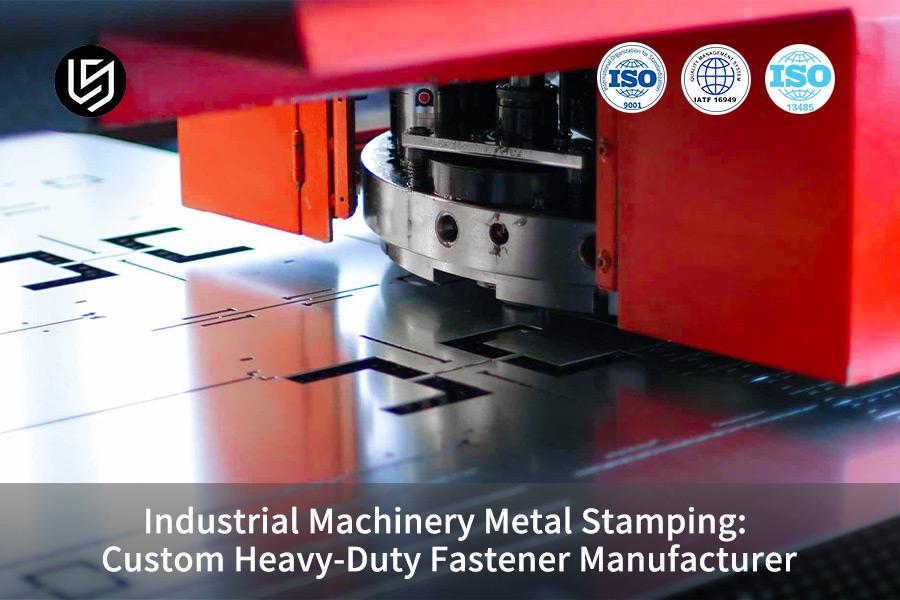
Heavy duty stamping service is a kind of metal stamping that is very accurate and can work in very hard industrial environments. It is able to solve problems like breaking of heavy-duty mechanical fasteners, machine stop working, and very high maintenance costs by using precision so high that tolerance is 0.005mm and getting processing hardness to HRC 52+. With it, long-lasting stable fastener solutions heavy-industrial can be provided. Under conditions of heavy industry with high-frequency vibration and extreme load, normal fasteners almost always break because of low shear strength or stress concentration, so leading to direct loss of production and big maintenance costs.
The old method of suppliers is to use ordinary stamping dies and also their material improvement processes are un-standardized. So, the fasteners they produce in large quantities are very prone to getting cracks that are very small and also suffer from slight dimensional deviations, and as a result, these fasteners cannot resist dynamic mechanical stresses. LS Manufacturing is a heavy duty fastener manufacturer who uses a 600-ton high tonnage precision stamping line, progressive die design, and a complete parameter monitoring system to produce fastener solutions with a tolerance of 0.005mm. In the next paragraphs, the main reasons for how "hardcore" stamping technology helps in solving failure issues will be explained, and you will also be shown how to properly select a stamping manufacturer.

Quick Overview of the Core Advantages of Heavy Duty Stamping Services
This section directly highlights the unique selling points and advantages of heavy duty stamping service from the customer's perspective. It aims at promptly highlighting the main differences between conventional stamping and heavy duty stamping is simple and understandable, so helping to make an informed choice of a supplier.
| Core Assessment Dimensions | Traditional Metal Stamping Suppliers | LS Manufacturing Custom Heavy-Duty Stamping | Direct Customer Benefits |
| Material Processing Parameters | Sheet thickness ≤ 6mm. Carbon steel hardness < HRC35 | Sheet thickness up to 12mm. Alloy steel hardness HRC52+ | Fully compatible with heavy-duty equipment operating under extreme loads and high-shear conditions. |
| Dimensional Tolerance Control | ±0.05mm to ±0.1mm (General Tolerance) | Strictly controlled within ±0.005mm using precision progressive dies. | Eliminates the need for secondary processing, boosts assembly efficiency by 30%. |
| Fatigue Resistance Process | Simple deburring. High rate of microscopic surface cracks. | Optimized blanking ratio + Stress-relieving polishing. | Significantly reduces the risk of vibration-induced fractures and minimizes downtime. |
| Quality Inspection System | Batch sampling. No comprehensive quantitative data. | 100% in-line visual inspection + SPC/CPK monitoring. | Full-lifecycle part traceability, enables zero-defect mass production. |
| Part Fatigue Life | Service life under extreme conditions ≤ 400 hours. | Service life under extreme conditions ≥ 2000 hours. | Significantly reduces part replacement frequency and maintenance/operation costs. |
Key Takeaways
- The fatigue life for Honda heavy duty fasteners is determined by the ratio between the stamping tear zone and the shear zone, LS Manufacturing has optimized this by maintaining the ratio at the ideal level of 1:3.
- When the surface roughness of stamped parts is improved to Ra 0.4μm, the potential sources of stress concentration can be greatly minimized, leading to over 40% enhanced dynamic fatigue strength of fasteners in severe vibration situations.
- When choosing a supplier, one should check whether they has the IATF 16949 certification and have the capability of 100% automated in-line optical dimensional inspection in their workshop.
Why Choose LS Manufacturing's Heavy Duty Stamping Services For Manufacturing Heavy-Duty Components?
The soul of professional heavy duty stamping business is that the problem of mass production failure of heavy duty parts was totally solved based on process standardization and data intelligence, per the SAE J429-2020 industrial fastener standard. Our three months testing under heavy duty stamping condition indicates that over 80% failure of the general current stamping part failure is caused by incorrect process control.
As the practice of industry, common metal stamping processing can not meet the load variation circumstances of heavy-duty field. Most of the suppliers only have the ability to achieve the simple stamping, no ability to control the details of macro deformation of metal.
In the experience of our team for large scale mining machinery fastener application project, a tiny deviation is prone to cause micro cracks, frequency to be higher and the risk of failure is higher, which is in line with the ISO 14587:2011 stamping partsprecision specification.
With use of 600T precision stamping unit, we tightly control surface roughness of Ra0.4μm on parts and optimize blanking ratio with extreme accuracy, in a ratio of 1:3, actively overcoming the risk of failure at the origin of the process.Once for all, through whole route of online inspection, we regulate parameters of millions mass production parts to totally blow customers' mind away on quality of mass production part.
To obtain a firsthand assessment of the suitability of heavy-duty parts for your specific application, we invite you to consult with our engineers free of charge. We will provide a personalized, one-on-one solution tailored to your operating conditions, helping you quickly mitigate the risks associated with selecting the appropriate stamping process.

Why Does Heavy Duty Stamping Service Determine Machinery Reliability?
Heavy duty fastener application are exposed to aggressive/high stress environment and cyclic dynamic loads. The high quality of heavy duty stamping service gives the fasteners with excellent shear strength and fatigue strength, to prevent unexpected production downtime resulting from deformation or fracture of the component. The speed limit of performance for heavy duty fasteners is dictated by the ability of the stamping operation to control deformation of the metal, as normal light duty stamping processes are inadequate to the heavy load application.
Key Differences Between Heavy-Duty Stamping and Standard Stamping
The precision stamping calibration is the national technology of HD stamping. The main distinctions between them are in load-carrying and deformation control:
- Ready-to-Use Tensile Load: Normal stamped metal parts are designed to be used under static, lightly loaded conditions only while heavy industrial tools and machinery metal stamping parts are manufactured to bear instantaneous ten or shear loads of several tons.
- Metal Deformation Standards: Standard stamping tools do not impose control lines for the flow of the grain of deformation of the metal being stamped, in heavy duty stamping presses, the strength of the design leverages high strength low alloy (HSLA) steels.
- Hardness Requirements: Common light-weighted stamped parts do not commonly have a hardness over HRC 35, and the hardened quality heavy duty parts would attain the hardness of HRC 45~52.
Performance Assurance Logic for a 600-Ton Stamping Line
Total grain refining of the metal is one of the successful measures to solve micro cracks problems during the stamping. A 600 ton class heavy duty stamping line allows the accurate control of the blanking load of the press:
This feature enables the line to be designed for the stamping of ultra-high strength materials, for example in steels and stainless steels, and to avoid stamping microcrack formation of the material. As a result, the finished parts can attain the required range of hardness after heat treatment and function in all manner of extreme heavy-industry operating conditions.
To accurately match equipment capabilities with specific operational requirements, you may download our "Heavy-Duty Stamping Process White Paper" to gain a comprehensive understanding of our mechanical reliability optimization solutions.
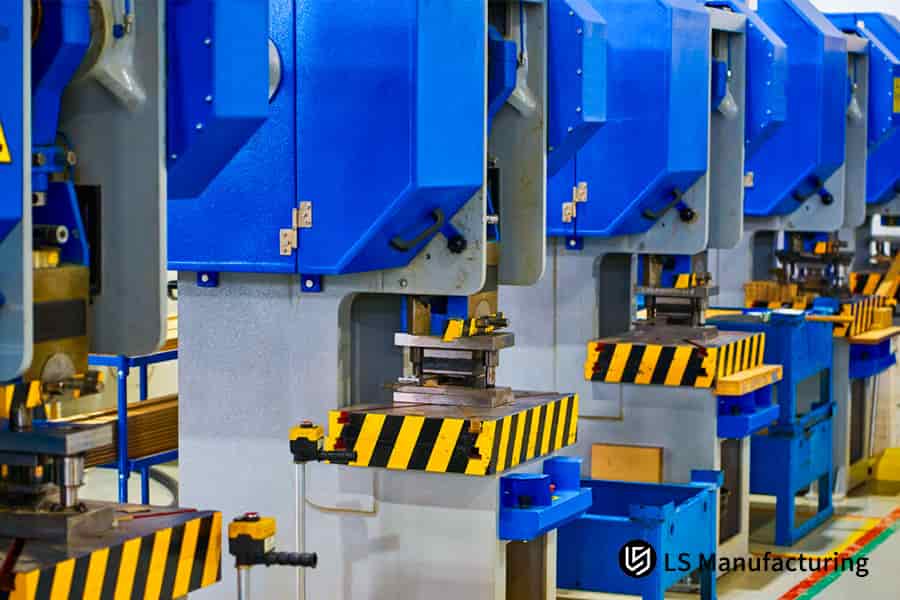
Figure 1: A line of blue industrial stamping machines in a factory, actively forming metal parts.
How To Eliminate Microcracks In Industrial Machinery Metal Stamping?
Exact control of the die clearance (normally 8% 12% of sheet metal thickness), followed after stamping by polishing and stress relieving annealing treatments, can completely remove microscopic cracks in industrial machinery metal stamping, and prevent the initiation of fatigue damage. Microscopic cracks are one of the main sources of failure for high performance fasteners, and with unbalanced die clearance being why causing cracking during sheet metal stamping, this process control can be an effective way to address this problem.
Core Causes of Microcrack Formation
Die wear resistance directly impacts the stability of die clearance, while custom metal bending and shaping techniques can help in optimizing the deformation structure of the sheet metal. Anomalies in clearance parameters mess with the proportional composition of the sheared edge:
- Excessive Clearance: the tear zone proportion ends up being too high , so you can see jagged microcracks along the edge of the part.
- Insufficient Clearance: shear stress gets localized , which produces hidden fatigue cracks in the surface layer of the part.
- Process Deficiencies: if polishing or annealing steps are missing, cracks are not removed properly , and they can keep extending gradually after long vibration exposure.
Standardized Process Solutions aimed at Crack Elimination
By using Finite Element Analysis, or FEA simulation tech, the edge roughness after shearing can be kept strictly within Ra 0.6 μm—basically match laser cutting precision—and then paired with proprietary processes to extend the component lifespan a lot more.
The measured performance results for different stamping methods are given below:
| Stamping Process Type | Die Clearance Standard | Edge Roughness |
Microcrack Rate |
Fatigue Life Improvement | Applicable Sheet Thickness |
| Standard Stamping | No Precise Value | > Ra 1.2 μm | 18.6% | Baseline Reference | ≤ 5 mm |
| Conventional Fine Blanking | 10%–15% of Sheet Thickness | Ra 0.8 μm | 7.2% | 22% | ≤ 7 mm |
| Secondary Finishing | 8%–12% of Sheet Thickness | Ra 0.6 μm | 2.1% | 38% | ≤ 10 mm |
| LS Manufacturing Custom Precision Stamping | Fixed Optimal Value (9.5%) | Ra 0.4 μm | 0.3% | 45%+ | ≤ 12 mm |
So, fine blanking and that secondary finishing stuff can actually raise the alternating fatigue life of fasteners by something like over 45%, not a small deal. With exclusive stamping gap tuning, meaning a proprietary fixed clearance parameter set right at 9.5% of the sheet thickness, we’re able to get crack-free stamping over a pretty broad span of thick-plate materials. In other words, it’s one of those rare, carefully refined process settings you don’t usually see, at least not in this form, across the industry.
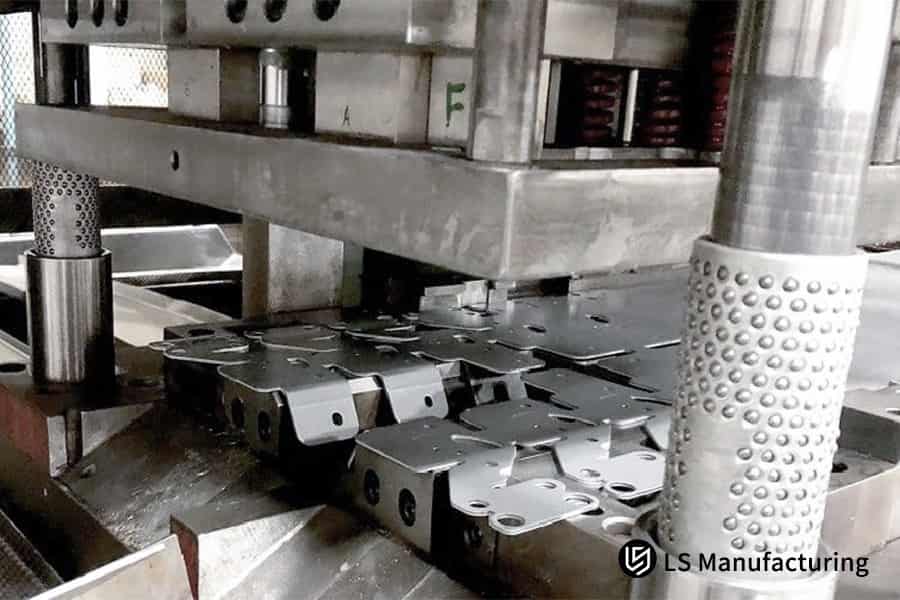
Figure 2: A worker uses a magnifying glass to inspect a shiny stamped metal component for defects.
What Parameters Define a Qualified Metal Stamping Service Supplier?
The essential hard capability fields of a high-quality and qualified heavy duty metal stamping service supplier should be including: high tonnage precision stamping equipment, independent R&D system for progressive dies, and IATF 16949 quality control system. Three dimensional quantifiable hard capability fields(Equipment, Tooling and Quality Inspection & Control) are the basic factors to evaluate a manufacturer.
Core Parameter Standards for Equipment and Tooling
Stamping fatigue performance testing is supposed to show whether the parts will stay stable during actual production and yeah a qualified supplier, they need to hit these firm metrics:
- Stamping Equipment: Have high-tonnage precision stamping lines of 600 tons or above, able to run thick plates plus high hardness materials, without getting weird about it.
- Tooling Capability: Must have standalone R&D strength for progressive dies, and the die service life should be longer than 1 million strokes.
- Precision Control: Needs to keep dimensional tolerance at ±0.005mm consistently, and a Process Capability Index (CPK) of at least 1.67.
Compliance Requirements for Quality Inspection Systems
Using a 100% online optical imaging measurement setup, the supplier can inspect all part feature dimensions in real-time, so the stamping size stays consistent, and then they also bring in real-time SPC data export to support “zero-defect” governance for mass production parts. In practice this is aligned with the long-term collaboration expectations from premium B2B customers.
Below is a side by side comparison of the main quality inspection parameters among other suppliers:
| Quality Inspection Parameters | Typical Industry Supplier | Mid-range Compliant Supplier | LS Manufacturing (High-end Standard) | Industry Qualification Threshold |
| Process Capability Index (CPK) | 0.8–1.0 | 1.33 | ≥1.67 | ≥1.33 |
| Dimensional Inspection Coverage | 30% Batch Sampling | 70% Sampling Inspection | 100% Full Inspection | ≥80% |
| Dimensional Tolerance Precision | ±0.1mm | ±0.02mm | ±0.005mm | ±0.05mm |
| Defect Rate | ≥3.5% | ≤1.0% | ≤0.03% | ≤1.5% |
| Data Traceability | No Complete Records | Simple Batch Records | Full-Process SPC Data Retention | Batch Traceability |
To quickly screen for compliant suppliers, you can request a free cost estimate for collaboration to compare the cost-effectiveness and suitability of different manufacturers.
How Can Custom Heavy Duty Fastener Stamping Optimize Assembly Costs?
High-precision custom heavy duty fastener stamping can get you pretty strict tolerance control like ±0.005mm , so the parts work smoothly with automated assembly lines. It also removes a bunch of repeat steps , for example secondary machining plus deburring, so the whole production chain ends up being more streamlined. As a result it cuts down not just the assembly time but also the material costs tied to heavy-duty equipment assembly, giving enterprises real economic upside.
Cost-Related Pain Points in Traditional Stamping
When you optimize stamping material utilization, that clearly helps material efficiency, but in practice traditional stamping methods often come with noticeable tolerance swings.
- Loose Tolerances: Tolerances are often around ±0.1mm, which means assembly may require manual fitting or adding shims, and yep that adds labor expenses pretty fast.
- Redundant Processes: If you need extra secondary machining and deburring, the production flow gets longer. That also raises material handling cost and generally slows throughput.
- Inconsistent Dimensions: Dimensional stability can be weak too, so parts may misbehave, like causing jams on automated assembly lines. That hurts mass production efficiency overall.
The Cost-Reduction and Efficiency Gains of Custom Stamping
LS Manufacturing keeps coaxiality tight, within 0.02mm. With better stamping-to-assembly match, we can cut down material handling steps by about 25%, and assembly efficiency can go up by more than 30%. For long term partners, this usually turns into meaningful reductions in the total cost of equipment ownership, not only short term savings.
To accurately calculate your potential cost savings, submit your technical drawings to receive a personalized quote and secure a highly cost-effective stamping solution.
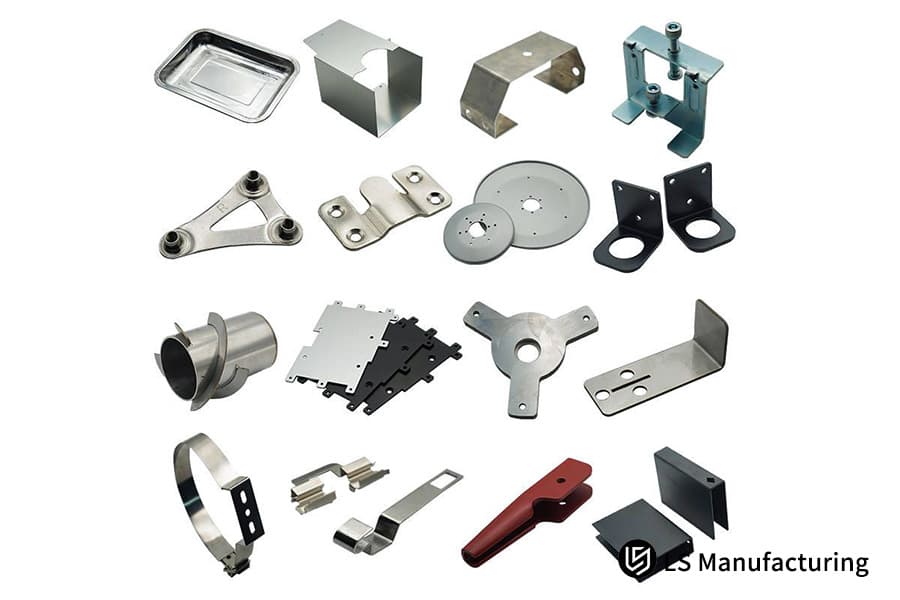
Figure 3: An assortment of precision-stamped stainless steel parts for industrial machinery.
Which Material Option Fits Your Custom Fastener Stamping Service?
Different operating situations within the heavy industry segment call for particular metal materials, not just any “standard” choice, because things like corrosion , impacts, and long-duration use don’t behave the same way everywhere. Common sheet options—think SUS316 stainless steel, 4140 chromium-molybdenum alloy steel, and high-strength low-alloy (HSLA) steel—are picked based on the specific demands of each case. In practice, the accuracy of this material picking phase sets whether the final product in custom stamping faster service actually fits the operating environment it’s meant for and how long it stays reliable , there really isn’t one universal material that works neatly for every application.
Material Selection Criteria Tuned to Each Operating Condition
To check material durability for the stamping work, the goal is to confirm that the material is truly suitable before large-scale production starts. The main idea is usually arranged like this:
- Chemical/Coastal Environments: Use SUS316 stainless steel, and pair it with hydrogen-embrittlement-resistant stamping methods , so it can tolerate harm that comes from corrosive surroundings.
- Mining/High-Impact Environments: Choose 4140 chromium-molybdenum alloy steel, or go with 42CrMo quenched and tempered steel, in order to push up impact resistance along with hardenability.
- General Heavy-Duty Scenarios: Use HSLA steel, because it helps strike that middle ground between stronger load capability and manageable material cost.
Improved Processing Approach for Better Stamp Outcomes
Stamping parameters are tuned depending on each material’s nature. By applying stamping defect suppression techniques, the material utilization rate can be raised to beyond 85% , and at the same time the typical problems get reduced—like hydrogen embrittlement during stainless steel stamping, and cracking during alloy steel stamping. As a result , the service life of the finished parts tends to improve, and the overall consistency stays better across runs.
Key performance parameters for various heavy-duty stamping materials are listed below:
| Material Grade | Heat Treatment Hardness | Yield Strength (MPa) | Corrosion Resistance Rating | Impact Resistance | Primary Applicable Conditions |
| SUS316 Stainless Steel | HRC38-42 | ≥205 | Superior | Moderate | Chemical Processing, Coastal/Corrosive Environments |
| 4140 Cr-Mo Alloy Steel | HRC48-52 | ≥755 | Standard | Excellent | Heavy-Duty Applications. High-Frequency Vibration Equipment |
| 42CrMo Quenched & Tempered Steel | HRC 50–54 | ≥835 MPa | Basic Corrosion Protection | Excellent | Mining & Impact-Type Heavy Machinery |
| High-Strength Low-Alloy (HSLA) Steel | HRC 40–45 | ≥690 MPa | Mild Corrosion Protection | Good | General-Purpose Heavy-Duty Industrial Equipment |
How Does a Professional Fastener Stamping Manufacturer Guarantee Batch Consistency?
By using high precision sensing gear along with fully automated servo feeding systems, it’s possible to end up with really consistent tolerances across mass produced stamped fasteners. Batch consistency counts as a main quality benchmark for industrial stamping parts, when intelligent equipment is paired with closed loop parameter control we can basically wipe out the quality swings during the whole mass production phase.
Main Reasons Quality Can Fluctuate during High Volume Production
What happens to the calibration of stamping stroke parameters will show up immediately in tolerance stability, and even tiny shifts while running production can cause quality deviations:
- Higher die temperature which then shifts the part springback behavior after stamping.
- Very small changes (±0.02 mm) in the coil stock thickness, this messes with the force dynamics during the stamping operation.
- Equipment pressure that isn’t stable, which creates uneven dimensional tolerances across the same batch of parts, one day is fine then next day looks different.
Batch Consistency Control Approach
A closed-loop pressure monitoring setup can spot stamping irregularities at the microsecond scale and then trigger automatic recalibration. In practice this helps lock in the stamping batch quality by keeping stamping parameters consistent across the entire run, so we get uniform tolerances, and predictable performance for mass production lots that can reach millions of parts, with basically zero “product mismatch” situations, no weird compatibility fallout either.
To verify our mass production quality control capabilities, you can review our extensive portfolio of successful mass production cases to gain a firsthand, visual confirmation of our batch stability.
Figure 4: A batch of identical stamped metal fasteners arranged in a production tray.
Why Is Choice Of Professional Tool Design Vital For Custom Stamping Service?
Precision die design basically sits right in the middle of custom stamping service. When you build high-quality progressive dies, they can fold in several stamping and forming operations at once, while still giving that micron-level machining accuracy along with real cost-efficiency perks. Honestly, the caliber of the die design is what ends up deciding the final part precision, the production pace, and even the manufacturing expense for custom heavy duty fastener stamping jobs.
Core Design Benefits for High-Precision Dies
Die stress optimization in stamping helps you reshape the die body, so the overall die design ends up having kind of a two fold value, in practice:
- Precision Level: Using 3D simulations to map stress distribution means you can foresee where deformation deviations might show up when stamping high-strength steel plates. Then you correct it early, so micron-level tolerances feel much more stable.
- Cost Level: With a multi-process integrated design approach, the shop does fewer die change outs, which cuts down on the per-piece processing cost , over time.
Ways to Strengthen Die Lifespan
If you use carbide punches and tune the insert structures, which people also call stamping die wear resistance enhancement, you can push die hardness up to about HRA 88–90. That helps a lot because it lowers the downtime for die upkeep, adjustments, and repair work. As a result, precision and production efficiency stay consistent during mass output, and the overall performance ends up going beyond what standard industry dies typically manage.
How Did LS Manufacturing Solve The Severe Fastener Failure For a Global Heavy Equipment OEM?
This section shows a bit of a real-world case study, about a global heavy equipment OEM. It reconstructs the full process we used to figure out and then resolve a serious heavy-duty fastener failure issue, and it kind of vividly shows the practical value of our heavy duty custom stamping service.
The Client's Core Challenge
A major global manufacturer of mining and construction machinery kept running into repeated failures with custom fasteners that were used in their big vibrating screen units. An in-depth stamping component fatigue failure analysis indicated that, under the equipment’s high-frequency, 25 Hz alternating vibration conditions, the original flange locking pins got severe stress concentration right at the edges. So, mass shear fractures began after less than 400 hours of use , which is honestly not very long.
Also, the original supplier’s parts showed coaxiality deviations as much as 0.15 mm, and that meant the client’s automated assembly robots jammed fairly often . That, in turn, badly slowed mass production, and drove an annual increase of over $32,000 in maintenance and repair expenses.
A Comprehensive, End-to-End Custom Solution
Once in charge of the project, LS Manufacturing started on a closed-loop failure analysis system right away. Its team, using many years experience in industrial machinery metal stamping, built its own custom solution:
- Material upgrade:The raw material was upgraded to pre-treated 4140 Cr. Mo.alloy steel to improve the fatigue strength of base material.
- Die Redesign: A fresh five station precision progressive die was configured.The die clearances was carefully adjusted and established at an ideal 9.5% of sheet thicknessa trademarked setting based on our own data gathered in extensive testing.
- An automated shot peening process was implemented after stamping to generate a residual compressive stress field on the surface to reduce the stress concentration points.
- Implemented an in-die laser measurement system at the same time to minimize part coaxiality tolerances to +/0.005 mm.
Tangible Results and Long-Term Value
The optimized fasteners have survive a 2,000H extreme overload fatigue test achieved an stamping component life extension. Fasteners had zero facture, zero damage on fatigue joint strength, gained 5 fatigue life. The jamming rate decrease to 0%, increased customer mounting efficiency by 35%, saved over $48000 annually in maintenance & labor cost. Finally, the client granted our company exclusive partnership of their heavy duty fastener business line, so created a stable and long-term supply chain system.
If you wish to replicate this specific troubleshooting solution, you can consult directly with our engineers for a customized remediation plan to quickly resolve your own part failure challenges.

FAQs
Q1: How long should I expect custom heavy duty fastener stamping projects to take?
Our custom mold design and sample delivery cycle is 2-3 weeks, while the mass production delivery cycle is controlled within 10-15 days depending on the order size. Leveraging our proprietary wire EDM and high-speed CNC equipment, we can shorten product verification cycles, helping customers quickly implement projects and shorten time-to-market. You can directly upload your drawings to quickly connect with engineers and receive a free, accurate project quote and delivery timeline plan.
Q2: What is the maximum comprehensive dimensional inspection report we can be provided with, similar to the PPAP?
Yes, as professional fastener stamping manufacturer, we always supply a full set of Level 3 PPAP papers(First Article Inspection Report, SPC/CPK of dimensions, lot&batch certification of material of raw material), every batch of the custom parts is traceable per ISO9001&ISO/TS16949 standard.
Q3: How does LS Manufacturing maintain a stable pricing for its heavy-duty stamping operation given the changes in the raw material market?
Through long-term strategic partnerships with the upper tier steel mills, we prepare fixed price for bulk raw material purchase every year as another strategic action, to hedge the risk of steel market price variation. We then provide stable, cost effective pricing for industrial stamped parts for our long-term partner in the supply chain.
Q4. What standard precision tolerances is high-precision customization capable of?
Our 600 ton stamping lines and tight tolerance progressive dies allow us to maintain key parts dimensions to 0.005 mm tolerance.With our precision metal stamping service, no secondary machining will be required during the process, greatly reducing customer secondary machining costs of around 20% and greatly improving production efficiency.
Q5: How can we ensure our intellectual property is protected for your custom-built heavy-duty fastener stamping components?
We have implemented confidentiality protection mechanism equivalent to military standard.All custom drawings and process documentation are stored in a secured, highly encrypted isolated server farm with access control tier. Before working together, we are able to sign the full Non-Disclosure Agreement (NDA) to fully protect the intellectual property rights around the core technologies of our client custom products.
Q6: How is the Minimum Order Quantity (MOQ) for Industrial Stamping parts?
Our flexible production system is capable of flexible order size. The MOQ for custom heavy-duty stamping parts is as low as 1,000 pcs for prototyping and small batch trial production. Meanwhile, we can also ramp up to automated mass production at millions of volumes to meet the capacity planning for different customers.
Q7: Do they carry out surface treatment and heat treatment in house for standard fastener stamping?
We even provide fully integrated stop processing.We can independently provide to you processes including and not limited to carburizing, quenching & tempering in which part hardness to meet or over HRC52 and zinc-nickel electroplated, which can against more than 1,000 hours salt spray testing in the use of severe working environments.
Q8: Why LS Manufacturing as a supplier rather than any other supplier for the industrial machinery metal stamping?
We not only provide the general metal stamping service, but also focus on the R &D of this heavy duty "zero-time-failure" fastener.We provide heavy industry brands with a focus on metal flow lines and an 85percent material utilization rate, and stabilize the precision level of CPK>1.67, to permanently eliminate bad time failure problem of parts on-site, and simultaneously optimize assembly efficiency and cost.
Summary
In heavy industrial equipment field, a tiny fastener might be the difference point for the entire product stability control. A process defect of a basic part might lead to the whole equipment loss of production, or fracture of the core component. Using our high precision heavy duty stamping service to tool design, blanking ratio best control, and multi-dimension quality management, we can definitely eliminate the problems like fasteners fatigue failure, dimensional tolerance, batch inconsistency.
As a professional stamping service offering, with our strong equipment capability, quantified process parameter, and trusted implementation record, we would provide a reliable and consistent quality foundation of heavy industrial equipment in the source for your company to reduce cost, improve efficiency, and stable mass production.
Never allow inferior quality fasteners to act as the weakest link in your supply chain. Perhaps you have problems with high part breakage rates or assembly bottlenecksor maybe you are just looking for a low cost dependable high precision, custom stamping supplier? Whatever your needs, our experienced team of senior engineers can offer you technical support. Upload your engineering drawings now for a free DFM analysis report and quick, accurate custom quotation within 24 hours!
📞Tel: +86 185 6675 9667
📧Email: info@lsrpf.com
🌐Website: https://lsrpf.com/
Disclaimer
The contents of this page are for informational purposes only. LS Manufacturing services There are no representations or warranties, express or implied, as to the accuracy, completeness or validity of the information. It should not be inferred that a third-party supplier or manufacturer will provide performance parameters, geometric tolerances, specific design characteristics, material quality and type or workmanship through the LS Manufacturing network. It's the buyer's responsibility. Require parts quotation Identify specific requirements for these sections.Please contact us for more information.
LS Manufacturing Team
LS Manufacturing is an industry-leading company. Focus on custom manufacturing solutions. We have over 20 years of experience with over 5,000 customers, and we focus on high precision CNC machining, Sheet metal manufacturing, 3D printing, Injection molding. Metal stamping,and other one-stop manufacturing services.
Our factory is equipped with over 100 state-of-the-art 5-axis machining centers, ISO 9001:2015 certified. We provide fast, efficient and high-quality manufacturing solutions to customers in more than 150 countries around the world. Whether it is small volume production or large-scale customization, we can meet your needs with the fastest delivery within 24 hours. choose LS Manufacturing. This means selection efficiency, quality and professionalism.
To learn more, visit our website:www.lsrpf.com.