English



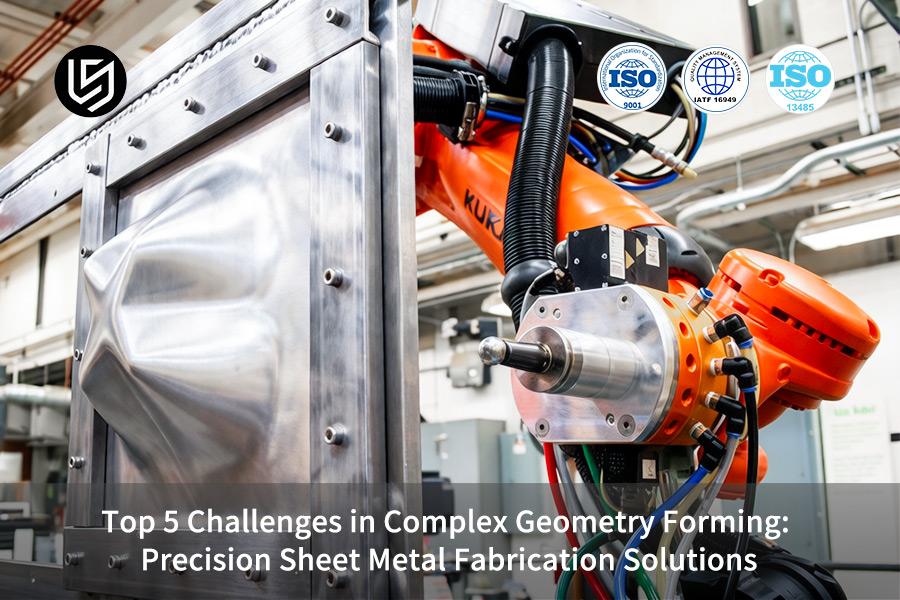
Precision sheet metal fabrication services face increased complexities in the aerospace, medical, and communication industries, owing to integrated design which imposes geometric limitations. This makes the design decisions faced by OEM procurement managers a difficult balancing act and prone to risks such as forming cracks and springback, since the fabricators usually lack intricate models for anisotropy and stress relief. They usually go through trial-and-error processes, which reduce their efficiency and make them prone to delays that are expensive and unplanned.
LS Manufacturing will explain in this context how multi-physics simulation plays its part in delivering those very precision sheet metal fabrication services. Our solutions address the critical issues of formation without any cracks or springback, maintaining micron-accuracy tolerances for intricate parts. We provide that forward-looking approach that makes the difference between risks and results.
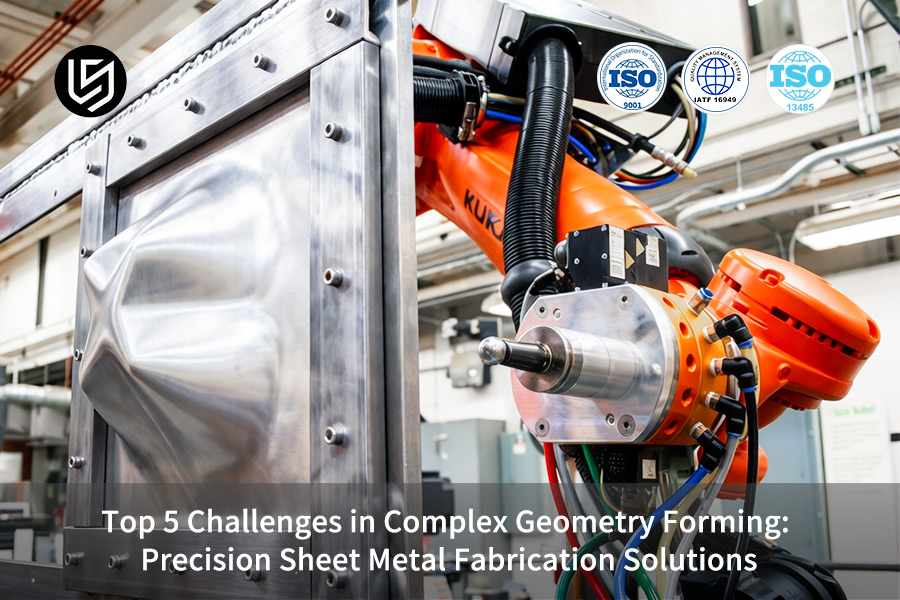
Complex Geometry Forming: Top 5 Challenges & Solutions
| Challenge | Precision Fabrication Solution |
| Compound Curve & Contour Bending | We utilize CNC press brakes with 3D interpolation capabilities and custom tooling to produce high-precision bends from sheet stock. |
| Thin-Wall Collapse & Wrinkling | We use mandrels within metal bending operations and custom punches/dies for sheet stock to ensure wall support throughout the forming process. |
| Springback in High-Strength Alloys | We use predictive software and tool compensation techniques to over-bend materials to account for springback and achieve the desired final form. |
| Feature Distortion Near Bends | We consider bend sequence optimization and precision tooling to separate feature areas (such as holes and slots) from the areas of distortion. |
| Assembly Alignment Across Multiple Parts | We integrate self-location features (tabs/slots, pilot holes) in fabricated components for assembly, along with proper fixturing for welding. |
| Our Engineering-Led Process | We integrate CAD simulation, tooling design, and SPC to verify complex geometries before manufacturing starts. |
| Result: Form & Function Realized | Produces intricate sheet metal part shapeswith both aesthetic and functional properties fulfilled. |
| Result: Seamless Assembly Integration | Guarantees multiple-part complex assemblies assemble seamlessly, decreasing time for adjustments and ensuring a superior-quality end-product. |
We address the most common problems of forming intricate sheet metal and tubing geometries including springback, thin-wall collapse, and assembly alignment issues. Our accurate fabrication processes and engineering-based methodology assure the manufacturing capability of your complex designs with proper functionality. We offer you perfectly fitting and reliable components designed to withstand the most challenging applications.
Why Trust This Guide? Practical Experience From LS Manufacturing Experts
Sheet metal fabrication services have seen the need for accuracy push beyond normal boundaries in aerospace, medical, and communications products, due to integrated design leading to complex geometries. The OEM procurement managers find themselves making sacrifices in their design considerations and dealing with flaws such as formation cracking and springback when the service providers still use old methodologies. Most manufacturers do not have the capability of material anisotropy and stress relaxation analysis through computer modeling.
In order to address this problem, at LS Manufacturing we use multi-physics simulation in our precision sheet metal fabrication processes, accurately simulating performance before the metal is cut. No longer are there any unknowns when it comes to complicated bends and stress-relief processes; we are able to achieve micron-level accuracy even in difficult alloys. This method allows us to avoid problems altogether and guarantee that our parts will meet all the International Aerospace Quality Group (IAQG) and ASTM International requirements.
By closing the chasm between design intent and manufacturing capabilities via process control that is based on sound scientific principles, we turn risk factors into repeatable results that ensure success when making mission-critical parts. We are committed to providing solutions that are certain to deliver the results you expect.
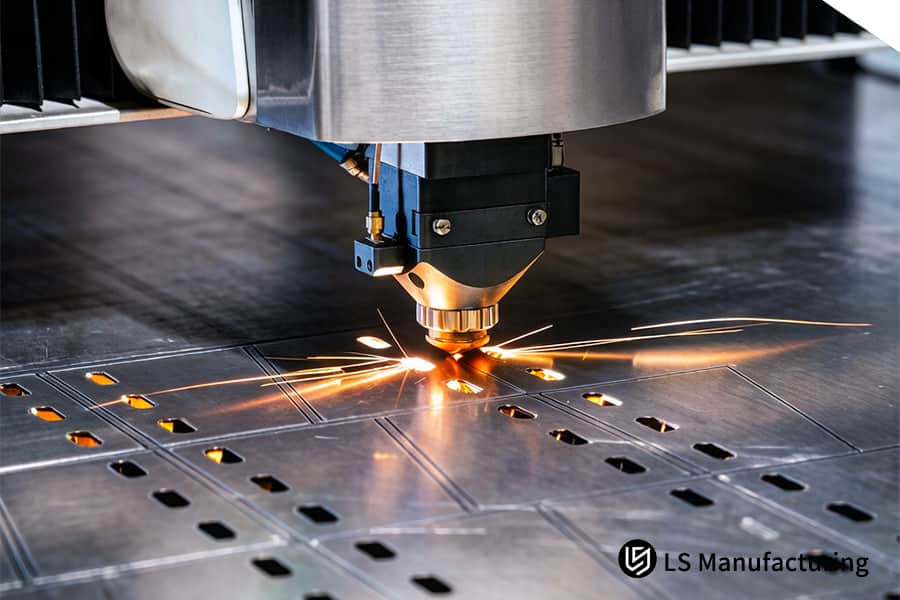
Figure 1: A laser melts 316L stainless steel for heavy machinery housings in precision sheet metal fabrication services.
Why Should Engineers Prioritize Precision Sheet Metal Fabrication Services For Deep Drawn Components?
Engineers need to take into consideration the importance of precision sheet metal fabrication services for deep drawn parts in order to address the issue of the difficult balance of keeping a part from wrinkling or from fracturing. The process of deep drawing offered by LS Manufacturing offers an innovative solution by providing proper material flow through closed-loop blankholder force technology. This means that we provide extra material security while minimizing scrap and speeding up the cycle:
Dynamic Blankholder Force Optimization
Anything above 3:1 ratio in terms of sheet height to diameter is no longer possible under static pressure for homogenous material feed. Our sheet metal fabrication services involve the use of hydraulic proportional valves that enable precise control of blank holder forces within the stroke cycles of the press. This achieves an optimal combination of compression and tensile forces, making it ideal for advanced sheet metal fabrication processes without wrinkling in the center area.
Wall Thinning Control for Extreme Environments
Incorrect thinning during the deep drawing process of stainless steel of 0.8mm thickness can impact the integrity of pressure vessels. One of our approaches to ensure optimal results is by using FEA to analyze the distribution of radial stresses in the deep drawing process. These adjustments limit the degree of thinning to less than 15%, ensuring accurate precision sheet metal fabrication.
Defect Prevention via Process Simulation
Without simulation, there is the risk of failure in the manufacturing process as a result of random stress fields. With our simulation process, we detect the strain paths and flow of material in order to ensure that the right process is followed in each phase. This eliminates any guesswork and makes it easier to carry out complex sheet metal fabrication processes using asymmetrical profiles.
Validation Under Operational Stress Profiles
The survival of the part depends on how it physically performs after its manufacturing. We validate deep drawn parts using burst pressure testing and cyclic fatigue testing, comparing physical performance with predicted simulation performance. Dimensional checks show physical compliance, ensuring quality assembly during specialized sheet metal fabrication processes.
LS Manufacturing utilizes simulation-based design techniques combined with thorough physical verification, creating high-precision fabrication processes that are not possible for conventional manufacturers. Our solution takes away all guesswork, delivering consistent and reliable components which consistently meet the most demanding engineering specifications through process control using data analysis.

How Does Complex Geometry Sheet Metal Forming Manage Springback Issues In High Strength Alloys?
Springback in high strength alloys is a challenging issue in complex geometry sheet metal forming, often causing unpredictable dimensional inconsistencies that negatively impact the assembly process. At LS Manufacturing, we use a precisely calibrated predictive system that compensates for any springback effects, ensuring that the angle accuracy is maintained at less than one degree in complex geometries:
Material-Calibrated Springback Modeling
- Lot-Specific Data Ingestion: Batch-Level Material Information Integration: Our material-calibrated predictive model accounts for certified HRB hardness and tensile properties by batch, correlating springback levels with the metallurgy of incoming high strength alloys.
- Work-Hardening Mapping: Mathematical equations calculate the gradients of strain-hardening behavior through complex curves, estimating non-uniform elasticity in complex 3D geometry.
Digitally-Compensated Tooling Strategy:
- FEA-Guided Die Offset: FEA calculations determine the exact negative angles of compensation for CAD surfaces prior to die machining, creating an over-formed computer-generated die in anticipation of springback.
- Variable Axis Correction: The multiple-axis compensation of complex surfaces yields precise final shape angles ±0.5°, ensuring the precision needed in tight-tolerance sheet metal fabrication.
Validated Closed-Loop Execution
- Inline Metrology Feedback: LS Manufacturing’s sheet metal fabrication services employ on-line laser measurement systems that capture springback data immediately after press unloading.
- Adaptive System Refinement: First piece inspection fine tunes our intricate sheet metal fabrication process to perfection, progressively approaching zero-defect mass production.
The engineering-based design by LS Manufacturing guarantees certainty on the assembly line as it solves for springback before the material is bent. The unique integration of material science and simulation optimization by LS Manufacturing guarantees that there will be no need to make adjustments after manufacturing, thus setting a new benchmark for demanding sheet metal fabrication.
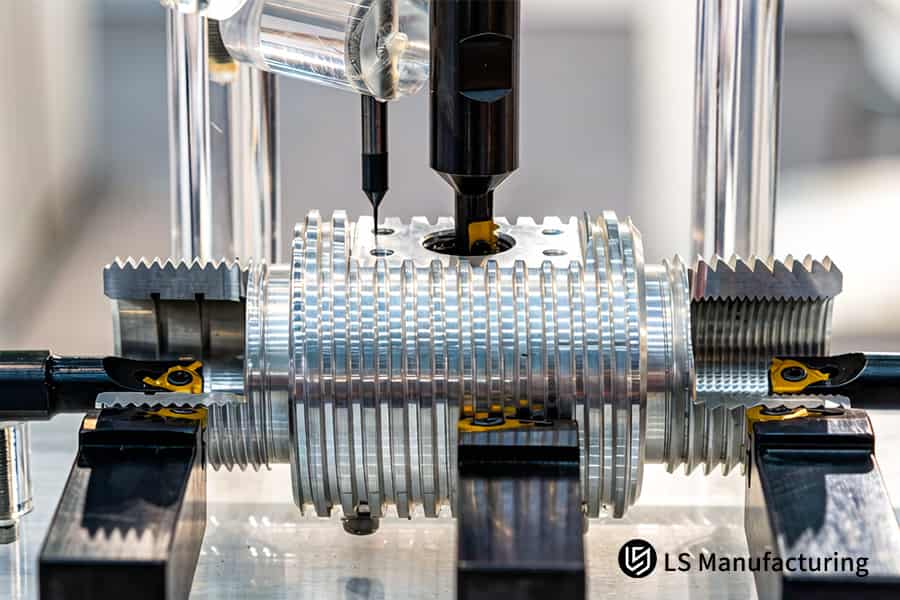
Figure 2: Fabricating complex sheet metal parts with precision tools for aerospace structural frame components.
What Role Do Custom Sheet Metal Fabrication Solutions Play In Solving Multi-Axis Bending Interference?
If there are more than eight bends in a congested arrangement, bending interference poses significant challenges that create a danger of faulty operation of tools and dimensional inaccuracies. This research will demonstrate how LS Manufacturing uses custom sheet metal fabrication solutions to avoid any potential clashes using computer simulation and special machinery designs, thus making perfection on the first try in assembling complex systems possible with rigorous sheet metal fabrication.
| Challenge Area | Engineering Approach |
| Bending Interference Simulation | Simulation based on 3D kinematics detects collisions between tools and parts during path planning before programming for complex sheet metal parts. |
| Segmented Tooling Deployment | Unique modular punches and dies are employed to achieve adequate clearance, allowing for the one-time creation of full U-shaped grooves in tailored sheet metal fabrication processes. |
| Structural Stability Management | Specially engineered multi-axis clamps and supports are used to maintain rigid control of sheet metal elements throughout rotational processes, critical for high-accuracy sheet metal fabrication. |
| Cumulative Dimensional Integrity | The simultaneous manufacturing of all bends prevents any accumulation of positional tolerance errors, maintaining aggregate angle deviation within ±0.5°. |
This engineering-driven method allows for transforming collision threats into consistent processes that have been validated digitally with specialized tooling solutions. The company manufactures complex sheet metal parts while retaining their design accuracy without the necessity of any modification or adjustments, which would otherwise become an issue for the assembly process. Our knowledge and experience in advanced custom fabrication will be clearly demonstrated in this case.
Why Is High Precision Sheet Metal Forming Essential For Heat Dissipation Structures In 5G Equipment?
Proper thermal management for the 5G network requires heat sinks with fin spacing under the millimeter threshold, as tiny geometric errors result in serious thermal losses. Our high precision sheet metal forming services ensure proper structural integrity with a rate of 60 cycles per minute, thus making sure that your electronic parts stay within safe temperatures during demanding sheet metal fabrication.
Progressive Die Alignment Systems
For 0.3mm aluminum fins, standard stamping introduces skew that disrupts laminar airflow. Our precision sheet metal fabrication services deploy guided progressive dies with ±5µm micro-pilots, mechanically enforcing fin parallelism and perpendicularity throughout the progression. This rigid guidance ensures consistent channel geometry, maximizing effective surface area for advanced thermal sheet metal fabrication.
Inline Optical Verification
Manual observation will fail to monitor drift at high speed. We incorporate vision sensors that take measurements of fin coplanarity at a frequency of every five strokes, relative to CAD datums, and monitor any drift as small as 0.02mm. Feedback from automated adjustment of the press ensures no defects accumulate and maintains greater than 99% of effective dissipation area in our high-reliability sheet metal fabrication process.
Strain-Robust Forming Strategy
Fabrication of 0.3mm thick aluminum fins is prone to distortion that might lead to turbulence of laminar flow. Sheet metal fabrication services provide progressive dies with ±5µm micro-pilots that enable accurate formation of fin alignment during fabrication. This ensures consistent geometry of the channel to optimize the effective surface area in long-term thermal fabrication processes.
Thermally Correlated Validation
Manually inspecting products on a conveyor belt is ineffective, particularly when dealing with fast-paced operations. Our approach includes inline vision sensors sampling fin coplanarity every five strikes relative to CAD datums to identify deviations as tiny as 0.02mm. Automatic control of the press parameters helps eliminate defects and ensures >99% effective dissipation area in our performance-critical sheet metal fabrication.
LS Manufacturing is the perfect balance of exacting forming and thermal function through intelligent tooling and obsessive validation, representing authentic engineering-led sheet metal fabrication. Our approach converts manufacturing variance into expected thermal results, ensuring the heat sink provides reliable cooling under sustained loading to safeguard expensive 5G technology in ways that commodity producers simply can’t compete.
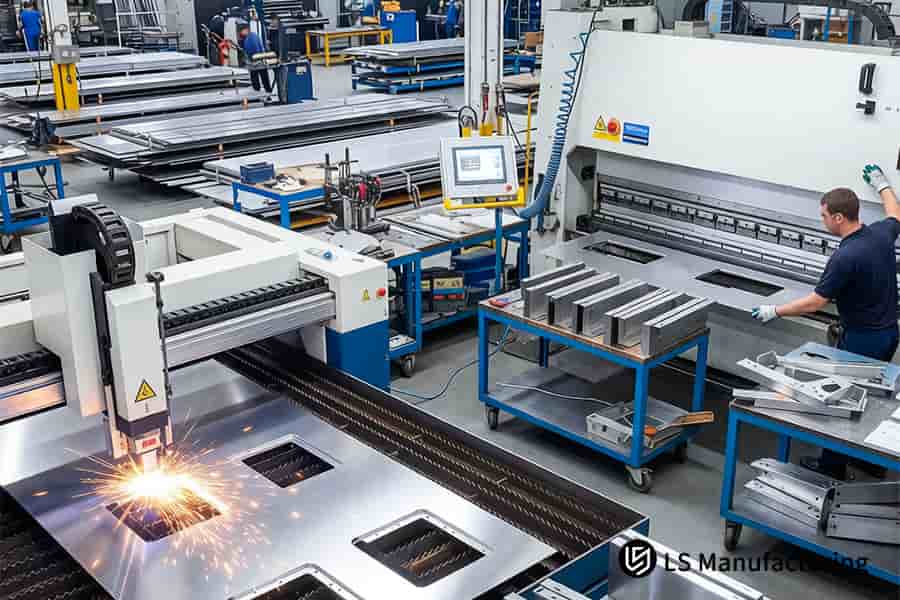
Figure 3: A worker monitors precision fabrication of 6061 aluminum plate for automotive sensor housing.
How Can Manufacturers Overcome Sheet Metal Forming Challenges During Large Scale Batch Production?
Process variation in a high volume production process accentuates typical sheet metal forming challenges, leading to dimensional variations that hinder assembly interchangeability. To address this problem, LS Manufacturing incorporates live statistical process control (SPC) in our sheet metal fabrication services, using real-time sensing to ensure a tolerance of ±0.05mm for 500,000 units:
Real-Time Parameter Monitoring
- Press Force Tracking: Force sensors gauge punching/shearing forces on a cycle-by-cycle basis, issuing warnings for any discrepancies above ±1.5%, which signify tool wear or variations in materials.
- Thermal Stabilization: Temperatures at the die face are monitored using thermocouples; cooling breaks are instituted whenever thermal expansion jeopardizes clearances in high-volume sheet metal fabrication.
Predictive Wear Forecasting
- Trend Analysis: SPC programs generate force and temperature trend charts based on historical tool-life data to predict wear rates without exceeding acceptable tolerance values.
- Proactive Maintenance: Scheduled tool polishing or replacement takes place at 85% projected tool wear limits, allowing for proactive planning to avoid unexpected downtime and sustain ±0.03mm dimensional stability.
Adaptive Process Correction
- Closed-Loop Adjustment: Sensor data enables real-time adjustments to press pressure and feed lengths, correcting any process shifts in no more than two cycles.
- Consistency Enforcement: Automated control of ram heights and pressures ensures that bend angles remain consistent (+/-0.25°) for high volume automated sheet metal fabrication.
Standardized Batch Integrity
- First/Last Part Matching: The in-line CMM inspection confirms that unit #1 and #500,000 match in terms of their geometric shape, within ±0.05mm tolerances.
- Traceable Documentation: Complete records of SPC are provided with all shipments, demonstrating the batch production quality relative to original design specifications.
At LS Manufacturing, we turn volume manufacturing from a source of uncertainty into a certain engineering result using our highly sophisticated instrumentation for industrial-grade sheet metal fabrication. By monitoring the well-being of our tools using our SPC methodology, LS Manufacturing ensures supply chain integrity when other approaches fall short due to their reactive nature.
Why Choose Precision Metal Forming Services For Medical Grade Titanium Implant Enclosures?
The medical grade titanium metal is susceptible to work hardening and biocompatibility requirements, which make tight radius enclosure fabrication challenging. At LS Manufacturing, we employ our precision metal forming services, which allow us to overcome such limitations using proper thermal treatment techniques, as follows:
| Challenge | Technical Solution |
| Work Hardening Mitigation | The use of intermediate vacuum annealing will help to maintain ductility after each forming step, which prevents the formation of cracks in areas of high stress. |
| Tight Radius Achievement | The use of step-wise bends along with precise ground tooling allows for tight radius production without causing localized thinning in excess of 10%. |
| Biocompatibility Preservation | Since all of our thermal treatment and forming is done in a contamination-free environment, we only use medical grade fabrication protocols. |
| Regulatory Traceability | Information about cycle pressure, dwell times, and temperatures are all recorded for traceability purposes following the guidelines set out by ISO 13485. |
Our custom sheet metal fabrication solutions have turned dangerous titanium forming processes into a standardized and reproducible methodology. We provide anatomically compliant enclosures that satisfy regulatory submission criteria, thus providing our customers with auditable parts that can be backed up with comprehensive evidence from the production process. This is what sets us apart as experts in certified medical sheet fabrication, as precision is critical in such cases.
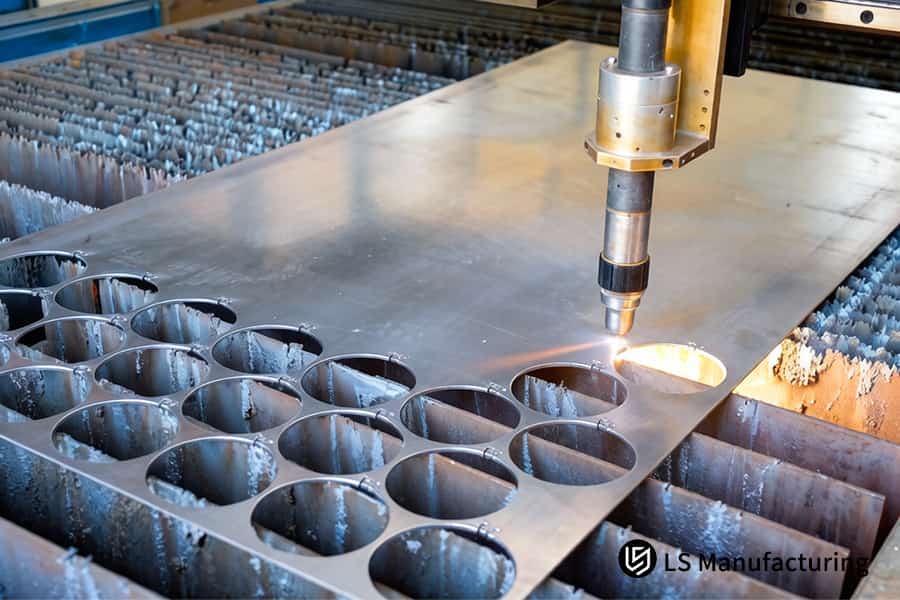
Figure 4: Piercing precise holes in 6061 aluminum for aerospace brackets with high precision sheet metal forming.
What Engineering Audits Should You Perform When Sourcing Complex Sheet Metal Parts?
Successfully sourcing complex sheet metal parts demands rigorous technical assessment to prevent costly redesigns, launch delays, and unintended manufacturing issues. This sourcing checklist outlines a systematic sourcing audit process designed to assess a prospective sheet metal fabricator's ability to reliably turn complex design concepts into high-yielding parts using precision sheet metal fabrication services.
Material Certification & Conformance Testing
Audits will need to confirm the performance of universal testing machines on the shop floor conducting a full tensile strength and elongation profile test on incoming coil inventory prior to manufacturing. This ensures validation of material properties according to manufacturer certificates to avoid premature failure in important assemblies and build a solid foundation for validated sheet metal fabrication processes.
Advanced Geometric Metrology Capabilities
The suppliers must have an optical comparator and high-resolution 3D scanning technology to digitally recreate complex, free-form geometries, including those hidden inside components. This equipment creates a point cloud that proves the part’s conformance to the CAD within microns, a requirement in certified precision sheet metal fabrication.
Simulation-Led Feasibility Assessment
Examine the regular use of FEA analysis when preparing estimates to determine the constraints of formability and stresses associated with complex sheet metal parts. Providers who rely on simulation-driven sheet metal fabrication are able to detect more than 80% of their potential problems before they invest in any tooling.
Actionable DFM Report Content
Examine examples of DFM reports, where you can find concrete suggestions about minimum bend radius, effects of grain direction, as well as accumulation of tolerances. Genuine engineering partners provide manufacturability risk assessment early on, using analytical sheet metal fabrication techniques that prevent costly redesigns and budget overruns.
LS Manufacturing creates a work process that is beyond these requirements for the audits, producing data-driven validation prior to cutting any material. Our process removes uncertainties from vendor guarantees and replaces them with proven engineering data to deliver audit-proven sheet metal fabrication that secures project timescales and ensures certainty within the supply chain.
Case Study: LS Manufacturing Aerospace Inconel 718 Complex Geometry Forming Project
An aerospace research institute was experiencing critical delays in the development of an Inconel 718 exhaust shroud because of excessive springback and mid-flange fractures. This paper examines the steps undertaken by LS Manufacturing to implement a custom sheet metal fabrication solutions for resolving such extreme complex geometry sheet metal forming problems using our aerospace sheet metal fabrication techniques.
Client Challenge
The customer needed an Inconel 718 shroud with a 1.2mm thickness that could handle compound curved forms at a ±0.15mm profile tolerance level; however, the client’s existing vendor was not capable of working with this type of material due to its high strength and memory behavior. Scrap rates of 60% caused by cracks and dimensional deviations caused a delay in R&D efforts of three months, which led to the identification of serious shortcomings in the standard high performance sheet metal fabrication process.
LS Manufacturing Solution
The multi-physics co-simulation helped us employ a tool face pre-setting compensation of 0.2mm, thereby offsetting any potential springback effect. In this regard, our team designed a technique involving controlled heating and new drawbead design to distribute restraint forces uniformly to avoid stress build-up and fractures during sheet metal fabrication.
Results and Value
Success with first-off tooling increased yield to 98.5% without any scrap loss and ensured rapid deliveries to match initial deadlines. The customer honored LS Manufacturing with an award for “Supplier of the Year” and transferred all complicated aerospace business exclusively to us, proving our aerospace sheet fabrication method capable of producing vital parts for their aircraft propulsion systems.
This project demonstrates how LS Manufacturing successfully converts difficult designs into predictable and reproducible results using sophisticated physics-based modeling and thermal processing. We provide verified complex fabrication systems based on full-process documentation that builds customer confidence, minimizes overall life cycle costs, and creates an undeniable competitive advantage in challenging aerospace projects by sheet metal fabrication.
Eliminate springback in aerospace-grade Inconel materials. Partner with our sheet metal fabrication services to achieve a 98.5% first-pass yield.

FAQs
1. What is the maximum material thickness for your precision sheet metal fabrication services?
We have extensive precision forming lines that cater to the whole range of materials in sheets with a thickness starting from 0.05mm up to 6.0mm. Such a range allows us to guarantee consistent bend radius regardless of the gauge of material used.
2. How does LS Manufacturing handle springback in complex geometry sheet metal forming?
Springback in complex geometries is handled by means of FEA simulation in design and calculation of over-bending angles and adjustments in draw allowance before actual mold engineering.
3. Do your sheet metal fabrication services support rapid prototyping within 24 hours?
Indeed, with agile manufacturing cell and automation of fast die change technology we provide fast sheet metal parts prototypes within 24-48 hours of receiving the approved drawings on any R&D project.
4. Why are LS Manufacturing's custom sheet metal fabrication solutions more cost-effective?
The cost-effectiveness of our services comes from thorough DFM study at the design stage, which reduces iterations for modifying dies by 30% and smart nesting to maximize material usage up to 92%. The savings generated are passed on in lower costs while keeping the product quality at a premium.
5. Can you maintain tolerances below 0.01mm in high-precision sheet metal forming?
With the help of high-precision optical probing devices, along with micron precision servomotors, the required positional tolerance is maintained under ±0.01mm in sheet metal forming. Controlled machining environment conditions ensure repeatability in this tight tolerance range.
6. How do you address the sheet metal forming challenge of surface scratching on polished parts?
Surface scratches in polished parts are avoided through the use of specially designed PVD molds along with non-scratchable polymer films for forming the part. The end result is a polished stainless steel part with no need for further polishing operations.
7. What industries typically require LS Manufacturing's complex sheet metal parts?
We are dedicated to industries that require ultra-high precision under tight conditions; hence, we manufacture hermetically sealed boxes for semiconductors, EMI-protected enclosures for medical imaging devices, and aluminum battery trays for electric vehicles. In these industries, the knowledge of our experts is invaluable to meet strict design and space criteria.
8. How can I request a quote for precision metal forming services at LS Manufacturing?
Send us your file via our online portal, and our expert engineering department will review it in no time. We'll provide you with a quotation with proper DFM recommendations within one working day.
Summary
With advanced industrial design that involves geometry in practical applications, complex sheet metal forms the benchmark for genuine supplier competency. At LS Manufacturing, with its expertise in multiphysics simulation, highly precise tooling and flexible pipelines, from prototype creation to large-scale manufacturing, we are not just suppliers of fabrication solutions but rather specialists in solving highly complex engineering problems for your business.
Do you currently have highly complex geometric forming issues that ordinary manufacturing plants cannot resolve? Do not sacrifice your outstanding product design due to the restrictions posed by manufacturing capabilities. Contact LS Manufacturing for a free detailed "Design for Manufacturability" (DFM) assessment of your product from our highly skilled engineers right now. Upload your drawing immediately to get a full assessment report including optimization of material usage, forming risks and an expert quote in just 24 hours!
Please click the button below immediately to upload your drawings and begin a professional consultation on sheet metal fabrication.
📞Tel: +86 185 6675 9667
📧Email: info@lsrpf.com
🌐Website: https://lsrpf.com/
Disclaimer
The contents of this page are for informational purposes only. LS Manufacturing services There are no representations or warranties, express or implied, as to the accuracy, completeness or validity of the information. It should not be inferred that a third-party supplier or manufacturer will provide performance parameters, geometric tolerances, specific design characteristics, material quality and type or workmanship through the LS Manufacturing network. It's the buyer's responsibility. Require parts quotation Identify specific requirements for these sections.Please contact us for more information.
LS Manufacturing Team
LS Manufacturing is an industry-leading company. Focus on custom manufacturing solutions. We have over 20 years of experience with over 5,000 customers, and we focus on high precision CNC machining, Sheet metal manufacturing, 3D printing, Injection molding. Metal stamping,and other one-stop manufacturing services.
Our factory is equipped with over 100 state-of-the-art 5-axis machining centers, ISO 9001:2015 certified. We provide fast, efficient and high-quality manufacturing solutions to customers in more than 150 countries around the world. Whether it is small volume production or large-scale customization, we can meet your needs with the fastest delivery within 24 hours. choose LS Manufacturing. This means selection efficiency, quality and professionalism.
To learn more, visit our website:www.lsrpf.com.