English




TIG welding service is one of the biggest challenges facing the high-precision industries like the semiconductor and aerospace industries. For these industries, the standard process results in "weld and scrap." Uncontrolled heat input results in severe distortions for thin sections less than 1.0mm thick. It also results in product failures. This is because the process is viewed as manual labor, with important factors like 99.999% argon purity and stress control for dimensional stability being completely neglected.
Our "full process thermal control" framework provides the solution to this challenge. It is done using pulsed arc technology and our proprietary back purging techniques. It provides the best possible weld geometry and reduces stresses by over 40%. Flawless welds require a very rigorous engineering discipline. The following is our technical audit guide.
Precision TIG Welding: A Comprehensive Quick-Reference Guide
| Critical Aspect | Implementation in Manual TIG Welding |
| Process Control & Heat Input | Weldor controls the arc, filler, and speed of travel, which allows for precise control of heat input, vital for thin materials and exotic metals. |
| Joint Preparation & Fit-up | Welding of high-quality welds demands exceptional cleanliness of the joint, along with precise fit-up. Any gaps should be minimal. Weldor takes great care in joint preparation. |
| Shielding Gas Purity & Coverage | Argon gas, which is inert, must provide a perfect shield. Weldor uses pure gas, flow rates, and techniques to prevent oxidation of the weld. |
| Weldor Skill & Certification | Weld quality is directly related to the skill level of the weldor. Weldor has advanced skill levels in welding for aerospace, medical decives, nuclear industries, etc. |
| Material-Specific Techniques | Weldor uses specific techniques for aluminum (AC), stainless steel (DCEN), titanium, and other reactive metals. Sometimes, these metals are welded in a purge chamber. |
| Our Quality Assurance Protocol | All critical welds are visually inspected, with the option to include Dye Penetrant Testing (PT) or Radiographic Testing (RT) to ensure internal as well as external integrity. |
| Result: Superior Weld Integrity | Provides strong, ductile, and contaminant-free welds with excellent metallurgical properties for the toughest demands. |
| Result: Exceptional Aesthetic Finish | Creates clean, consistent, and virtually invisible welds with little to no finishing required, ideal for cosmetic or sanitary requirements. |
We provide the solution to the problem of achieving the best possible quality, reliable welds for your critical components. Our manual TIG welding process is an art form mastered by our team, with strict protocols followed to create welds that are strong, pure, and visually stunning. This guarantees your components will work flawlessly under pressure, meet the toughest industry requirements, and maintain integrity in the harshest conditions, from space chambers to medical devices.
Why Trust This Guide? Practical Experience From LS Manufacturing Experts
While there are countless online articles about precision TIG welding service, what you'll read here is the truth tempered by the fires of real-world fabrication. Our high-quality manual welding is refined every day on difficult aerospace and medical device parts where the quality of the weld is paramount. Our methodology is based on rigid standards derived from the Occupational Safety and Health Administration (OSHA) guidelines to guarantee every weld is of the highest quality in terms of safety and performance.
Our expertise is based on a decade of experience in resolving difficult welding problems related to thin-wall distortion and reactive materials. We've refined the precise parameters required for pulsed TIG welding to guarantee optimal results, a process outlined in some of the engineering principles outlined in Machine Design magazine.
This is because the expertise we offer is not based on theory alone, but on the hard work and practice required to ensure the techniques we recommend, from gas flow rates to electrode preparation, actually work. We can offer the expertise required to ensure consistency and quality in every weld, every time.
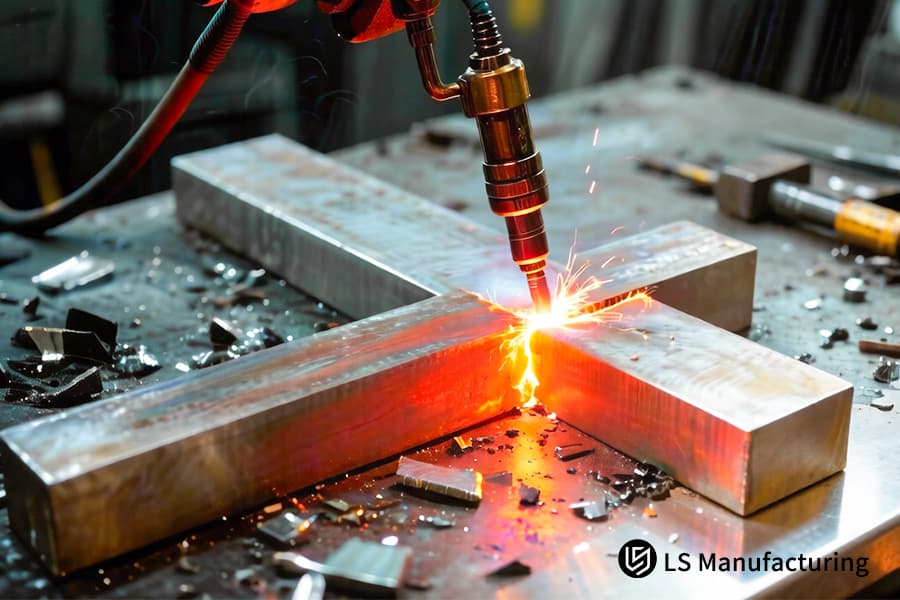
Figure 1: Assembling a custom square steel frame with TIG welding for machinery guards or structural support fixtures.
Why Is selecting A Professional TIG Welding Service Critical For Thin Walled Precision Components?
In the case of thin-walled components with wall thickness ranging from 0.5mm to 2.0mm, the uncontrolled heat input during the welding process can cause distortion, grain growth, and residual stresses, which can compromise the dimensional stability and functionality of the components. Therefore, the selection of a professional TIG welding service is not only important but also indispensable to mitigate these risks through the controlled heat input during the process. The value proposition is to transform the parameters into the outcome with minimal impact.
Precise Heat Input Management via Pulsing
We achieve this by strategically using a pulsed current. As opposed to a constant arc, we pulse the current and allow time for the material to cool. This approach results in a minimized heat affected zone (HAZ) by more than 30% compared to conventional techniques, thus directly eliminating warpage and metallurgical degradation in thin materials.
Ensuring Consistency with Parameter Optimization
Consistency is non-negotiable. For the material and thickness in question, the optimal pulse frequency and duty cycle is established through empirical testing. This creates a stable weld pool, which guarantees consistency in terms of penetration depth and bead shape throughout the entire weld. It is this level of consistency, which is the true definition of precision welding service, which guarantees every product in the batch is to the exact same, stringent standard.
Mitigating Oxidation with Advanced Gas Techniques
In addition to the torch, our gas shielding techniques are multifaceted. This includes the application of a backing gas, also referred to as back purging. This is applied to the backside of the weld. This is a vital component in our manual welding service, which prevents oxidation and the creation of sugars on the backside of the weld bead.
Validated Outcomes Through Rigorous Documentation
Our process is rounded out by a verification step. Each project creates data logs of parameters and results, which creates a feedback loop to continually improve our techniques. This is a reliable approach to predictability and control, which transforms the challenge of thin-wall TIG welding into a predictable engineering discipline, which safeguards your most critical components.
This document is more than simply generic advice because it outlines the decision-making and technology employed in a professional precision TIG welding process. What makes a precision TIG welding service provider competitive is a methodology focused on achieving reliable and distortion-free joints in high-value thin-gauge assemblies, as outlined in our manual TIG processes in critical industries.

How Can A Precision TIG Welding Service Manage Complex Thermal Deformation In Custom Stainless Steel Frames?
The low thermal conductivity of stainless steel causes a high concentration of heat during welding, which in turn causes severe and unpredictable distortions in custom frames. Our custom TIG welding service eliminates these problems by actively managing the thermal cycle during welding by using sequential techniques in combination with real-time monitoring. This ensures that critical tolerances, including ±0.2mm flatness, are maintained:
Sequential Skip Welding Strategy
- Our Method: A skip sequence is programmed into our welding process, distributing heat input across the frame assembly to avoid thermal buildup.
- Problem Solved: This approach systematically counteracts uneven shrinkage effects causing warping and twisting in custom frames.
Active Fixturing with Integrated Cooling
- Our Method: Custom hydraulic flattening jigs are used during the welding process to counteract warping tendencies in custom frames, while copper chill bars actively remove heat from critical areas.
- Problem Solved: This approach actively counteracts warping in real-time, reducing inherent stress in the stainless steel TIG welding process itself.
Real-Time Thermal Monitoring and Control
- Our Method: We require interpass temperature control via infrared pyrometers and maintain a stringent sub-100°C requirement prior to proceeding.
- Problem Solved: This process prevents carbide precipitation and maintains the material's inherent corrosion resistance, a key factor in our high quality welding service commitment.
Validated Outcome: Minimal Post-Weld Rectification
- Our Method: The cumulative result of the above process is a predictable outcome for every low distortion TIG welding project undertaken by our company.
- Problem Solved: The finished frame is provided within the required ±0.2mm flatness specification, thereby negating costly and time-consuming post-weld straightening operations.
The above protocol represents our active engineering controls, which comprise a true precision TIG welding service. Our competitive advantage is our empirical and controlled process for complex TIG welding projects, offering dimensionally stable, fully welded parts made of stainless steel without compromise.
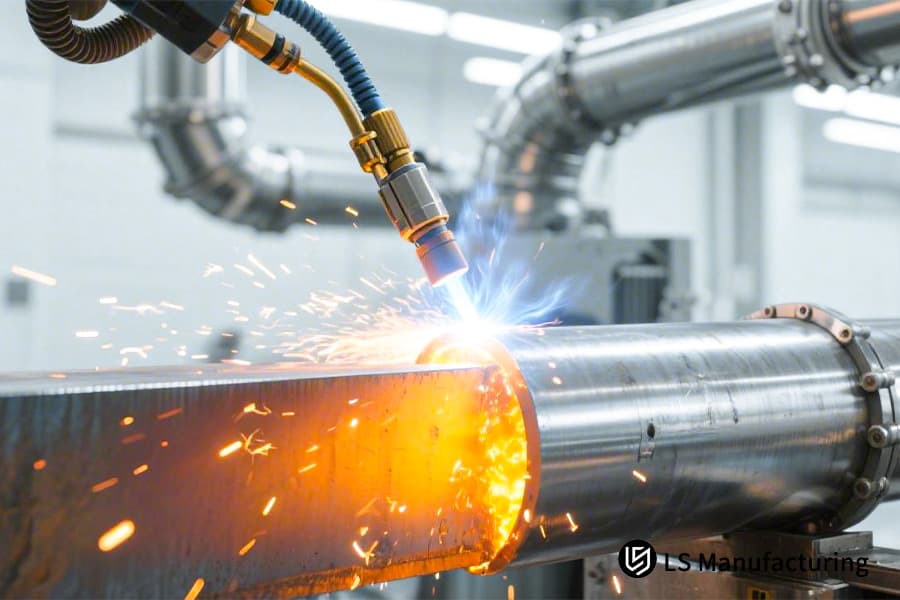
Figure 2: A welder joins stainless steel pipes with a TIG torch for industrial process piping or manifold systems.
What Are The Engineering Standards For High Quality Welding Service In Semiconductor Vacuum Chamber Projects?
The welding of semiconductor vacuum chambers has to meet a level of hermeticity that is not normally encountered in other welding operations. The problem in welding for these types of applications is to remove all possible leakage routes and contamination within the weld. Failure in these areas will have significant implications for the ultra-high vacuum environment that is a necessity for these semiconductor processing operations. The following document represents quantifiable engineering standards and protocols that can be used to define a precision welding service to these industries:
| Engineering Standard | Implementation in UHV Chamber Fabrication |
| Leak Rate Criterion | Leak rate must be <1x10⁻⁹ mbar·L/s, and helium mass spectrometer testing must be used. |
| Base Material Preparation | 316L grade stainless steel must undergo precision machining and then undergo a multi-stage solvent and alkaline vacuum degreasing process. |
| Joint Design & Preparation | Full penetration welds must be designed, and precision machining and cleaning must be performed prior to UHV chamber TIG welding. |
| Atmosphere Control | 100% internal argon back purging must be performed, and the oxygen content must be maintained below 20 ppm to avoid sugaring and oxidation. |
| Welding Process Execution | TIG welding for custom parts is executed with autogenous processes as well as matched filler wire processes, with control over heat input to prevent distortions. |
| Post-Weld Verification | A standardized bake-out process is followed by helium leak verification to ensure the integrity of the semiconductor-grade TIG welding. |
This protocol will serve as the empirical benchmark for which a high quality welding service is measured in relation to the fabrication of a semiconductor device. What will set us apart is our methodology and results in ultra-high vacuum welding that have addressed the essential client concerns of absolute vacuum integrity, in-process contamination avoidance, and non-negotiable requirements of semiconductor equipment manufacturers. This document will serve as our proof of these capabilities.
How Does A Custom Metal Welding Service Balance Aesthetic Weld Appearance With Structural Integrity?
A high quality weld will be one that not only possesses critical strength qualifications but also possesses a quality appearance that is a strong indicator of quality within. I believe that this is perhaps one of the greatest challenges for a custom welding service, particularly when working on a project that will be part of an architectural, automotive, or consumer-based project. This document will outline the methodology behind a high quality welding service where not only is the appearance of the weld impeccable but performance is not sacrificed, particularly in an architectural-based project utilizing a TIG welding style.
Mastering Arc and Filler Metal Control
The regular and artistic shape of the bead is a result of our control over the arc length and filler rod positioning, which is described as a fluid, overlapping motion, creating a regular stacked dime or fish scale pattern. This action is required for fusion and penetration, which is key to a strong and attractive weld in any architectural TIG welding project.
Validating Internal Integrity with NDT Methods
Though a weld may look perfect on the outside, it is imperative that internal integrity is validated as well, which is why we use radiographic (X-ray) and liquid penetrant inspections on critical welds performed by our team. These methods provide a definitive assessment of the absence of internal conditions such as porosity, slag, and lack of fusion that could cause a weld to fail in service, ensuring the reliability of a TIG welding for custom parts.
Implementing a Dual-Criteria Quality Standard
Each welded piece is subject to two-fold assessment, wherein the aesthetic quality is assessed based on smoothness, consistency, and discoloration, and the structural integrity is validated against engineering drawings. Such is the essence of our custom metal welding service, wherein the product not only functions optimally but also boasts the best aesthetic quality for the welded parts, thus resolving the dilemma of form versus function.
Leveraging Material-Specific Procedures
This is where the material-specific procedures come into play. For instance, in the case of stainless steel, gas mixes and flow rates are employed to maintain the passive film and color. For aluminum, heat input is controlled to prevent grain growth while maintaining the appearance of the weld. It is the application of the precision TIG welding techniques that makes all the difference.
This document will outline the process, which is a controlled and verification-based methodology to truly define an integrated welding solution. Our point of differentiation in the marketplace is this methodology for an TIG welding process, which actively works to resolve the dilemma that the client must face in choosing between beauty and strength in welds that must be certified and verified to be defect-free and excel in inspection and validation testing.
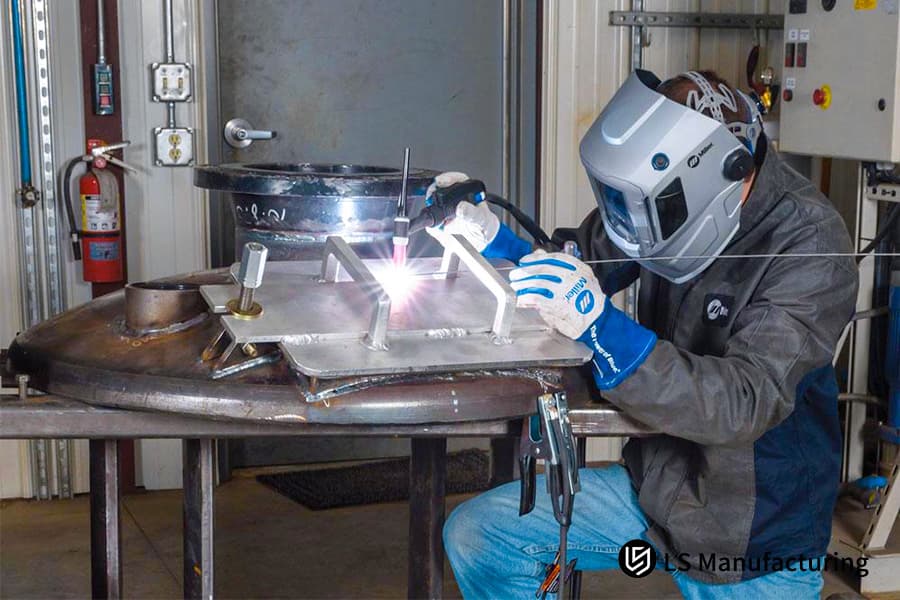
Figure 3: Welding a steel mounting bracket with 308L filler rod for automotive chassis or suspension component assembly.
Why Should Engineers Prioritize A Custom TIG Welding Service For Aluminum And Exotic Alloy Assemblies?
Welding aluminum and exotic alloys, like titanium, can be difficult because of the tendency for these materials to rapidly form an oxide layer, which can interfere with proper weld integrity. A generalized approach to these welds results in weak and contaminated welds. A custom TIG welding service is critical to implementing specific and controlled processes to actively counteract these natural behaviors:
Overcoming the Oxide Barrier
- Our Method: We use TIG welding with balanced wave control, which takes full advantage of cathode cleaning.
- Problem Solved: This safely breaks through the refractory oxide layer on the aluminum, with minimal penetration of the underlying metal, which is a critical requirement for clean welding.
Implementing Rigorous Pre-Weld Preparation
- Our Method: Our rigorous protocol includes a mandatory process of mechanical brushing, followed by alkaline cleaning and passivation for alloys such as 6061-T6 in the aerospace industry.
- Problem Solved: This critical step in welding aluminum alloys involves completely cleaning the surface contaminants and oxides just before welding, which is a critical requirement for a successful aluminum alloy TIG welding process.
Selecting Precise Filler Alloys
- Our Method: We take a meticulous approach to filler metal selection, which is critical in determining the grade of alloy and its required service conditions, e.g., ER4043 for general-purpose welding and ER5356 for higher strength.
- Problem Solved: This is critical in determining tensile strength, ductility, and resistance to cracks in the weld, which is a critical requirement in our custom metal welding service.
Controlling Post-Weld Metallurgy
- Our Method: Utilization of the appropriate post-weld heat treatment, such as re-aging for 6061-T6, in accordance with the material specification.
- Problem Solved: Restoration of the mechanical properties of the heat-affected zone to ensure that the assembly meets performance targets for challenging exotic alloy TIG welding applications.
This document outlines the material-specific protocols that constitute a capable TIG welding service for reactive materials. The key differentiator for our company in a crowded market is this scientific, controlled approach, which solves the essential problems for the client: oxide-free fusion, choice of filler metals, and retention of the parent metal's properties in high-performance TIG welding.
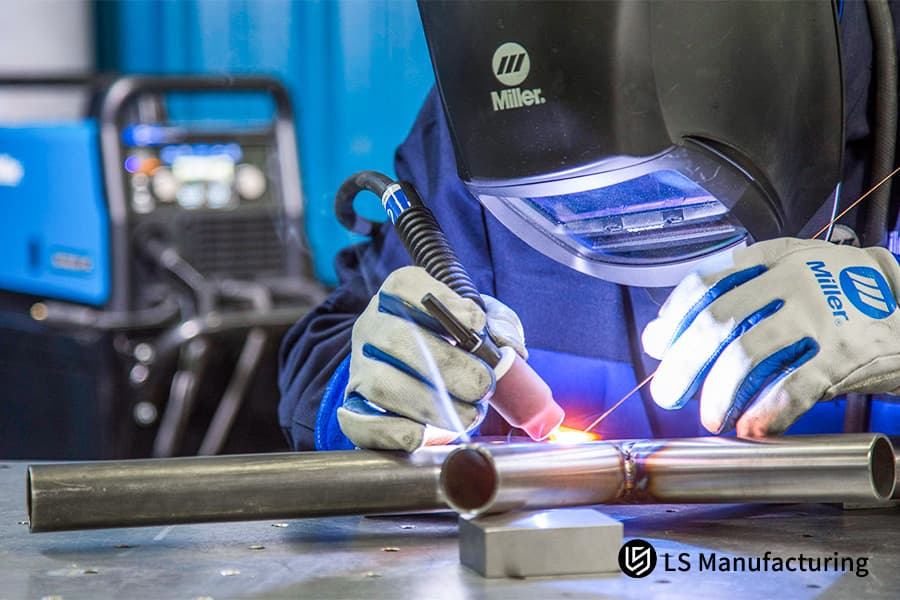
Figure 4: A welder fuses 304 stainless steel tubing with a TIG torch for fluid handling or structural system components.
How Can Manual Welding Service Expertise Reduce Development Costs For Specialized Laboratory Prototypes?
For specialized, low-volume laboratory prototype parts, the mix complexity and high rate of change can make automated welding systems difficult to justify. The true cost driver is not necessarily the welding process, but the iterative design process and redesigns required due to unmanufacturable design features. Early practitioner intervention in a manual welding service can provide critical Design for Manufacturability (DFM) advice, which directly translates to reduced design revisions and faster development cycles:
| Area of Expert Intervention | Impact on Prototype Development |
| Early-Stage Design Review | Expert welding engineers identify inaccessible joints and provide viable alternatives before fabrication, eliminating costly mid-project design changes. |
| Joint Accessibility & Geometry Optimization | Recommendations are provided to modify overly complex designs into simple and stronger butt joints, which remove stress points and improve the quality of prototype TIG welding. |
| Material and Filler Selection Guidance | Recommendations are provided for weldable material grades and filler materials to prevent cracking and ensure that the mechanical properties of the prototype are representative. |
| Iterative Build and Adjustment Support | Expert welders are able to adjust welding techniques on-the-fly for complex TIG welding assemblies, which facilitates rapid physical validation and design improvement in a single build cycle. |
The above document highlights that a genuine precision welding service involves performing upfront experience-based analysis of design for manufacture. Our custom metal welding service is aimed at directly addressing our clients’ problems by reducing design iteration by an average of 20%, preventing unfabricable design, and managing costs for low-volume TIG welding projects.
Case Study: LS Manufacturing Medical Aerospace Titanium Cooling Module Precision TIG Welding Project
This case study will discuss how the engineered solution provided by LS Manufacturing addressed the critical failure in the flight-critical titanium cooling module assembly. The precision welding service offered by us had to provide a solution to the critical failure, which became evident in the 50G qualification tests conducted on the titanium TA6V cooling module assembly, wherein a controlled atmosphere weld process was used to ensure weld integrity.
Client Challenge
Our global aerospace client had been suffering from a series of failures with their titanium TA6V cooling module assemblies during the mandatory qualification 50G shock tests. Our initial precision welding service had resulted in a series of weld fractures, which were caused by the atmosphere in the weld joint, with oxygen levels exceeding 200ppm, which is not visually evident but is critical in this flight-critical assembly. As a consequence, the client had to incur redesign and delay costs on this critical avionics project, with a 100% failure rate.
LS Manufacturing Solution
Our intervention approach was based on absolute control of the atmosphere. We developed a portable argon gas chamber that ensured that the oxygen level remained below 50ppm throughout the entire aerospace-grade TIG welding process. The innovation in the design lay in the post-weld controlled cooling cycle and the 100% liquid penetrant inspection of all welds. The controlled environment welding process was developed to prevent the alpha case embrittlement and micro-cracks that caused the failure.
Results and Value
The new modules have resulted in a 100% pass rate in the subsequent 12G vibration and 50G shock tests. The reliability of the process has also allowed the client to delete the 100% x-ray inspection requirement, which has resulted in a 15% cost reduction per unit. The reliability of the TIG welding process has resulted in the client consolidating their entire precision titanium welding business with us.
This can be seen in this case, whereby the ability to identify the root cause failure and carry out controlled processes can be seen. LS Manufacturing offers a risk-mitigating TIG welding service to ensure integrity issues are addressed. This, as can be seen in the 100% pass rate and 15% cost savings, is essential in high-stakes, high-value TIG welding applications in the aerospace industry.
Partner with LS Manufacturing for TIG welding that guarantees 50G impact certification and 15% lower assembly costs.

What Quality Audit Standards Ensure The Reliability Of TIG Welding For Custom Parts At LS Manufacturing?
For TIG welding for custom parts, the reliability of the TIG welding process is not taken for granted. It is systematically ensured through the verifiable quality chain. Within this document, the multi-layered standards used to ensure that the precision welding service not only promised but delivered can be seen, whereby every part functions accordingly:
Certified Personnel and Qualified Procedures
Furthermore, every welder working on critical projects is certified by AWS or has international certification equivalency, ensuring they are certified each year. Moreover, every individual project commences with a certified Welding Procedure Specification, whereby a Procedure Qualification Record physically validates the mechanical properties of the weld. This ensures a consistent quality standard by eliminating the problem of variability in manual TIG welding.
Rigorous First-Article and In-Process Verification
Our company is committed to 100% first-article inspection by 3D laser scanning to verify dimensional accuracy against CAD data before proceeding with production. During the actual production process, certain non-destructive testing techniques, including surface discontinuity testing by means of dye penetrant testing, will be employed in accordance with a WPS. This certified TIG welding process actively prevents errors in dimension and/or defects, ensuring a custom TIG welding service is dimensionally perfect.
Destructive Testing and Performance Validation
For pressure or structural assemblies, we perform hydrostatic or pneumatic testing to the client's specified proof pressure, confirming leak-tight integrity. Periodic destructive testing of witness coupons from production runs is also performed. This last validation step addresses the client's need to have absolute confidence in the integrity of the weld, i.e., to have empirical evidence of the reliability of the weld, not just visual confirmation.
Comprehensive Documentation and Traceability
Each and every component is accompanied by a comprehensive data package, which includes material certifications, weld maps, inspector reports, and NDT results. This ensures full traceability from raw material to finished product. This highly disciplined approach to documentation addresses the client's need to have unambiguous records of compliance and control in their high-integrity TIG welding.
Our audit system is the definition of an effective precision welding service. The competitive edge lies in the entire system of certified personnel, qualified procedures, multiple inspection processes, and full traceability, which actively resolves the client's risks on part conformity, in-service failure, and supply chain accountability for mission-critical fabrications.
FAQs
1. What is the minimum sheet thickness that LS Manufacturing's precision TIG welding service can handle?
Using the high-precision pulsed arc welding process, LS Manufacturing is capable of welding stainless steel and aluminum alloys with material thicknesses as low as 0.5mm, with no burn-through occurring on the weld.
2. How do you ensure that sensitive materials, such as titanium alloys, do not oxidize during the welding process?
We ensure that the weld seams attain a golden or silvery-white color by strictly enforcing procedures such as 99.999% high-purity argon back purging and trailing shield protection.
3. Does LS Manufacturing accept custom orders for single-piece prototypes?
Absolutely. We fully understand the critical importance of the R&D phase; LS Manufacturing maintains a dedicated unit for small-batch customization to support rapid prototype development, even for quantities as low as a single unit.
4. How do you ensure dimensional tolerances are met following the delivery of your custom metal welding services?
By utilizing precision welding fixtures in conjunction with CMM (Coordinate Measuring Machine) inspection, we can typically maintain linear tolerances for medium-sized welded assemblies within a stable range of ±0.3mm to ±0.5mm.
5. Why is TIG welding considered more reliable than MIG or laser welding for stainless steel vacuum components?
TIG welding achieves deep penetration without the need for excessive filler materials, resulting in a finer grain structure within the weld seam. Its superior leak-resistance performance makes it the preferred choice for the vacuum industry.
6. Can LS Manufacturing provide DFM (Design for Manufacturability) optimization recommendations prior to welding?
Yes. During the quotation phase, our welding engineers review the technical drawings and offer suggestions—specifically regarding joint design optimization—to help reduce processing time and minimize the risk of deformation by 10% to 20%.
7. How do you maintain quality consistency for batch orders processed via your manual welding services?
We ensure the standardization and predictability of quality in our manual operations through regular destructive cross-section analysis of weld seams, as well as 100% dye penetrant testing.
8. How can I obtain a formal quotation for TIG welding services from LS Manufacturing?
Please upload your STEP or PDF technical drawings, specifying any required tolerances and non-destructive testing (NDT) requirements. LS Manufacturing's team of experts will provide you with a transparent, itemized cost breakdown within 24 hours.
Summary
Metal welding is a sophisticated systems engineering discipline, encompassing materials thermophysics, arc dynamics, and rigorous quality validation. LS Manufacturing integrates artisanal craftsmanship with engineering data to eliminate manufacturing uncertainty through microscopic HAZ control, 100% inert gas shielding, and stringent NDT. Choosing us means partnering with a reliable firm that proactively anticipates risks and elevates welding to aerospace-grade standards.
Introduce zero-defect welding standards to your precision components; avoid letting mediocre quality become your supply chain's weak link. LS Manufacturing offers a complimentary DFM audit service, evaluating technical drawings and providing a comprehensive Specialized Technical Assessment Report with parameter recommendations, stress strategies, and cost breakdowns. Upload STEP files or contact our experts today for a one-on-one consultation to leverage precision and redefine your manufacturing foundation.
📞Tel: +86 185 6675 9667
📧Email: info@lsrpf.com
🌐Website: https://lsrpf.com/
Disclaimer
The contents of this page are for informational purposes only. LS Manufacturing services There are no representations or warranties, express or implied, as to the accuracy, completeness or validity of the information. It should not be inferred that a third-party supplier or manufacturer will provide performance parameters, geometric tolerances, specific design characteristics, material quality and type or workmanship through the LS Manufacturing network. It's the buyer's responsibility. Require parts quotation Identify specific requirements for these sections.Please contact us for more information.
LS Manufacturing Team
LS Manufacturing is an industry-leading company. Focus on custom manufacturing solutions. We have over 20 years of experience with over 5,000 customers, and we focus on high precision CNC machining, Sheet metal manufacturing, 3D printing, Injection molding. Metal stamping,and other one-stop manufacturing services.
Our factory is equipped with over 100 state-of-the-art 5-axis machining centers, ISO 9001:2015 certified. We provide fast, efficient and high-quality manufacturing solutions to customers in more than 150 countries around the world. Whether it is small volume production or large-scale customization, we can meet your needs with the fastest delivery within 24 hours. choose LS Manufacturing. This means selection efficiency, quality and professionalism.
To learn more, visit our website:www.lsrpf.com.