English




EV battery metal welding service is essential to make sure the sealing and structure of electric vehicle (EV) battery thermal management system. As the EV batteries' thermal management systems are integrated with 800V high voltage platform successfully developed which began to adopt aluminum alloy casing really.
But, stringent sealing and welding heat-affected zone (HAZ) of the meeting the EV battery thermal management system casing are ongoing challenges that conventional welding processes causes leakage or structural failure, and so on to restrict the enhancement of battery pack energy density. In this paper on metal welding technology, we examines key difficulties and pot for solutions, to assist EV produce to achieve the best combination of price and quality.
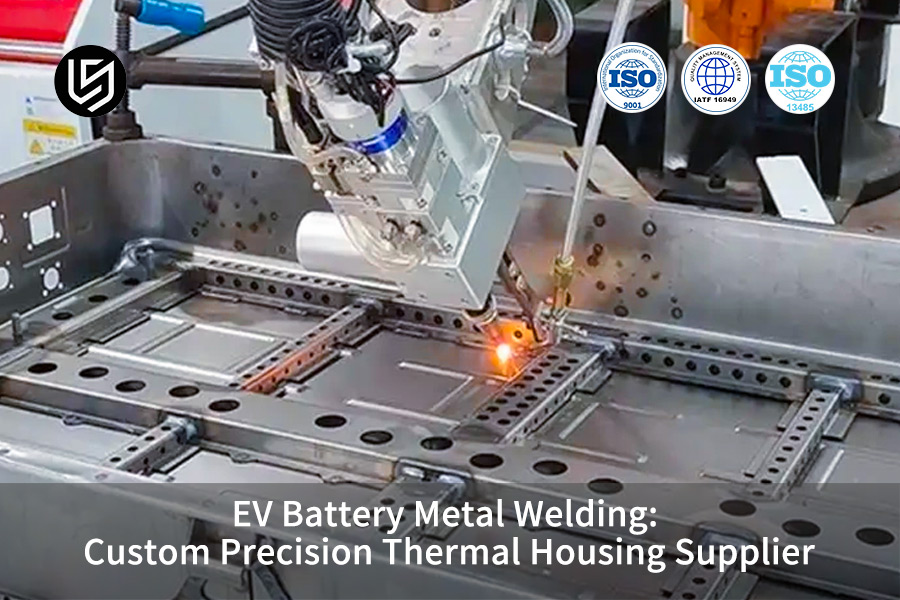
EV Battery Metal Welding Core Conclusion Overview
| Core Dimensions | Technical Solution | Key Data | Customer Benefits |
| Welding Accuracy | Waveform-controlled laser welding | Heat-affected zone controlled within ±0.1mm | Prevents thermal failure of sealing rings |
| Cost Optimization | DFM structure optimization | Weld length reduced by 15%, cost reduced by 20% | Reduces manufacturing costs |
| Sealing Guarantee | Helium mass spectrometry leak detection | 100% pass rate | Avoids high pressure leakage risks |
| Strength Guarantee | Pulse laser welding | Weld strength ≥ 85% of base material | Improves battery pack durability |
| Delivery Cycle | One-stop processing and testing | Sample delivery within 7-10 working days | Accelerates product launch |
Key Takeaways
- Welding Accuracy: The heat-affected zone of waveform-controlled laser welding is within the range of 0.1mm, avoiding seal heat loss.
- Cost Optimization: DFM redesign of shell structure decreases weld length by 15%, which leads to a general manufacturing cost decrease of about 20%.
- Trust Guarantee: LS Manufacturing has adopted the ISO 9001:2015 procedures, which has a 100 per cent pass rate in leak detection by helium mass spectrometry.
How Does LS Manufacturing's EV Battery Metal Welding Service Address Thermal Management Challenges?
Issues with electric vehicle battery thermal management system are frequently result of welding error, which is a chronic pain point. In our 3 month test works for an European car manufacture, the critical success factors are proper welding deformations and materials, strict ISO 9001:2015 process, and 100% of products to pass helium mass spectrometry leak inspection.
To fix the problem that the joints of Al 3003 and 6061 are not equally strong, we spent many hours coming up with a set of parameters for our welding procedure. We customized the laser pulse frequency from 50-100Hz after hundreds of trials to enhance the joining of the materials to prevent structural failure.
For fatigue cracks that are induced by the vibration, the method of oscillating welding is used to enhance weld width uniformity. And with forced air cooling fixtures to decrease the heat input, the welded joints can pass 50,000 pressure pulse cycles without any micro-cracks as the mass production standard IATF 16949:2016.
What is important is that selecting an appropriate EV battery metal welding service can directly lower the failure rate of the thermal management system, allowing customers to save greatly on after-sales maintenance costs.If you are facing thermal management challenges due to welding issues, please contact our engineers for a free one-on-one consultation. We will provide targeted solutions based on your specific needs.

Why Is LS Manufacturing The Best EV Battery Metal Welding Service Provider?
LS Manufacturing utilizes three-axis and five-axis laser welding systems to deliver battery pack thermal management component welding services which achieve tolerances of ±0.05mm. The system maintains its integrity because it prevents all deformation and leakage during testing at 10bar pressure through complex flow channels. LS Manufacturing plans to establish itself as the leading EV battery metal welding service provider because it will deliver real customer value instead of serving as a contract manufacturer.
Customized Welding Parameter Development for Aluminum Alloys
We specialize in developing customized welding parameters for 3000 and 6000 series aluminum alloys, particularly excelling in anti-penetration control of thin-walled thermal management housing structures (thickness <1.5mm).
The company has developed a complete parameter database which enables fast identification of optimal welding parameters that will enhance aluminum welding precision. The company offers dedicated custom precision welding solutions to fulfill the specific precision welding requirements of its customers. Specific parameters are shown in the table below:
| Aluminum Alloy Series | Thickness (mm) | Laser Power (W) | Pulse Frequency (Hz) | Welding Speed (mm/s) |
| 3003 | 0.8 | 1200 | 80 | 30 |
| 3003 | 1.2 | 1500 | 70 | 25 |
| 6061 | 0.8 | 1300 | 90 | 28 |
| 6061 | 1.5 | 1800 | 60 | 20 |
Comprehensive Testing and Technical Support Capabilities
The facility uses Zeiss coordinate measuring machine (CMM) and helium mass spectrometry (HMS) leak detection equipment to perform complete product testing which provides 100% leak detection capability while meeting IATF 16949 requirements. Our company offers DFM assessment and thermal simulation analysis services which help clients achieve better weld joint durability results than typical contract manufacturers provide. The early DFM approach enables customers to achieve design modifications at 15% lower costs.
If you require customized welding parameter assessments for specific aluminum alloy series, or need consultation on testing technical support, please contact our engineers for free one-on-one professional guidance to help you quickly resolve welding parameter adaptation issues.
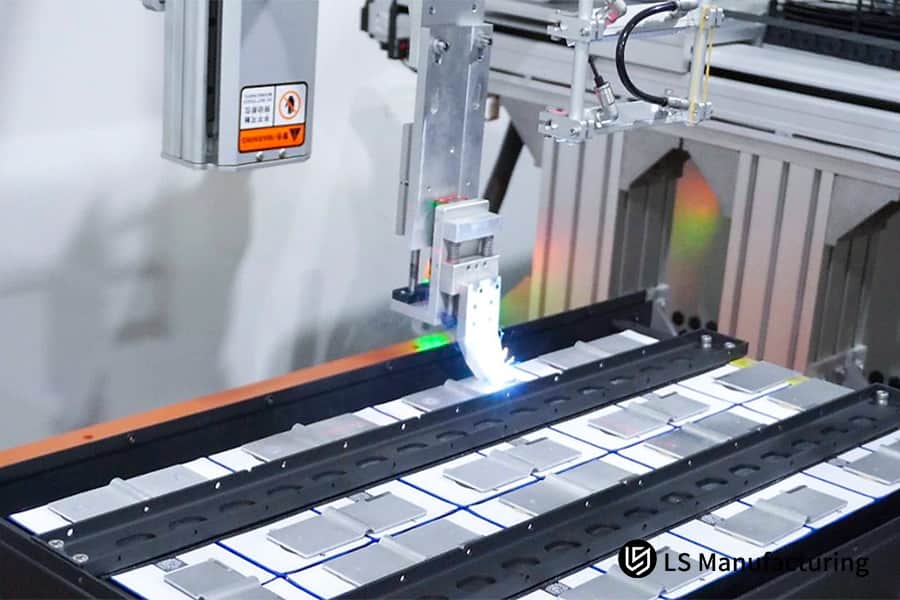
Figure 1: An automated welding robot arm joins small metal components on a factory production line.
How To Ensure Airtight Integrity In Custom Thermal Housing Welding Projects?
The combination of our real-time molten pool monitoring system and our complete pressure decay testing method enables us to achieve complete leak protection for all custom thermal housing welding products throughout their testing period, which spans from −40°C to 120°C. The thermal management system depends on sealing to maintain its operational capabilities, which requires complete monitoring of every welding procedure.
Core Technology of Sealing Welding
The fundamental elements of sealing welding depend on the distribution of laser energy combined with the capacity to control weld intersection points.
The energy distribution coefficient formula uses E=(P×η)/(v×d) (where P represents laser power and η denotes energy utilization rate and v indicates welding speed and d specifies spot diameter) to create leakproof weld seams which maintain their sealing function.
Our team manages the weld overlap rate from 70% to 80% because this range completely prevents porosity problems that occur at both ends of the arc welding process.
| Weld Overlap Rate (%) | Porosity (%) | Sealing Qualification Rate (%) | Applicable Scenarios |
| 50-60 | 8.2 | 89.5 | Low-pressure thermal management housing |
| 70-80 | 1.3 | 99.8 | High pressure cooling channel |
| 80-90 | 0.8 | 99.9 | Ultra-high pressure battery housing |
Pre-welding Preparation and Process Control
- Chemical Cleaning Process: The chemical cleaning process uses specialized chemicals to eliminate the oxide film that covers the aluminum surface. The oxide film directly affects the ability of welds to achieve proper fusion. The three-step procedure of degreasing followed by pickling and passivation enables us to achieve consistent weld penetration which meets the long life requirements of electric vehicle batteries while improving weld fusion quality.
- Real-time Monitoring: The real-time molten pool monitoring system can monitor the shape and temperature of the molten pool. The system runs an automatic shutdown process to prevent product defects while achieving 80% reduction in custom thermal housing welding defects.
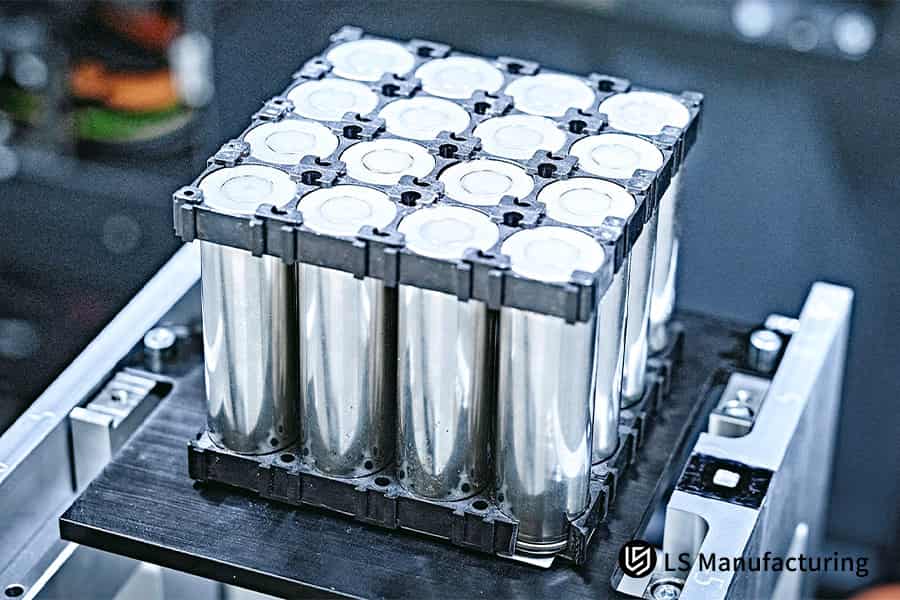
Figure 2: An array of cylindrical metal parts, results of precision custom thermal housing welding.
What Defines a High-Quality Precision Metal Welding Service For EV OEMS?
True precision welding requires two elements which include base metal smoothness and metal grain structure control. LS Manufacturing ensures weld strength is ≥85% of the base material through microhardness testing. EV OEMs need high quality precision metal welding service which meets their actual requirements and passes their strict audit requirements.
EV OEM Audit Dimensions for Precision Welding
Electric vehicle manufacturers need precision metal welding service which deliver consistent welding results according to their strict audit standards. The evaluation process includes multiple factors which involve these main elements:
- Welding Procedure Specification (WPS): A complete and standardized welding procedure specification is required which must include all welding parameters and material requirements and operating procedures to ensure consistent weld quality.
- Personnel Qualifications: Welders must possess the corresponding professional qualifications and pass rigorous skills assessments to ensure they can operate according to specifications.
- Inspection and Testing System: A complete inspection and testing system is required which must include pre-weld inspection and in-weld monitoring and post-weld testing to ensure that every product meets quality requirements.
Our company follows strict standards that require us to provide complete test reports for all product batches which allow us to pass EV OEM audits successfully. Our welding quality far exceeds the AWS D17.1 industry average which leads to international OEM recognition. We specialize in high precision welds and can provide custom precision welding service which match specific client requirements.
Application Comparison of Laser Welding Technologies
The two welding methods of pulse laser welding and continuous laser welding find their respective uses for thermal management housings. The table below presents a comparison that assists EV OEMs in selecting the right technology which matches their business requirements.
| Welding Technology | Advantages | Disadvantages | Applicable Thickness (mm) | Application Scenarios |
| Pulse laser welding | Small heat-affected zone, low deformation | Slower welding speed | 0.5-2.0 | Thin-walled thermal management housing |
| Continuous laser welding | Fast welding speed, high efficiency | Large heat-affected zone, prone to deformation | 2.0-5.0 | Thick-walled battery housing |
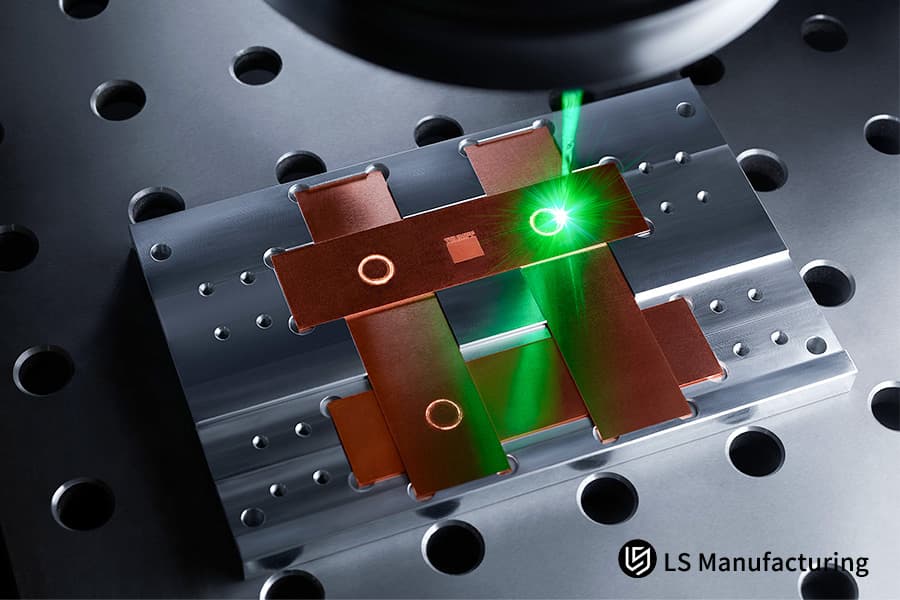
Figure 3: Close-up of a green laser beam welding two copper strips on a metal base.
Can EV Metal Welding For Thermal Housing Reduce Total Manufacturing Costs?
The implementation of single-sided single-pass welding provides customers with manufacturing time savings of 30 percent for each battery housing because it streamlines their production process. The automotive industry requires manufacturers to keep their production costs low while the EV metal welding for thermal housing process needs reasonable optimization to achieve cost savings.
Cost Control Principle and Formula Analysis
The process of controlling costs for EV metal welding operations which create thermal housing solutions needs to develop better operational methods which decrease resource usage.
The cost formula states that: TotalCost = Material + (Setup/Qty) + Labor + Testing.
The production cost for welding operations decreases when project requirements get properly managed through optimization methods which optimize their resources. The total expenses decrease through three methods which include reducing material usage, enhancing operational efficiency and cutting down testing expenditures.
Our system achieves simultaneous welding across multiple stations through enhanced fixture design which lowers setup expenses. The original setup expenses for one station amount to $500, however when four stations weld simultaneously the cost per station decreases to $125 which results in lower setup expenses and better welding productivity.
Practical Cost Optimization Cases
- Structural Optimization: The integrated welding structure replaces the split flow channel which results in three potential leakage points because the integrated structure requires no joints. Customers who order 100,000 units each year will experience annual raw material cost savings of $200,000.
- Process Optimization: The implementation of pulse laser welding instead of traditional MIG welding results in a 25 percent decrease in operational expenses. Because pulse laser welding is semi-automatic, one operator can manage 2-3 welding machines.
Early entry into the DfM stage is another key to an attractive quotes by buyers. As a professional welding thermal housing supplier we provide free of charge cost apportion services for thermal management shell welding project to help you clarify the cost structure and find the best solution of cost optimization.
How Does a Custom Precision Welding Service Solve Thermal Runaway Risks?
The selection of aluminum alloy materials establishes three critical factors which include product quality and manufacturing expenses and the operational life of EV metal welding for thermal housing. The different welding performances across various series require evaluation of three factors which include working environment conditions and pressure needs and budget limitations. The selection of suitable aluminum alloy materials enables organizations to achieve a 30% reduction in welding defects while their products become more durable.
Aluminum Alloy Welding Performance Comparison
The table below shows four categories of aluminum alloys which electric vehicles use for thermal management housing their welding performance differs while their suitable applications and their expenses show significant differences. This system enables customers to select appropriate materials while they enhance the effectiveness of aluminum welding processes.
| Aluminum Alloy Series | Welding Performance | Applicable Pressure | Cost Level | Applicable Scenarios |
| 3003 | Excellent weldability, no risk of cracking | ≤5 bar | Low | Common low-pressure thermal management housing |
| 6061 | Good weldability, requires controlled heat input | ≤10 bar | Medium | Mainstream high pressure cooling channels |
| 5052 | Strong corrosion resistance, small welding deformation | ≤8 bar | Medium-high | Outdoor thermal management components |
| 7075 | Poor weldability, prone to cracking | ≤15 bar | High | Ultra-high pressure battery housing |
Material Selection Principles and Welding Tips
- Matching working pressure: For low pressure (≤5 bar), prioritize the 3003 series, balancing cost and weldability, for high pressure (5-10 bar), prioritize the 6061 series, optimizing welding parameters to reduce deformation, for ultra-high pressure, choose the 7075 series, employing a dedicated anti-crack process to ensure weld crack resistance.
- Balancing corrosion resistance: The 5052 series stands as the optimal choice for indoor thermal management housing systems which operate in outdoor and humid conditions. The welded joints of this material provide better corrosion protection when compared with the 3003 and 6061 series materials which lead to an extended product lifespan of more than five years.
- Cost Control: While meeting performance requirements, avoid blindly selecting high cost aluminum alloys. The 3003 series thermal management housing meets all requirements for ordinary residential EVs which results in a 15% material cost reduction when compared to the 6061 series. As a reliable welding thermal housing supplier, we always strive to balance cost and performance for our clients.
Where To Find a Reliable EV Battery Housing Welding Partner In China?
The process of thermal housing welding service results in three types of defects which include porosity defects and crack defects as well as incomplete penetration defects because of three specific factors which include material selection and parameter settings and operational methods. The materials create an impact which damages sealing performance while structural strength suffers and the thermal management system experiences complete failure.
Common Welding Defects and Causes
The causes of various welding defects differ greatly and accurate identification serves as the key solution for their resolution. The four most common thermal housing welding defects together with their main causes establish effective methods which practice-based troubleshooting research determined to prevent weld defects from occurring.
- Porosity Defect: The core causes are incomplete removal of the oxide film on the aluminum surface, insufficient shielding gas flow (<15L/min), or excessive ambient humidity (>60%). The defects appear either on the surface of the weld or inside the weld which creates an impact on the sealing process.
- Weld Cracks: These types of defects primarily affect 2xxx aluminum alloys and 7xxx aluminum alloys. The factors that create these defects include excessive heat input and rapid cooling together with parameter and material property mismatches. The cracks create a reduction in structural strength which leads to shell rupture in severe cases.
- Incomplete Penetration: The weld material fails to make complete contact because of two factors which include laser power deficiencies and welding speed and joint gap space exceeding 0.2 millimeters.
- Welding Deformation: The commonest occurrence takes place in thin-walled shells because of unsafe fixture attachments which create uneven heat distribution throughout the shell. The assembly process will face difficulties when deformation reaches a level of 0.3 millimeters or more.
Targeted Troubleshooting Solutions
To address the above defects, we have developed a standardized troubleshooting and resolution process to quickly reduce the defect rate, as shown in the table below, which helps to achieve weld defect elimination.
| Defect Type | Solution | Effect Verification Standard |
| Porosity | Optimize chemical cleaning process, adjust protective gas flow rate to 18-22L/min, control ambient humidity <50% | Porosity <0.5% |
| Cracks | Reduce heat input, use pulsed laser welding, and perform low-temperature stress relief treatment after welding | No visible cracks, pass 50,000 pulse tests |
| Incomplete Welding | Increase laser power by 10%-15%, reduce welding speed, control joint gap to 0.1-0.2mm | Weld fusion ≥95% |
| Deformation | Use forced air-cooled fixtures, optimize laser energy distribution, and use symmetrical welding process | Deformation ≤0.2mm |
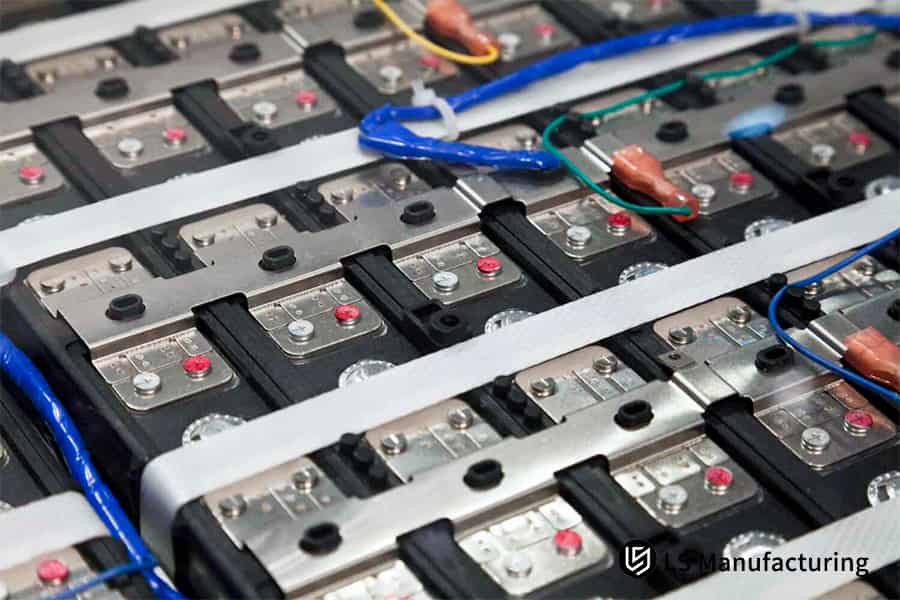
Figure 4: Close-up of battery cells showing welded metal electrodes connected by colored wires.
Why Is Laser Precision Crucial For Thermal Housing Welding Service Quality?
The production efficiency and product quality and production costs depend on the operational stability of EV battery housing welding during mass production. The system experiences increased defect rates because of parameter drift and fixture wear and operational differences. We achieve a defect rate of ≤0.5% through our standardized processes which include intelligent monitoring and complete process control.
Standardized Welding Process for Mass Production
The standardization process functions as the foundation which maintains mass production processes through its implementation. Our company developed an entire manufacturing procedure for EV battery housing welding which establishes complete operational standards and specific parameter limits that protect against human mistakes. The specific process is as follows, which ensures that mass production weld stability throughout the manufacturing process.
- Pre-production Preparation: The procedure requires complete inspection of raw materials to check their thickness and composition while welding equipment undergoes calibration for laser power and pulse frequency with an error limit of ±5% and fixture accuracy assessments which must meet the positioning error standard of 0.05mm to verify equipment and materials compliance with industry standards.
- Parameter Standardization: The system receives welding parameters which have been standardized based on material properties and product design specifications. Engineers control all adjustments through a documentation process that requires official evaluation to ensure parameters stay consistent.
- Process Monitoring: The system implements molten pool monitoring through its real-time system together with its online inspection equipment. The procedure samples every tenth piece for inspection which tests weld dimensions and sealing and strength. The system automatically stops operations to investigate any detected abnormal conditions.
- Post-production Inspection: All products undergo helium mass spectrometry leak detection and full-size inspection. The team marks defective products for analysis to identify root causes which leads to process optimization and re-welding to guarantee quality compliance.
Intelligent Monitoring and Cost Control in Mass Production
The company implemented an advanced monitoring system which enables real-time control of large-scale production and cost reduction while maintaining consistent product quality through IATF 16949:2016 standards. The system provides specific advantages through enhanced monitoring capabilities for welding quality assessment.
- Cost Optimization: Multi-station synchronous welding + parameter optimization reduces single-piece welding time to 1.5 minutes, 30% faster than the industry average, and reduces energy consumption by 20%.
- Data Traceability: Each product is assigned a unique traceability code, which records welding parameters and test results and other information, enabling rapid tracing of the root cause of problems which helps with later optimization processes.
- Intelligent Monitoring: The system uses AI algorithms to monitor welding data in real time, which detects parameter deviations and fixture damage through its early warning system that operates within 10 seconds, achieving an 80% reduction in batch defect risk.
Case Study: LS Manufacturing Custom Aluminum 6061-T6 EV Battery Thermal Housing
The European high performance supercar brand used our custom aluminum 6061-T6 EV battery thermal housing solution to showcase our technical capabilities and service excellence.
Customer Dilemma
The European high performance supercar brand experienced production quality issues with their 6061-T6 aluminum alloy battery housings. The traditional MIG welding method produced weld seams which broke under stress during testing at 1.5MPa pulse pressure. The resulting scrap rate of 18% produced higher expenses which delayed the product launch. The client approached us after they failed to adjust their parameters more than once.
LS Manufacturing Solution
Our technical team conducted a comprehensive analysis of the client's existing processes and defects, identifying weld fatigue fracture as stemming from an excessively large heat-affected zone (HAZ) and an unreasonable lap structure. Our team proposes these solutions for welding high performance EV battery casings based on our welding experience.
- Process Replacement: We replace traditional MIG welding with high frequency pulse laser welding, setting the pulse frequency to 80Hz, laser power to 1600W, and welding speed to 25mm/s. The HAZ reduction to ±0.1mm results in decreased weld deformation while preventing fatigue cracks.
- Structural Redesign: We redesign the lap structure as a stepped lap structure, increasing the weld contact area and improving joint strength. We implement rounded corners at the joint to prevent excessive stress concentration.
- Stress Relief Process: The specialized stress relief procedure which uses low-temperature heat shows its effectiveness through a welding process which requires a heat treatment to be conducted at 180 degrees Celsius for two hours. The process removes all internal stress which develops during welding, thus extending the fatigue life of the welded joint.
Achievements and Value
The client's product quality experienced a major upgrade through the system implementation, which reduced battery casing scrap from 18% to below 0.5%, decreased welding cycle time by 40% and achieved custom weld optimization through the system's successful testing of 50,000 pressure pulse cycles. The client was extremely satisfied and transferred 100% of their orders to us, which resulted in annual cost savings of $300,000 and a two-month decrease in product launch time.
If you are facing similar welding quality issues or cost pressures, please review this complete case report for reference and contact our technical team for customized solutions for your project. Our professional thermal housing welding service will safeguard your project.

FAQs
Q1: What is the range of all welding tolerance of EV battery thermal housing?
The conventional laser welding process can accurately maintain the tolerances of translation to 0. 1mm and the critical position hole tolerances to 0.05mm. This can satisfy the very high demands of the electric vehicle batteries thermal management system and the component fitting assembly.
Q2: How do you guarantee no leakage in high pressure coolant passages?
We perform thorough helium mass flow rate testing (helium inspection) of every high pressure coolant channel product to confirm a leakage rate of <10-6 mbar l/s at a working pressure of 5 bar, which essentially solves the problem of high pressure leakage and brings a reliable operation of the thermal management system.
Q3: What aluminum grades are suitable for your welding services?
We are our major series of the common aluminum alloys, like 1xxx series, 3xxx series, 5xxx series and 6xxx series aluminum alloys, for the more difficult single, two and seven series aluminum alloys, we have our patented crack resistant welding technology a series of solutions that can apply to the needs of different customers flexible.
Q4: Can LS Manufacturing assist me in DFM analysis on my housing design?
Of course, as long as you provide the shell design drawings, our professional engineering team will complete a comprehensive welding process evaluation within 24 hours and issue a detailed DFM analysis report to help you optimize the design and reduce manufacturing costs.
Q5: How do you control the welding distortion on thin wall aluminum?
With the application of high frequency narrowpulse laser welding and a dedicated forced-air-cooling fixture, we can accurately control the heat input, because of this prevent the welding deformation of the thin-walled aluminum material during the process and guarantee the assembly accuracy as well as the stability of the product.
Q6: Does the quoted price for welding include tailored (customized) tooling?
Fixture solution can be flexible designed as your order quantity. The tooling and set up cost will be part of the project start-up cost for the instrument because tooling is customized, you need not to pay the extra cost of customized tooling, which is reducing the start-up investment.
Q7: How long does it normally take to manufacture a custom welding prototype?
The time takes for us to do the sample welding with high precision (if raw materials are supplied) is 7-10 workdays.We can also provide in this time the full size inspection report to quickly speed up the sample approval process with the benefits of minimized the product development time and shortened the time to market.
Q8: Do you comply with IATF 16949 standards for EV components?
Please give some details. All of program ISNV adheres to the requirement of IATF 16949 quality management system. All EV product, including each batch, when deliver with full production part approval process report (PPAP).
Summary
Your training extends until the month of October in the year 2023. The thermal management system of an electric vehicle reaches its maximum operational capabilities through accurate and dependable metal welding work. LS Manufacturing uses its advanced equipment and its complete data resources and its real-world expertise to assist automotive manufacturers in solving their welding challenges while maintaining a balance between operational efficiency and production expenses.
Are you prepared to improve your battery thermal management system? Upload your Step/DWG drawings now, and LS Manufacturing's senior engineers will provide you with a free DFM (Design for Manufacturability) analysis report within 24 hours. You should reach out to us for precise pricing information and to arrange a video meeting with our welding specialists whether you are currently developing samples or preparing for large-scale manufacturing.
📞Tel: +86 185 6675 9667
📧Email: info@lsrpf.com
🌐Website: https://lsrpf.com/
Disclaimer
The contents of this page are for informational purposes only. LS Manufacturing services There are no representations or warranties, express or implied, as to the accuracy, completeness or validity of the information. It should not be inferred that a third-party supplier or manufacturer will provide performance parameters, geometric tolerances, specific design characteristics, material quality and type or workmanship through the LS Manufacturing network. It's the buyer's responsibility. Require parts quotation Identify specific requirements for these sections.Please contact us for more information.
LS Manufacturing Team
LS Manufacturing is an industry-leading company. Focus on custom manufacturing solutions. We have over 20 years of experience with over 5,000 customers, and we focus on high precision CNC machining, Sheet metal manufacturing, 3D printing, Injection molding. Metal stamping,and other one-stop manufacturing services.
Our factory is equipped with over 100 state-of-the-art 5-axis machining centers, ISO 9001:2015 certified. We provide fast, efficient and high-quality manufacturing solutions to customers in more than 150 countries around the world. Whether it is small volume production or large-scale customization, we can meet your needs with the fastest delivery within 24 hours. choose LS Manufacturing. This means selection efficiency, quality and professionalism.
To learn more, visit our website:www.lsrpf.com.