English



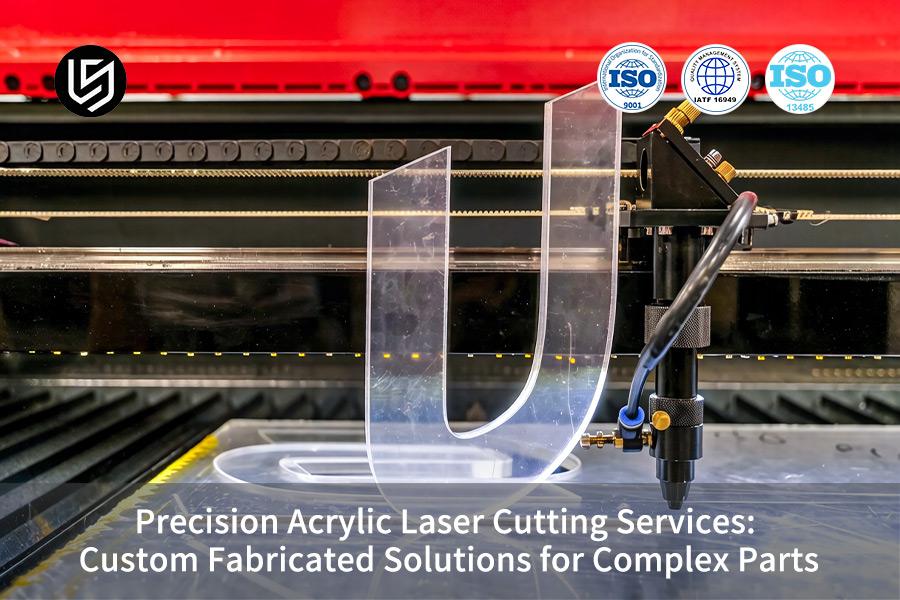
Precision acrylic laser cutting services begin with engineering verification of the what kind of acrylic is used for laser cutting; however, mass production faces challenges such as micro-cracks and kerf taper in complex components. The problem is that most of the suppliers have no ability to digitally control the differences between mechanical properties of cast and extruded acrylics when compensating laser power density to minimize the heat-affected zone.
LS Manufacturing overcomes the problem through DFM examination and the application of "cold pulse" cutting technology, allowing for ±0.05mm tolerance of laser cut acrylic parts of up to 15mm thickness. The custom fabricated laser cutting offered by our company involves path optimization to stress relief annealing in order to deliver the best possible value. The following analysis shows how professional technical solutions address the precision-efficiency conflict in complex acrylic parts production.
Precision Acrylic Laser Cutting: Complex Parts Quick-Reference
| Technical Challenge | Fabrication Solution for Complex Designs |
| Internal Stress Cracking | We employ stress-relieved cast acrylic and optimal cutting paths to reduce stress relief. |
| Fine Feature & Thin-Wall Machining | We make use of precision optics and parameter tuning to cut out fine features without melting or breaking the material. |
| Edge Clarity & Polish | The heat generated by the laser causes a natural polishing effect that results in a smooth, clear finish. |
| Multi-Layer & Assembly Features | We can cut tabs, slots, and registration holes into the part so that we can assemble it accurately. |
| Our 3D Nesting & Fixturing | We design custom nests and fixturing in 3D to allow us to machine multi-plane geometries in one operation from flat sheet laser cutting material. |
| Result: Optical & Dimensional Integrity | Fabricates parts with clear contours, high definition, and no risk of stress-clouded haze or deformation. |
| Result: Ready-to-Assemble Precision | Fully assembled products that fit perfectly, making assembly easier while providing aesthetic value. |
Our solutions address the issues associated with the production of intricate and precise acrylic components. Through our laser cutting system, we ensure the prevention of stress, accuracy of details, and optical quality. The outcome is dimensionally accurate components that are ready to assemble with functionality and aesthetics in mind, for display or prototype laser cutting applications.
Why Trust This Guide? Practical Experience From LS Manufacturing Experts
Hundreds of articles describe precision acrylic laser cutting services, however, we have been operating for 15 years on first-hand experience. Daily struggle against challenging geometry and thermal loading of our workshop creates components which must never fail and meet standards such as ISO 13485 for medical devices and International Aerospace Quality Group (IAQG) guidelines. True experience means that we understand acrylic behavior during laser cutting operations.
Our techniques of reducing the heat-affected zone and avoiding micro-cracking have been perfected using dynamic laser calibration. With our bespoke designed laser cutting systems having tolerances less than ±0.05mm, they are reliable in critical industries. The painstaking experience acquired makes it easier for us to manufacture your complicated designs efficiently and effectively without wasteful experimentation.
Below is our guide on our best practices in addressing the conflict between precision and efficiency. This includes our comprehensive process, from DFM analysis down to stress release, to guarantee that your project will be successful from prototyping to manufacturing. This is our proven system to ensure the integrity of your parts and the best price for your most challenging acrylic parts.
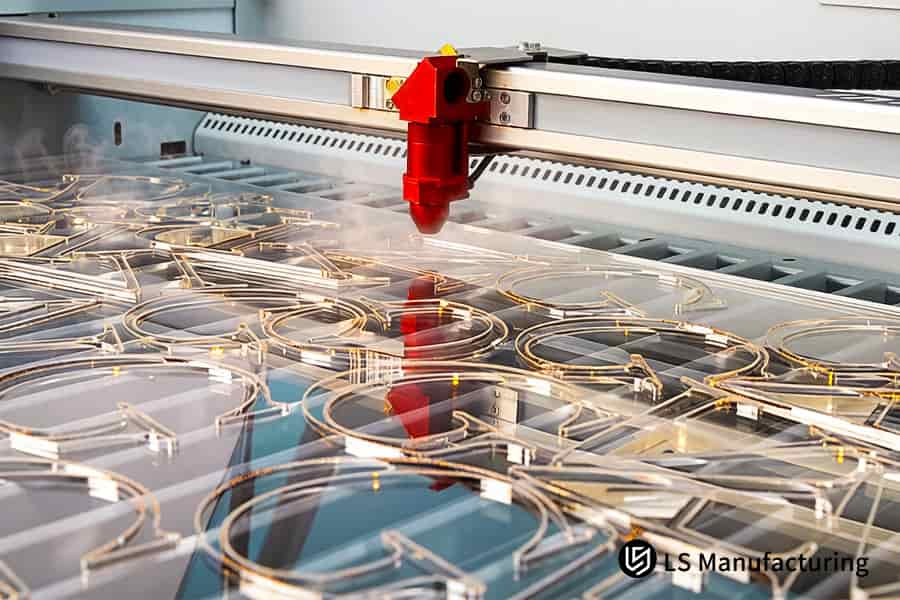
Figure1: Laser cutting forms precise gear teeth on extruded acrylic for industrial automation parts.
Why Is LS Manufacturing The Premier Choice For Precision Acrylic Laser Cutting Services In 2026?
In precision machining, the total error accumulation of multiple components in complex assembly continues to be a significant cause of inefficiencies and high costs. At LS Manufacturing, we address this problem through our closed-loop digital control system, combined with statistical process control, to achieve feature tolerance of ±0.05mm. This process guarantees part interchangeability and improves assembly yield:
Closed-Loop Digital Control for Micron-Level Stability
The system we employ employs a complete digital feedback mechanism whereby interferometric encoders are used to measure the position of the laser galvo. The data collected is then evaluated against the digital copy of the design. Deviations trigger a correction mechanism that addresses thermal drift. This capability is at the core of our precision acrylic laser cutting services, enabling reliable production of parts for custom laser cutting solutions.
SPC Dashboards: Proactive Drift Management
We moved from sampling to real-time quality assurance. Important factors like those are automatically monitored by the vision system and shown on real-time control charts. In this way, it becomes possible for the engineer to react immediately in case there is any variation such as differences between lots of materials before affecting the tolerance. This proactive system underpins every acrylic laser cutting service we provide, ensuring consistency in laser cutting for optical applications.
Tolerance Locking Strategy for Assembly Success
Our decision to enforce a strict tolerance of ±0.05mm is based on a highly strategic approach, and this is meant to ensure that stack-up tolerances are completely eliminated. For this purpose, it is essential to use highly sophisticated LS Manufacturing technology during the lens focusing and environmental control process. This will ensure perfect interchangeability between parts across different batches, thus paving the way for successful high-volume laser cutting.
In this paper, we describe the strategy behind our innovative manufacturing process. Having access to advanced technology is only one aspect; however, we have managed to create an integrated system where digital control, analytics, and highly rigid tolerancing work together to solve the problem of error accumulation.

How Can Custom Laser Cutting Services Achieve Optical Grade Edge Clarity For Medical Devices?
The practice of applying unnecessary secondary finishing operations for producing optical quality edges in the medical devices is not only time-consuming but also inefficient. This article outlines the engineering solution that will cause a controlled reflow of the material at laser cutting to achieve sub-Ra 0.8µm surface finish. The key to the proposed solution lies in energy management and gas dynamics that enable “self-annealing” cuts:
Precise Energy Control for In-Situ Melting
- Challenge: Uncontrolled energy leads to a rough, striated surface on the cut face.
- Our Method: Controlling the focal spot location of the 10.6 µm laser by positioning it below the surface of the material in order to achieve a uniformly melted kerf.
- Outcome: A uniform molten zone is produced that can be smoothed, a necessity for medical device laser cutting with no exceptions made for surface integrity.
Gas Dynamics for Surface Reformation
- Challenge: Conventional assist gases usually lead to quick cooling of the melt zone, stopping its movement.
- Our Method: By using a laminar flow of ultra-high purity nitrogen, we create a micro-environment devoid of oxygen. This shields the molten polymer, allowing surface tension to reform the melt.
- Outcome: The process produces unparalleled optical clarity on the edge, making possible tight-tolerance laser cutting with an immediately usable surface produced by the machine itself.
Integrated Parameter Synchronization
- Challenge: Optimization of individual parameters does not produce consistent and reproducible outcomes.
- Our Method: Our closed-loop system fine-tunes the focal point, gas pressure, and feed rate. Parameters are configured according to the material in question via a recipe that configures the optimal "polishing window."
- Outcome: The result of this coordination creates the conditions for custom laser cutting services using a pre-finished edge without post-process actions, resulting in a cost reduction as a consequence of the lack of post-processing. That's how we implement our reliable precision laser cutting services with great value addition.
The technological solution is based on extending existing techniques in cutting by adding processes such as beam manipulation, atmospheric control, and parameter synchronizations in one cycle. In our methodology, we target addressing the issue of edge finishing in terms of the as-cut component using an efficient solution capable of doing away with costly manual polishing methods. Process engineering is a significant element in our unique approach, which guarantees successful outcomes and savings in complex laser cutting projects.
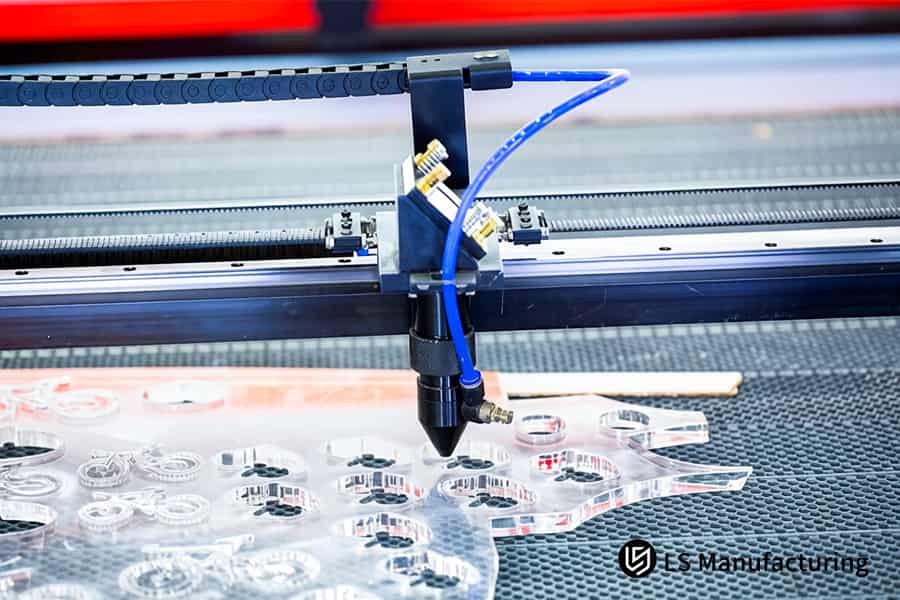
Figure 2: Laser cutting slices clean gasket edges on mirror acrylic for electronic device enclosures.
Why Should OEM Engineers Prioritize Laser Cutting For Complex Parts With Integrated DFM Engineering?
Thermal distortion poses a critical, latent risk to dimensional fidelity in components with intricate geometries. This document details a proactive methodology that mitigates this risk at the design stage through targeted DFM optimization. Our engineering-led analysis for complex part laser cutting converts potential production failures into predictable, cost-effective outcomes, ensuring superior project reliability from the outset.
| Challenge Category | Our Proactive DFM Method | Quantifiable Outcome & Value |
| Non-Planar Geometry & Thermal Stress | Reviewing the inner edge angle optimization to ensure there’s a balance between heat energy and material mass without creating local deformation. | Reduces probability of thermal deformation to greater than 60%. |
| Micro-Feature Arrays (e.g., Vent Holes) | Research and recommendation on a high-density laser cutting pattern that prevents thermal accumulation. | Avoids potential thermal accumulation that melts the micro features and alters the design. |
| Anisotropic Material Behavior | Evaluation of the blank alignment and material grain formation relative to the cutting path. | Keeps uniformity in the edges and dimensions, independent of the part axes. |
| Critical Interface Features | Basing datum structures and sacrificial tabs during the nesting stage to enable post-processing stress-free. | Guarantees the accuracy of the finished product during further processing to cater to tight-tolerance laser cutting. |
This document highlights the engineering of manufacturing reliability in complex components before fabrication. Our approach to laser cutting for complex parts entails a deterministic DFM study that tackles thermal root cause issues, thus delivering 100% schedule assurance. This method prevents wasteful spending incurred in post-launch modifications, making our service stand out in aerospace laser cutting. We provide robust manufacturing methods, not only parts.
What Enables A Professional Acrylic Laser Cutting Service To Mitigate Internal Stress Cracking?
One of the common defects in acrylic materials is stress cracking, which could lead to catastrophic failure when the material is exposed to solvent. This technical report will detail our patent for the process of removing internal stress cracking from the custom fabricated laser cutting parts we fabricate using an annealing process.
Targeted Thermal Soaking for Stress Redistribution
The conventional approach to this defect involved cooling that created thermal gradients. However, our technique involves heating the material gradually until it reaches a predetermined soaking temperature, which is below the material distortion temperature. At this point, the molecules can be relaxed, resulting in equal stress relief for the entire component body.
Validated Performance Through Aggressive Testing
We prove our ability to deliver stress-free components by undergoing testing. Components fabricated by us, especially the medical grade parts, undergo aggressive testing where they are submerged in 70% isopropyl alcohol. Those that have gone through our process do not have micro-cracking, which confirms stress neutrality.
Process Integration for Consistent Outcomes
This is no independent batch processing. The annealing cycle specifications are pre-programmed in the job traveler card for each individual project. This way, all batches go through a perfectly optimized process which is key for successful precision laser cutting and therefore produces results deserving the reputation of a professional acrylic laser cutting service.
The below paper describes a process-oriented solution to cracks caused by the usage of solvents in acrylics. Our company offers a patented stress relief procedure which effectively tackles the root cause of the issue. It is the depth of the process that makes our high-stability laser cutting truly unique. Our validated annealing process guarantees crack-free acrylic under solvent exposure. Submit your specifications for a reliability-engineered manufacturing quote.
How Does Custom Fabricated Laser Cutting Optimize Material Nesting For Expensive Engineering Plastics?
The materials themselves can often make up over 40% of the total product price, which makes material utilization a primary lever for cost optimization. The below paper presents our technical approach to maximizing the use of sheets via optimal nesting and kerf control in custom fabricated laser cutting projects.
Algorithmic Nesting with Dynamic Kerf Compensation
- Challenge: The traditional method of nesting with fixed kerf will result in waste because of the complexity of geometrical figures and high density.
- Our Method: The algorithms for dynamic changes in the cutting pattern and the position of the parts will allow us to minimize the use of bridges and gaps. With the precise control of laser beams, it is possible to set the kerf as small as 0.8mm.
- Outcome: In such a manner, we are maximizing parts placement per single sheet and allowing high-yield laser cutting with 91% utilization rate in some documented instances.
Geometric Analysis for Optimal Layout
- Challenge: Oddly-shaped parts and mixed batch productions create unused spaces in sheets of material.
- Our Method: Our software performs thorough geometrical analysis, thus allowing us to maximize the layout of parts by rotating them in such a way that negative spaces are minimized.
- Outcome: This method plays an essential role in automated laser cutting production of various components, which constitutes the basis of our effective laser cutting solutions for acrylic and synthetic materials.
Automated Micro-Bridging for Sheet Integrity
- Challenge: The possibility of the movement or falling of parts while cutting becomes greater with complete detachment of pieces from the sheet.
- Our Method: The software builds up micro-bridges between various parts at certain points, where stress arises, ensuring that they will be kept stable till the end of the cutting process.
- Outcome: It enables us to reach the optimal nesting without affecting the quality of cuts, which is essential to ensure precision laser cutting projects.
Integrated Cost Modeling and Reporting
- Challenge: Potential for cost savings through efficient nesting is hypothetical and lacks concrete explanations provided to the client.
- Our Method: We supply a separate report on each nesting project with details on the quantity of the material used, the amount of waste generated, and the savings in terms of material cost per part that are fixed in the quotation.
- Outcome: The above-mentioned numbers offer transparency and cost optimization based on facts, making sure that the cost savings mentioned are achieved at the unit price level.
The paper introduces a technically sound approach, which uses materials from one of the major cost centers and turns it into one of the highly effective segments of our business. The answer to the waste problem lies in dynamic kerf management and geometry optimization coupled with process-retention automation technology. The degree of technical complexity helps us present our competitively priced engineering plastics laser cutting.
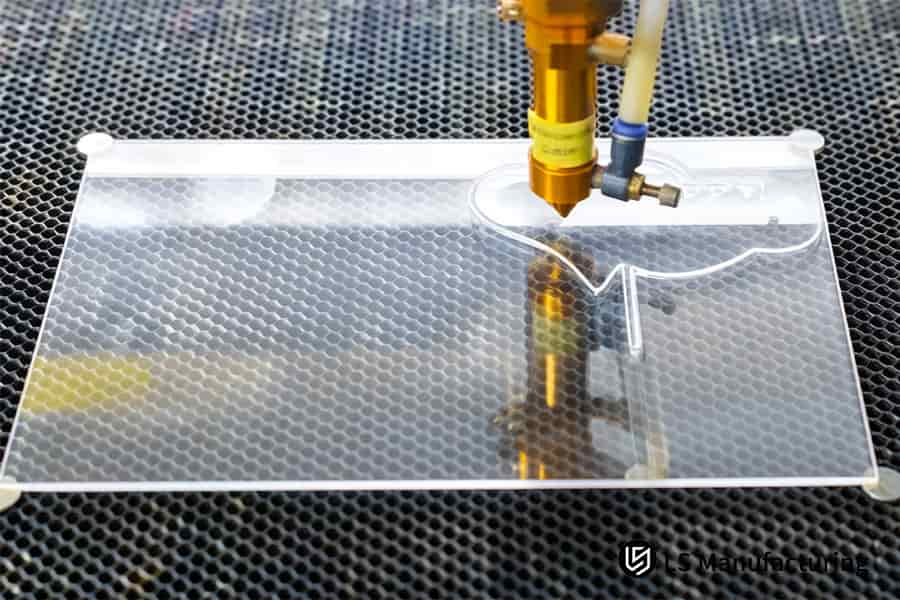
Figure 3: Laser cutting drills holes in clear acrylic for kitchen appliance control buttons.
Can Precision Laser Cutting Services Maintain Micron Level Consistency Across 10000 Units?
In mass production, consistency is the linchpin of supply chain reliability. This document details the technical protocols that enable our systems to maintain a positional tolerance of ±0.05mm over 1.5-meter scales across 10,000+ unit runs. We achieve this through a closed-loop focal calibration system governed by strict CPK stability metrics, ensuring deterministic output for precision laser cutting services.
| Challenge | Our Technical Solution | Quantified Outcome |
| Material Thickness Variation | Continuous Z-axis and focal plane compensation for every sheet ensures no defocus errors. | Ensures the beam profile necessary for precision acrylic laser cutting services. |
| Thermal & Mechanical Drift | Control of micro-scale drift through the use of vision systems and scaling feedback maintains the cutting head’s accuracy in real time. | Ensures programmed trajectories are accurate and necessary for high-volume laser cutting. |
| Proactive Process Management | Inline SPC Dashboard that monitors dimensional deviation and CPK stability to send notifications before any drift occurs. | Aids proactive management of continuous capabilities of complex part laser cutting services. |
| Beam Profile Consistency | Automated collimation prior to and profiling during laser cutting helps maintain optimum cutting tool performance. | The critical beam profile is maintained for manufacturing purposes. |
As can be seen in this paper, it is very clear that precision to a micron is an engineering accomplishment. Using real-time feedback on focusing and positioning along with process control, we are able to minimize errors and provide the reliability required for closed-loop laser cutting in a zero defect, high volume supply chain environment.
Why Is Laser Cutting Solutions For Acrylic The Key To Achieving Ra 0.8 Surface Finish On Thick Plates?
It is a hard technical problem to make a vertical cut and get a surface finish Ra 0.8 on acrylic sheets (20-30mm). Below is the summary of how our patented method, frequency-modulated pulsing protocol, will help us to have control over both the geometry of the cut and the quality of the surface simultaneously, meaning cuts with deviation in verticality <0.5° and Ra ≤0.8µm - important for advanced purposes:
Dynamic Frequency Modulation for Controlled Heat Input
Unlike the usual CW (continuous wave) or constant-pulse laser that provides non-uniform heat input and causes recast layer and striations, in our approach the frequency and amplitude of the laser pulses are changed in real-time while the laser cut goes through the thickness of the sheet. Thus, we can control HAZ (heat affected zone), thereby preventing undesired melting and getting high-quality surface finish. This is why we offer superb acrylic laser cutting service.
Assist Gas Optimization for Molten Material Ejection
Besides cutting quality, a smooth surface requires proper evacuation of the melt from the kerf. We utilize a controlled and pressurized laminar flow of dry air or gas mixtures. The gas flow is synchronized with the pulsed laser to remove the melt immediately from the kerf without returning to the cut wall. This process is important for efficient thick plate cutting. This system represents one of the main components of our precision laser cutting systems.
Integrated Parameter Optimization via Digital Twin
These parameters can vary and are optimized for every unique material and its thickness by using a computer simulation of the cutting process. Before actual production begins, we simulate the complete laser cutting process and achieve a prediction about its performance, thus obtaining an exclusive parameter set providing perfect edge perpendicularity and lowest possible surface roughness. It is a more complex approach than usual, providing laser cutting solutions for acrylic materials with guaranteed results, which we demonstrate with the help of metrology reports after thick acrylic laser cutting.
This paper outlines a deterministic method, resolving the issue of quality versus efficiency in thick material processing. The ideal result, which involves getting a high-quality edge laser cutting, can be achieved using sophisticated beam handling systems, accurate gas handling, and simulations before production. The sophisticated technology outlined in this paper, supported by complete dimensional measurement reports, provides a unique advantage, ensuring that a typical process becomes a definite solution for manufacturing optical-quality edges on acrylic materials.
How Does Complex Part Laser Cutting Minimize The Heat Affected Zone For Heat Sensitive Components?
For the case of heat-sensitive acrylic components, the thermal energy input created by the process of complex part laser cutting will eventually result in low durability because of HAZ weakening. The present paper provides detailed information about the dynamic power compensation solution we have developed, which is able to prevent HAZ thickness from going under 0.1mm and thus preserve more than 98% of tensile strength in the base material.
Adaptive Power Modulation for Thermal Management
- Challenge: Continuous energy input through the laser causes overheating of the material and creates a significant zone of weakness.
- Our Method: We reduce laser energy consumption in areas of paths' bending and vector ends where the majority of energy tends to accumulate.
- Outcome: Through heat restriction, we can guarantee accurate HAZ control that is required for a proper electronic-component laser cutting.
Intelligent Cooling with Synchronized Gas Pulsing
- Challenge: Conventional techniques used for dissipating heat through gas flow do this quite inefficiently for thin structures.
- Our Method: Through gas pulse cooling that occurs when the laser stops working, heat is quickly dissipated.
- Outcome: This is an efficient method for controlled cooling to control the thermal profile of the sensitive component laser cutting.
Validated Process Libraries for Predictable Outcomes
- Challenge: The general setting cannot be used for heat-sensitive materials like composite materials and cast acrylic.
- Our Method: We rely on our material-specific recipes from a proprietary process library, which have been already validated using metallographic testing to ensure adequate HAZ depth and strength of material after laser cutting.
- Outcome: This approach guarantees our clients that our precision acrylic laser cutting services will provide reliable and validated results. This is how we define our expertise in low-HAZ laser cutting.
This paper explains a thermal management process aimed at solving the HAZ issue using power control, cooling synchronization, and pre-validated parameter settings. The method guarantees minimal thermal effects to provide parts with reliable performance and high structural integrity to meet the advanced standards of electronics and medical devices integration, which is empirically proven in laboratory tests.
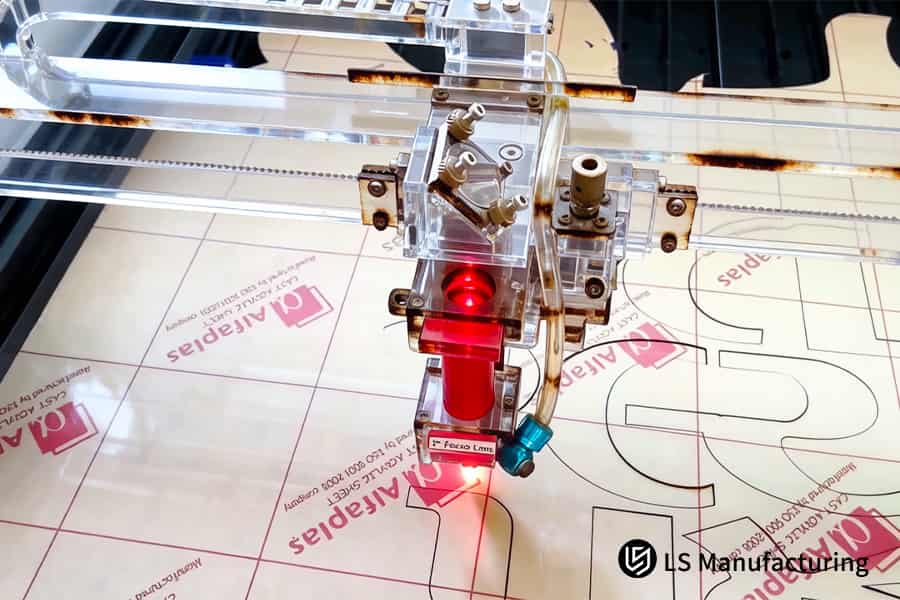
Figure 4: Precision acrylic laser cutting services mark registration patterns on acrylic for rapid prototyping systems.
Case Study: LS Manufacturing Medical IVD Equipment Window Precision Custom Solution
This case study explains how LS Manufacturing solved an important problem with a 15mm thick optical inspection window in an IVD equipment from an international company. The faulty component was unable to withstand autoclave sterilization, resulting in leakage. Our innovative solution utilizing custom fabricated laser cutting and post-processing ensured improved reliability, proving our ability to provide mission-critical medical-grade laser cutting:
Client Challenge
The client’s original observation window of 15mm cast acrylic had micro-cracking due to thermal stresses on the edges, resulting in only 65% assembly yield and product failure during 500-cycle autoclave test validation. As a consequence, this caused delay and incurred huge costs in terms of scrapped parts. This ultimately delayed the schedule of final device assembly.
LS Manufacturing Solution
High cross-link cast acrylic was selected for the chemical resistance of the product. The key technology we developed was the bi-directional gas cooling precision laser cutting process. Once the contouring is done, our proprietary 6-hour step annealing removes any stress. The path compensation is ensured through a 100% CCD vision system for complex part laser cutting.
Results and Value
The final parts had a 100% pass rate when tested for helium leaks. The cut surface had an optical grade Ra 0.4 surface roughness, and no further polishing was required. First-pass assembly yield went up to 99.8%. This led to the client's assembly time being reduced by two weeks and a 18% decrease in part costs overall, giving decisive rapid prototyping and manufacturing benefits.
This particular case is one that shows just how LS Manufacturing has used their engineer-driven approach to solve some really tough problems in manufacturing. We were able to develop a reliable process because of our use of material science in combination with controlled thick-plate laser cutting and stress relieving techniques.
If your medical windows require guaranteed sealing under autoclave sterilization, contact us for a precision cutting and annealing solution that ensures zero leakage and maximum yield.

FAQs
1. Why choose LS Manufacturing for my precision acrylic laser cutting project?
In addition to the precision tolerance of ±0.05mm, we conduct pre-design DFM analysis and stress relief techniques suitable for specialty acrylic materials to ensure your parts' optimal functionality.
2. What is the maximum thickness for high-quality acrylic cutting services at LS Manufacturing?
Using a 15kW high brightness laser cluster, we are able to supply cast acrylic parts with thicknesses up to 50mm, all while providing edge perpendicularity up to industry standards.
3. How quickly can I receive a quotation for a complex, custom-fabricated laser cutting order?
Simply submit your STEP files, and our engineering department will provide you with a detailed quotation—including machining recommendations—within 12 to 24 hours.
4. Does LS Manufacturing support low-volume production for custom laser cutting services?
Of course, we do not apply rigid Minimum Order Quantities. We help you advance quickly through the product development phase, by delivering rapid prototyping & validation, which guarantees an effortless transition from prototype into full-scale manufacturing in terms of accuracy and quality.
5. Can you achieve optical clarity on the cut edges of complex acrylic parts?
Yes, using precise control over laser pulses frequency as well as the amount of gas used as auxiliary gas, we can obtain the surface of cut material having "flame-polishing" quality with Ra up to 0.8.
6. How do you prevent crazing during your acrylic laser cutting service?
We prevent crazing by implementing an ISO-certified, controlled annealing process to relieve internal stresses, thereby ensuring that your parts remain structurally stable even when exposed to solvents or extreme environmental conditions.
7. What certifications does LS Manufacturing hold for medical-grade precision fabrication?
We hold both ISO 9001 and ISO 13485 certifications. Our production processes fully comply with the quality traceability requirements for precision components mandated by both the EU RoHS directive and the FDA.
8. Why is laser cutting more cost-effective than CNC milling for clear acrylic parts?
Laser cutting offers a 400% increase in processing speed and inherently produces a smooth, finished edge. This eliminates the need for expensive 5-axis CNC machining time and subsequent manual polishing costs, thereby significantly reducing your unit cost per part.
Summary
Exceptional acrylic laser cutting extends far beyond simple material shaping. At LS Manufacturing, true precision is achieved through micron level heat zone control, engineered stress relief, and rigorous DFM optimization. We transform complex physical parameters into measurable commercial value—whether for optical windows or zero clearance medical bases. Partner with a provider skilled in materials science and integrated processes to ensure your project is delivered on time, to spec, and on budget.
Stop letting supplier-induced processing cracks or dimensional inaccuracies delay your product’s time-to-market. Your precision designs deserve a physical realization solution of laboratory-grade quality. Click the "Get a Quote" button below to upload your technical drawings; LS Manufacturing’s team of senior engineers will provide you with a complimentary, one-on-one DFM feasibility assessment, helping you secure the most competitive, direct-from-manufacturer solution within just 24 hours. Let us define your brand's value through the power of precision.
📞Tel: +86 185 6675 9667
📧Email: info@lsrpf.com
🌐Website: https://lsrpf.com/
Disclaimer
The contents of this page are for informational purposes only. LS Manufacturing services There are no representations or warranties, express or implied, as to the accuracy, completeness or validity of the information. It should not be inferred that a third-party supplier or manufacturer will provide performance parameters, geometric tolerances, specific design characteristics, material quality and type or workmanship through the LS Manufacturing network. It's the buyer's responsibility. Require parts quotation Identify specific requirements for these sections.Please contact us for more information.
LS Manufacturing Team
LS Manufacturing is an industry-leading company. Focus on custom manufacturing solutions. We have over 20 years of experience with over 5,000 customers, and we focus on high precision CNC machining, Sheet metal manufacturing, 3D printing, Injection molding. Metal stamping,and other one-stop manufacturing services.
Our factory is equipped with over 100 state-of-the-art 5-axis machining centers, ISO 9001:2015 certified. We provide fast, efficient and high-quality manufacturing solutions to customers in more than 150 countries around the world. Whether it is small volume production or large-scale customization, we can meet your needs with the fastest delivery within 24 hours. choose LS Manufacturing. This means selection efficiency, quality and professionalism.
To learn more, visit our website:www.lsrpf.com.