English




Injection molding service represents an essential challenge in 2026 for OEM experts trying to figure out what are the types of injection molding because of short iterations, expensive trials, and size issues during scale-up. The root cause is that most vendors cannot achieve both cost-effective prototyping and mass manufacturing of precise parts due to shrinkage management failure.
Custom injection molding service solves this problem. Our company uses scientific molding and experienced DFM analysis to make prototyping compatible with mass production by controlling the process at the microsecond level, thus ensuring 100% consistency throughout the entire product lifecycle. This guide illustrates how we set new standards in precision molding decision-making from prototyping to manufacturing.
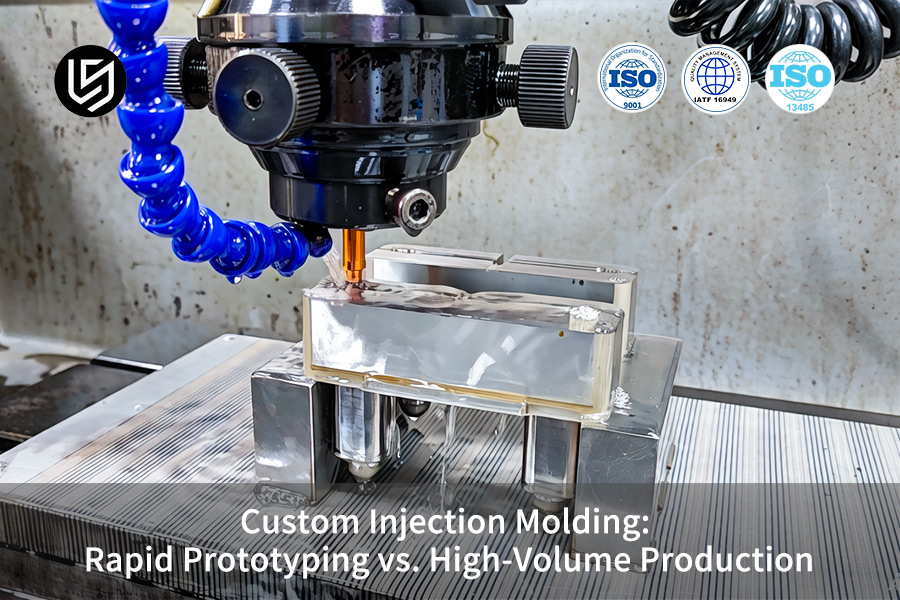
Custom Injection Molding: Prototype VS Production Quick-Reference
| Critical Factor | Rapid Prototyping Strategy | High-Volume Production Strategy |
| Tooling Investment | Lower injection molding cost by using low cost aluminum or soft steel molds; tool life is secondary. | High cost, highly engineered hard steel molds used for millions of cycles. |
| Cycle Time Priority | Secondary consideration, often longer cycle times are used to simplify tuning process. | Primary cost driver and optimized to second power, for maximum parts per hour. |
| Material Selection | Many times use production equivalent "look alike" material that allows us to simulate functional performance. | Exact production grade, cost optimized, production specified material. |
| Process Stability | Human intervention required, variation in parameters is inherent and acceptable. | Process is fully automatic, uses closed loop control with SPC for maximum consistency. |
| Our Approach | Deliver form-fit-function validated using bridge tooling and multi cavitation. | Injection molding material and process are engineered together for optimal cost efficiency. |
| Result: Project Value | Value through rapid development of functional parts for design de-risking and stakeholder buy-in. | Lowest cost possible per part, competitive pricing in the market place. |
Key Takeaways:
- Purpose Defines Process: Prototyping is done to learn; producing is done to earn. The purpose and performance measures involved are entirely different.
- Tooling is a Strategic Choice: Using aluminum molds represents a short-term investment in tooling costs; while using steel molds reflects a long-term investment.
- Consistency is the Currency of Production: Statistical Process Control, automation, and process controls cannot be bypassed in high volume production.
- The Bridge Matters: Successful completion of any project calls for having a partner capable of translating prototypes into production excellence.
Why Trust This Guide? Practical Experience From LS Manufacturing Experts
There's no lack of general information available regarding injection molding. What makes this guide unique? We at LS Manufacturing have hands-on experience working through the unique issues surrounding prototyping and mass production. Material selection and process verification procedures here are systematically benchmarked to match those set forth by ASTM International.
This means that we serve industries in which the stakes are high, ranging from disposable, biocompatible prototypes for surgical instruments to millions of connectors for cars. Going from the simple prototype to efficient mass manufacturing requires an exactness that conforms to measurement techniques and calibrations supported by the National Institute of Standards and Technology (NIST).
The lessons we learn are derived from thousands of repetitions where learning as much about why something doesn’t work as when it succeeds is invaluable. We’ve learned the skills necessary to make parts that not only have the perfect design from the start but have been proven to be manufactured using the right tool steels and optimal cycle times without sacrificing part quality.
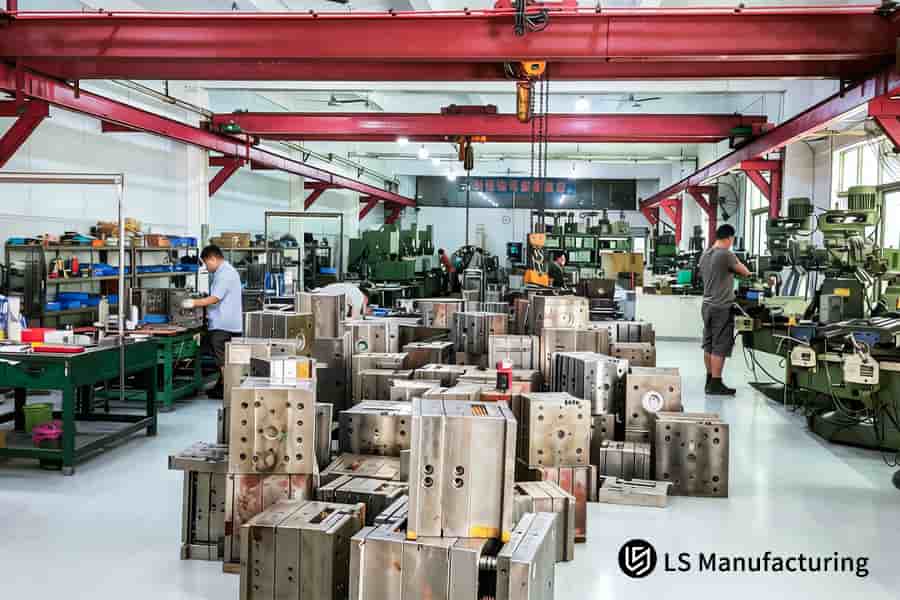
Figure 1: Multiple P20 steel injection molds are stacked for high volume production molding service in automotive.
Why Is Choosing An Integrated Injection Molding Service Strategic For Reducing Your Project TCO?
Choosing a manufacturer involves considering the costs incurred throughout the lifecycle of the product rather than just the cost per unit. The document below will discuss how an injection molding service that is strategically integrated can effectively minimize your overall total cost of ownership. The technical strategies involved in transforming the initial cost of engineering into long-term operational efficiency are detailed below.
| Aspect | Strategic Impact of Integrated Service |
| Design & Engineering Early | Design for Manufacturability (DFM) analysis eliminates costly post-production modifications, directly targeting total cost of ownership reduction. |
| Process Superiority | Utilizing all-electric high volume injection molding machines consistently improves cycle time by 15-25%, improving efficiency and agility in manufacturing agility. |
| Material & Volume | For production runs over 100 parts, injection molding process offers better material performance and unit costs than machining or 3D printing processes. |
| Cost & Supply Stability | This process guarantees 100% long-term supply certainty, turning procurement into a reliable and cost effective framework. |
| Quality & Precision | Tight control over processing windows ensures consistent, high-tolerance part quality in precision injection molding. |
A fully integrated injection molding service is essential for minimizing total cost of ownership in volume production. The decision is technical, relying on the principles of scientific injection molding and mastery of processing windows for quality and speed. This analysis is critical for competitive scenarios where final cost and reliability are paramount. We solve problems by eliminating late-stage flaws and stabilizing costs within a cost effective framework, converting fixed expenses into sustained margin advantage.

How Can Rapid Prototyping Injection Molding Compress Your Time To Market Without Material Compromise?
In conventional prototyping methods, achieving both fast delivery and high material fidelity becomes a trade-off that delays design validation. In contrast, this paper explains how rapid prototyping injection molding solves this problem through the creation of a rapid turnaround of parts using production-intentional materials. Rapid prototyping injection molding aims to de-risk the product development process as follows:
Technical Core: Engineered for Speed and Fidelity
We solve the material compromise by utilizing high-performance prototype injection molding tooling, machining cavities from Al7075 aluminum or P20 pre-hardened steel. This approach supports the high pressures and temperatures of engineering-grade resins, enabling true functional testing. Tooling lead time is thus reduced from 6+ weeks to 5-7 business days, and the process stability allows for the collection of critical process data for production scaling.
Economic Architecture: Optimized via the Master Unit Die
We eliminate prototype cost inefficiency through the master unit die system, where clients leverage a reusable, standardized mold base. This architecture confines investment solely to custom cavity and core inserts, removing the recurring cost of a full mold. The result is a typical unit cost reduction of approximately 40% per iteration, while the system’s design inherently accelerates future design changes and iterations.
Validated Path to Full-Scale Production
With this approach, the creation of a low-risk, streamlined connection to volume production is ensured. Through the use of the functional prototypes, thorough testing and design validation and parts will be facilitated. With the proven part geometry and process information collected from the bridge tool injection molding process, an easier transition to the final production through our custom injection molding service will be guaranteed.
By removing launch delays, we offer production-grade injection molding prototypes in days using our innovative process. Our approach incorporates production-grade precision through the use of the master unit die system. It serves as the unequivocal method of low volume injection molding validation, allowing for the safe entry into the market using production-grade material-specific prototypes. Stop risking launch delays with 6-week lead times. To validate your design in 7 days with production-grade materials, submit your CAD file for a feasibility review and a rapid-turn quote.
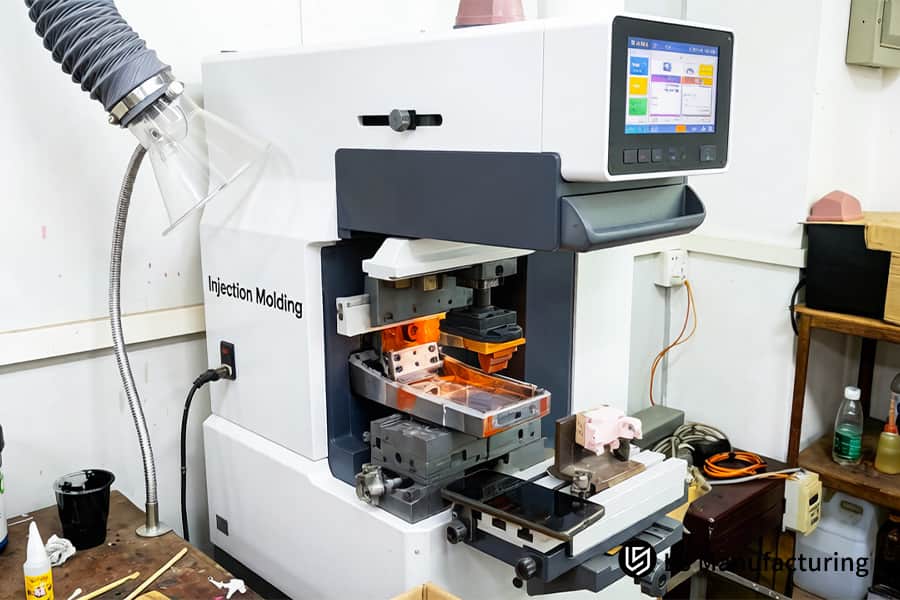
Figure 2: The injection machine processes ABS polymer into housing parts under monitored parameters for consumer goods.
What Strict Parameter Controls Define A Top Tier Production Molding Service For High Precision Parts?
If the performance and quality of a component are paramount, then a production molding service is only as good as its tolerance to variation. The key to success lies in maintaining an extremely tight process window at all times. The following outlines the parameter controls that ensure zero defect execution of complex components:
Foundational Process Engineering: Designing Robustness
- Challenge: Inconsistencies in fluid viscosity lead to air pockets and stress concentrations.
- Our Solution: Process engineering through mold flow analysis enables us to optimize gate design and runner systems, creating a scientific injection molding process window.
Real-Time Parameter Mastery: The Control Loop
- Cavity Pressure Control: Our direct cavity pressure control sensors enable us to move from the fill phase to the pack phase depending on the melt conditions rather than the screw position, with an accuracy of 0.01 seconds. This process is important for successful high-pressure injection molding applications.
- Packing Precision: The hold pressure is accurately controlled at 150–180 MPa, ensuring full cavity fill and density without overpacking.
- Thermal Stability: Oil-temperature control systems are used to regulate the mold surface temperature to ±1°C, a necessary element for dimensional repeatability and molded-in stresses prevention.
Execution & Verification: Enforcing the Standard
- Closed-Loop Control: These deliver instant correction in the event of any deviation and serve as the backbone of a dependable automated injection molding cell.
- Statistical Process Control (SPC): We perform live SPC tests on the relevant dimension(s) of the part, which shall later correlate to cavity pressure control data in order to take immediate action.
- First-Article Validation: Every production run involves checking the first part on the CMM machine as a method of verifying dimensional repeatability.
Our roduction molding service ensure dimensional precision of parts via rigorous parameter management. This is accomplished with the help of proactive process engineering, cavity pressure control, and zero defect execution methodologies. This scientific approach eliminates the problem of ensuring dimensional repeatability in tight-tolerance injection molding operations.
Why Is Evaluating Injection Molding Rapid VS Production Tool Wear The Key To Predictable Procurement?
The first procurement risk revolves around the initial tooling cost. The evaluation of the injection molding rapid vs production processes will be crucial when forecasting the overall life cycle cost. This paper aims to provide a data-based approach in procurement forecasting through a comprehensive discussion on the technical and economic reasons behind strategic tool steel selection, from the prototype to an advanced injection molding process.
| Consideration | Rapid Tooling (Prototype Focus) | Production Tooling (Volume Focus) |
| Primary Objective | Fast and cheap prototype/testing. | Durable and precision injection molding process for high-volume production. |
| Tool Steel & Construction | P20 or aluminum for quick results and low investment. | High-quality tool steel taxonomy (ASSAB S136) coated with diamond-like carbon to prevent tool fatigue. |
| Economic Model | Low investment; tooling is a sunk cost. | Higher upfront cost compensated by volume to reduce individual piece-part cost. |
| Lifecycle & Maintenance | Brief life expectancy (about 10,000-50,000 cycles). | Predictive mold maintenance curves to maximize performance and minimize downtime. |
| Procurement Impact | Allows easy entry with little effort. | Enables accurate long-term procurement forecasting and budget stability. |
The strategic choice between injection molding rapid vs production tooling hinges on volume and lifecycle cost. We apply a precise tool steel taxonomy and advanced coatings to combat tool fatigue, providing data-led mold maintenance curves for accurate procurement forecasting. This solves the problem of unplanned downtime, transforming tooling into a predictable asset for successful, engineered injection molding programs.
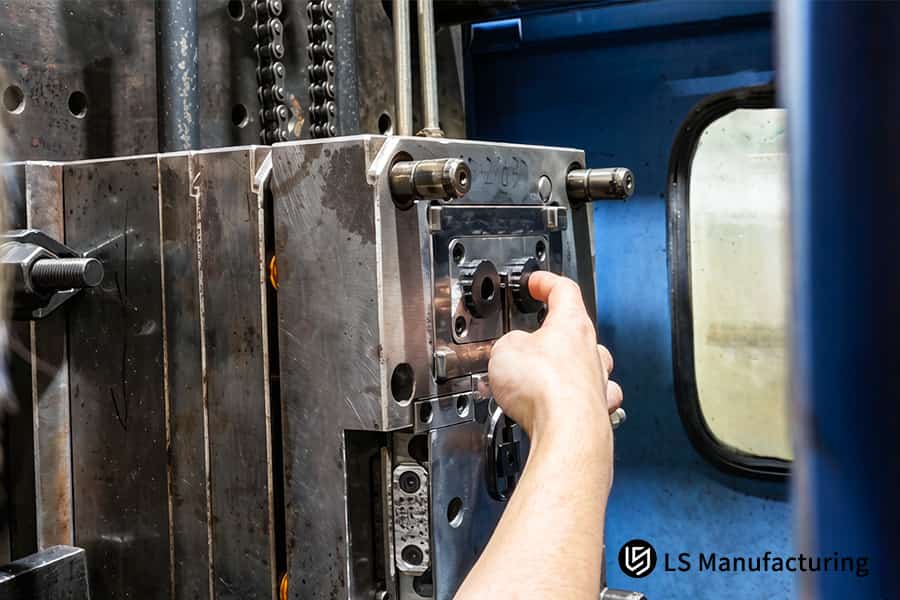
Figure 3: A technician calibrates 4140 steel mold bolts with a handwheel for rapid prototyping injection molding.
How Does A Premier Custom Injection Molding Service Optimize Design To Eliminate Molding Defects?
It should be a hallmark of a quality custom injection molding service to avoid any faults before building a mold at all. In this paper, It present a method of engineering design aimed at preventing expensive mold redesigns from occurring because of problems identified at the design phase. Our approach is based on:
Systematic Design Interrogation via DFM
24 hours after we receive the design, our engineers perform an in-depth analysis of it. We create and give you a signed DFM package, which is more elaborate compared to other standards because it zeroes in on important areas requiring additional focus, for instance, where there are changes in wall thickness exceeding 30%. It seems like the variations are among the major reasons behind plastic deformation physics resulting in sink marks and warping.
Predictive Simulation for Proactive Correction
The utilization of moldflow optimization allows us to predict the behavior of material flow, cooling, and shrinkage. The predictive simulation process enables us to detect areas that will lead to defects like knit lines and air traps due to shear heating and pressure drop. We receive a data map from the simulation process, which enables us to solve over 95% of the problems through technical injection molding.
Prescriptive Geometry Modification
This is addressed through carefully designed editing of the injection molding design process. We facilitate the placement of ribs and gussets that retain stiffness but ensure uniform wall thicknesses. We control gate placements and geometries such that flows can be directed without causing any weaknesses due to knit lines. Such targeted action toward defect mitigation addresses the sources of sinks and stress buildup.
By using our custom injection molding service, we address defects by enforcing strict initial engineering through moldflow optimization analysis and a complete DFM package. By making use of the plastic deformation physics, we are able to make recommendations that result in the necessary defect mitigation before any defects arise during production.
What Custom Validation Metrics Should You Demand From An Injection Molding Prototype Service Provider?
Choosing a prototype partner involves assessing their expertise in managing advanced material science beyond simple shape making. An injection molding prototype service should offer objective and production-ready information. This paper explains our validation measures for handling advanced materials and ensuring that prototypes meet the requirements for high functional validation:
Material-Specific Process Engineering
- Challenge: Default parameters do not work for sophisticated engineering alloys like PEEK, PEI, and carbon-filled, resulting in degradation or improper consolidation.
- Our Protocol: We employ a unique scientific molding database of material-specific viscosity and temperature behavior. The information creates a narrow and specific process window for engineering-grade injection molding from the initial shot to produce the right polymer structure.
In-Process Monitoring and Control
- Shear Rate Management: We apply in-cavity sensors for monitoring and controlling the shear rate at the gate, avoiding material degradation.
- Surface Finish Verification: The controlled process, along with optimal mold finish, consistently produces a surface quality Ra 0.2 in first articles without additional finishing processes.
- Data-Led Adjustments: We measure all the data (pressure, temperature, speed) to create a process fingerprint for easy scalability.
Validation for Functional Performance
- Beyond Dimensional Checks: We carry out validation testing according to the intended use of the prototype, for example, thermal cycling or chemical resistance.
- Assembly & Fit Testing: The prototypes are tested in assembly fixtures to confirm fit and function using tolerances that match real-world conditions.
- Data Delivery: We offer a full report connecting process variables to results, producing a validation-ready injection molding prototype along with a full process plan.
We turn prototype testing into a data-producing exercise rather than a go/no-go test. Our injection molding prototype service offering resolves material uncertainties through the use of scientific molding database and real-time monitoring, resulting in surface quality Ra 0.2 and consistent characteristics. This ensures the high functional validation required to mitigate risk in developing products with engineering alloys.
Can High Volume Injection Molding Consistently Maintain Micron Level Tolerances Across Millions Of Cycles?
Sustaining micron tolerance levels throughout millions of cycles is the unique challenge of high volume injection molding. In this document, we outline the combination of systems and processes that turn this challenge into an ensured result. Our production molding service is designed to provide absolute dimensional consistency, thus allowing our clients to avoid incoming inspection and proceed directly to assembly:
IoT-Enabled Process Monitoring and Control
Our process comes with intelligence. All-electric presses have cavity pressure sensors (RJG system), and we link them through an IoT-based monitoring system. This gives us real-time closed-loop control of the process by immediately making micro adjustments to offset any variation due to material and other factors, which is fundamental to automated injection molding.
Rigorous Data-Driven Quality Enforcement
Quality assurance is achieved through statistical data rather than sampling. We use our SPC quality protocol where we monitor the dimensions on the fly and record data for each cycle or at set intervals. The data collected is directly correlated to our CPK tracking metrics to ensure that our process capability (Cpk) stays at 1.33 and beyond, and thereby the dimensional variation is maintained at a tight tolerance of ±0.005mm.
Closed-Loop Correlation and Corrective Action
A self-correcting feedback loop is formed in this manner. The real-time SPC information is correlated with the actual machine and cavity sensor variables. If there is any tendency of moving towards a control limit, the system initiates an action as per its pre-defined set procedure within the machine itself without the generation of any non-conformances. In such a case, the scientific injection molding process continues uninterrupted.
Dimensional consistency during the process of high volume injection molding is assured by the use of real-time cavity sensors in combination with an extensive SPC quality protocol and CPK tracking metrics. This addresses the issue of inconsistent dimensions faced by the client and associated testing costs. The result will be production-ready components that can be used to eliminate costly IQC procedures for micron-level injection molding.
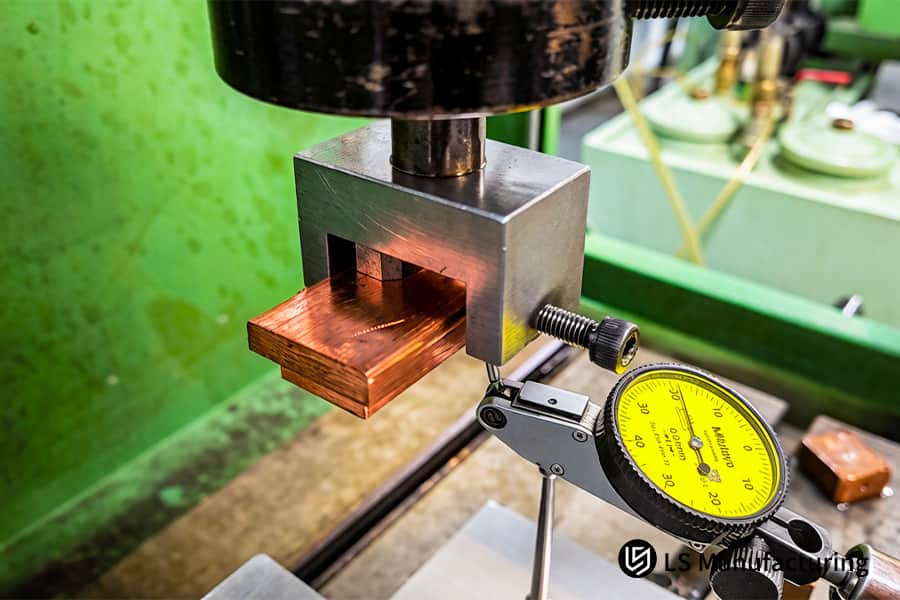
Figure 4: A stamping press forms C11000 copper alloy into a small connector component for electronic device circuits.
How To Strategically Plan The Scalability From Early Injection Molding For Production Into Multi Cavity Tools?
One of the crucial mistakes in the use of injection molding for production is tooling based on current volume but not future volume needs. In this paper, a strategy is proposed for scalable manufacturing which provides for future expansion without the need for revalidation and investments in new tools. This involves foresightful design of the tool as well as process, as described below.
Foundational Design: The Modular Tooling Strategy
- Core Principle: The very first mold designed is modular, meaning that it has standard interfaces.
- Our Implementation: The interfaces in our master mold base will be positioned in consideration of our future need for multi-cavity expansion.
- Client Benefit: The process of expanding the production capacity by duplicating and adding additional cavities becomes extremely fast without starting from scratch.
Process Integrity: Ensuring Uniformity Across Cavities
- Challenge: Adding cavities to the mold without runner balancing results in inconsistencies in the flow of material.
- Our Solution: By employing simulation technologies, we design a running system, hot or cold, that is perfectly balanced.
- Guaranteed Outcome: The same assured process window acquired through the first mold will remain constant, thereby assuring that the optimized injection molding process will operate smoothly irrespective of the number of cavities used.
Execution & Ramp-Up: Seamless Capacity Multiplication
- Scalable Process: Parameters for the process, such as pressure, temperature, and velocity will quickly scale up with respect to the new mold.
- Rapid Deployment: The new cavity blocks will be created and then assembled into the current modular injection mold setup, thereby significantly reducing the cycle time.
- Operational Impact: The modular tooling strategy will result in the reduction of the delivery time of our batches by more than 30% as well as enable high-production injection molding.
The challenge of capital risks and lengthy lead times amid rising demand is addressed through our scalable manufacturing process that utilizes a modular tooling strategy and validated runner balancing to allow quick multi-cavity expansion. Through this, we provide an answer to the technical issues surrounding injection molding production through a clear, actionable pathway toward successful scale-ups of production.
Case Study: LS Manufacturing Medical Device Housing Precision Custom Injection Molding Solution
This LS Manufacturing case study examines a critical medical device challenge: ensuring hermetic seal integrity for a high-volume insulin pump housing. The client faced severe delays and part failure due to inadequate prototyping and uncontrolled production variation. Our custom injection molding service provided a holistic engineering solution, enabling a reliable rapid to production transition to high volume injection molding:
Client Challenge
The med tech firm, which was manufacturing products for the entire world, needed a PC/ABS hermetically sealed housing for its insulin pump. After the vendor's failure to develop a satisfactory prototype using its 3D printer, it caused delays as well. There was a lack of temperature and pressure control in the vendor's injection mold tool, causing the parts to be warped, which resulted in weak knit lines. As a result, the parts failed in a mechanical fatigue test with 18% leakage ratio.
LS Manufacturing Solution
The intervention started with a 24-hour DFM analysis, recommending conformal cooling. We provided functional prototypes within 5 days via an Al7075 quick-turn tool. For the production phase, we designed an 8 cavity mold with S136 steel with a 4 point valve gate hot runner system, deploying closed-loop injection molding technology that responds in 0.01 seconds. This validated injection molding process together with 100% inline CMM inspection addressed the core causes of thermal stress and dimensional variance.
Results and Value
Our multi-faceted intervention increased the first pass pressure test performance to 99.85%, realizing hermetic injection molding. The cycle time was reduced by 22% while reducing scrap by 15%. The guaranteed availability of the components with zero quality issues helped our client save nearly $240,000 per annum on quality costs, ensuring a consistent and scalable supply of critical parts.
This project highlights our capability in achieving the smoothest rapid to production transition for a highly regulated product line. The issues with the prototype and the production were tackled through the use of optimized processes, state-of-the-art equipment, and data-driven controls. LS Manufacturing offers OEMs with the highest level of technical collaboration in ensuring their quality and supply chain security.
Prove 99.85% first-pass yield for your medical housing. To replicate this reliability, send your specifications for a leak-test analysis and a detailed savings proposal.

FAQs
1. What is the primary difference in turnaround times between rapid prototyping vs. high-volume tooling?
At LS Manufacturing, we provide quick prototype aluminum or steel molds using our proprietary 5-axis CNC machining center. Our rapid prototyping takes 5 to 7 days while the development of high-cavity and multi-cavity progressive molds that will produce at least one million production runs usually takes 4 to 5 weeks.
2. How does LS Manufacturing effectively reduce total procurement costs for custom injection molding services?
Through our Moldflow simulation technique for the efficient mold layout optimization, we minimize waste and flash losses—especially on expensive engineering plastic materials—by as much as 15%. With our highly-automated production line, this translates to an average of 25% total savings on your tiered unit price structure.
3. Can your injection molding prototype service process real engineering plastics, such as carbon fiber-filled PEEK?
Yes. Unlike 3D-printed parts—which typically serve only as visual models—our prototyping service is equipped with specialized high-temperature injection screws capable of reaching up to 400°C. This enables us to injection mold any high-strength, authentic engineering material within our rapid steel or aluminum molds.
4. What criteria should I demand from a production molding service provider to evaluate quality consistency remotely?
Procurement managers should request three pieces of concrete data evidence: ① SPC/CPK stability charts containing data from a continuous 24-hour production run (where the CPK value must exceed 1.33); ② A comprehensive, full-dimensional inspection report generated by a third-party Zeiss CMM, complete with official international certification stamps; and ③ An unedited, real-time video recording of the entire production process within the factory's automated, closed-loop injection molding workshop.
5. Why is a Master Unit Die (MUD) structure preferred when comparing rapid prototyping to full-scale production molding?
Because the Master Unit Die (MUD) structure allows you to pay only for the customization of the core molding inserts. This significantly reduces the fixed capital investment required for mold tooling—by over 50%—when launching a new project, making agile, small-batch prototyping extremely cost-effective and efficient.
6. Does LS Manufacturing provide a comprehensive DFM evaluation package before I issue the purchase order?
For every valid commercial inquiry, we provide an in-depth, manual DFM (Design for Manufacturability) review report—audited by senior engineers with over 10 years of technical experience. This report not only identifies potential defects (such as sink marks or voids) but also offers direct, quantified recommendations for drawing modifications.
7. How can your high-volume injection molding lines consistently maintain tight tolerances of ±0.005mm?
We utilize all-electric, high-precision servo-driven machinery, featuring multi-point pressure and temperature sensors embedded within the mold cavities (RJG system). This technology enables adaptive holding pressure compensation at the microsecond level to account for real-time changes in the plastic melt's viscosity.
8. How can I upload my 3D design to receive a cost analysis for custom precision injection molding services today?
To obtain a detailed cost analysis, simply upload your 3D CAD files (we support STEP, IGES, or X_T formats) through our secure portal. Our dedicated application engineers will then conduct a thorough analysis and promptly provide you with a highly competitive, tiered quotation within 24 hours to kickstart your project.
Summary
In today’s competitive OEM landscape, separating prototyping from mass production increases delays and hidden costs. LS Manufacturing’s advanced prototype molding acts as a critical physical parameter study to enable seamless volume production. Using multi-physics simulation, scientific process control, and IATF 16949 systems, we remove transition barriers—ensuring predictable delivery and lower total cost through data-driven automation.
Stop letting warping, stress, and delays from a split supply chain drain resources. Click “Get Quote & Technical Assessment” to upload your STEP/IGES files. Within 24 hours, receive a free DFM report with flow simulation, risk alerts, and a transparent quote. Let data and cases show why LS Manufacturing is your trusted precision injection molding partner in 2026—start your defect-free production journey today.
📞Tel: +86 185 6675 9667
📧Email: info@lsrpf.com
🌐Website: https://lsrpf.com/
Disclaimer
The contents of this page are for informational purposes only. LS Manufacturing services There are no representations or warranties, express or implied, as to the accuracy, completeness or validity of the information. It should not be inferred that a third-party supplier or manufacturer will provide performance parameters, geometric tolerances, specific design characteristics, material quality and type or workmanship through the LS Manufacturing network. It's the buyer's responsibility. Require parts quotation Identify specific requirements for these sections.Please contact us for more information.
LS Manufacturing Team
LS Manufacturing is an industry-leading company. Focus on custom manufacturing solutions. We have over 20 years of experience with over 5,000 customers, and we focus on high precision CNC machining, Sheet metal manufacturing, 3D printing, Injection molding. Metal stamping,and other one-stop manufacturing services.
Our factory is equipped with over 100 state-of-the-art 5-axis machining centers, ISO 9001:2015 certified. We provide fast, efficient and high-quality manufacturing solutions to customers in more than 150 countries around the world. Whether it is small volume production or large-scale customization, we can meet your needs with the fastest delivery within 24 hours. choose LS Manufacturing. This means selection efficiency, quality and professionalism.
To learn more, visit our website:www.lsrpf.com.