English



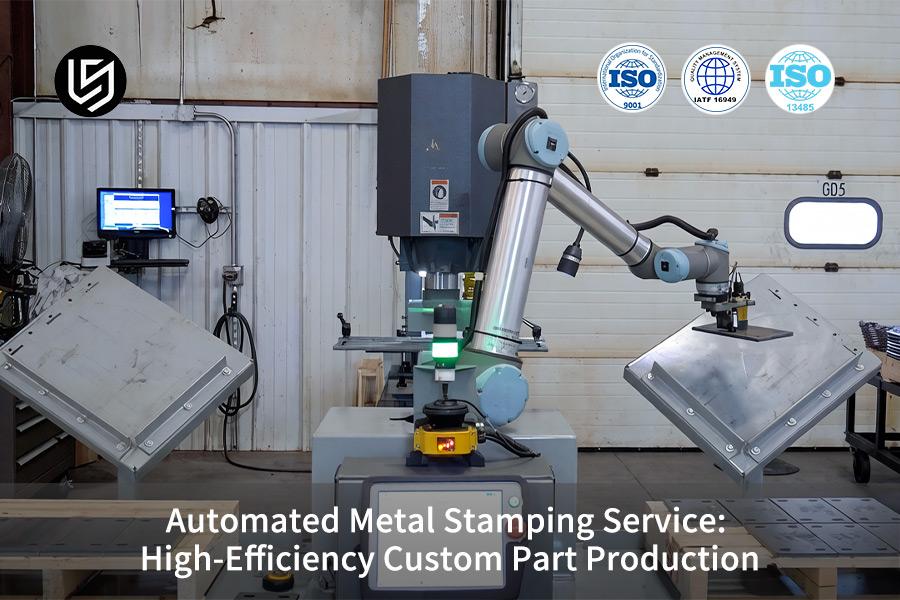
Automated metal stamping service is first explored by Procurement Managers who want to know “how does metal stamping work”, but most of the time, all they learn is the basics of dies. However, in mass manufacturing, problems occur such as low metal yieldb, continuous die repair, and unreliable product quality. The key problem here is that conventional manufacturers do not have any digital means to track their punch deterioration or Material Hardness Variation in real time, resulting in scrap rates being too high.
The LS Manufacturing team takes care of this with our automated metal stamping service with smart sensors and closed-loop feedback technology. With our Precision Progressive Die and its 3 times higher efficiency while keeping tolerances within ±0.01mm, we can deliver reliable results that fit your budget. If you’re looking for a reliable partner that will optimize design and guarantee 100% delivery, read on.
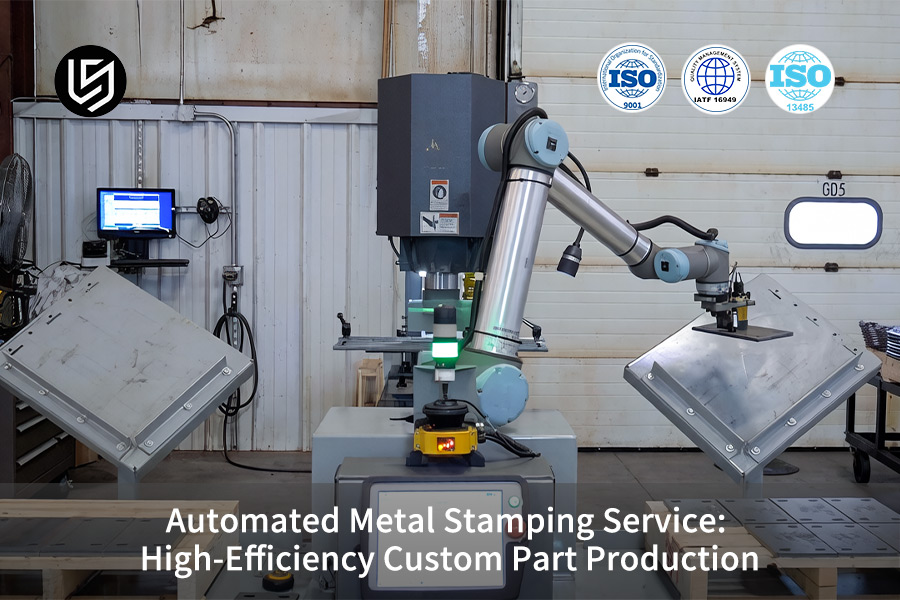
Automated Metal Stamping: High-Efficiency Production Guide
| Challenge / Focus Area | Root Cause / Key Factor | Our Engineering Solution | Outcome / Benefit |
| High-Volume Consistency | Manual handling mistakes and inconsistencies during set-up from batch to batch. | Progressive Die Stamping: Multi-step stamping process executed in a single automated press cycle. | Accuracy within ±0.05mm and >99.5% consistent parts for high-volume manufacturing. |
| Rapid Job Changeover | Traditional die set-up time is long, resulting in expensive machine idle times. | Quick-Change Tooling & SMED: Standardized clamps and pre-assembled tooling. | Die changes now take less than 10 minutes, increasing press operating time. |
| Scrap & Material Cost | Inefficient strip layout and errors during feeding. | Optimized Coil Nesting: Machine learning-based coil layout and servo-controlled feeding systems. | Up to 85-92% efficient use of materials, reducing metal stamping raw material expenses. |
| Complex Part Geometry | Additional processing stages increase handling and costs. | Integrated Forming Stations: Pierce, bend, and coin the sheet metal in one die. | Produce complex components in one cycle, without the need for any secondary processes. |
| In-Line Quality Control | Inspection after processing misses problems early, causing scrap. |
Real-time Monitoring: Cameras and tonnage measurements at every station. |
Detect faults instantly and automatically stop the press to avoid producing scrap lots. |
| Labor Cost & Safety | Manual loading in potentially dangerous press environment. | Material Handling by Robots: 6-axis robots for loading, unloading and piling parts. | Savings of up to 70% in direct labor and improved safety standards. |
We provide solutions to the key issues of speed, cost-effectiveness, and quality when it comes to custom metal stamping. With our automated systems that employ progressive dies, we achieve maximum volume output with high accuracy and uniformity. The result is lower costs per part, reduced waste, and faster turnaround times to guarantee a steady flow of parts for your most challenging OEM applications.
Why Trust This Guide? Practical Experience From LS Manufacturing Experts
Whereas some merely theorize about metal stamping automation services, our knowledge is born out of hands-on experience. We do not work in a controlled laboratory but rather in a highly functional facility designed specifically for efficient custom metal parts manufacturing, where we address the practical concerns of advanced metals and intricate shapes. We formulate our approaches in perfect accordance with industrial guidelines such as those provided by the Society of Manufacturing Engineers (SME).
Our experience is demonstrated by millions of parts used in the automobile, aerospace, and electronics industries. Every single part, whether it is an essential safety bracket or simply an electrical contact point, has contributed immensely towards honing our skills such as learning tensile pressing methods, predicting tool wear from sensor information, and creating progressive dies, which is vital for environmentally-friendly practices as per Environmental Protection Agency (EPA) guidelines.
We provide solutions to the key issues of speed, cost-effectiveness, and quality when it comes to custom metal stamping. With our automated systems that employ progressive dies, we achieve maximum volume output with high accuracy and uniformity. The result is lower costs per part, reduced waste, and faster turnaround times to guarantee a steady flow of parts for your most challenging OEM applications.
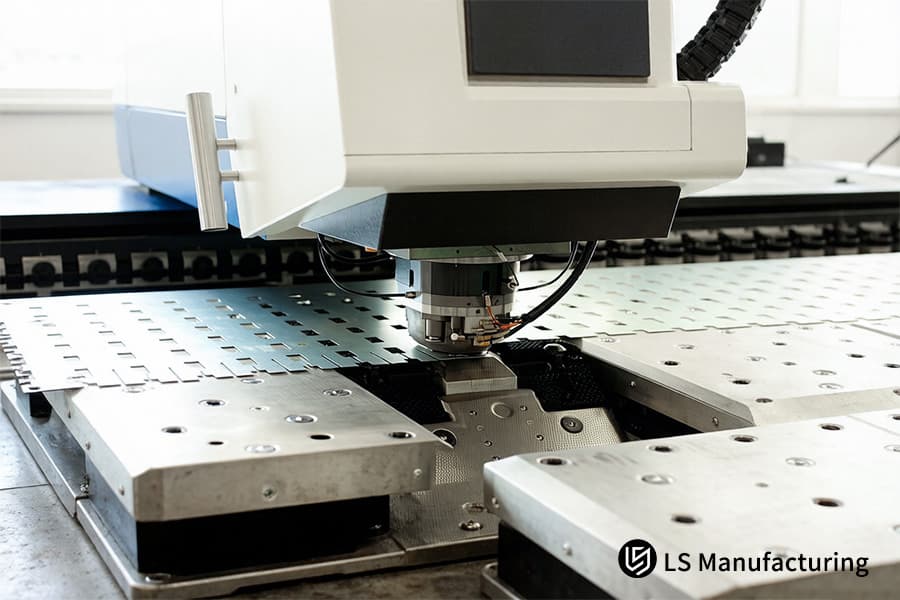
Figure 1: A hydraulic press stamps carbon steel sheet into an L-bracket with 0.02mm alignment for automotive use.
Why Is An Automated Metal Stamping Service The Key To Reducing Your Unit Cost In 2026?
In the year 2026, the critical determinant for unit cost optimization is the comprehensive use of an automated metal stamping service. The paper outlines the technological approach where automation leads to reduced wastage of raw materials. The technology employed in this case includes servo feed control and algorithms for strip optimization and reduces the engineering precision to the cost advantage of your metal stamping service. The technology approach entails:
Micron-Level Feed Control via Servo Technology
Servo feeders with extremely precise steps are used. This ensures there won’t be any position errors due to the mechanism because each step occurs at an exactly calculated position. It allows us to develop strips with minimal bridges and safety margins. As a result, we get rid of skeleton waste and ensure a key factor for unit cost optimization during high-volume metal stamping production.
Algorithm-Driven Strip Layout Optimization
In the course of designing our engineers, we utilize our proprietary simulation software that is able to analyze the blank geometry taking into consideration the constraints imposed by the material coil. By numerous iterations, it calculates the optimal configuration of blanks taking into account parameters like grain structure and web stiffness. Our simulation software plays an indispensable role in our automated metal stamping service, pinpointing the layout providing maximum part yield per unit of steel and thus reducing the cost of your precision metal stamping components.
Integrated Process Monitoring for Continuous Refinement
The automated system is programmed with sensors that check feed length consistency and tonnage in stamping in real time. The flow of this information into the control loop prevents any misfeeds before any wastage occurs. As a result of the closed-loop control, the automated stamping process control is always kept at maximum efficiency, thus providing the cost savings promised.
This approach is known to be scientifically validated, with engineering precision used to realize cost savings. The use of servo technology, modeling, and data analytics has allowed us to establish a deterministic model for the guarantee of unit cost optimization. Having acquired the science behind waste management, this experience places us at a competitive edge in offering an efficient automated metal stamping service that can handle even demanding metal stamping applications.

How Can A Professional Metal Stamping Service Ensure 100 Percent Part Consistency For Mission Critical Applications?
Mission critical applications in aerospace and medical equipment usually have the problem of inconsistency between various batches as a result of metal stamping practices. For achieving complete uniformity of the parts, the professional metal stamping service should make sure that the 10,000th part would not differ from the first one. Instead of performing statistical tests, our service employs in-die sensing to provide a digital fingerprint for each stroke. This allows manufacturing consistency at the single part level. Technical approach description is provided below:
Direct Process Measurement via In-Die Sensors
- Technology Integration: Embedding piezoelectric force and linear displacement sensors into the die design itself.
- Data Capture: Obtaining precise tonnage and stroke data directly from the actual point of the deformation process rather than the whole press.
- Problem Solved: Detects any minute variation in material thickness and lubrication that causes springback defects.
Real-Time Analytics for Per-Stamp Verification
- Digital Fingerprinting: Produces a digital fingerprint of tonnage/stroke data for a known-good stamp.
- Instantaneous Comparison: Matches each produced stamp against the digital fingerprint of the master stamp in real-time.
- Problem Solved: Alerts when any part falls outside the ±1.5% tolerance limits for inspection, thus preventing non-conformity parts from entering the batch in critical high-tolerance metal stamping.
Closed-Loop Control for Proactive Adjustment
- Predictive Correction: Linking sensor data with press and feeder controllers to enable automatic feed-in of parameters for subsequent blows.
- System Response: Compensates for any changes in tool wear and thermal drift before it impacts dimensional stability.
- Problem Solved: Refining the process from reactive inspection to preemptive stabilization, which is mandatory for mission-critical metal stamping operations.
The aforementioned document depicts how the changeover from reactive testing to instantaneous validation of metal stamping procedures took place. By digitizing the actual forming process, our precision metal stamping service provides deterministic and empirical manufacturing consistency in every part produced. This technical prowess in tackling the underlying issue of variability is what sets us apart as specialists in complex metal stamping assemblies.
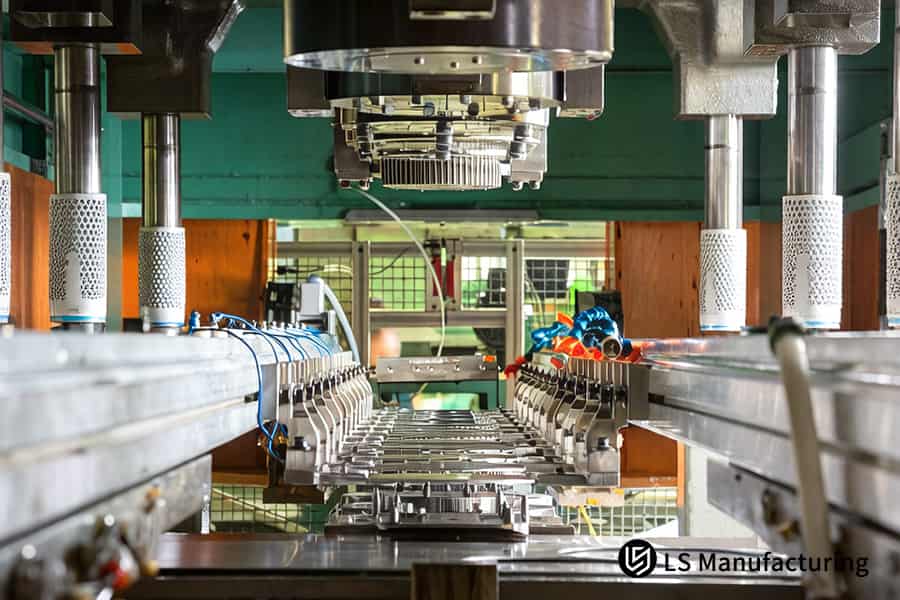
Figure 2: The stamping press forms precise steel components on a conveyor for automotive manufacturing applications.
What Technical Advantages Does High Efficiency Metal Stamping Offer For Rapid Scaling Of Hardware Projects?
The primary obstacle facing hardware scaling is the shift from prototype design to reliable and volume production. Current techniques add variability and inefficiencies. Here, we detail our approach to using high efficiency metal stamping with custom-made progressive dies to simplify multiple processes down to a single automated line. We also describe how we simulate the entire operation in advance to ensure success without failures that can slow production scaling.
| Technical Focus Area | How It Solves the Scaling Challenge |
| Unified Progressive Die Design | We design and use only one die that performs the three functions – drawing, piercing, and forming – using a strip of metal. The variability associated with using different dies becomes a thing of the past. |
| FEA Simulation for Formability | Using FEAPerforming formability simulation with software allows us to determine whether there will be any tearing or splitting during the high-speed progressive metal stamping. |
| In-Line Process Automation | With automated stamping for custom parts through the use of servo feeding, cycle times will be sustained and manual handling will no longer be a limitation for scaling. |
| Predictive Tooling Management | Based on tonnage profiling and tooling wear analysis, maintenance scheduling will prevent unexpected machine shutdowns that adversely affect production during high-volume stamping production. |
The methodology suggested above overcomes two core challenges that scaling poses – variability in quality and uncertainty about how quickly processes can run through a system. With most of the complexity incorporated into our automation process of progressive dies, we provide a deterministic transition from prototype to mass production. Such an approach to mission-critical metal stamping operations is essential for efficient production scaling.
Why Choose A Custom Metal Stamping Service With Dedicated DFM Engineering Support During Quoting?
Total cost of ownership encompasses much more than just part pricing, since it suggests tool life and production stability. Selecting a custom metal stamping service along with DFM engineering during the quotation stage will be helpful for addressing those problems. Here is how we solve this problem: modifying your design in such a way as to ensure an extended life span and prevent downtime completely:
Proactive Design Analysis for Tool Stress Reduction
A finite element analysis is performed to determine areas in the die that would experience stress. Sharp corners in the die are found, and we identify the appropriate corner radius size. This critical DFM engineering technique helps spread the stress uniformly without causing any fatigue on the die, thus facilitating efficient stamping production for complex parts.
Strategic Strip Layout Optimization for Die Longevity
Apart from material yield strength, we factor in the effect of part placement in the strip. By manipulating the feed angle, we distribute the stress loads on sensitive components such as punches and guide pins effectively. This deliberate approach towards achieving custom precision metal stamping ensures equal wear of the components, thus exceeding 300,000 cycles.
Material Specification and Process Validation
The selected material grade and temper are analyzed according to the forming operations performed by the company. We could recommend light annealing or a different material to improve the material formability and reduce spring back. As you can see, our initial analysis is aimed at ensuring that the selected material is suitable for mass metal stamping production without issues related to galling and wear associated with heavy tooling operations.
In addition, the DFM engineering process offered by our team solves the issue of tooling failure or malfunction even before designing a single stamping die. In other words, the process itself helps transform the service of consulting into the guarantee of durability of the tools created. This particular approach makes our custom metal stamping service unique and lays down the foundation for profitable stamping.
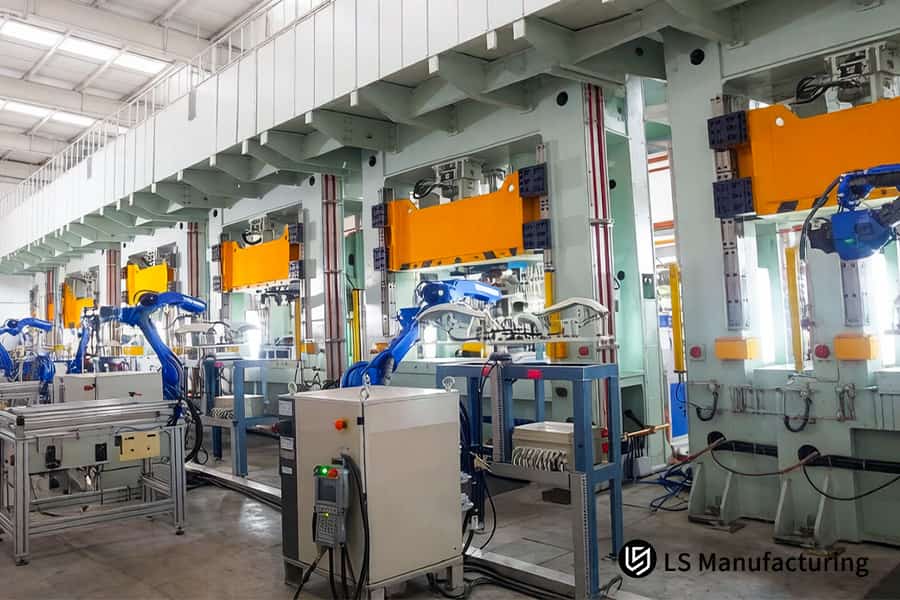
Figure 3: Automated robots feed carbon steel into 1000-ton presses for vehicle frame parts with 0.02mm tolerance.
How Does Automated Stamping For Custom Parts Mitigate The Risk Of Hidden Manufacturing Defects?
In metal stamping service, hidden defects like micro-burns or minute burrs can escape manual inspection, only to cause catastrophic failures in final assembly. Relying on statistical sampling is insufficient for mission-critical components. Our solution embeds 100% in-line optical inspection directly into the automated stamping for custom parts workflow, transforming quality assurance from a probability to a certainty and delivering substantive quality risk mitigation:
In-Line Optical Inspection at Production Speed
- Technology Integration: Co-locating high-resolution strobe synchronized cameras at press exit points.
- Data Capture: Image capture of every part within milliseconds to identify surface defects (scratches, dents), and dimensions.
- Problem Solved: Eliminates fallibility in manual inspections to ensure that no defect goes undetected during high-precision metal stamping.
Data Binding for Full Traceability
- Digital Thread Creation: Images and inspection data of each part are time stamped and associated with its batch of manufacture.
- Actionable Record: Creates an actionable audit trail useful in pinpointing causes of anomalies.
- Problem Solved: Provides more than mere production; it gives verifiable quality certificates, a must for traceable metal stamping production.
Automated Closed-Loop Rejection
- Real-Time Decision: Inspection software analyzes inspected parts based on predefined standards.
- Physical Action: This leads to rejection of defective parts using a pneumatic ejector system.
- Problem Solved: Protects against defective pieces entering the stock inventory, a core function of automated defect-free metal stamping.
This integrated system solves quality risk by making inspection a deterministic, in-process function rather than a post-production audit. The documented method—from high-speed imaging to automated rejection—provides data-driven proof of conformity for every single part. This technical rigor defines our metal stamping service, offering clients complete quality risk mitigation and ensuring reliability for demanding custom metal stamping applications where failure is unacceptable.
Can High Volume Metal Stamping Remain Cost Effective For Complex Multi Stage Component Geometries?
One of the biggest challenges associated with high volume metal stamping of complex-geometry metal stamping components is dimensional shift due to thermal expansion. This paper outlines a closed-loop approach that combines in-line metrology and adaptive process control. This addresses the fundamental issue of ensuring that high volume metal stamping can be achieved without sacrificing precision due to complexity at scale.
| Technical Focus Area | How It Solves the Complexity-at-Scale Challenge |
| Integrated Multi-Stage Process Design | The use of an integrated transfer system within a single press machine to undertake multi-stage metal stamping. |
| In-Line Metrology for Real-Time Auditing | The use of a programmable CMM within the cell to audit critical dimensions, identifying minute thermal drifts ranging between ±5 microns. |
| Adaptive Process Compensation | Using the measurement information in real time to adaptively adjust the presses, an absolutely necessary process for precision tight-tolerance metal stamping over long production cycles. |
| Predictive Maintenance Triggers | Associating dimensional trend information with wear modeling for tools to ensure die maintenance at a time before tool wear affects part quality in precision structural metal stamping. |
Our approach addresses the precision at scale problem through the visibility and correction of variation in real-time that is critical for successful high volume metal stamping runs. Our system provides you with a controllable and self-correcting manufacturing process, rather than simply a process. The science behind this approach, including integrated metrology and adaptive control, distinguishes our precision metal stamping service, allowing us to ensure that even geometry complexity does not compromise the success of large volume manufacture.
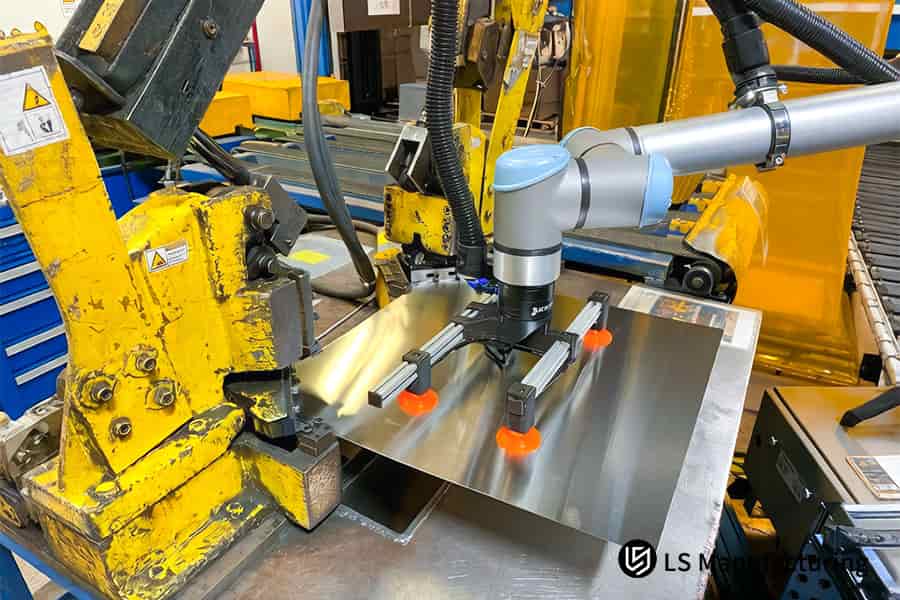
Figure 4: Orange robotic suction cups position ASTM 304 steel sheets for high-speed stamping of custom parts.
Why Is A Precision Metal Stamping Service Vital For Sub Millimeter Electronic Interface Components?
In case of sub-millimeter devices, geometrical specifications are critical. In that case, the need for burrless fabrication to tolerances of ±5 µm becomes critical for the precision metal stamping service you require. As shown below, it is possible through our solution for the necessary tooling and control processes to meet micro-fabrication specifications and produce higher quality electrical contact and mating of your sub-millimeter electronic components.
Ultra-Precision Tooling with Controlled Clearance
Dies made from tungsten carbide inserts with wire-EDM capability provide cutting clearances of up to 3% of the material thickness. This ensures precise control of the clearance all around the die. This leads to the formation of a clean shear with burnish heights exceeding 80% and surface finish of Ra 0.8µm or higher. This is ideal for connector metal stamping without micro arcing.
In-Process Stability through Thermal Management
The fast-paced stamping results in localized heating, resulting in dimensional changes in the tools. The solution would be to use temperature-controlled tooling plates and press tonnage monitoring system, thereby facilitating thermal growth management in high-precision metal stamping processes.
Metrology-Led Process Validation and Control
Initial part validation can be achieved using optical comparators and vision CMM with sub-micron capabilities. The information gathered here will serve as the template for manufacturing purposes. Inline vision systems would then perform statistical sampling on critical parameters such as pin width and coplanarity. Such a closed loop would ensure that all batches conform to the extremely stringent requirements needed for the custom metal stamping service of micro-interconnects.
The solution to the micro-precision problem is through the proper management of the three major factors: the geometry of the tool, its thermal stability, and measurement. The method, which we have successfully documented from tool creation to actual measurement during the process, assures the quality of the electronic components. We are able to offer precision metal stamping service because of the above technical considerations and ensures geometrical integrity of micro-pitch metal stamping.
How Can Metal Stamping Production Integrated With Secondary Processing Shorten Your Global Supply Chain?
The global supply chain network is vulnerable to multiple challenges when dealing with multi-vendors, such as long production schedules, lack of product handover quality assurance, and obscure costs. A vertically integrated metal stamping production system addresses these shortcomings by ensuring all fabrication and finishing activities take place under one roof. This paper outlines the process of vertical integration and explains how it streamlines the manufacturing process by incorporating supply chain integration:
Vertical Integration of Critical Secondary Processes
- In-House Process Control: Heat treatment, plating, and cleaning machines operate inside the stamping press factory building.
- Eliminated Logistics Handoffs: No need to send partially manufactured goods to an external provider, removing all delivery times and logistics hassles.
- Problem Solved: Creates a seamless flow from blank to finished part, drastically shortening the total manufacturing lead time for complete metal stamping solutions.
Synchronized Process Engineering & Scheduling
- Unified Process Flow: Engineering secondary processes (for example, tempering conditions, coating thickness) together with stamping dies.
- Optimized Material Handling: Automated conveyance using conveyor belts and Automated Guided Vehicles (AGV) to transport materials between operations without packaging or queues.
- Problem Solved: This eliminates any incompatibility issues and enables just-in-sequence manufacturing, which is a significant strength of integrated stamping productionfor complex sub-assemblies.
Unified Data Continuity and Quality Traceability
- Single Digital Thread: Maintaining a single quality document trail of the part from raw material input, through stamping operations, heat treatment, and coating procedures.
- Holistic Root-Cause Analysis: Allows fast identification of any abnormality to its exact cause, be it at the stamping stage or at any subsequent processing stage.
- Problem Solved: Ensures comprehensive traceability of all lots and facilitates easy quality management of secondary-process metal stamping products.
Transparent Cost Structure and Accountability
- Consolidated Quoting: A single consolidated quote for all stages of production without any intermediary costs incurred between different suppliers.
- Single Point of Responsibility: The responsibility for part quality, functionality, and delivery falls on one vendor.
- Problem Solved: Simplified procurement process and reduced total cost of ownership through efficient use of an automated metal stamping service along with additional features.
The solution to supply chain vulnerability lies within our holistic approach that removes the reliance on outside parties and potential handoffs. By offering a seamless workflow from input to output, we eliminate all concerns associated with supply chains. Vertical integration, incorporating both an automated metal stamping service and secondary operations, becomes the defining strategy of our supply chain integration approach.
Case Study: LS Manufacturing Precision Automotive ECU Housing Automated Stamping Custom Solution
In this case study, the LS Manufacturing discusses their experience working with a Tier-1 automotive manufacturer to address a critical issue in the production of their aluminum ECU housing. After encountering significant yield problems and delays, this customer needed a total overhaul of their process. The LS Manufacturing automated metal stamping service provided a highly precise and custom-tailored solution, showcasing our complex aluminum stamping, even in the most difficult circumstances:
Client Challenge
The client struggled to mass-produce a thin-wall, deep-drawn aluminum 6061-T6 ECU housing. The existing process induced micro-fractures during high-speed forming, capping first-pass yield at 78%. This resulted in costly rework, delayed deliveries by three weeks per batch, and jeopardized their Just-in-Time supply commitments. The core problem was uncontrolled material flow and inconsistent press tonnage in their high-volume metal stamping production, creating unsustainable waste and risk.
LS Manufacturing Solution
The forming process was modified accordingly. A new progressive die design included improved draw stations, as determined through an FEA simulation that maximized stretch-compression ratios. An automated lubrication process maintained optimal friction levels. The key development involved the integration of a 20-ton servo cushion with feedback control, ensuring the forming force remained within a ±0.5% tolerance limit. Automated stamping for custom parts resulted in a reliable and controllable process for high-precision metal stamping that directly targeted the fundamental issues leading to fracture and variability.
Results and Value
These improvements have raised the first-pass yield to 99.7%, increased production rates from 45 to 120 pieces per minute, and cut per-part cost by 22%. In over two million additional cycles since implementation, the system has not had any unplanned downtime. These results ensure on-time delivery, avoid the need for sorting operations, and create an uninterrupted supply chain. Consequently, the client transferred all of its automotive metal stamping operations to LS Manufacturing.
This case exemplifies our engineering-led approach to solving intractable production problems. We delivered not just a part, but a fully characterized and stabilized manufacturing process. The quantifiable results in yield, speed, and cost underscore the technical depth of our automated metal stamping service, proving our unique capacity as a partner for the most mission-critical precision metal stamping applications.

FAQs
1. Why choose LS Manufacturing for my high-volume metal stamping needs?
With 15 years of experience in precision stamping, we guarantee stable tolerances of ±0.01mm, backed by a 100% automated sensor monitoring system.
2. How quickly can I receive a custom metal stamping quote for a complex project?
Simply upload your STEP or PDF drawings, and our engineering team will complete a DFM review and provide a detailed quote—including tooling costs—within 24 hours.
3. What materials can LS Manufacturing process using automated stamping?
We specialize in stainless steel, cold-rolled steel, phosphor bronze, and various hard aluminum alloys, capable of handling material thicknesses ranging from 0.1mm to 6.0mm.
4. Does LS Manufacturing support low-volume production of custom parts?
While we excel at mass production, our "Quick Die Change" technology allows us to flexibly accommodate custom orders starting from just 1,000 pieces.
5. How do you ensure mold durability during high-efficiency metal stamping?
We exclusively utilize premium mold steels—such as DC53 and ASP60—imported from Japan or Sweden. Combined with PVD surface coatings, this ensures a mold lifespan exceeding 1 million cycles.
6. Can you provide precision metal stamping services for miniature electronic components?
Yes, we operate a dedicated micro-stamping line specifically designed to produce extremely tiny, high-precision contacts—often barely visible to the naked eye—for the medical and consumer electronics sectors.
7. What types of secondary surface treatments do you offer for stamped metal parts?
We offer a comprehensive suite of surface treatments—ranging from anodizing, gold plating, and nickel plating to electrostatic powder coating—to ensure that your parts are not only functionally reliable but also aesthetically flawless.
8. How can I be sure that my intellectual property is safe with LS Manufacturing?
We are prepared to sign a legally binding Non-Disclosure Agreement (NDA) as early as the inquiry stage. Furthermore, we employ a closed-loop digital drawing management system that strictly restricts access to project-specific information.
Summary
True manufacturing excellence in automated stamping integrates precision, cost control, and risk management. LS Manufacturing’s core metal stamping service turns advanced technology—including precise DFM analysis, in-mold monitoring, and full post-processing—into clear business advantages. We remove technical hurdles from design to mass production, ensuring seamless delivery. Choosing LS Manufacturing means partnering with an expert dedicated to strengthening your product’s competitive edge.
Are you concerned about persistently high unit costs or inconsistent part quality? Put an end to that uncertainty today. Contact a senior engineer at LS Manufacturing right now and upload your design drawings. We will provide you with not only a highly competitive metal stamping quotation but also a complimentary DFM optimization assessment, helping you lock in the most cost-effective structure before mold fabrication even begins.
Is your stamping yield below 80%? Let's schedule a process review to achieve 99.7%.
📞Tel: +86 185 6675 9667
📧Email: info@lsrpf.com
🌐Website: https://lsrpf.com/
Disclaimer
The contents of this page are for informational purposes only. LS Manufacturing services There are no representations or warranties, express or implied, as to the accuracy, completeness or validity of the information. It should not be inferred that a third-party supplier or manufacturer will provide performance parameters, geometric tolerances, specific design characteristics, material quality and type or workmanship through the LS Manufacturing network. It's the buyer's responsibility. Require parts quotation Identify specific requirements for these sections.Please contact us for more information.
LS Manufacturing Team
LS Manufacturing is an industry-leading company. Focus on custom manufacturing solutions. We have over 20 years of experience with over 5,000 customers, and we focus on high precision CNC machining, Sheet metal manufacturing, 3D printing, Injection molding. Metal stamping,and other one-stop manufacturing services.
Our factory is equipped with over 100 state-of-the-art 5-axis machining centers, ISO 9001:2015 certified. We provide fast, efficient and high-quality manufacturing solutions to customers in more than 150 countries around the world. Whether it is small volume production or large-scale customization, we can meet your needs with the fastest delivery within 24 hours. choose LS Manufacturing. This means selection efficiency, quality and professionalism.
To learn more, visit our website:www.lsrpf.com.