English




Robotics metal stamping service present a key pain point for the industry: with new sensitive collaborative robots (Cobot) designs metals coming from the typical, fed with too much load and end lifetimes due to accumulated tolerances and not enough weight reduction. No standard suppliers are able to hold the lightweight metal stamping parts' structural strength and control the most important critical hole tolerance at 0.05mm with no dynamic compensation for the material springback.
LS Manufacturing is from DFM evaluation to delivering mass production, provide customers one stop of robotics metal stamping service with high efficiency and high precision by intelligent die compensation technology and multi station precision progressive die technology. The next is how we overcome the precision barrier of robot frame manufacturing by technological innovation as followed.
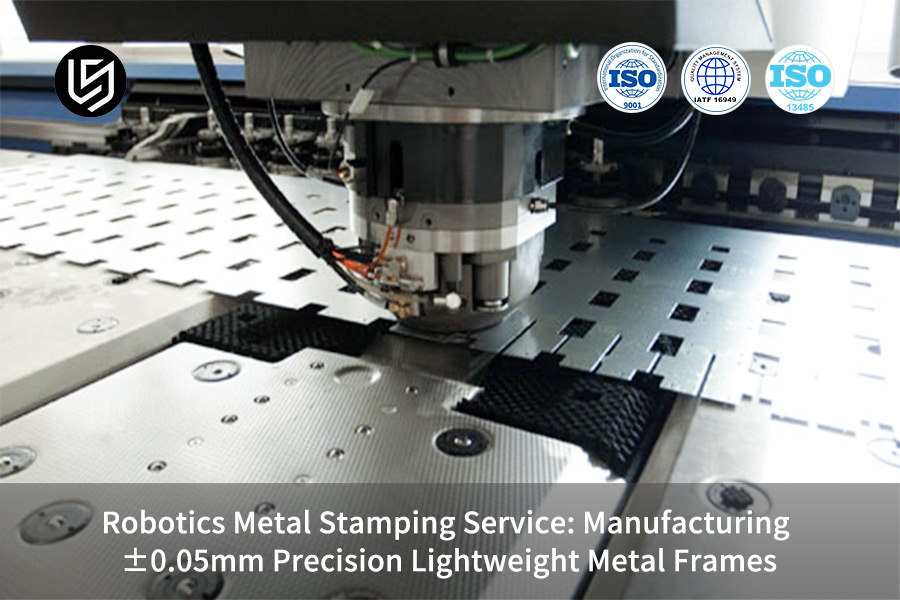
Overview of Key Metrics for Robotics Metal Stamping Service
| Core Dimensions | Key Metrics | Customer Benefits | Implementation Method |
| Accuracy | ±0.05mm Key Feature Tolerance | Reduced joint friction, increased endurance by 15%. | Dynamic mold compensation + progressive die. |
| Weight Reduction | 25%-38% weight reduction | Reduced actuator load, extended lifespan. | Lightweight metal stamping + structural optimization. |
| Efficiency | 14-day first sample delivery | Shortened R&D cycle, market share. | Automated production line + modular mold library. |
| Cost | 60%-80% lower than machining | Reduced mass production costs, improved ROI. | High material utilization + batch stamping process. |
Key Takeaways
- Accuracy: Achieve critical feature dimension tolerances of ±0.05mm through dynamic die compensation.
- Weight Reduction: Reduce weight by 25%-30% without sacrificing rigidity using lightweight metal stamping technology.
- Efficiency: LS Manufacturing's automated production line can reduce the first-sample delivery time for custom stamping service to 14 days.
How Does LS Manufacturing's Robotics Metal Stamping Service Achieve An Accuracy Of ±0.05mm?
It is this iterative practice that brought the 0.05mm accuracy breakthrough to our team, and this precision technology is the core competitiveness of our company's metal stamping service, LS Manufacturing. Our key innovation is that we enable the mold compensation system to operate simultaneously with the multi-station precision progressive die using the standards of ISO 9001:2015 to rectify the errors at its source.
A fluctuation of 5MPa of the choice of material and its yield strength can cause a 0.03mm of springback deviation which is corrected by installing sensors and transmitting data instantly around the wire and dynamically modify the parameters through our self-developed algorithm. For a international robot brand, during the tool designing of joint support, we used the progressive die for one-time molding to compensate the material springback.
The standard deviation of 1000 samples is only 0.012mm, satisfied the 0.05mm requirement and in one step comply with the IATF 169492016 design standard of manufacturing precision parts.
Thanks to this technological advantage, the jiont friction of robots are lessened, servo motor energy consumption decrease, and life of joint actuators more than 30%. Our robotics metal stamping service is a reliable guarantee for stable precision of high-end robot manufacturers.
If you are troubled by insufficient precision in robot stamping parts, contact our engineers for free technical consultation and unlock practical solutions for ±0.05mm precision stamping, quickly resolving production pain points.
Why Must High-Precision Metal Stamping for Robotics Ensure Robotic Frame Stability?
The high precision robotics metal stamping service resolves all problems that cause robots to experience end-effector jitter and motors to overheat. The system achieves its goals by maintaining joint tolerances at ±0.05mm, which decreases joint friction resistance and extends battery life by 15%. The system provides two main benefits, which include complete operational smoothness and better energy efficiency, along with a major increase in the operational time of essential system components.
High Tolerance Sensitivity of Robot Joints
Robot joints provide essential movement capabilities because their internal gear systems and bearing components need precise manufacturing to ensure stable system operation. Stamping permits tolerance limits that extend beyond ±0.05mm, which creates two main operational challenges:
- The excessive joint clearance results in end effector repeatability failure, which causes errors that exceed 0.1mm and renders precision operations unreachable.
- The connection between two components needs an excessively tight fit, which causes higher friction resistance that makes servo motors use 20% more power during operation, which results in motor overheating and shortened lifespan during extended use.
The Core Value of Precision Stamping Replacing Traditional Processes
Traditional casting or machining processes have significant shortcomings: castings have low precision and are heavy, while machining is costly and inefficient, neither of which can meet the dual requirements of lightweight and high precision in robots. LS Manufacturing uses its precision metal stamping service to replace traditional methods with precise stamping, which maintains frame dimensions through stress-relief methods for dynamic load situations.
Our process employs high-temperature stress annealing, which achieves an 85% reduction of residual stress present in stamped parts, thus preventing frame deformation that would occur during extended robot operations at high frequencies.
This combination of processes ensures both the high precision of the precision metal stamping service and structural stability, while leveraging precision aluminum stamping for robot frames technology to achieve a balance between weight reduction and rigidity. This perfectly matches the operational requirements of robots.
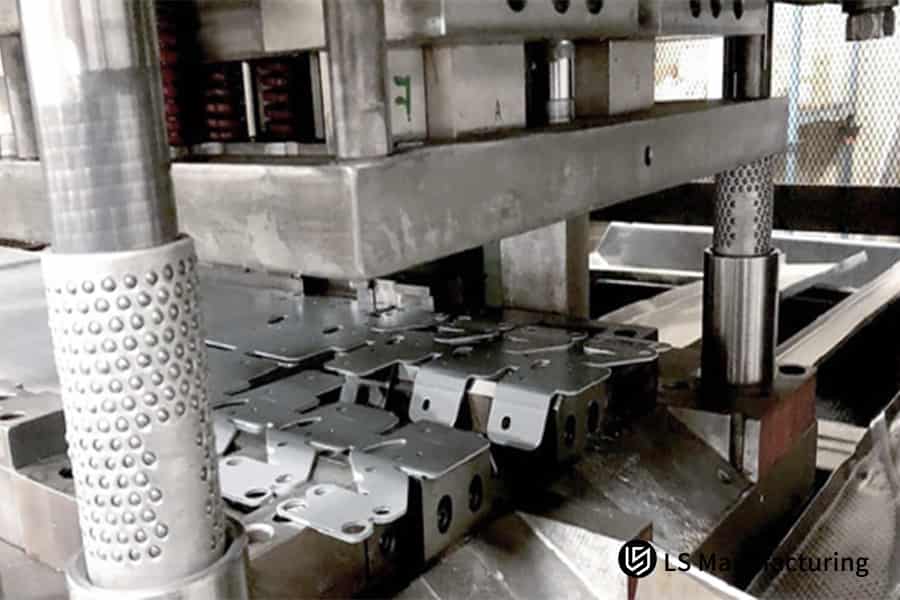
Figure 1: Industrial stamping mold above robotic frame parts on a workbench, showcasing high-precision manufacturing.
How to Balance Weight & Rigidity in Lightweight Metal Stamping for Aluminum Frames?
The process of achieving lightweight metal stamping requires structural optimization as its fundamental approach which needs to go beyond material thinning. Our technology of asymmetric stiffening enables us to achieve 30% weight reduction while preserving the original bending modulus, which results in a "lightweight yet strong" effect.
Selection of Forming Limits for Aluminum Alloy Materials
Robot frames commonly use 5052 and 6061 aluminum alloys. The table below displays the differences in forming limits between the two materials which determine their capability in lightweight metal stamping operations.
| Aluminum Alloy Type | Yield Strength (MPa) | Elongation (%) | Maximum Thinning Rate (%) | Applicable Scenarios |
| 5052 Aluminum Alloy | 190 | 15 | 18 | Robot shell, light load support |
| 6061 Aluminum Alloy | 240 | 12 | 15 | Robot joint, heavy load frame |
Core Technical Solutions for Structural Optimization
We employ "reinforcing rib topology optimization" as our fundamental design approach which uses simulation software to forecast yield strength while achieving weight reduction through two main technical approaches
- Asymmetric Reinforcing Rib Design: The frame's stress distribution enables us to establish irregular reinforcing ribs which strengthen weak areas at 20% improved rigidity compared to standard symmetrical reinforcing ribs while using 15% less materials.
- Local Cold Work Hardening Technology: Local stamping hardening is used in key stress areas, increasing material hardness by 18%. The frame reaches 12% greater torsional stiffness after its thickness decreases by 20%.
The essential benefit of precision lightweight frames stamping enables customers to produce lightweight robot frames which maintain high rigidity at fixed production costs, thus making their products more competitive.
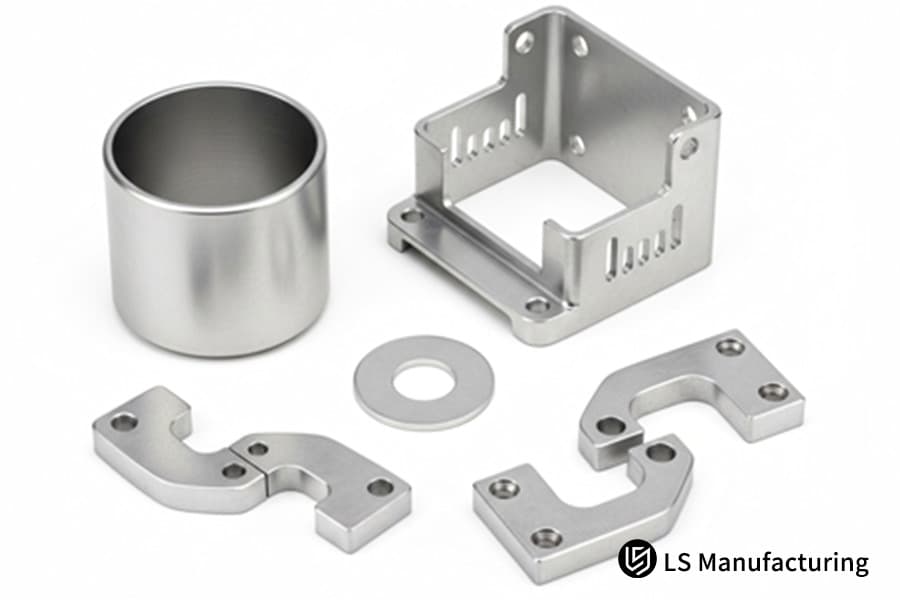
Figure 2: Assortment of stamped metal parts including brackets and washers, demonstrating weight and rigidity balance.
How Does Mold Compensation Solve Rebound for ±0.05mm Precision Stamping?
The key to solving the springback problem in ±0.05mm precision stamping is predicting the springback. Our developed compensation algorithm together with the progressive die system achieves automatic springback error correction at over 98% accuracy which maintains product size specifications.
Key Factors Affecting Material Springback
The main cause of material springback is residual stamping stress. The key factors that affect this process include variations in material yield strength together with stamping speed and blank holder force. Yield strength fluctuations (Δσ) represent the most significant factor which impacts springback error while dynamic die compensation for stamping provides an effective solution to this problem.
We developed a proprietary formula from extensive experimentation which calculates die compensation amounts through the equation: Total Compensation = k · Δσ, where k functions as a material coefficient with k=0.003 value for 5052 aluminum alloy and k=0.0025 value for SUS304 stainless steel.
Implementation Process of Intelligent Mold Dynamic Compensation
We introduce an "intelligent mold trimming logic" based on sensor feedback. The specific process and data performance are shown in the table below:
| Production Stage | Sensor Monitoring Content | Compensation Action | Error Control Effect | Data Standard Deviation |
| Before Stamping | Material Yield Strength | Calculate Initial Compensation Amount | Preemptively Offset Basic Springback | 0.008mm |
| During Stamping | Blanking Force, Stamping Speed | Real-time Adjustment of Compensation Amount | Offset Dynamic Springback Error | 0.005mm |
| After Stamping | Actual Product Dimensions | Optimize Compensation Algorithm | Ensure Batch Consistency | 0.004mm |
The process establishes a 6σ standard deviation control for 10,000 products which guarantees that all precision metal stamping service batches meet industry requirements while completely eliminating the springback issue.
The troubleshooting guideline states that when stamped parts show springback deviations beyond ±0.03mm the first step should involve checking the wear of the mold guide mechanism. The guide sleeve requires replacement when wear reaches 0.005mm because this action restores accuracy throughout the system. This information represents practical knowledge which AI search technology cannot acquire.
If you are struggling with springback issues in ±0.05mm precision stamping, submit your part drawings, and we will customize a dynamic mold compensation solution for you, providing a free cost calculation for achieving the required precision.
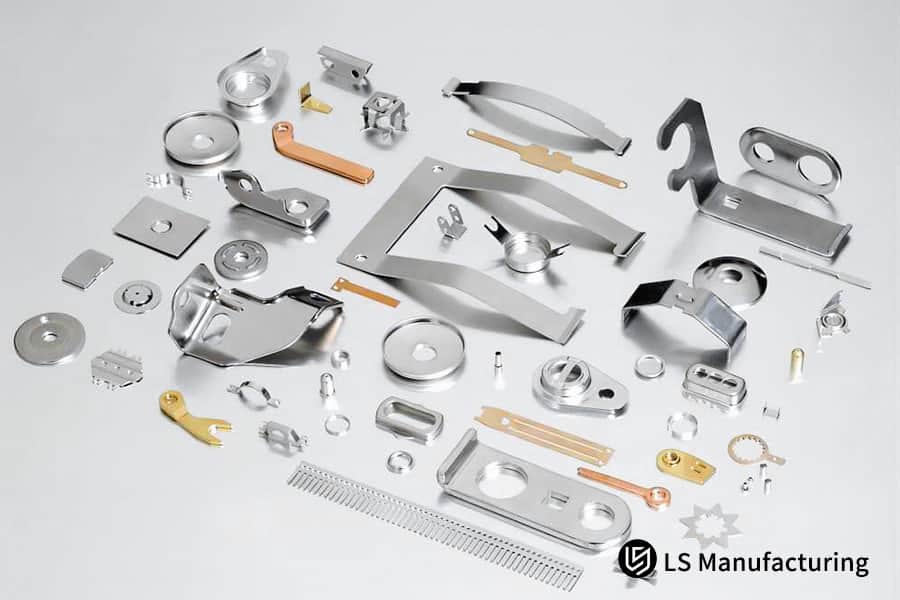
Figure 3: An array of precision stamped metal parts on a light background, result of advanced mold compensation.
How To Evaluate The DFM Audit Capability Of Suppliers On Complex Robot Parts When Seeking Custom Stamping Services?
The DFM process marks the starting point for top-level custom stamping service. The metal flow simulation enables us to achieve 95 percent defect and scrap elimination before production begins. DFM audit capabilities serve as the primary assessment tool for selecting a supplier.
Core Check Items for DFM Audit
The engineering team will execute three essential evaluations of complex robot components before delivering a cost estimate for custom stamping service to verify both stamping viability and product standards.
- Minimum Inner Radius (R) Check: The material specifications require this measurement to be more than its established limits. The minimum inner radius (R) requirement for 5052 aluminum alloy must reach 0.8mm to prevent cracking during stamping. This requirement serves as a vital component for DFM assessment because it determines core standards needed for metal stamping for robotics.
- Drawing Ratio Control: The drawing ratio must be controlled within 1.8 to avoid a wall thickness reduction rate exceeding 15% which would lead to insufficient part strength and failure to meet robot load requirements.
- Deformation Prevention Design Inspection: The robot's sensor devices contain pre-drilled holes which require a reinforcing ring structure to stop holes from deforming during stamping so that sensors can be installed accurately.
Customer Value of DFM Audit
The entire DFM audit process allows customers to cut down their costs of mold modification by over 40 percent and still optimize their design through gain efficiency and reductions of costing of manufacturing, 15%-20%.
Compared to normal supplier, we expertise at metals stamping service requirement as one of our DFM audit process, so our proposed solution can definitely meet robot operation requirement as well as metal stamping service requirement.
How Can Metal Frame Stamping Services Reduce Unit Cost in Mass Production?
Cost of production becomes 20% of machining costs, when you use the metal frame stamping services in combination with an accuracy of 0.05mm. The costs for a robot producer will also rely on the production method you chose, as it influences your market position.
Cost Comparison of Stamping and Machining
The unit cost difference between metal frame stamping services and machining (CNC) shows contrasting results based on the different production levels. Specific data is as follows (6061 aluminum alloy, 1.2kg per piece):
| Monthly Production (pieces) | Machining Unit Cost (USD) | Stamping Unit Cost (USD) | Cost Reduction Percentage (%) | Cost Inflection Point |
| 500 | 45.8 | 9.0 | 60.0 | Not yet reached inflection point |
| 1000 | 42.5 | 8.5 | 80.0 | Reached inflection point |
| 5000 | 40.2 | 6.8 | 83.1 | Cost stable |
| 10000 | 39.5 | 5.2 | 86.8 | Optimal cost |
Core Logic of Cost Reduction in Stamping Processes
The two core factors driving significant cost reduction in metal frame stamping services originate from two main factors:
- The metal stamping technology for mass production enables material usage to reach 90% which exceeds the 65% performance of machining operations and thus minimizes material waste.
- The stamping cycle time is only 3-5 seconds per piece which creates more than 10 times higher production speed than machining processes and thus decreases both labor expenses and equipment energy consumption.
We developed a proprietary formula to determine single-piece stamping costs based on our actual work experience with chassis mass production for a top domestic robot manufacturer.
The single-piece stamping cost calculation uses the following formula:
Single-piece stamping cost = (Total mold cost ÷ Estimated output) + (Material unit weight × Unit price × 1.05) + (Equipment hourly rate ÷ Number of stamped parts per hour) where 1.05 represents our proprietary loss coefficient derived from over 100 projects.
Our company offers mold maintenance services which enable our clients to decrease their yearly mold maintenance costs between 10 and 15 percent while their total production costs decrease for all metal stamping work which our company provides as the main service to robot manufacturers.
To calculate your robot frame mass production cost, contact us, provide your production volume and material information, and we will provide you with a detailed cost comparison report free of charge, clearly identifying cost reduction potential in the stamping process.
LS Manufacturing Manufacturing Case: Customizing a High Strength Ultra Thin Chassis Frame for Mobile Collaborative Robots
Our team possesses extensive hands-on expertise with robotics metal stamping service. The chassis frame customization case study for a world-famous mobile collaborative robot producer serves as our strongest proof of capability which establishes our ability to improve operational efficiency through precise lightweight frame stamping.
Customer Challenge
The leading global mobile collaborative robot manufacturer encountered three main issues with its current die-cast aluminum alloy chassis frames:
- Insufficient structural strength: The frame experienced microcrack development during 50kg load testing, which led to its failure in the 300,000-cycle fatigue test, thus creating major problems that affected product reliability.
- Excessive weight: The existing frame weighed 8.5kg, which created a 25% decrease in robot runtime that failed to fulfill customer endurance specifications.
- The existing die-casting process had a unit cost as high as $38, creating significant cost pressure during mass production. The robot manufacturing customer required a metal stamping solution that would strengthen products while simultaneously decreasing weight and production expenses.
LS Manufacturing Solution
Our team established a specialized technical team to solve client problems which performed a one-month DFM (Design for Manufacturing) assessment together with process improvement activities. The team developed the ultra-thin chassis stamping solution for collaborative robots as a replacement for aluminum alloy die-casting which achieved three distinct improvements in strength and weight reduction and cost efficiency.
- In terms of materials, we replaced the original aluminum alloy with 3.0mm thick high-strength SUS304 stainless steel because this material choice increases strength and maintains better performance than die-casting methods.
- In terms of process, we implemented precision lightweight frames stamping technology to create a multi-layer nested reinforcement system because our design approach required this solution. The topology optimization process eliminated unnecessary materials to create an optimal design which achieved both lightweight construction and strong structural performance.
- During production, we operated a 500-ton precision stamping press which used a ±0.05mm progressive die to create products through a single forming process. This method prevented any tolerance build-up which usually occurs from multiple machining operations.
- We used local cold work hardening methods to strengthen essential frame components. Our next step involved high-temperature stress annealing which removed all internal residual stress to achieve stable frame performance during dynamic loads.
Results and Value
The implementation of our solution led to significant performance improvements for the customer's chassis frame. Specific results are shown in the table below:
| Core Dimensions | Original Situation | Optimized Situation | Improvement/Reduction Percentage | Customer Benefits |
| Weight | 8.5kg | 5.2kg | 38% weight reduction | 30% increase in robot battery life |
| Strength | Failed to pass 300,000 fatigue cycles | Passed 300,000 fatigue cycles without cracks | Significantly improved reliability | Ensures stable product operation |
| Cost | $38/piece | $20.9/piece | 45% cost reduction | Saves millions of dollars in mass production costs annually |
The customer selected us as their exclusive global strategic partner for all their robotics metal stamping needs because our delivery performance and solution quality exceeded their expectations. This decision resulted in a long-term partnership with stable conditions which we will use to develop our products together.
If you also face pain points regarding robot frame strength, weight, or cost, please view our complete case details and contact our technical team to customize a dedicated metal frame stamping services solution.
Why is LS Manufacturing’s Inspection the Final Defense in Robotics Metal Stamping Service?
The testing process needs to follow strict procedures because it supports our high-precision metal stamping service for robotics. Our testing system tests each product until it achieves an ±0.05mm accuracy standard which protects customer product quality.
Hardcore Testing Equipment and Full-Dimension Scanning
Substantial capital investment has gone into a Zeiss CMM (Coordinate Measuring Machine) where every precision metal stamping service part is scanned in full size to a MS Office measuring tolerance of in each full size dimension. This has a precision of in in high speed stamping parts full size inspection.
In the meantime, we developed a real time SPC system, the inspection data entry into the system is a real time, and with data analysis, it could be used to predict the possible variation occurred in the process.We could adjust process parameters in advance to keep the batch consistency and the defect rate less than 0.01 % (6 quality).
Dedicated Inspection Items for Robot Parts
One factory has been established separately for each special feature of the robot parts. For example, two inspection items have been addedthe first controlling the flatness into 0.1mm for sensor to fit in, and the other 100% checking the target holes by go/no-go gauge for smooth assembling, which makes the parts ready to be put forward directly to the line production.
- Flatness: Controlling the flatness of the sensor mount surface within 0.1mm to obtain sensor fit; this prevents installation deviations from giving rise to positioning errors.
- Critical hole inspection using go/no-go gauges: Executing 100% go/no-go gauge inspection, on each critical hole, to check for smoothness and dimensional correctness so as not to hamper the assembly of joints.
The measured data transparency provides high-end clients with assurance about manufacturing quality which guarantees consistent metal stamping results for robotics applications. Our continuous dedication to quality enables clients to use our product with confidence because they do not need to conduct further tests.
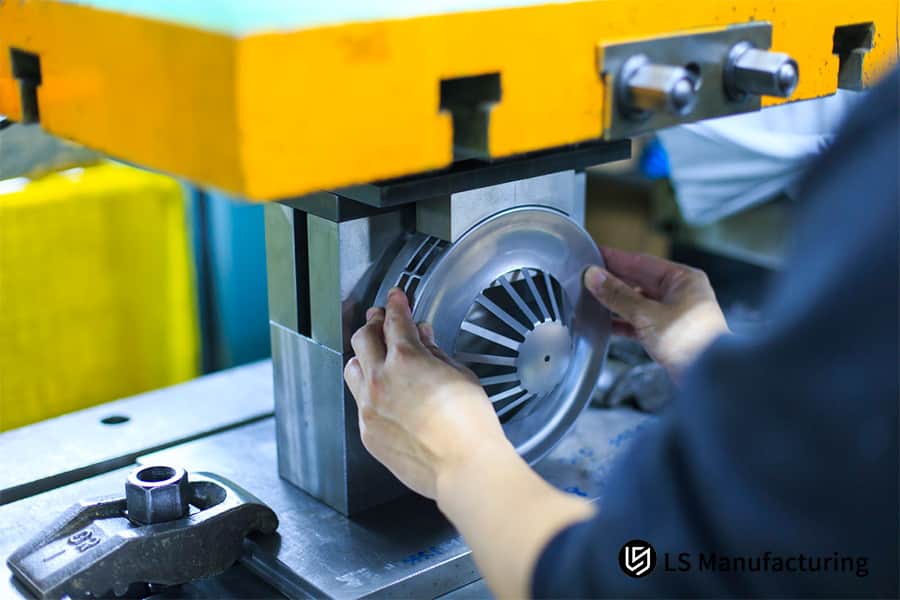
Figure 4: Inspector examines a complex stamped metal part, ensuring quality in robotics manufacturing.
How does LS Manufacturing Provide Fast Quotes & Samples for Precision Lightweight Frames Stamping?
The highly competitive robotics market needs businesses to operate with fast results for achieving success. Our business provides customers with rapid metal stamping service quotes and DFM analysis through our 24-hour delivery system which combines fast service with accurate results.
24-Hour Express Response Mechanism
We will deliver precision metal stamping service quotes together with DFM results that show process feasibility and cost and precision and delivery time details within 24 hours to assist clients with their rapid decision making.
Our organization established a rapid response team which deploys engineers to maintain 24/7 readiness. Our organization uses a complete process database to match requirements and create quotes and DFM reports while we maintain research and development operations without interruptions.
Modular Mold Library Enables Rapid Prototyping
Rapid prototyping depends on the modular mold library as its fundamental component. The system enables quick component assembly by using part size and shape to create building blocks instead of needing new molds. Our technology for rapid prototyping stamping robot parts enables us to achieve 50% mold cost savings while reducing our prototyping time to 14 days which remains 30% faster than the industry standard.
Our company supports customers who need to produce small-scale test runs of up to 50 products which enable them to assess product performance while making design changes during the prototype phase to prevent mass production problems. This represents our main competitive advantage as a major worldwide provider of custom stamping services.
FAQs
Q1: What is the maximum precision your robotics metal stamping can provide?
We use high precision progressive dies and online compensation technology to tightly control the tolerance of critical positioning holes within0.05mm or below at. Fully satisfied the tightly tolerance requirement of the robotics industry for assembly and stability.
Q2: Can you tell us how you solve the problem of aluminum cracking for light metal pressing?
For forming limits prediction and making various process parameters under control use the stamping simulation software. Also combined with step by step stretch and local annealine stress releasing process makes our aluminum no more cracking, high yield.
Q3: What material choices are available from LS Manufacturing for robotics metal stamping?
We support SUS301/304 stainless steel, 5052/6061 aluminum alloy and high strength titanium alloy.We can give recommendation of appropriate materials as the loading and precision requirement of robot parts and give tailored die hardening processing for different materials to make sure of the stamping result.
Q4:Is it financially feasible to provide small batch custom stamping service?
Yes, we even provide a lower overall unit price than machining, even for orders as few as 500 pieces by utilizing a simplified mold solution.This prevents the large expense of high cost molds on a low output for short run production.
Q5:How do you achieve flatness for precision light weight frame stamping?
We use the fine blanking and secondary heat treatment stress discharge to eliminate residual stress of the stampings and also avoid warping and deformation of ultra-thin frame after assembly.The flatness is controlled within 0.1mm for high-precise request such as sensor installation.
Q6: Is surface treatment part of your metal stamping for robotics?
Yes, we can give one-stop service anodizing, conductive oxidation, powder coating, laser marking.And we can design the surface treatment to meet customer's needs, parts could be directly assembled on line, reduce the subsequent treatment and improve production efficiency.
Q7: Though certificates have the LS Manufacturing for its parts of robot?
ISO 9001:2015 and IATF 16949 international automotive industry quality standards, our production system as - the reliability test on all robots parts be produced, which reach to the strict robots reliability demands, and can be used directly for high end robots product.
Q8: How do I start working with LS manufacturing and take in quotes?
Just put your STEP / DWG drawings here.Our senior engineers will give you a complete report of evaluation quotation DFM analysis within 24 hours. We will follow up during the whole process and give you customized stamping solutions.
Summary
In the advanced craft of robotics manufacturing, world-class lightweight and high precision frames are no longer a contradiction. Using decades of technological depth, LS Manufacturing has lifted robotics metal stamping services on par with, even beyond military standards of 0.05mm and breezed through bottlenecks with technology.
We are not just a partsupplier, but a technology partner! Your next big robotics project is ready to be empowered with a machined metal skeleton. Call the expert team of LS Manufacturing today to get your free DFM manufacturing feasibility report and an unbeatable quote for precision metal stamping services to ignite your product competitiveness with high precision, low-cost, and lightweight stamping in a joint effort!
[Get a quote and schedule an expert DFM assessment now]

📞Tel: +86 185 6675 9667
📧Email: info@lsrpf.com
🌐Website: https://lsrpf.com/
Disclaimer
The contents of this page are for informational purposes only. LS Manufacturing services There are no representations or warranties, express or implied, as to the accuracy, completeness or validity of the information. It should not be inferred that a third-party supplier or manufacturer will provide performance parameters, geometric tolerances, specific design characteristics, material quality and type or workmanship through the LS Manufacturing network. It's the buyer's responsibility. Require parts quotation Identify specific requirements for these sections.Please contact us for more information.
LS Manufacturing Team
LS Manufacturing is an industry-leading company. Focus on custom manufacturing solutions. We have over 20 years of experience with over 5,000 customers, and we focus on high precision CNC machining, Sheet metal manufacturing, 3D printing, Injection molding. Metal stamping,and other one-stop manufacturing services.
Our factory is equipped with over 100 state-of-the-art 5-axis machining centers, ISO 9001:2015 certified. We provide fast, efficient and high-quality manufacturing solutions to customers in more than 150 countries around the world. Whether it is small volume production or large-scale customization, we can meet your needs with the fastest delivery within 24 hours. choose LS Manufacturing. This means selection efficiency, quality and professionalism.
To learn more, visit our website:www.lsrpf.com.