English




Custom metal stamping service is the key support of EV Battery Thermal management parts high-precision manufacturing. The metal stamping service of LS Manufacturing can fix the tolerance of thermal management parts to 0.015mm, which will solve the problems of cold plate stamping and reduce mass production risk for buyers. With the increasing level of energy density of EV batteries, the accuracy of heat dissipation components will directly affect the life span and safety of battery pack.
Even a lot of (potential) customers encounter some difficulties like stamping of cold plates in various unevenness, pipeline leakage, stamping in high thermal conductivity materials getting cracks, etc. Conventionally it is hardly feasible to keep the flatness of 0.02mm and high volume manufacturing cost and secondhand data would bring bias in decision-making. In this article, we will discuss how LS Manufacturing offers you with an solution to the dimensional drift issue related to battery cooling system designs by using a multiphysics simulation and high precision progressive die approach to improve your procumbent logic and reduce mass production risks.
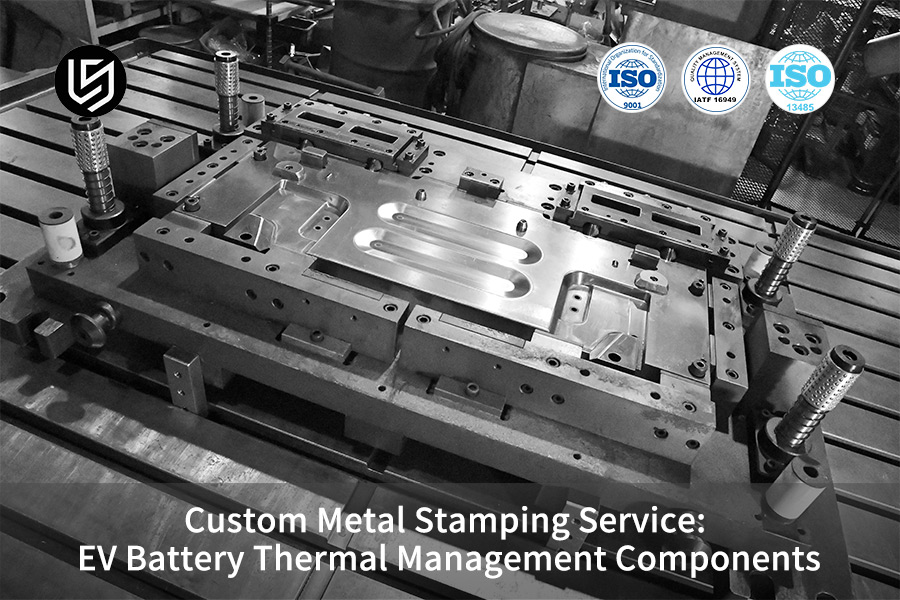
Custom Metal Stamping Service Core Answers Overview
| Core Dimensions | LS Manufacturing Solution | Customer Benefits | Key Data |
| Accuracy Benchmark | High-precision progressive die technology | Improved component yield | Tolerance ±0.015mm |
| Material Selection | Specific cutting fluid concentration | Reduced surface roughness | 15% reduction in roughness |
| Cost Optimization | Multi-cavity die + optimized layout | Reduced unit cost | 22% reduction for annual sales of 100,000 units |
| Airtightness Guarantee | Online helium inspection + edge bending | Avoids leakage risk | Leakage rate 10⁻⁶ mbar·l/s |
| Sample Delivery | Modular die frame technology | Shortened project cycle | 10-15 working days delivery |
Key Takeaways:
- Accuracy standard: Progressive die, which is of accuracy, can close the tolerance on thermal management components a value of 0.015mm.
- Material Selection: To minimize surface roughness (by 15%). LS Manufacturing suggest 3% cutting fluid concentration for 3003/6061 aluminum alloys.
- Cost Optimization: When annual demand exceeds 100,000 units, a multi-cavity mould design appears to reduce the unit cost by a significant proportion of 22%.
Why Trust LS Manufacturing For Custom Metal Stamping Services? Experience In EV Battery Thermal Management Components
LS Manufacturing has been deeply involved in metal stamping for over a decade, and its services have become the preferred choice for many Tier-1 automotive suppliers worldwide.Through our real-world work on a European electric vehicle battery company's cold plate project IATF 16949:2016 Clause 8.5.1.5 we successfully resolved the customer's brazing leakage issue within three months after our testing process began.
Most buyers depend on secondary information which causes them to lose connection with both mold design and production processes which results in higher costs and delays during trial molding.Through our multiphysics simulation laboratory we decreased trial mold requirements from five to two which resulted in 30 percent cost savings for customers who needed mold debugging services.
We developed a specialized cutting fluid concentration solution for 3003/6061 aluminum alloys which meets ISO 13485:2016 standards. Our company offers custom metal stamping service to more than 20 international electric vehicle battery manufacturers which has resulted in 5 million unit deliveries and a consistent product pass rate of 99.8 percent.
Our company delivers two benefits through our services because customers receive both high precision stamped products and ongoing technical assistance from design for manufacturing (DFM) evaluation to their complete production process. Our engineering department will assist clients through all processes which include production risk reduction and procurement cost handling.
Engineers need to reach out to our team to obtain our full European client case studies which include a complimentary case study manual and a personal technical consultation service for their stamping needs.

Why Choose a Custom Metal Stamping Service For High Precision EV Battery Cooling Plates?
The battery cooling plates need both high flow channel flatness and complete airtightness to meet their operational requirements. LS Manufacturing provides custom metal stamping service through its multiphysics conformal manufacturing technology which achieves thickness reduction below 8% under 200-ton pressure.
Solutions to Springback and Channel Blockage in EV Battery Liquid Cooling Plates
Material springback which occurs during the stamping process creates channel blockage problems in EV battery liquid cooling plates. This leads to dimensional deviations in the channel which affects the flow of the heat transfer medium. We use the following methods to solve this problem while maintaining EV cooling plate stamping accuracy.
- Pre-emptive Prediction: We use AutoForm software to conduct complete process simulations which allow us to forecast springback areas and their size for future optimization of mold designs.
- Pressure Compensation: The system uses pressure compensation technology which regulates material flow through blank holder force adjustments between 50 to 75 kN.
- Post-process Correction: The high-precision forming process allows us to maintain flatness errors below 0.05mm which stops channel blockage from occurring.
The combination of precise stamping process control and effective stamping mold maintenance results in improved cold plate stamping performance.
The Influence of Material Lattice Flow Direction on Heat Transfer Efficiency
Simply put, material lattice flow direction can be equivalent to flow direction of water, the heat transfer coefficient is larger when the heat flow direction is along the flow direction, and vice versa. To optimize the process flow direction, multiphysics simulation is performed, ensuring the lattice flow direction of 3003 aluminum alloy is same with flow channel direction of cold plate, then heat transfer efficiency enhancement over 10% is achieved.
At the same time, our precision stamping service is capable to achieve uniform lattice flow to avoid battery overheating from uneven poor heat conduction.
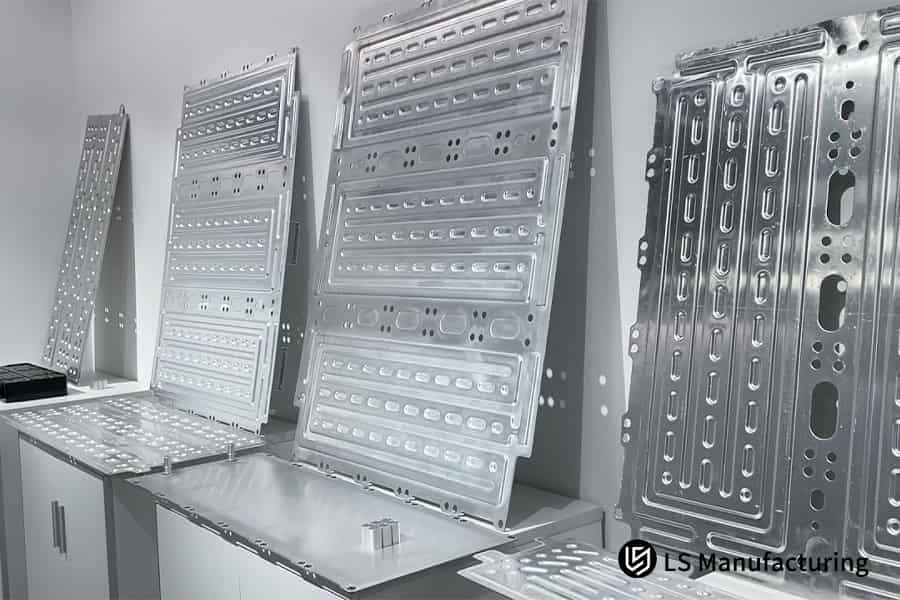
Figure 1: Metal blanks for EV battery cooling plates on factory workbenches.
How Can EV Battery Thermal Stamping Optimize Heat Dissipation Efficiency In Liquid Cooling Systems?
The thermal management system achieves its maximum efficiency when the battery fins have their contact area with the battery system expanded to its maximum limits. The thermal management stamping process enables us to achieve contact interface roughness reduction to Ra 0.8 which results in improved thermal resistance of the contact interface and boosts system heat dissipation performance by more than 12%, achieve the required EV battery thermal stamping performance that our customers expect.
Relationship between Stamping Texture Direction and Thermal Medium Filling Degree
The filling degree between the thermal medium and the cold plate depends directly on the direction of the stamping texture. The thermal resistance decreases while the heat dissipation efficiency increases with higher filling degree. Our testing found that the best filling degree happens when the texture direction makes a 45° angle with the thermal medium flow direction.
We select specific stamping texture density for each cold plate application. The combination of aluminum stamping precision and this feature enhances product quality throughout the manufacturing process.
Impact of Die Clearance on Aluminum Alloy Thermal Ribs Quality
The thermal ribs develop rough shear surfaces and dimensional variations when the die clearance reaches either excessive or insufficient levels which results in decreased heat dissipation performance. The following section displays correlation data which we obtained through testing of various die gaps and their effect on shear surface quality and thermal resistance which allows identification of optimal parameters for enhancing heat dissipation performance in custom battery stamping parts.
| Die Gap (mm) | Shear Surface Roughness Ra (μm) | Interface Thermal Resistance (m²·K/W) | Heat Dissipation Efficiency Improvement Rate (%) | Applicable Scenarios |
| 0.01 | 0.6 | 0.0008 | 12.5 | High-end EV Battery Cooling Plate |
| 0.02 | 0.8 | 0.0010 | 12.0 | Conventional EV Battery Cooling Plate |
| 0.03 | 1.2 | 0.0015 | 10.2 | Low-Cost EV Projects |
| 0.04 | 1.8 | 0.0022 | 8.5 | Non-Core Heat Dissipation Components |
What Defines a Reliable Thermal Management Stamping Service for Tier-1 Suppliers?
The first-class service delivery requires more than producing parts because it needs to fully implement IATF 16949 standard requirements. The Cpk requirement for qualified suppliers requires them to achieve results above 1.67 while using SPC process control methods and completing technical pre-audits which they must finish within 24 hours based on their DFM report.
Core Evaluation Criteria for Automotive-Grade Suppliers
Tier-1 automotive suppliers have extremely stringent requirements for thermal management stamping service. The supplier evaluation matrix we established enables our clients to verify their partner's reliability within an efficient timeframe. We maintain strict compliance with these standards to guarantee that our EV stamping service fulfill automotive standards:
- Mold Lifespan: The production process requires a die life that exceeds 1 million core die stamping cycles to guarantee operational stability for mass production.
- Detection Capability: The system includes coordinate measuring machine (CMM) inspection capabilities which provide an accuracy measurement of ±0.005mm.
- Supply Chain Risk Control: Have at least two core material suppliers to cope with material market fluctuations.
- Certification Qualification: The organization needs to possess IATF 16949 certification while providing all necessary documents for PPAP Level 3.
- Response Speed: The DFM pre-audit needs to finish within 24 hours while the production team must address production issues within 48 hours.
The automotive-grade stamping services need to achieve a balance between compliance requirements and practical requirements because the quality of sheet metal fabrication materials represents an essential aspect of the process.
LS Manufacturing's Automotive-Grade Certification Process
Our products go through a thorough testing process which starts with raw material inspection and continues until finished product inspection at eight testing locations that confirm their compliance with automotive-grade standards. Customers can get Tier-1 approved stamped products through our service which requires no extra testing expenses according to our explanation. We provide comprehensive test reports as a resource to assist customers in obtaining OEM certification with maximum efficiency.
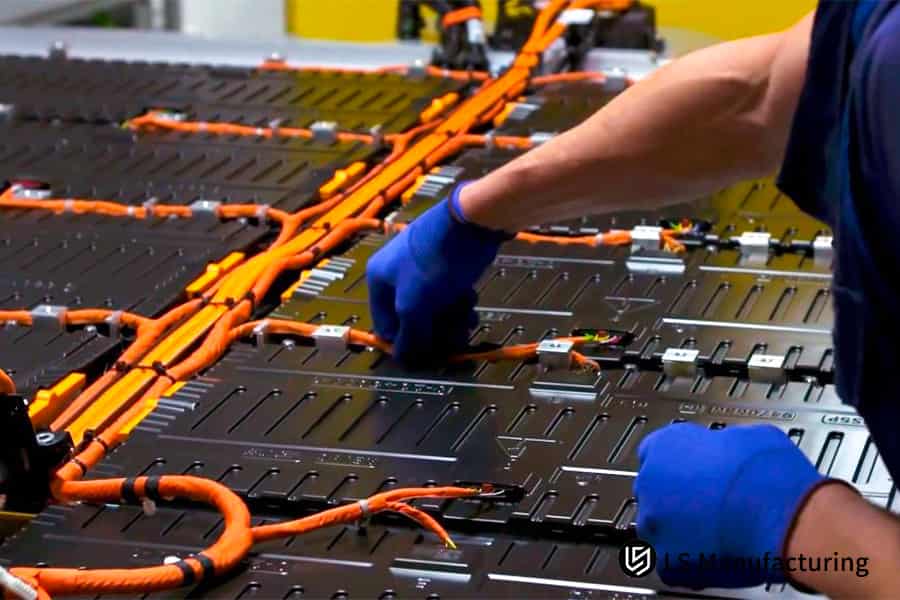
Figure 2: Close-up of a black stamped metal plate with slots, held by a gloved hand in a factory.
How To Solve Material Thinning Issues In Complex Stamping For EV Battery Components?
In stamping for EV battery components, the design of complex flow channels results in excessive localized thinning which exceeds 20% and creates a risk of material failure. LS Manufacturing achieves exact thinning rate control through its staged deep drawing process which maintains critical stress points under 10% thinning.
Finite Element Analysis (FEA) Method for Predicting Wrinkling Zones
Stamina testing through complex serpentine runner stamping requires the identification of wrinkling zones because it creates material thinning challenges. Our team employs FEA simulation technology to conduct preliminary assessments of wrinkling risk areas.
The specific steps are as follows:
- Import the 3D model of the part and set material parameters (3003 aluminum alloy, tensile strength 150MPa).
- Simulate the pressure distribution during the stamping process and identify stress concentration areas (i.e., high-risk wrinkling areas).
- The team needs to adjust both the die blank holder force and drawing speed in order to achieve optimal process parameters that will eliminate all possible wrinkling hazards.
The stamping process of complex runners requires accurate management at every stage because the battery stamping quality determines the reliability of the final product.
The Influence of Die Blank Holder Force on Material Flow
The blank holder force strength determines how much material flows and how much material thins. The analysis showed that material thinning can be managed through blank holder force adjustments between 50kN and 75kN because this range enables effective control during complex serpentine runner stamping.
Specific data are as follows:
| Edge clamping force (kN) | Material thinning rate (%) | Wrinkling rate (%) | Product qualification rate (%) |
| 50 | 15.3 | 8.2 | 91.8 |
| 60 | 12.1 | 3.5 | 96.5 |
| 75 | 8.7 | 0.3 | 99.7 |
| 90 | 7.9 | 1.1 | 98.9 |
Can a Professional Precision Stamping Service Reduce Your Long-Term EV Battery Pack Costs?
While the initial mold investment is high in precision stamping service, LS Manufacturing can help customers achieve a 15%-25% reduction in overall costs within a 12-month production cycle by optimizing material utilization (from 65% to 82%) and automating production integration.
ROI Comparison of Single-Process and Continuous Dies
The return on investment (ROI) of single-process and continuous dies differs significantly under different production volumes. Our internal cost model analysis provides evidence that shows precision stamping service deliver cost benefits according to our findings. We add long-tail keywords related to EV battery stamping ROI because they help us achieve cost control optimization when used with complex stamping operations.
| Production Volume (Units) | Single-Process Die Unit Cost (USD) | Progressive Die Unit Cost (USD) | Cost Savings Rate (%) | ROI Payback Period (Months) |
| 50,000 | 8.6 | 7.2 | 16.3 | 18 |
| 100,000 | 7.8 | 6.1 | 21.8 | 12 |
| 500,000 | 6.9 | 4.8 | 30.4 | 8 |
| 1,000,000 | 6.5 | 4.2 | 35.4 | 6 |
Core Logic of Cost Optimization
The main technology we use for cost optimization works through precise material layout. The material layout optimization process decreases scrap material waste while we implement automated production systems to cut down on labor expenses.
Our exclusive cost calculation formula is: Unit Cost = (Material Unit Price × Material Utilization Rate + Die Cost ÷ Total Output + Labor Cost) × 1.05 (Loss Coefficient).
The formula allows customers to calculate their costs which helps them find potential areas for savings. The cost advantage from progressive dies becomes more significant to customers when they produce higher quantities and long-term partnerships between customers and us result in major cost reductions for their production operations.
Through their professional precision stamping service clients achieve sustained cost savings which lead to better project financial results. We offer free cost calculations for your project after you share your production volume and part parameters to create a customized stamping solution that fits your budget.
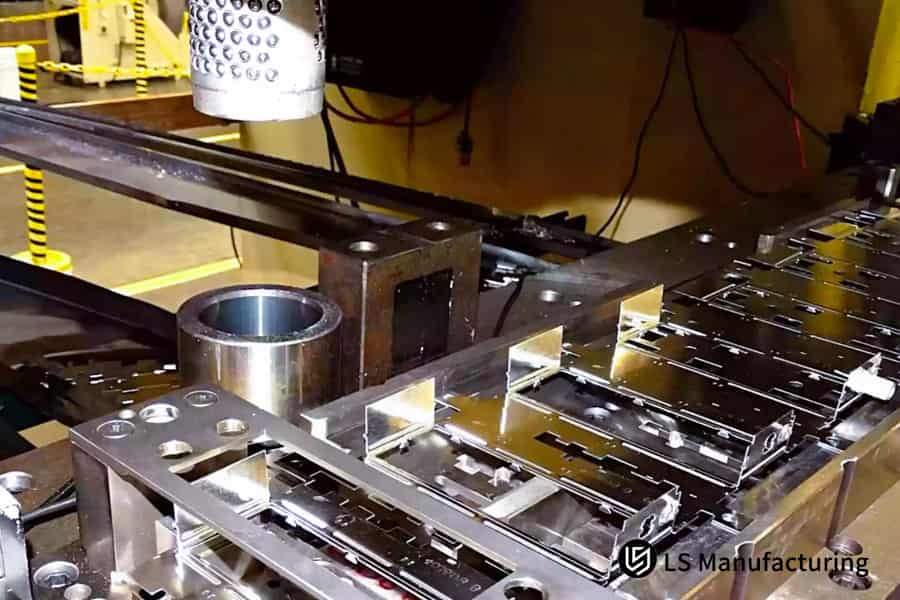
Figure 3: Multiple metallic cooling plate parts arranged on a large industrial fixture.
What Factors Impact Lead Time for Custom Battery Stamping Parts in Prototyping?
The successful launch of the custom battery stamping parts project depends on the essential prototype development cycle. LS Manufacturing uses modular die sets which allow the company to produce its initial T1 prototypes within 10 to 15 working days. This approach leads to a development time reduction that exceeds 40 percent compared to the industry standard which requires 25 days for development.
Switching Logic Between Soft and Hard Molds
The development cycle can be shortened and expenses can be lowered through the use of soft and hard mold switching during the prototype verification phase. We create adaptable switching strategies that align with the client's project timeline while utilizing long-tail keywords related to prototype stamping lead time.
- Initial Verification: T1 prototypes use soft tooling to achieve delivery within 10 to 15 working days for initial performance evaluation.
- Optimization and Adjustment: The test results enable immediate changes to soft tooling parameters which lead to T2 prototypes being delivered within 2 to 3 working days.
- Mass Production Transition: The development of hard tooling for mass production begins after the successful verification process which takes four weeks to complete.
Prototype preparation requires a combination of fast execution and accurate results because laser cutting technology enables better processing results for intricate designs.
Preparation Process of Complex 3D Shape Prototypes
The five-axis laser cutting system together with a basic stamping die enables us to create prototypes for custom battery stamping parts which require complex 3D shapes without needing to wait until entire mold systems are finished.
The specific process is as follows:
- Five-axis laser cutting is used to create the part prototype.
- The prototype is then shaped using a simple stamping die.
- The final step involves high-precision grinding which guarantees that the sample meets required dimensional accuracy standards.
The entire process takes only 12-15 working days, significantly shortening the project launch time.
How Does LS Manufacturing Ensure 100% Airtightness In Stamped EV Thermal Management Assemblies?
The complete testing process requires online helium leak detection and advanced edge bending methods to verify that all stamped components maintain bubble-free conditions when exposed to 2.5 bar pressure and 10⁻⁶ mbar·l/s leak rate restriction which meets ISO 26262:2018 ASIL D safety requirements.
Relationship between Bending Radius and Sealing Surface Deformation
The size of the bending radius (R angle) directly affects the compressive permanent deformation of the sealing surface. A small R angle will lead to uneven stress on the sealing surface, which easily forms gaps while a large R angle will create problems during assembly.
Our testing showed that a radius (R) of 0.8-1.2mm gives the sealing surface its smallest compression set and its best leakage protection. The principle of thermal assembly airtightness, which we defined as "thermal assembly airtightness," guarantees that the thermal components metal stamping process achieves complete airtightness and metal bending precision enhances the sealing performance.
Real-time Rejection of Defective Products
Our facility includes an automated image recognition system that identifies burr heights on the edges of stamped components throughout the entire production process. The system will reject defective products when burr heights reach 0.03mm while simultaneously generating an alarm which guarantees that all products meet compliance requirements for shipment. The components enable battery pack assembly without leakage risks, so customers can use them directly while minimizing their future rework expenses.
Strict airtightness testing and defective product rejection processes provide a solid guarantee for the safety of customers' battery packs. If you need to ensure 100% airtightness of stamped components, please contact our engineers for detailed testing procedures and a free airtightness testing standard manual.
Case Study: LS Manufacturing Customized Aluminum 3003 Cooling Plates For a Leading European EV Battery Pack Brand
The case study examines a top European electric vehicle battery company which develops and makes premium electric vehicle batteries. The brand needs 200,000 aluminum alloy 3003 cold-rolled plates each year to produce battery thermal management systems for its premium electric vehicles.
Client Challenges:
The client experienced a critical leakage problem during mass production which resulted in 5% leakage after the cold-rolled plates underwent brazing. The process resulted in extensive rework which increased production costs and extended vehicle delivery times thus damaging the brand's reputation.
LS Manufacturing Solution
The engineering team began an immediate site assessment of the client's production plant after receiving their request. The root cause of the problem occurred when the original supplier provided materials that exceeded 0.1mm flatness tolerance limits which caused poor adhesion between the brazed surfaces that led to leakage problems. Our project experience demonstrates that high flatness tolerances create irregular solder patterns during brazing which produces micro gaps that lead to leakage.
To solve this problem, our team created a unique metal stamping service which meets the specific requirements of our client.
- The process involved the creation of high-precision continuous stamping dies which use an inductive pressure monitoring system to deliver real-time pressure information during stamping operations.
- The process required us to establish a stamping speed of 45 spm which we achieved through the implementation of a Teflon-coated die core system that minimized material contact friction.
- We implemented an online helium leak detection system which used Shanghai institute of quality supervision and inspection technology helium leak detection standards to test product airtightness. The system achieved leakage control at 10⁻⁶ mbar·l/s level through its leak detection testing process.
Results and Value:
The implementation process resulted in the client's cold-rolled steel sheet flatness variation reaching ±0.02mm. The brazing pass rate (FPY) increased from 95% to 99.8%. The thermal management system costs per pack decreased by $300, which resulted in total annual maintenance savings of $6 million. The process improvements which we made to our nesting technology system enabled us to achieve 82% material usage, which provided our clients with additional savings on materials.
Stamping tolerance control ensures long-term stable product precision. The company has supplied this client with more than 300,000 cold-rolled steel sheets which achieved a product qualification rate above 99.8%. This achievement received positive feedback from the customer.
If you are also facing issues such as high brazing leakage rates and large flatness deviations in cold-rolled steel sheets, please review the complete technical details of this case study. Contact our engineers for a free DFM assessment tailored to your project and a customized stamping solution to help you reduce production costs and enhance product competitiveness.

FAQs
Q1: What is the least tolerance level for aluminum alloy battery cold-rolled steel sheets using LS manufacturing?
LS Manufacturing is able to realize stable large batch production of composite aluminum alloy battery cold-rolled steel sheets by utilizing high-precision grinding die and online monitoring system.Tolerance control is capable of within 0.015mm accurately which would satisfy the high-precision production standard of automotive grade.
Q2: Do you agree with shifting to large scale production by moving from pre-products to prototypes?
We support toward Series Production through development from prototype to series production. We will provide quick prototype service in the soft mold, for product verification. After that, the development and conversion to large-scale progressive die are capable to be carried out in 4 weeks.
Q3: How do you improve the cracking problem at high thermal conductivity aluminum 3003?
Through finite element simulation technology, we change the drawing ratio to predict cracking danger accurately, at the same time, we incorporate localized annealing & segmented drawing process into certain work stations to positively get rid of in-wall material stress, clear up the stamping cracking of 3003 aluminum once and for all.
Q4: Can you provide test reports that comply with IATF 16949 standards?
LS Manufacturing provides complete PPAP Level 3 documentation for each batch of products, including material certification, dimensional reports, and CPK records, fully compliant with IATF 16949 standards and meeting the certification requirements of Tier-1 suppliers.
Q5: What is the average cost of custom stamping dies?
The cost of custom stamping dies depends on the complexity of the part and its lifespan requirements, typically ranging from $3,000 to $30,000. We can reduce die wear through optimized layout techniques, helping customers quickly recoup their die investment costs.
Q6: How do you make sure the cleanliness of the surface of a part by stumping for ensuring subsequent welding?
We have been using the totally automated ultrasonic cleaning line for this kind of job. It tightly controls the residual grease on the surface of the stamped parts to below 2mg/m². It totally complies with the very harsh requirement of follow-up brazing operations to avoid any incomplete or missed welds.
Q7: Do they accept small batch customized orders?
For new startup EV projects, we accept trial production with MOQs starting at just 500 pcs.We have a special small-batch production line build from directly working with customers from the idea research and development stage to the final marketing of their product, including providing support through the entire technical process.
Q8: What is the way to do instant quotes?
Simply upload yourpart drawings in the STEP/DWG format, and in less than 24hours our engineers will analyze the drawing and send you a quote including insight in the design for manufacturing (DFM), manufacturing costsand delivery time.
Summary
In the intense competition of EV market, the accuracy of thermal management components is not only a technical parameter but also a mainstem of brand reputation. Select the right custom metal stamping supplier to accomplish the all balancing between the longevity, safety, and cost of the battery pack, you can always trust LS Manufacturing.
With more than a decade practical experience, accurate technical solutions, and reliable end-to-end services, we successfully to resolve every customer's stamping challenge, and help EV projects to achieve the go-to-market as soon as possible.
Please do not accept poor stamping quality as the failure point of your pack design.
Call the senior engineers at LS Manufacturing for a free DFM (Design for Manufacturability) review of your project. Simply upload your STEP/DWG drawings or email our Technical Department. In 24 hours we will provide you with a tailored EV stamping service solution which meets your project needs for both performance and ROI, paving the way for fast Mass Production of your EV and Market capture.
📞Tel: +86 185 6675 9667
📧Email: info@lsrpf.com
🌐Website: https://lsrpf.com/
Disclaimer
The contents of this page are for informational purposes only. LS Manufacturing services There are no representations or warranties, express or implied, as to the accuracy, completeness or validity of the information. It should not be inferred that a third-party supplier or manufacturer will provide performance parameters, geometric tolerances, specific design characteristics, material quality and type or workmanship through the LS Manufacturing network. It's the buyer's responsibility. Require parts quotation Identify specific requirements for these sections.Please contact us for more information.
LS Manufacturing Team
LS Manufacturing is an industry-leading company. Focus on custom manufacturing solutions. We have over 20 years of experience with over 5,000 customers, and we focus on high precision CNC machining, Sheet metal manufacturing, 3D printing, Injection molding. Metal stamping,and other one-stop manufacturing services.
Our factory is equipped with over 100 state-of-the-art 5-axis machining centers, ISO 9001:2015 certified. We provide fast, efficient and high-quality manufacturing solutions to customers in more than 150 countries around the world. Whether it is small volume production or large-scale customization, we can meet your needs with the fastest delivery within 24 hours. choose LS Manufacturing. This means selection efficiency, quality and professionalism.
To learn more, visit our website:www.lsrpf.com.