English



Global metal casting service (GMS) is an industrial precision casting solution tailored to the world's supply chain reorganization in 2026. It encapsulates three major pain points in industrial casting procurement: long delivery cycle, high porosity, cost of small batch custom mold.
At present, most of the suppliers are too large to assured professional test simulation and process accuracy, but it can be easily scrapped casting parts in a mass series, this article is nine largest manufacturer technical advantage comparison, established a professional digital purchase guide, to find high-end suppliers over time.
Quick Overview of Core Parameters of global metal casting service Providers in 2026
Here are the main technologies, quality control capabilities, and cost advantages of nine mainstream casting service providers in one figure. Procurement staff can use this figure to quickly pick the suppliers that best meet their needs and effectively mitigate procurement risks.
| Service Brands | Core Process Advantages | Quality Control Parameters | Cost Advantages |
| LS Manufacturing | 45mbar ultra-vacuum die casting, segmented temperature control, five-stage hydrogen removal | Porosity ≤0.5%, density 99.5%, CT6 tolerance | 30% cost reduction for small batches. |
| Protolabs | Standardized die casting, rapid prototyping | Porosity ≤1.2%, standard dimensional tolerances | Low unit price for standard parts, high premium for customization. |
| Fictiv | Online standardized casting, automated quotation. | Porosity ≤1.0%, basic non-destructive testing. | Transparent pricing for regular orders. |
| Hubs | Multi-category supply chain integration, gravity casting + low-pressure casting full coverage | Porosity ≤1.5%, batch sampling non-destructive testing. | Outstanding cost-effectiveness for multi-category combination orders. |
| Xometry | Global manufacturing network integration, primarily standardized gravity casting. | Porosity ≤1.4%, full inspection of basic dimensions | Highly competitive unit price for large-volume regular parts. |
| 3erp | Precision investment casting, specializing in small stainless steel parts. | Standard CT7 tolerance, basic smelting composition control. | Small-part investment casting has a low unit price, while complex parts have a high premium. |
| Rapiddirect | Precision investment casting, custom alloy steel parts. | Standard CT8 tolerance, no fine hydrogen removal and temperature control process. | Fast delivery for medium-volume orders, but relatively high processing costs. |
| First Mold | Rapid mold prototyping, simple sand casting process. | Porosity ≥2.2%, basic dimensions manually controlled. | Very low mold production cost, but yield rate is not guaranteed. |
| Wayken | Small-batch sand casting, rapid prototype delivery. | Porosity ≥2.0%, basic dimensions sampled inspection. | Fast delivery for small-batch trial production, but poor long-term mass production stability. |
Key Takeaways
- By 2026, the best option for metal casting services is a leading international supplier with vacuum die casting and quantitative melting technologies.
- With full-segment temperature control and CT non-destructive testing, the internal porosity of very complex industrial castings can be limited to 0.5%.
- Upgrades of digital and flexible molds with the customized processes by LS Manufacturing can cut the total cost of small-batch manufacturing by 30%.
Why Trust LS Manufacturing's Global Supplier Experience For Custom Metal Casting Services?
Drawing on the extensive global supply experience acquired over the years, LS Manufacturing's custom casting service can be tailored to meet various high-quality industrial production requirements, thereby solving the issues of defect mass production and unstable supply chain, and strictly following the EN 12890:2000 industrial casting standard.
After three months' multi-brand process comparison testing, we deeply analyzed the mass production defects of nine service providers, and found that most platform-based companies are incapable of achieving high precision and low-cost mass production simultaneously. We have established a full-process digital quality control system referencing the parameters of ASTM B98-20, and our own vacuum die casting and segmented temperature control technologies can effectively solve the issue of microscopic defects in castings, thereby ensuring stable mass production.
We are currently IATF 16949 quality management system certifie 7S Corporation, and possess a complete range of precision testing tools and machinery to perform quality control on our product from the design process to the delivery of finished goods. We have been offering stable casting support services to over 30 industrial corporations on a world wide basis, greatly reducing the supply chain risks.
With our deep industry experience and standardized technical system, we are capable to meet various high-end custom casting requirements. Contact our engineers at any time for free one-on-one cost accounting service for accurately calculating the production cost of your order custom castings.

Why Do Industrial Metal Casting Buyers Still Face High Porosity Defects In 2026?
One of the main reasons why buyers of industrial metal casting have to deal with excessive porosity defects repeatedly is that quite a few suppliers are not the vacuum exhaust systems type or have our very specialized mold flow control capabilities. After pouring molten metal, the air and other impurities left can easily get trapped. While ultra vacuum die casting combined with electromagnetic filling at very low pressure can thoroughly prevent the entry of residual gas from the very beginning and thereby it can eradicate the porosity defect in castings completely.
Fundamental differences in porosity control in traditional and modern castings
Low-porosity castings are one of the main features in first-class industrial casting. Atmospheric pressure casting is highly likely to cause porosity defects. Main metal casting service providers like Protolabs and Fictiv who rely mainly on small-item die casting through standardized processes have not been quite able to resolve the problem of porosity in thick-walled, complex metal casting for industrial components. In fact, controlling is the ability to control porosity is something important in the differentiation of the quality levels of casting processes.
LS Manufacturing is using a vacuum gas replacement system which is compliant with international standards and can consistently and stably produce a mold cavity vacuum level of less than 45 mbar, which is so entirely expelling the air from the cavity. For the commonly used aluminum alloys like A356 and AlSi10Mg, it uses a five-stage rotor refining and hydrogen removal technology which strictly limits the hydrogen level of the molten metal to 0.1 mL/100g. The casting cavity evacuation process by itself eliminates porosity right at the source, greatly improving casting yield.
| Process Type | Mold Cavity Vacuum | Hydrogen Content in Molten Metal | Controllable Porosity | Applicable Casting Type |
| Conventional Gravity Sand Casting | Atmospheric Pressure | Uncontrolled Hydrogen | ≥2.0% | Non-precision structural parts |
| Standardized Low-Pressure Die Casting | ≤100mbar | ≤0.2mL/100g | ≤1.2% | Conventional industrial standard parts |
| Ultra-Vacuum Precision Die Casting | ≤45mbar | ≤0.1mL/100g | ≤0.5% | High-end heavy-duty hydraulic core components |
| Precision Investment Casting | ≤80mbar | ≤0.15mL/100g | ≤0.8% | Stainless steel/alloy steel precision small parts |
Four-Step Verification Method for Supplier Technical Authenticity
The purchasing staff can very fast verify the supplier's ability to control porosity by the use of standard steps. The procurement requirements of different industrial metal casting can be matched very closely, and the selection of reliable partners can be done efficiently.
- Verify the venting channel design in the mold to confirm that the venting channel width and depth are suitable for the casting wall thickness.
- Determine exactly the volume of the cold slug cavity so that uneven patterns of porosity arising from the presence of cold slugs can be avoided.
- Evaluate the degree of smelting dehydrogenation process to find out if it is capable of refining dehydrogenation at level 4 or above.
- Request a CT scan report to confirm that the casting porosity is up to the industry-leading standard of 0.5%.
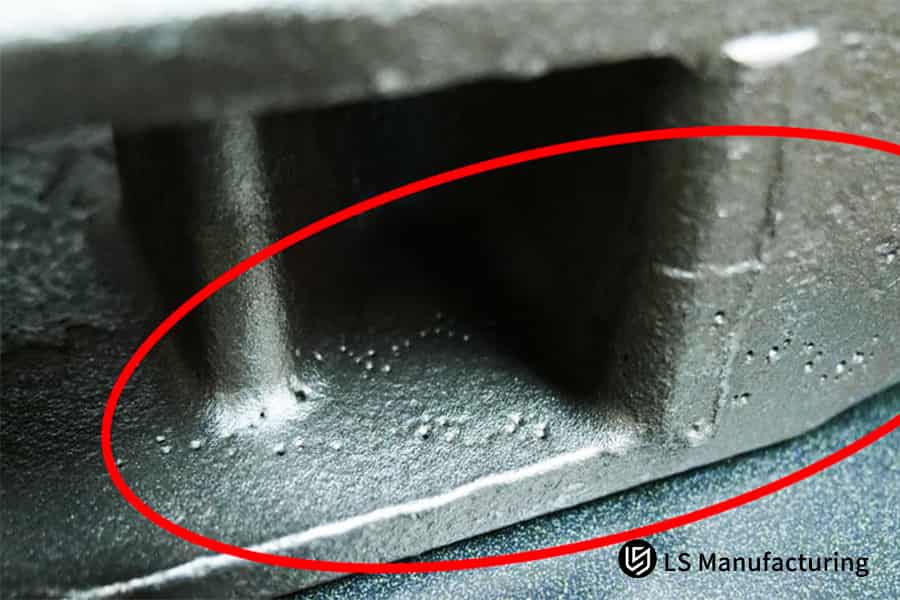
Figure 1: Metal casting with porosity defects (small holes) highlighted in red within a cavity.
How Can Custom Metal Casting Service Experts Maintain CT Verified Internal Density?
A fundamental key to hitting the high casting density targets with top-quality custom metal casting service is the precise control of the casting solidification temperature gradient and the avoiding of internal shrinkage defects. By deploying mold thermal conductive inserts, the latest fully automated micro-spraying technology, and industrial CT non-destructive testing, the casting internal density can be raised consistently to a level exceeding 99.5%.
Comparison of Quality Control Capabilities of Mainstream Suppliers
Refining the grain on a precision level is the determining factor of casting density. Platform-based metal casting service providers like Hubs and Xometry continue to rely on conventional casting and staged temperature monitoring methods, which are not capable of accurately controlling the solidification gradient, this way easily leading to the formation of thermal shrinkage cavities and failure to meet the high standard production requirements for heavy-duty metal casting for industrial components.
LS Manufacturing, by taking full advantage of temperature control technology that is fully segmented and the hot and cold runner layout of the mold, is able to achieve ordered solidification of the molten metal, which completely frees the product from micro-shrinkage cavities. The grains of the casting are stable and comply with the ASTM E155 Class II standard, having a uniform and densely packed internal structure. The casting structure densification technique are guaranteed to operate stably over a long period of time.
CT Non-Destructive Testing Quality Control Core Process
For the manufacture of high-end metal casting for industrial components, we have put in place a high-precision quality control system. The standardized flaw detection quality control process is laid out below:
- Industrial CT layer-by-layer scanning of the casting after it is formed is done to ensure that internal shrinkage cavities and porosity defects are fully covered.
- Metallographic structure is examined by determining whether the grain size and density conform to the working standards.
- Castings that do not pass the screening are separated and, at the same time, the corresponding batch pouring temperature control parameters are optimized.
- An official flaw detection report is generated, because of this ensuring full batch quality traceability.
Grain refinement with precision and CT non-destructive testing are two main core technologies to make sure the castings coming out of custom metal casting service are of high density. With their help, it is possible to remove shrinkage holes entirely and also comply with different long-term operating standards of high-end industrial components. We provide a free quality control cost estimate for those who want to plan the quality control, and also tailor-made one-on-one density optimization solutions for the people who have specific needs.
Which Global Metal Casting Service Can Secure CT6 Tolerances Without Secondary Machining?
Global metal casting service at a high-level can produce ISO CT6 level of accuracy without the need for machine processing. This is made possible by precision mold work, quality metal casting materials, with a smart algorithm that adjusts to thermal expansion automatically. With CNC craved molds and the shrinkage rates that iplement the material, it is possible to directly make casting of very high accuracies ready to use.
Comparison of Tolerance Boundaries Among Mainstream Service Providers
Among factors for high-precision casting, accurate die thermal adjustment is the major factor. 3ERP, Rapiddirect and others can only meet the tolerances of CT7-CT8 and because of this are dependent on subsequent machining to get the right dimensions, which leads to higher procurement costs. Traditional investment casting methods cannot deliver the precision levels required for high precision OEM metal casting service and usually, this remains a core technological limitation for top metal casting providers 2026.
LS Manufacturing's proprietary mold thermal expansion prediction system dynamically compensates for dimensional deviations during the design phase. And a stable production environment at a constant temperature, which prevents shell deformation, this method consistently yields CT6 precision castings. Our all-inclusive casting tolerance assurance system is perfectly suited for the manufacture of different types of high-end precision parts.
Core Advantages of High-Precision Casting for Cost Reduction
Techniques of high-precision and no-machining can A lot cut down the total procurement costs of the project. The main benefits stem from several aspects:
- Does not require secondary CNC machining which is the main source of time and material waste.
- Casting breakage and scrap due to machining are not an exposure.
- Maintains casting dimensional consistency so that the entire machinery assembly is compatible.
- Achieves a 25% reduction in procurement and processing costs with the added benefit of high cost-effectiveness during long-term mass production.
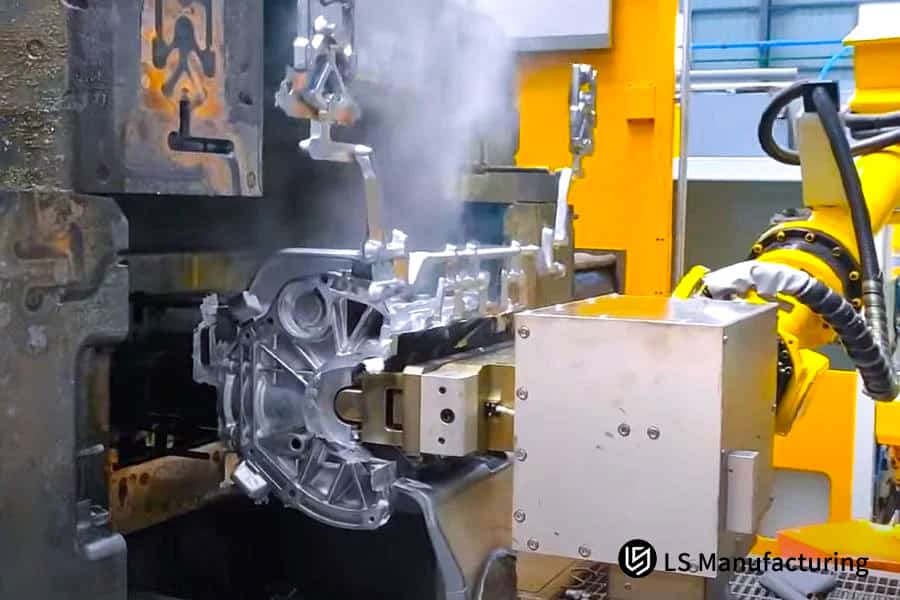
Figure 2: A robotic arm in a factory precisely handles a cast metal engine component.
What Parameters Differentiate High Volume Metal Casting From Prototype Casting Lines?
The main differences between metal high volume metal casting and prototype casting are mold life, production time, and composition of alloys consistency. Mass production mainly uses long-life hot-work die steel and automated, regular cycle times to ensure consistent quality and minimal tolerance drift of final products throughout millions of units.
Main Parameter Differences Between Mass Production and Prototype Casting
It is very important that alloy composition is tuned for stable mass production. But, prototype casting suffers from short mold life, cycle times can drastically fluctuate, and compositional deviations are quite big. For these reasons, it's not going to be suitable for long-term mass production. Most contract manufacturers operating in the metal casting industry use very broad mass production parameters, which often leads to a difficulty in ensuring product consistency in industrial metal casting.
Besides that, casting cycle optimization is the main key to taking mass production standards to the next level. LS Manufacturing has a 1600T-3500T automated die casting facility, uses 48-52HRC long-life die steel, and has a stable single-mold cycle time of 45s. Production personnel are tracking main parameters at all times, and molten metal from every batch by spectral analysis is 100% tested to have a strict control on impurities and compositional deviations, thereby hot cracking defects are eliminated. The casting batch consistency leads to consistent product quality across large batch sizes.
| Parameter Dimensions | Mass Production Casting | Prototype Casting | Capacity Efficiency Differences |
| Die Steel Selection | H13/DIEVAR Hot Work Steel (48-52HRC) | P20 Pre-hardened Steel (30-35HRC) | Mass production efficiency increased by more than 10 times. |
| Single Mold Cycle Time | ≤45s/mold | ≥120s/mold | Mass production capacity is 2.6 times+ of the prototype. |
| Alloy Composition Control | 100% OES spectral analysis per furnace | Batch sampling inspection | Mass production composition deviation ≤±0.05%. |
| Production Automation Rate | ≥95% Fully Automated Die Casting Unit | ≤30% Semi-Automatic/Manual Operation | Mass Production Yield ≥99% vs. Prototype ≤85% |
Core Verification Checklist for Mass Procurement
When large quantities of industrial metal casting products are being bought, various dimensions can be checked by enterprises to confirm a supplier's mass production capabilities and this way efficiently avoid the risks of batch quality and delivery.
- The mold steel type and hardness parameters should be checked to make sure that they are suitable for million-cycle mass production.
- Production line automation cycle time should be verified to ensure stable and controllable single-mold production efficiency.
- Please provide the alloy composition testing reports to verify that the material consistency of each batch is in a good condition.
- Batch defect risks can be reduced by verifying mass production vacuum monitoring data.
Steady mold life, automation cycle time, and alloy composition control are the main factors that make high volume metal casting mass production so efficient that they allow for a very high level of consistency in the quality of industrial castings in large quantities. Through a one-on-one talk, mass production solution assistance can be given to people who have procurement plans.
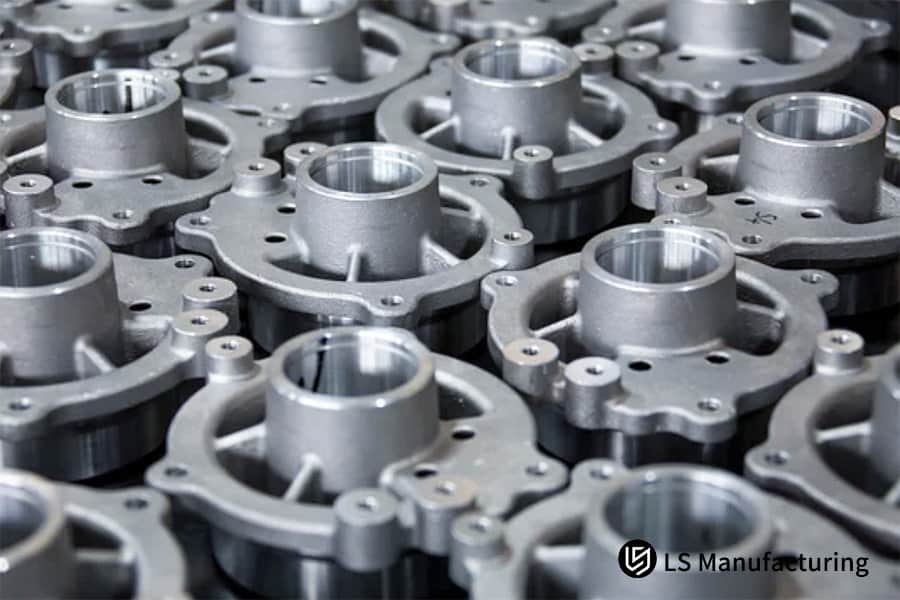
Figure 3: Aluminum castings in a grid pattern, representing high-volume manufacturing components.
How To Optimize Tooling Amortization For Small Batch Custom Metal Casting Service?
The key factor in cost cutting when it comes to small-batch castings is using flexible quick-change mold bases and prototyping processes that are lightweight. When you combine standardized main mold bases with detachable custom inserts, there is no need for the complete mold opening, which can reduce mold investment by over 45%. This is the main cost-reduction feature of high-quality custom metal casting service.
Analysis of Shortcomings in Flexible Manufacturing by Peers
Traditional service providers like First Mold and Wayken use single-piece mold structures leading to very high mold-making expenses and long lead times for small-batch orders. This is why they cannot be used for customization scenarios with 50-500 pieces, really increasing the procurement costs of metal casting for industrial components. Their flexible production capabilities are nowhere near to that of professional global metal casting service.
Practical Solutions for Cost Reduction and Optimization in Small-Batch Production
LS Manufacturing has made specific changes to its small-batch flexible production model to suit the different industrial part customization needs. Taking advantage of a lightweight casting cost optimization solution, it not only manages to decrease the total cost of small-batch customization but also does not compromise quality.
- By using a modular quick-change mold base, a customization of only core cavity inserts is required, and mold costs are reduced to 35% of conventional levels.
- The mold manufacturing cycle is reduced to 9 days through CAD/CAM modular design.
- To avoid over-design, the mold steel is matched with the demand, small batches are produced with P20 pre-hardened steel.
- Mold amortization costs are calculated very accurately to keep the unit purchase price to a minimum.
Case Study: How LS Manufacturing Solved a Complex Heavy Industrial Gear Pump Housing Design
This case study is about the casting of hydraulic gear pump housings for heavy industries. After adopting a tailor-made vacuum gravity casting technique, the company managed to eliminate the leakage problem under high pressure, deliver perfect quality products without any defects, and establish itself as a top metal casting providers 2026.
Client Problem
Hydraulic component casting takes a very high level of material density and sealing performance. This is why the multinational heavy industrial client could only get a 72% yield rate for their QT500-7 gear pump housing which was cast by Hubs' traditional gravity sand casting process. Besides, the gear pump housings kept leaking oil during the high-pressure test. They wanted professional OEM metal casting service with high-end industrial casting standards.
LS Manufacturing Solution
Our technical team used MAGMA casting simulation software to identify casting defects and decided to give up the traditional sand casting method in favor of a low-pressure vacuum casting method. We could completely eradicate shrinkage cavities by accurately fixing the pouring temperature, adjusting the inoculant ratio, enhancing graphite spheroidization, and placing water-cooled runners in hot spots, which also solved the issue of defects in thick-walled parts.
Results And Value
Optimizing the process the porosity in this batch dropped dramatically, the castings were able to withstand long-term high-pressure fatigue with zero leakage, and the rate of qualified finished product went up to 99.8%. This not only helped to reduce losses and cost of rework but also solved supply chain issues and led to a long-term exclusive mass production partnership.
This heavy-duty hydraulic casting case fully verifies the effects of vacuum casting and heat balance processes on improving the sealing and density of hydraulic part castings, demonstrating significant practical value. If you want to learn from experience, you can download our complete case file.

What Hidden Cost Factors Dictate Real Metal Casting Service Providers Quotation Sheets?
Identifying hidden costs in quotations from metal casting service providers is extremely important. You have to mainly look out for hidden expenses like machining allowances, riser residue treatment, heat treatment correction, etc. A genuine quotation must clearly state the net weight, riser recovery rate, and defect allocation costs so that there is no chance of asking for a higher price later on.
Industry Standard Pricing Calculation Formula
Getting the precision cost accounting right is essential if you want to steer clear of procurement woes. One can use industry-standard formulas to compute the prices for large-scale metal casting and custom metal casting services very precisely. Also, given the transparency with casting pricing, one can steer clear of various procurement traps that are hidden.
| Cost Items | Percentage Range | Industry Standard Calculation Rules | Common Hidden Risks |
| Raw Material Costs | 55%-65% | Net weight of castings + 3%-5% burn-off rate calculation. | Excessive use of recycled materials leads to decreased material performance. |
| Mold Depreciation Costs | 10%-20% | Total mold cost / Estimated amortization per batch. | Amortization of molds for small batch orders surges to 40%+. |
| Smelting and Processing Costs | 10%-15% | Smelting energy consumption + machining time calculation. | Unclearly defined premiums for non-standard processes lead to later price increases. |
| Heat Treatment and Inspection Costs | 5%-10% | Process type + workpiece surface area / sampling ratio calculation. | T6 solution treatment, CT flaw detection, etc., are not priced separately. |
| Management and Logistics Costs | 2%-5% | Fixed percentage of total order price calculation. | Unclear international logistics and tariffs lead to overspending on landed costs. |
Analysis of Advantages and Disadvantages of Mainstream Pricing Platforms
Online platforms like Fictiv and Xometry are pretty good when it comes to efficiency of pricing but the pricing accuracy for complex industrial parts is on the low side, and the platforms are also unable to determine the premiums for high-end processes. Whereas some small factories drastically add recycled materials to the limit of their products just to lower the unit prices and thereby, they undermine the mechanical properties of the castings and pose a potential risk of safety of the equipment.
- Procurement must make a difference in the cost of ADC12 aluminum alloy and ASTM A216 WCB carbon steel so that they can negotiate price effectively.
- Check the percentage of recycled materials that have been used and keep the safety limit of the industry at 30%.
- See if operations such as heat treatment and flaw detection have been separately priced so that you can avoid hidden charges.
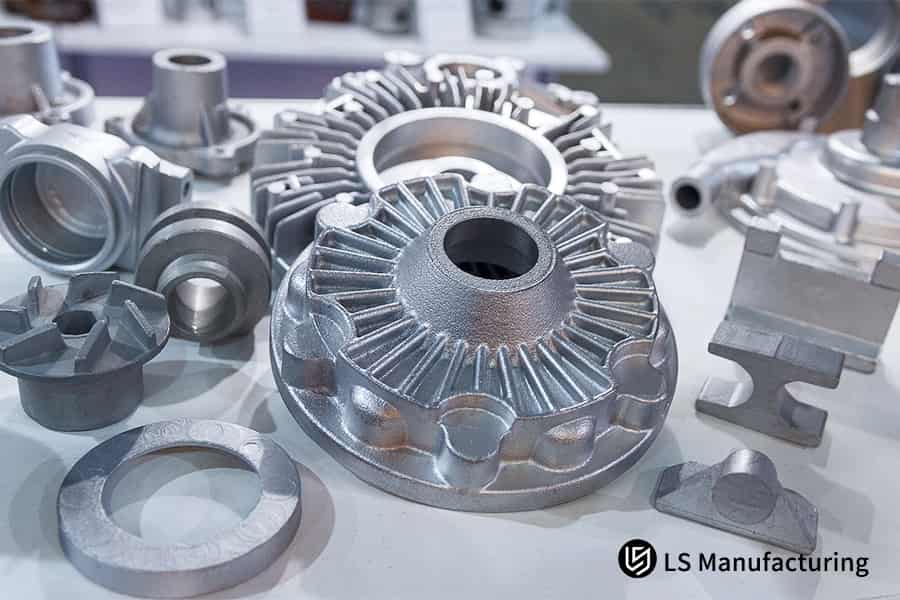
Figure 4: Various metal castings in different shapes and sizes, arranged on a white background.
Why Choosing LS Manufacturing Guarantees Zero Supply Chain Risks For Industrial Metal Casting?
The primary benefit of an excellent industrial metal casting supply chain is its IATF 16949 certification and the ability to conduct production through vertical integration themselves. They carry out all the steps from mold designing and casting to CNC machining independently and have integrated quality control and traceability digitally, so that only good products that are traceable pass through each step of production.
Hardware Quality Control Capabilities Throughout the Entire Process
One of the main aspects of supply chain management is stability. As a self-operated factory without third-party subcontracting, we have climbed among the top metal casting providers 2026 because of our strong quality control and manufacturing capabilities, which enable us to deliver orders continuously for various metal castings for industrial components.
Complete Lifecycle Traceability System
We have established a digital traceability system that is geared to supply chains worldwide. Utilizing a detailed casting quality traceability system, we provide complete lifecycle quality traceability of castings from raw material to the end product.
- Raw Material Archiving: Certificates of material test records (MTR) are stored for each batch of metal raw materials, guaranteeing control over the material from the source.
- Production Traceability: Key process parameters, e.g. melting temperature, die-casting cycle time, and vacuum level, are recorded during the whole production process.
- Quality Inspection Traceability: CT flaw detection and mechanical testing reports accompany the goods.
- Service Traceability: 24-hour technical support, rapidly responding to design modifications and capacity changes.
FAQs
Q1: What is the minimum wall thickness can you achieve with your custom metal casting service?
We rely on advanced ultra-vacuum die-casting technology to stably control the minimum wall thickness of aluminum alloy castings to 1.2mm±0.15mm, this way enabling regular and complete filling, effectively avoiding common defects like cold shuts and incomplete casting, etc. and getting the customized production needs of various compact industrial parts.
Q2: How does LS Manufacturing by themselves ensure the chemical composition consistency of aluminum alloys?
We conduct a comprehensive test with an imported direct-reading spectrometer before each melting batch of aluminum alloy, tightly controlling iron content to 0.8%, and all the strengthening elements deviations to within 0.05%, because of this making the alloy composition of each batch stable and uniform.
Q3: Is it possible for your global metal casting service to comply with both ASTM and EN metallurgical standards?
We are producing our customer orders all over the world very comfortably corresponding not only to the main industrial standards internationally such as ASTM, EN or GB but also supplying the most popular alloys e.g. A356 EN AC-43400. We are That means ready to fulfill the compliant production of customers located worldwide.
Q4: What types of non-destructive testing are available at your end for high-pressure components?
We have a complete set of professional non-destructive testing equipment, including industrial CT tomography, magnetic particle testing, and dye penetrant testing. We can also provide authoritative and compliant test reports to meet quality control requirements of high-grade industrial components.
Q5: How do you protect the die casting molds from premature thermal cracking?
For our dies, we choose the high-end hot work die steels, DIEVAR and H13, with a tempered hardness that is steady at 48-52 HRC. And this, the piece is equipped with a fully automated micro-spray lubrication system, which together resist high temperature impact quite effectively. Also, a single set of the mold is capable of mass production over 100,000 cycles with stability about performance.
Q6: Why is your low-volume metal casting quotation more competitive than traditional foundries?
A modular quick-change mold base system is what we have incorporated. With small-batch production, it is not required to reconstruct the whole mold set, only the core cavity inserts have to be manufactured for production, leading to a decrease of about 45% in the mold amortization cost. You are able to directly upload your drawing files to obtain a precise customized quotation.
Q7: What secondary CNC machining tolerances can you maintain after the industrial metal casting process?
We have a single operated five-axis CNC precision machining workshop and so are able to perform precise secondary machining on casting blanks. The dimensional tolerances of key assembly positions, bearing holes, and other core locations can be stably controlled within 0.005mm, which is suitable for high-precision assembly scenarios.
Q8: What is the standard lead time for a new metal casting project for industrial components?
We use a fully digital DFM analysis and parallel mold design process, which allows us to provide T1 rapid prototype samples within 9 days. The lead time for high-end mass production die-casting molds is 25-30 days, meaning that the overall time required for project development and implementation is greatly reduced.
Summary
Our main focus for premium industrial metal casting procurement in 2026 is to control porosity, increase precision, ensure stability of mass production, and keep costs within limits. We offer professional technology and comprehensive quality control along the whole production chain, and this guarantees a one-stop solution to various casting purchasing problems, resulting in a strong and high-quality supply chain system for your company.
It is about time for your supply chain, which has been struggling with problems in casting porosity, dimensional errors, and the very high cost of molds, to go through a thorough upgrading of the casting supply chain with high-quality products and eventually realize the product quality optimization, thereby completely avoiding superficial collaborations that actually delay project delivery.
Why don't you upload your 3D drawings right now and get back to you with a tailor-made technical plan and price? Our experts will carry out DFM analysis, provide mold flow simulation reports, and factory quotations which are easy to understand and transparent all within 24 hours. Utilization of main casting knowledge and comprehensive quality assurance allows us to establish a stable base for your worldwide industrial casting supply chain.
📞Tel: +86 185 6675 9667
📧Email: info@lsrpf.com
🌐Website: https://lsrpf.com/
Disclaimer
The contents of this page are for informational purposes only. LS Manufacturing services There are no representations or warranties, express or implied, as to the accuracy, completeness or validity of the information. It should not be inferred that a third-party supplier or manufacturer will provide performance parameters, geometric tolerances, specific design characteristics, material quality and type or workmanship through the LS Manufacturing network. It's the buyer's responsibility. Require parts quotation Identify specific requirements for these sections.Please contact us for more information.
LS Manufacturing Team
LS Manufacturing is an industry-leading company. Focus on custom manufacturing solutions. We have over 20 years of experience with over 5,000 customers, and we focus on high precision CNC machining, Sheet metal manufacturing, 3D printing, Injection molding. Metal stamping,and other one-stop manufacturing services.
Our factory is equipped with over 100 state-of-the-art 5-axis machining centers, ISO 9001:2015 certified. We provide fast, efficient and high-quality manufacturing solutions to customers in more than 150 countries around the world. Whether it is small volume production or large-scale customization, we can meet your needs with the fastest delivery within 24 hours. choose LS Manufacturing. This means selection efficiency, quality and professionalism.
To learn more, visit our website:www.lsrpf.com.