English



Precision sheet metal fabrication services have become the mainstay of high end OEM supply chains as they assure component stability over large volumes.
Processing issues crop up frequently when parts become more complex, especially if the suppliers fail to identify the design errors at an early stage. To help have no unexpected quality, LS Manufacturing provides detailed specifications that help in producing consistent quality on the line.
Eight major technologies allow one to evaluate the major risks that are associated with each one of the phases, that is, what could go wrong, and how to prevent that even before the lines start to slow down. Substantial cost savings are achievable through avoidance of line delays and scrapping of the final products.
Efficient Mass Production Of Sheet Metal Fabrication For OEM: Quick List Of Core Answers
| Core Requirement | Solution | Key Data | Customer Benefit |
| Micron-level Tolerance Control | Full Closed-loop CNC System + LAMS Compensation | ±0.05mm Tolerance | Complies with Strict Medical/OEM Standards. |
| Non-standard Special-shaped Structure Processing | FMS Flexible Machining Unit | 50% Mold Cost Savings | High ROI for Small-batch Orders. |
| Complex Bending Anti-interference | DFM Guidelines + 3D Simulation | 35% Yield Improvement | Reduce Mass Production Rework Losses. |
| Stainless Steel Welding Anti-warping | Pulse Laser Welding + Custom Fixtures | Flatness 0.2mm/m | Ensure Sealing and Mechanical Performance. |
| Rapid Prototype Iteration | Closed-loop Prototyping + K-Factor Compensation | 50% Debugging Time Savings | Shorten New Product R&D Cycle. |
This article is about your main problems. It lists eight key technologies. Then it mixes data and real-life examples to help you overcome mass production issues. LS Manufacturing will deliver a working solution for sheet metal fabrication.
Why Choose LS Manufacturing For Precision Sheet Metal Fabrication Services?
As one of the leading OEMs, a few factors that can decide your global competitive edge are fabricating sheet metals' stability, accuracy, and price efficiency.
The best choice is LS Manufacturing, with 15 years experience in precision sheet metal processing, as highly professional contacts to your long-time reliable supports. If you opt for LS Manufacturing, your parts will conform to ISO 13485 medical-grade standards and meet global OEM requirements.
Our fully closed-loop CNC system for sheet metal fabrication precision allows us to normalize tolerances within 0.05mm, resolve your precision cavity machining issues to increase component yield from 72% to 99.8%, and this rework cost-saving can be around $100,000 annually.
Our custom sheet metal fabrication flexible solution helps you avoid the pressure of small batch order mold investment. After a certain aviation customer adopted it, the initial mold cost decreased by 60% and the initial ROI increased by 45%. Our service follows the ASTM A653 standard to ensure stable material properties and processing accuracy, and to avoid risks from the source.
We are well aware of your need for supply chain stability and have established a full process digital traceability system. Each link can be traced, and the Cpk value is stable at 1.33 or above, helping you achieve controllable supply chain and traceable quality.
Choosing us means not only receiving precise processing services but also personalized DFM optimization advice, proactively mitigating potential mass production risks. Contact our technical experts now for a free sheet metal fabrication process assessment and unlock customized cost optimization solutions.

How Do Precision Sheet Metal Fabrication Services Ensure Micrometer Tolerances?
Medical equipment that involves precision parts must be kept at very exact tolerances, even the tiniest deviations can affect the functionality of the machinery or worse lead to safety issues. Primarily, the advantage of precision sheet metal fabrication services lies in the excellent control of tolerances over the different stages.
- Fully Closed-Loop CNC System: We employ a fully closed-loop CNC system for our stamping and laser cutting machines, offer real-time feedback, and auto-adjustment of processing data. That is the reason why we can guarantee that the stamping and cutting tolerances remain within a very stable range of 0.05 mm, an error so small that it is even less than the thickness of a single human hair.
- Material Thickness Deviation Compensation: By taking measurements of material thickness deviations in different batches, we build a special compensation database that helps us make processing parameters changes in advance to counteract the non-linear effects of bending accuracy.
- Laser Angle Measurement System Calibration: With the help of LAMS to check and make up for bending angles and springback continuously, bending angle error is kept within 0.5 for T6 aluminum.
These measures ensure that medical components meet industry tolerance standards, preventing assembly failures. For more details, please download the Precision Sheet Metal Fabrication Services white paper or contact an engineer for a free tolerance assessment.
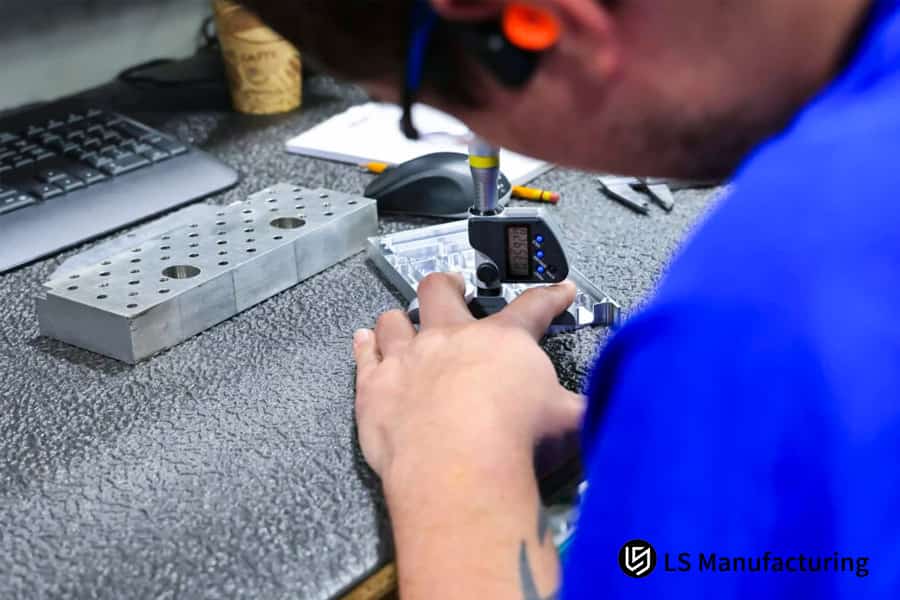
Figure 1: A technician uses a digital micrometer to precisely measure a metal part on a workbench.
How Can Custom Sheet Metal Fabrication Avoid Mold Costs For Irregular Parts?
OEM customers may face difficulties with mold costs when working on small-batch, multi-variety non-standard and irregular sheet metal parts. The flexible processing features of custom sheet metal fabrication are the main solution to this problem.
Flexible Manufacturing Unit(FMS)
By using a Flexible Manufacturing System integrating CNC turret punch presses with fiber laser composite processing technology, we do away with the need for traditional molds. The benefits are:
- Integrated forming: Without the need for dedicated molds, it can directly perform integrated processing of countersunk holes, louvers, and extrusion tapping, thus reducing the number of processes and increasing efficiency.
- Capable of handling small batches and multiple varieties: Parameters for different processes can be changed very quickly without changing the molds, which leads to a significant reduction in the delivery cycle.
ROI Comparision of Two Processing Solutions
For a clear illustration of the benefits, a comparison is made between the return on investment (ROI) of the traditional mold-making solution and the LS flexible manufacturing solution in the table below:
|
Processing Plan |
Mold Cost (USD) |
Unit Processing Cost (USD) |
Total Cost for 1000 Units (USD) |
Delivery Cycle (Days) |
|
Traditional Mold Opening Plan |
8,000-12,000 |
1.2 |
9,200-13,200 |
25-30 |
|
LS Manufacturing Flexible Machining Plan |
0 |
1.8 |
1,800 |
7-10 |
How Can DFM For Sheet Metal Design Prevent Interference In Bent Parts?
During the mass production of complex bent parts, the physical interference caused by the mold entering the confined space can affect efficiency and lead to part scrap. The DFM for sheet metal design criteria can avoid this risk from the source.
Bending Sequence Optimization
Mistakes in the bending sequence are greatly responsible for interference. We employ 3D simulation software to replicate the bending steps and set an ideal order from "inside to outside, small to large" in order to eliminate the collision between the mold and the bent part.
Structural Design Optimization
A thoughtfully created design may lessen the possibility of interference and simultaneously increase yield. Some of the main actions we have taken include:
- Minimum Bending Edge Limitation: Relying on 1.5t-2.0t standard (t = material thickness), we have our own parameter table that specifies the minimum bending edge dimensions of various materials of different thicknesses so as to prevent bending or interference.
- Process Hole Design: Placing process holes at the intersection of the bends not only gets rid of stress concentration but also gives the forming tool enough clearance. Besides, this way, the possibility of interference is decreased by 90% and mass production yield is increased by 35%.
We also fine tune the radius (R) angle to balance bending accuracy and efficiency. For free DFM (Design for Sheet Metal) design review, please submit your drawings, optimization suggestions will be provided within 24 hours.
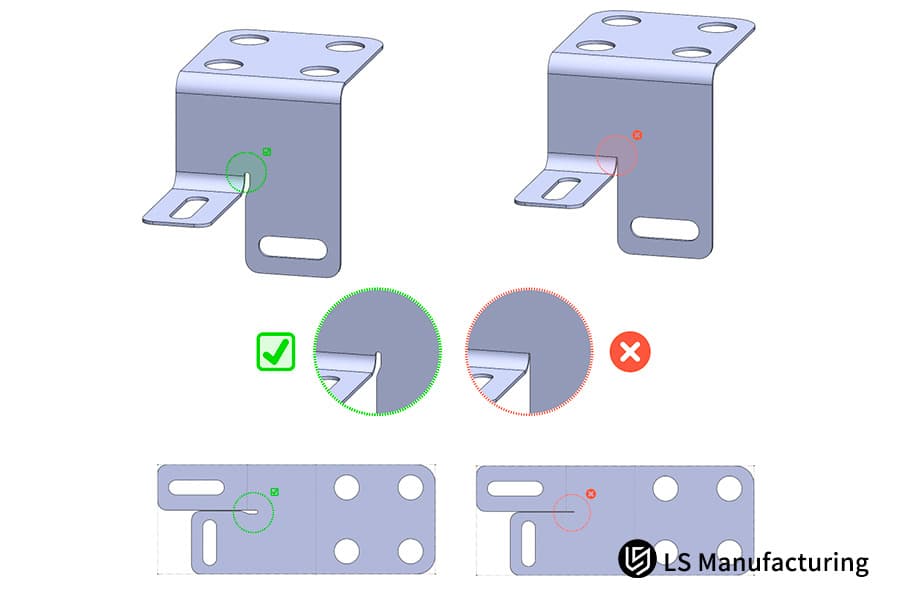
Figure 2: 3D models of sheet metal parts illustrate correct vs. incorrect bending designs to prevent interference in a factory.
How To Establish Traceable QC In Sheet Metal Fabrication For OEM?
The core requirements for long-term OEM collaboration are supply chain stability and quality traceability. The core competitiveness of sheet metal fabrication for OEM is to establish a fully traceable quality control system throughout the entire process to avoid batch quality fluctuations.
Full Process Quality Control
Our quality control spans the entire processing flow, with clear standards and procedures at each stage:
| Quality Stage | Testing Standard | Testing Equipment | Control Precision | Traceability Method |
| Raw Material Inbound | Material Certificate (MTR) | Spectrometer | Composition Error ±0.01% | Raw Material Batch Number |
| First Article Inspection | FAI Standard | Coordinate Measuring Machine | ±0.02mm | First Article Inspection Report |
| Process Monitoring | Cpk≥1.33 | Online Testing System | Real-time Feedback | Process Data Recording |
| Finished Product Outbound | GD&T Standard | Laser Tracker | ±0.15mm | Finished Product Inspection Report |
Dedicated Traceability Service
For long term OEM collaborations, we provide dedicated traceability services to enhance the stability of the supply chain. The practices involve:
- Digital Traceability System: Creating a complete system with a unique traceability code for each batch of components, making it possible to get data in real time at each stage.
- Dedicated Customer Service: Giving long term customers traceability system accounts so that they can access the processing data for each batch anytime and thus eliminate quality blind spots.
- Aerospace Grade Additional Inspection: The outsourcing of non destructive testing for the addition of aerospace grade sheet metal parts is the method used to satisfy OEM global assembly line requirements.
We perform non destructive testing on aerospace grade sheet metal parts and also give long term clients dedicated traceability accounts, which support quality that is controllable and traceable.
How Does Multi-Axis Machining Solve Forming For Complex Sheet Metal Components?
OEM parts are getting more and more complicated every day, with highly complex sheet metal components being characterized by things like curved surfaces and beveled holes. Obviously, conventional machining methods create secondary clamping errors quite easily and this is something that our multi axis machining technique completely gets rid of.
Multi Axis Machining Equipment and Programming
By merging the use of five axis laser cutting and precision bending units with expert CAM programming, we are capable of eliminating the secondary clamping errors entirely from both an equipment and a technological point of view. The benefits are as follows:
- Five Axis Machining Equipment: Has the ability to perform machining from several different directions, is capable of directly machining curved surfaces and beveled holes without performing multiple clamping operations, so that the clamping errors are not introduced.
- CAM Programming Optimization: Becomes the one that plans the machining path accurately, accomplishing zero secondary clamping errors and at the same time, reducing the oxidation in the heat affected zone, which means that the forming accuracy is secured.
Material Adaptation Optimization
The parameters of protective gases were adjusted according to various properties of materials so as to guarantee kerf quality and forming accuracy. The measured data are:
| Material Type | Protective Gas | Flow Rate (L/min) | Kerf Roughness (Ra/μm) | Heat Affected Zone Width (mm) |
| Titanium Alloy | Argon | 25-30 | 1.2 | 0.15 |
| High-Strength Steel | Nitrogen | 20-25 | 1.5 | 0.2 |
| 316L Stainless Steel | Argon + Nitrogen | 18-22 | 1.0 | 0.12 |
| T6 Aluminum | Nitrogen | 15-20 | 1.8 | 0.25 |
How Does Precision Metal Prototyping Ensure Data Accuracy In Fast Iterations?
During the research and development stage, OEM customers often have to make many changes in quick succession when creating a precision metal prototyping parts. The quality of prototype data can be a decisive factor of a successful mass production. Many customers end up time consuming and expensive mold debugging because of data deviations.
Closed Loop Prototyping Model
The basis of our rapid prototyping service is a closed loop model of "rapid prototyping - data feedback - process optimization, " and the steps are as follows:
- Rapid Prototyping: By means of an autonomous prototyping department, we can rapidly finish the work to comply with the demand for high frequency iterations.
- Data Feedback: We monitor the deformation patterns of prototypes by high level measurements, log principal parameters (e.g. the K-Factor) and supply suggestions for compensation.
- Process Optimization: We make the process better according to prototype data, foresee mass production issues, and confirm prototype and mass production data matching.
Core Technology Support
When dealing with complicated bending prototypes, we employ full scale mold simulation technology to identify possible mass production issues. Indeed, this model has been proven in practice to cut the mold debugging time by over 50%, the product development cycle by 30%, while maintaining data consistency.
If you are facing issues such as frequent prototype iterations and inaccurate data, you can contact our technical experts for a free precision metal prototyping evaluation or download the prototyping guide.
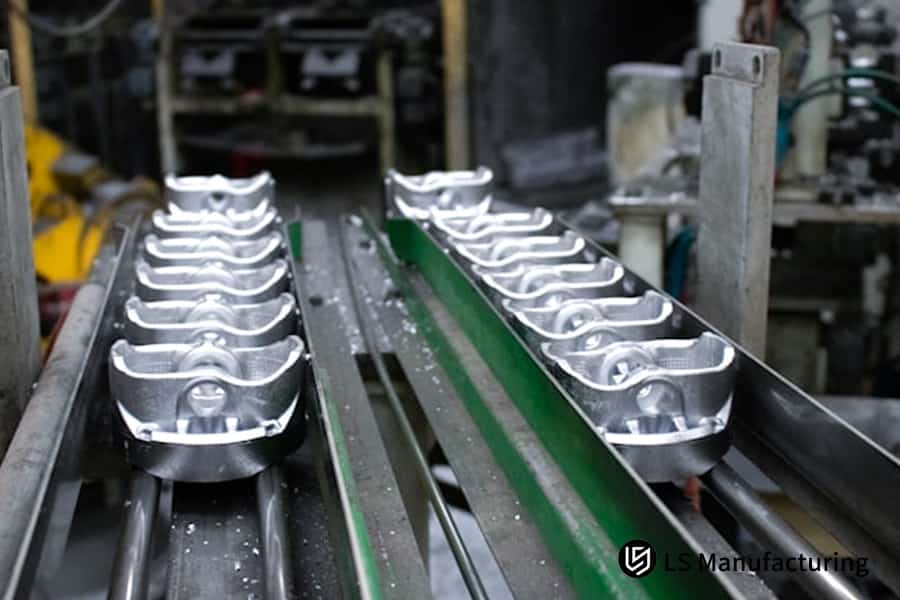
Figure 3: Multiple rows of identical, shiny metal parts are precisely aligned on industrial conveyors in a factory.
How Can Sheet Metal Design Optimization Reduce Weight & Part Costs?
Materials and processing time contribute greatly to the cost of purchasing high end OEM components. The sheet metal design optimization scheme can achieve weight reduction and cost reduction while improving structural strength through structural optimization.
Structural Topology Optimization
This method lies at the heart of cutting down weight and cost in the production of structures. We convert multi part welded components into a one piece stamped and bent part, thereby diminishing the number of welding stations and reducing material wastage.
Following their use by an aerospace client, the percentage of materials used went up from 75% to 92%, and the cost for one unit dropped by 18%, even though the stability of the structure was further enhanced.
Strengthening Rib Design
By cleverly designing the strengthening rib, a component can be made to simultaneously be stronger and lighter without increasing the material thickness. Some of the facts are:
- Enhanced Strength: It is possible to raise the bending strength of the component by 30%, which is adequate to satisfy the performance standards required by high end OEMs.
- Lowering Weight as Well as Cost: Capable of reducing weight by 15%, which has an immediate impact on lowering raw material cost and also the shortening of processing duration.
- Tailor made Optimization: Allowing customers to transparently calculate their use of materials and processing time, and hence, lowering their average unit procurement costs by 15%-25%.
How To Control Welding Stress In Stainless Steel Fabrication Services To Prevent Warping?
During the welding of 304 and 316L stainless steel sheet metal, stress concentration happens quite easily, which causes the component to warp and change shape, the assembly won't be accurate anymore. It really is a major worry for OEM customers ordering stainless steel fabrication services.
Pulsed Laser Welding Process
The core method to managing the welding stress is pulsed laser welding. A minute change in parameters can bring a lesser stress level. The following is a detail:
- Accurate control of the welding heat input between 80 and 120 J/mm can minimize the heat affected zone and reduce stress.
- Experiments demonstrate that pulsed welding stress levels are less than 60% compared to traditional welding, thus preventing warping and deformation.
- When heat input at 90J/mm, the weld penetration of 316L stainless steel was found to be 2.5mm with no major deformation.
Tooling and Weld Optimization
Through customized tooling and weld layout optimization, welding stress was released, ensuring component accuracy and stability. The measures are as follows:
- Customized Tooling Fixtures: Components are fixed by their structure design during welding to make sure that the stress is released uniformly and that there is no excessive local stress.
- Weld Layout Optimization: Through welding which is staggered and segmented, the flatness of long span thin plate components was controlled within 0.2mm/m, appearance and performance both were ensured.
LS Manufacturing Case Study: Developing High Vacuum Complex Sheet Metal Components
At a high end OEM area, high vacuum cavity components are very difficult to be processed, the requirements for welding accuracy, bending consistency, and sealing being very strict. We accomplished to solve these problems of a semiconductor equipment customer and make a big improvement in the yield.
Customer Problems
When trying to make 316L high vacuum cavity complex sheet metal components, the original supplier of the customer failed to control the consistency of the bending inner radius.
So tiny cracks were found in welds, the helium leakage rate was very high above 110 Pam/s, and the yield of finished products was less than 65%. Besides, the company was wasting a lot of its raw materials, the delivery times were very long and the losses amounted to almost $150,000 per month.
LS Manufacturing Solution
- Firstly, we recalibrated the springback parameters of 316L stainless steel by carrying out a sheet metal design optimization. Based on the earlier material performance data, we reworked the bending process, meticulously maintaining the bending inner radius tolerance to 0.1mm so that the cavity joints could be sealed effectively.
- At the same time, we upgraded to robotic precision laser welding, keeping track of the welding thermal balance in real time and adjusting the welding heat input to a range of 80-100J/mm. Along with the use of customized tooling fixtures, this approach guaranteed that stress was uniformly released throughout multi point welding, thus avoiding micro cracks.
- Besides that, we rearranged the weld line layout and switched to staggered welding operation to further enhance weld sealing. Welding of all components was performed in accordance with ASTM A967 standards.
Results and Benefits:
Reworking the complex sheet metal components led to the vacuum sealing passing the test 100% of the time, with helium leakage at the level of 5×10⁻¹⁰ Pa·m³/s or less, which is so much better than the customer standards. Assembly tolerances were tightened from 0.3mm to 0.08mm so as to satisfy the assembly needs.
Due to those process changes, the customer managed to reduce the secondary grinding time by 30% and have a drop in processing cost per piece by 22%, thus making an annual saving of nearly $1.8 million and ensuring the project would be delivered on time.
This case demonstrates our ability to precisely solve pain points in complex sheet metal processing and create real value. If you face similar challenges, submit your requirements to obtain customized solutions and a free quote.

FAQs
Q1: What is the smallest hole diameter to sheet thickness ratio made by LS Manufacturing precision sheet metal processing?
For custom sheet metal fabrication, precision fiber laser cutting is by far the most common method to ensure a 1:1 hole diameter to sheet thickness ratio. However, for some special materials, 0.8:1 ratio can be achieved and thus the requirements of most OEMs can be met.
Q2: How do you keep the positional tolerances of very large, complicated sheet metal parts?
A large CNC gantry CMM is utilized for 3D full size inspection together with the real time calibration by a laser tracker. The positional tolerance of critical mounting holes is limited to 0.15mm, therefore ensure the accuracy of assembly.
Q3: Do you add a charge for DFM (Design for Metal) sheet metal audits?
Absolutely not, DFM audits are part of the overall quotation process and no additional charges are levied for them. They help develop the most cost effective solutions and also avoid manufacturing risks in a proactive way.
Q4: Do you include electropolishing or passivation in your stainless steel fabrication services?
We provide pickling and passivation services according to ASTM A967, and also offer mirror electropolishing with a surface roughness value of Ra 0.2μm to meet different surface quality standards.
Q5: In case of precision metal prototyping orders with complex bending features, how do you manage those?
We have a separate prototyping workshop and a multi axis bending center. After full scale mold simulation, we get detailed control of the processes and therefore, can usually finish complex prototype orders in 3-5 working days while ensuring data integrity.
Q6: What is the reason for recommending sheet metal design optimization prior to mass production?
Along with increasing raw material utilization efficiency, design optimization in sheet metal also helps reduce the number of welding stations, shorten cycle time, enhance structural strength, and decrease long term procurement costs. All of the above contribute to the success of mass production.
Q7: Which type of QC Report do you provide for precision OEM components?
To ensure quality traceability, we supply a variety of test and inspection reports including MTR FAIR film thickness testing, salt spray testing reports, and third party non destructive testing reports.
Q8: Does precision sheet metal fabrication service support mixed material welding?
Sure, we do have dissimilar metal welding technology options. For instance, we can laser braze copper to stainless steel or aluminum to stainless steel in order to fulfill complex OEM design requirements.
Summary
Precision sheet metal manufacturing directly affects the quality of high end OEM components. Choosing a trustworthy partner becomes indispensable when it comes to mass production and cost effectiveness.
Equipped with advanced technological facilities and stringent management, LS Manufacturing helps you overcome your production limitations and provides you with substantial support.
If your precision sheet metal design has tolerance and cost problems, you can always turn to LS Manufacturing's technical experts for the most suitable solution. Upload your STEP or DXF file now and receive a free quote along with a comprehensive analysis that will help you bring the best engineering ideas to fruition within 24 hours.
📞Tel: +86 185 6675 9667
📧Email: info@lsrpf.com
🌐Website: https://lsrpf.com/
Disclaimer
The contents of this page are for informational purposes only. LS Manufacturing services There are no representations or warranties, express or implied, as to the accuracy, completeness or validity of the information. It should not be inferred that a third-party supplier or manufacturer will provide performance parameters, geometric tolerances, specific design characteristics, material quality and type or workmanship through the LS Manufacturing network. It's the buyer's responsibility. Require parts quotation Identify specific requirements for these sections.Please contact us for more information.
LS Manufacturing Team
LS Manufacturing is an industry-leading company. Focus on custom manufacturing solutions. We have over 20 years of experience with over 5,000 customers, and we focus on high precision CNC machining, Sheet metal manufacturing, 3D printing, Injection molding. Metal stamping,and other one-stop manufacturing services.
Our factory is equipped with over 100 state-of-the-art 5-axis machining centers, ISO 9001:2015 certified. We provide fast, efficient and high-quality manufacturing solutions to customers in more than 150 countries around the world. Whether it is small volume production or large-scale customization, we can meet your needs with the fastest delivery within 24 hours. choose LS Manufacturing. This means selection efficiency, quality and professionalism.
To learn more, visit our website:www.lsrpf.com.