English



Laser cutting services are rated by heavy machinery OEM purchasers who weigh is plasma cutting cheaper than laser cutting, particularly for pieces that exceed 20 mm thickness where the perception is that plasma cutting is the only viable option. Such emphasis on the upfront quote does not account for overall expenses, since plasma’s kerf accuracy tolerance of 1.5 mm - 3.0 mm and large heat affected zone requires subsequent CNC machining and grinding, thus adding extra expense in excess of 30% with no certainty in lead times.
We offer you the ultimate answer with our state-of-the-art 30 kW ultra-high power laser cutting that can guarantee true cost-effective laser cutting for thick plate fabrication using high-pressure air cutting without any secondary operations. Below is a comprehensive manufacturing parameters model to illustrate the synergistic cost management of our process.
Laser Cutting VS Plasma Cutting: A Cost-Benefit Comparison
| Key Factor | Laser Cutting | Plasma Cutting |
| Material Thickness Range | Optimal for thin to medium plate (25mm). | Optimal for thick plate (6mm-150mm+). |
| Cutting Precision & Tolerance | High cutting accuracy of ±0.1mm with fine details and tiny cuts. | Suitable for moderate accuracy (±1-2mm) and rough cuts. |
| Edge Quality & Kerf | Square-cut edges with very narrow kerf. | Edges have bevels with dross, larger kerf, hence loss of material. |
| Heat-Affected Zone (HAZ) | Minimal HAZ and thermal distortion because of minimal heat input. | Large HAZ due to high heat input which distorts thin metals. |
| Operating Cost | Expensive upfront but cheap to operate for thin parts. | Low initial cost but expensive operating costs due to expensive tips/electrodes. |
| Our Advisory Service | Laser cutting recommended for parts requiring precision and fine details. | Plasma cutting recommended for structural parts requiring quick and effective results. |
| Result: Optimal Process Choice | Precise parts which do not require further finishing before welding. | Fast economical option for heavy and structural profiles. |
We resolve the conundrum surrounding process selection for the cutting of heavy-metal parts. With our extensive knowledge and experience, we assist you in choosing the best option that would give you optimal results in terms of quality, pricing, and turnaround times. We avoid any potential pitfalls that could result in over-engineering, unnecessary costs, and other hidden expenses, thus ensuring you receive the best value for your metal fabrication project.
Why Trust This Guide? Practical Experience From LS Manufacturing Experts
There are many articles about laser versus plasma cutting available on the Internet. What sets this apart from all others? Our expertise is practical, not theoretical. It stems from over a decade of experience cutting metal in our shop, where every decision concerning which process to use has direct financial implications. Our evaluation of cut quality and overall costs is thoroughly based upon the ASM International material standards.
We cater to industries that demand exacting standards, from aerospace frame manufacture that cannot afford even slight heating deformations to sturdy mining machinery and intricate energy fabrications. Each of our projects, be it prototyping or high volume manufacturing, teaches us how to maximize the nesting of plate metal, select appropriate assist gases, and achieve optimal balance between cutting speed and high-quality edges.
These insights and approaches are implemented on a daily basis to manufacture dependable, economical components. Optimization of processes and performance measures is consistent with the American Production and Inventory Control Society (APICS) standards of production. Both successes and failures in our thermal cutting experience will provide us with valuable advice so that you may be able to make informed decisions in order to avoid repeating the same mistakes we made during our production process.
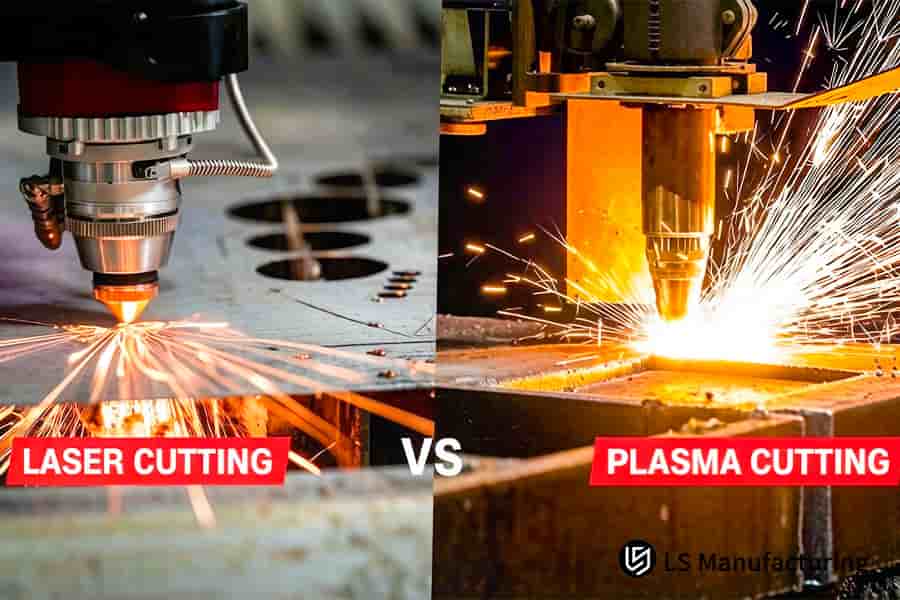
Figure 1: Plasma cutting processes thick steel with a bright arc, contrasting with laser cutting thin metal with a concentrated beam.
Why Is Laser Cutting Services Becoming The New Standard For 20mm Plus Heavy-Duty Steel?
Traditionally, 20mm represented a point where laser cutting services were not an economically feasible alternative, mainly because of the poor edge quality produced. It is precisely this innovation which makes a difference as it provides precision machining-grade cuts, without the need for further processing before welding. This represents a paradigm shift in heavy steel fabrication as well as:
Mastering Energy Density for Superior Kerf Quality
Raising the laser power alone will not suffice as the unregulated energy output leads to a broad, tapered cut. Our research methodology involves keeping up the high density of energy. This has been accomplished through the use of very bright fiber lasers together with beam-shaping optics, giving rise to a precise, narrow and stable cut with roughness value Ra 12.5μm, thereby making it possible to weld parts cut using our heavy duty metal laser cutting without further processing.
Closed-Loop Control to Mitigate Thermal Effects
Local heating may lead to distortion and alteration of microstructure. The suggested method uses a closed loop controller. Sensors will measure the condition of the cut in order to make corrections to the speed of feed, pressure of the gases, and laser pulse width. Thus, effective cooling will take place; hence there will be minimal heat affected zones and no distortion of parts ensuring dimensional accuracy laser cutting components.
Integrated Process for Seamless Workflow
Precision at the cutting head must be preserved through handling. Our system integrates automated material loading, in-process laser marking for part identification, and automated offloading. This seamless integration minimises manual intervention, eliminates handling damage, and ensures the precision machining-ready quality is maintained directly through to the next assembly stage, streamlining the entire value chain.
Above mentioned documentation provides comprehensive information on the use of the technologies involved in incorporating high-power laser cutting in precision manufacturing. The application of the integration process through our proposed approach of incorporating advanced beam control technology, heat management, and automation technology can be considered the optimal solution. It is only through the integration process that the main problem can be resolved and establish a benchmark for effective and highly tolerant heavy steel fabrication from plate thicknesses greater than 20mm.

How Does Laser Cutting VS Plasma Cutting Impact The Total Cost Of Ownership For OEM Parts?
In case of the OEM, the selection process of either cutting technology is mainly based on the manufacturing cost rather than ignoring the future assembly costs incurred by the process. The key problem from the technological perspective is the determination of the influence of high-quality results obtained by laser cutting vs plasma cutting on total expenditure. In this regard, the following methodological framework will be applied in performing the TCO analysis:
Implementing a Holistic Cost Modeling Framework
- Cost Driver Mapping: We examine every factor that affects the cost of production: cutting, secondary operations such as deburring and reaming, scrap rate, rework, and assembly labor costs.
- Data-Driven Baseline: A comparative analysis of laser cutting cost comparison against plasma is based on empirical data and takes into account the effect of quality on subsequent processes.
- Case Application: We determined that a rise in costs by 15% due to ultrafast laser cutting per meter was rendered irrelevant by avoiding 100% reaming and grinding following cutting.
Quantifying the Value of Dimensional Precision and Consistency
- Technical Metric: Hole Position Consistency: We ensure that hole position consistency is greater than 99.8% in our precision laser cutting services.
- Solving Assembly Challenges: Fit-up issues are resolved by the fact that no adjustments are needed for holes that match perfectly.
- Result: The enhanced cut shape provided by our automated laser cutting cell guarantees that minimal distortion occurs, making it possible to use the components right away, as the products from plasma cutting machines cannot.
Collaborative Budget Reallocation for Optimal Outcomes
- Strategic Cost Shifting: We assist our clients in shifting their money from their secondary manufacturing budget to their primary cutting operations.
- Forecasting Total Spend: Proactively planning our spend based on our total cost of ownership analysis yields predictable and even reduced costs.
- Enabling Design Optimization: High reliability enables design complexities, leading to fewer parts and less manual assembly work. This is one of the aspects that can be realized through precise laser cutting parameter optimization.
What we discuss here goes well beyond process selection itself. By explaining the full details of our process and its integration into cost modeling, we make clear the importance of a correctly applied technical process to achieving positive financial outcomes. This makes clear our expertise in delivering cost reduction through manufacturing efficiency.
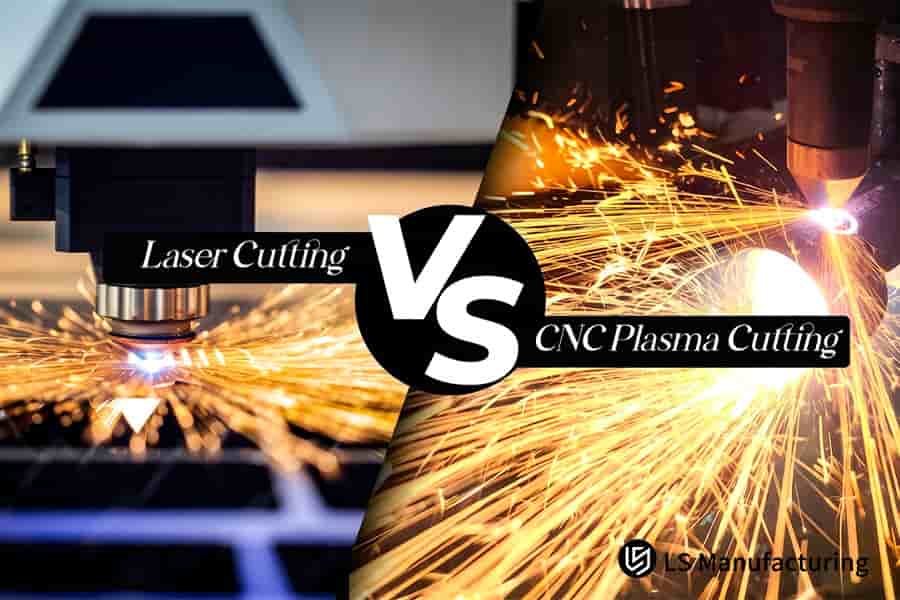
Figure 2: CNC plasma cutting creates heavy spark showers on thick plate as laser cutting works on thinner sheet with controlled sparks.
How Can Cost Effective Laser Cutting Optimize Material Nesting For Expensive Alloy Plates?
For OEMs using expensive alloys like Hardox, material can exceed 60% of a part's cost. The core challenge is maximizing yield from these costly plates. This document details our cost effective laser cutting methodology, which employs advanced nesting to directly boost material utilization. The following analysis quantifies how this approach delivers measurable savings for alloy steel cutting projects:
| Focus Area | Technical Implementation & Result |
| Process Foundation | The precise sub-millimeter kerf of precision laser cutting allows for extremely tight packing of parts relative to thermal technologies. |
| Nesting Strategy | The use of intelligent nesting software allows us to apply the micro-joint method, which reduces spacing between parts to only about 5mm. |
| Technical Execution | Custom laser cutting solutions allow us to control kerf and temperature during cutting to ensure integrity of the high-strength material that was nested. |
| Quantifiable Outcome | Such an approach normally increases the efficiency of material use by about 12-15%, thus increasing cost savings. |
From the foregoing analysis, it can be seen that strategic cost effective laser cutting is an engineering technology that deals primarily with yield. With the connection between advanced nesting, which is facilitated by narrow-kerf laser cutting, and part economics, we have provided you with a technical guide that uses empirical data for process selection. This paper provides technical information for decision-makers involved in competition for award-winning projects.
Why Choose Heavy Duty Metal Laser Cutting For Components Requiring Zero Heat Distortion?
Thermal distortion resulting from excessive heat during the cutting process affects accuracy. It also makes secondary operations more expensive as a result of the need to compensate for the distortion. This paper describes the heavy duty metal laser cutting process for components that do not require heat distortion. Heat control is at the center of solving the problem as follows:
Precision Thermal Input Control via Advanced Pulse Modulation
The bulk heating effect is alleviated through the use of high-speed pulsed laser cutting techniques, which enable accurate energy deposition per unit time through a fast pulse rate. This reduces the overall heat load responsible for macro distortion, thereby facilitating the use of laser cutting for heavy parts with uniform geometry irrespective of fixturing.
Active Cooling and HAZ Minimization Strategy
In order to localize the thermal effects, an assisted gas delivery system using liquid nitrogen is incorporated. This cooling technique at the cut point leads to quick cooling, resulting in a heat-affected zone of less than 0.1 mm. Thermal cycle control is essential to avoid the formation of phase changes in the material, which would cause hardening of the edges and generate residual stresses.
Preserving Material Properties for Downstream Processing
The laser cutting process parameters have been designed to ensure metallurgical integrity. Through manipulation of pulse parameters and speed of cutting, the temperatures are kept low enough such that the critical temperature for austenitization is not exceeded. This ensures consistent metallurgical characteristics and ductility of the metal at the cut edge, an essential factor in guaranteeing good threading during subsequent processes in which the component will be tapped.
The following technical brief details an engineering method for controlling distortion in manufacturing parts. This is done not by merely stating the low heat input but by ensuring it is achieved using certain pulse parameters and cooling techniques. Low-distortion laser cutting is an essential competitive advantage for companies specializing in precision heavy parts whose manufacturing requires exact dimensions and metallurgical properties.
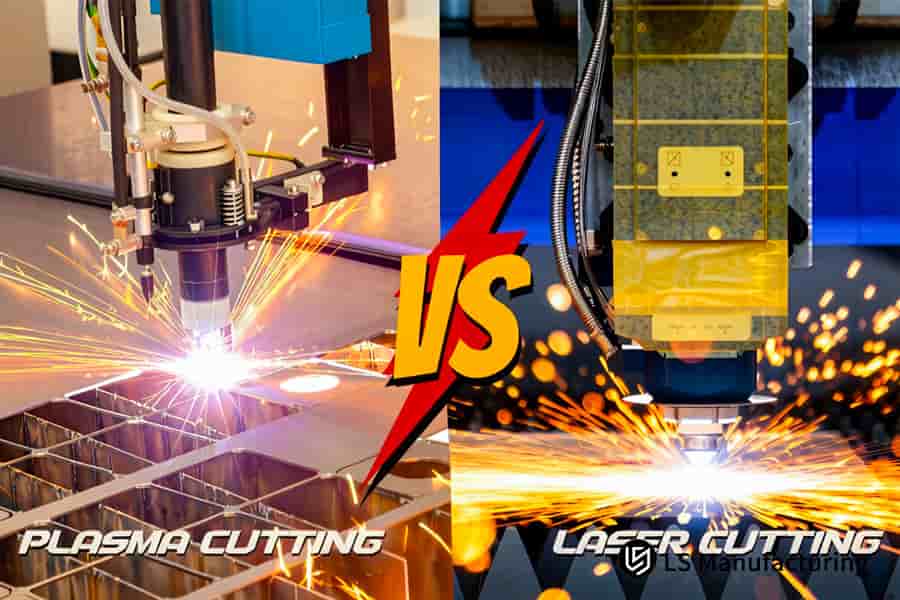
Figure 3: A plasma torch generates a scattered, intense arc versus a laser’s focused, high-intensity beam for metal cutting.
How Does Laser Cutting For Heavy Parts Ensure Weldability Without Secondary Edge Cleaning?
The issues of oxidation and dross formation on cut edges, which often occur during thermal cutting operations, require expensive subsequent cleaning prior to the welding process, thus causing delays and inconsistencies. This document describes our proprietary technical procedure for laser cutting for heavy parts, which provides a pristine, oxidation-free cut edge, allowing components to go immediately from the cutting process to robotic welding workstations. Our approach involves meticulous atmospheric control around the cut area:
Advanced Assist Gas Chemistry and Dynamics
- Proprietary Gas Mix: A special combination of nitrogen and dry air under pressure is utilized.
- Chemical Role of N2: It forms an environment around the cavity that prevents any entry of oxygen.
- Dynamic Role of Air: It affects the dynamics of molten metal flow, thereby effectively removing it from the cut region.
- Direct Result: This results in bright and dross free cuts through direct-weld laser cutting with the help of laser.
Precision Parameter Synchronization for Edge Quality
- Integrated Parameter Control: Precision laser cutting services offered by our company entails synchronization of power, speed, and gas pressure.
- Targeted Outcome: The laser cutting process control will result in a cut with full penetration on thick sheets.
- Problem Solved: This solves the problem of the dross at the bottom edge that is created during welding, which is the major factor responsible for requiring extra welding preparation.
Integrating Cutting into Automated Flow
- Workflow Design: We offer you always weld-ready edges without any grinding station in the process flow.
- Throughput Engine: This will result in a seamless transition from high-pressure laser cutting to welding.
- Operational Impact: By reducing the handling time and cycle time, it increases production throughput.
Indeed, what it involves is the development of the manufacturing process, rather than just the cutting process itself. The chemical composition and profile of the cut surface will be created in such a way as to be a proper welding material. It is incredibly essential to have this capability in any reliable manufacturing process that can remove RMAs using precisely cut and metallurgically prepped materials for automatic welding.
Why Is Precision Laser Cutting Services Vital For Complex Geometries In Structural Engineering?
Complex structural components, featuring intricate geometries like interlocking teeth or complex cutouts, demand absolute cutting fidelity. Inaccuracies cause assembly interference and induce unintended stresses, compromising structural integrity. This document details how our precision laser cutting services ensure critical dimensional accuracy for structural steel parts. We quantify the technical approach that enables complex-geometry laser cutting and seamless fit-up:
| Technical Focus Area | Implementation & Measured Outcome |
| Core Technology for Complex Contours | In this regard, we depend on our precision linear motor drives and motion controls to carry out complex-geometry laser cutting with no deviation, even with sharp edges and tight radius contours. |
| Quantifiable Precision in Critical Features | With the technology, it is now easy to perform cuts such as a small diameter hole (e.g., 10 mm) from thick plate metal (e.g., 30 mm) where the roundness is ±0.05 mm tolerance range. |
| Solutions for Specific Design Challenges | Our custom laser cutting solutions offer software compensation for the specific designs and dynamically tuned laser cutting parameters to prevent thermal deformation resulting from geometrical transitions. |
| Resulting Value in Assembly | The accuracy of the cutting process prevents the need for corrections using a force fit to avoid metallurgical deformation and stresses within the part during final assembly processes. |
Precision has been identified as one of the possible outputs that can be achieved. Precision has been made possible by allowing the provision of sub-millimeter feature accuracy through the use of high-accuracy laser cutting. This solves the problem of disparity between the digital design of a component and its real form, which makes fieldwork expensive.
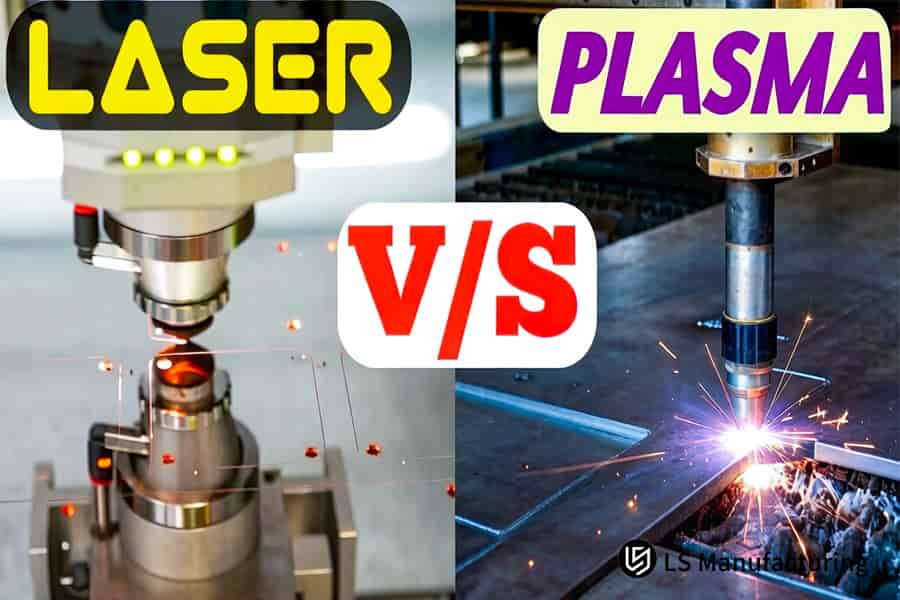
Figure 4: Plasma cutting emits a broad, violent arc on steel while laser cutting produces fine, precise sparks on sheet metal.
How Do Custom Laser Cutting Solutions Adapt To Diverse Material Grades For Heavy Machinery?
Diverse materials such as carbon steel, wear resistant plate, and aluminum alloys among others are used in the manufacturing of heavy machinery parts. The challenge is to ensure that the quality standard is maintained despite the varied types of materials. Here, we examine how our company handles the challenge while providing custom laser cutting solutions for you:
Real-Time Process Monitoring and Closed-Loop Control
To monitor the sparks in our device, optical sensors are used at the cutting head level. The characteristic of the spectrum produced by the light emissions within the kerf is obtained in our device due to analysis of the feedback on the spectrum of the process in real time. With the feedback of the spectrum, the characteristic of the materials being cut, be it aluminum or steel, becomes possible based on their wavelength-specific laser cutting.
Dynamic Parameter Adjustment for Material-Specific Optimization
These two crucial parameters are adapted to the conditions depending on the feedback from the sensors. For instance, the focal point is changed when cutting reflective materials like aluminum, while the gas flow is adjusted for the materials that produce heat during the cutting process, such as high-strength steel. Such adaptive laser cutting technology guarantees perfect energy transfer and melting.
Ensuring Consistency Through Automated Quality Logic
The system provides the closed-loop process, which eliminates any potential quality discrepancies due to slight changes in material grades or condition within one piece of sheet metal. As a result, we get consistent edge quality, kerf geometry, and minimum amount of dross throughout all the material pieces within the batch. This process is essential for process-adaptive laser cutting and LS Manufacturing quality control protocol.
This document describes a deterministic process based on sensor technology for handling variability in materials. By introducing a system of monitoring and adjusting parameters automatically in real time, we ensure that our laser cutting services offer consistent, reliable performance for all parts. In other words, we eliminate potential problems at the batch level and guarantee the integrity of your production schedule and material adaptability.
Case Study: LS Manufacturing Mining Equipment Gear Plate Custom Laser Cutting Solution
A global company dealing with manufacture of mining equipment faced difficulties in quality when machining 35 mm thick 42CrMo gear plates. The previous laser cutting service provider could not manage edge hardening after conducting high-power laser cutting trial. This is a case study that focuses on how LS Manufacturing overcame this problem by designing a custom solution for heavy duty metal laser cutting to give a new dimension to the company's production:
Client Challenge
The initial process used by the client to cut the 42CrMo gears entailed cutting at 5.5 degrees off the center of the gear plates. It was too much of an angle resulting in excessive gaps in the meshed gears. In addition, the amount of heat generated resulted in excessive edge hardening (greater than 50 HRC). The gears were very hard to machine in subsequent precision milling processes, leading to high scrap percentage of 18%.
LS Manufacturing Solution
LS Manufacturing developed its unique laser cutting for heavy parts protocol. It used a 30kW laser with dynamic focusing heads that limited cut face bevel angle to below 0.5°. Crucially, adaptive pulse laser cutting waveforms were used to precisely manage the thermal cycle and prevent quench hardening. Process-based thinking ensured the square edges could be machined further. The problem had been approached holistically by focusing on the underlying metallurgy and geometry.
Results and Value
The result was a high-yield laser cutting process. Uniform geometry and edge quality made it possible for the parts to be immediately sent to finishing grinding, lowering the overall machining cycle by 45%. No scrap parts resulted in cost savings due to the improved yield rate. Based on this success, the client gave LS Manufacturing another $500,000 worth of business within a year.
This is an example of how LS Manufacturing applies its expertise in process science to solve root cause defects. By optimizing the geometry and metallurgy of the cut edge, LS Manufacturing can provide its customers with significant value. The process science execution results in tangible business performance, namely shorter cycle time and no scrap due to defects, making LS Manufacturing a valuable partner for heavy industry leaders.
Solve plasma's hardening and poor fit. Transform gear plate manufacturing with 30kW laser cutting for precision-ready parts.

FAQs
1. Is plasma cutting cheaper than laser cutting for high-volume heavy parts?
Although plasma cutting is economically advantageous on a per-meter basis, taking into account additional processes such as grinding and drilling, LS Manufacturing's laser-based solutions enable a savings rate of greater than 15%.
2. What is the maximum plate thickness for your laser cutting services?
Using ultra-powerful lasers with 30kW, it is possible to cut carbon steels up to 50mm and stainless steels up to 30mm with excellent cut edge perpendicularity.
3. Why does LS Manufacturing offer a more precise laser cutting cost comparison?
The cost analysis is conducted using an advanced Design for Manufacturability (DFM) analysis, which takes into account the effective use of materials, costs of post-processing, and assembling the product—rather than just the cost of power consumed by the cutting equipment.
4. Can your custom laser cutting solutions handle odd-shaped heavy structural steel?
Yes, LS Manufacturing can process odd-shaped components with our large format fiber lasers, which can accommodate any shape up to 4000mm x 2000mm in dimensions.
5. How does laser cutting for heavy parts impact the heat-affected zone (HAZ)?
As a result of the high concentration of energy and fast rate of laser cutting, the HAZ produced is only one tenth the size of the HAZ formed by plasma cutting. This ensures that the properties of the base metal are unchanged.
6. Why choose precision laser cutting services for parts that require automated welding?
Since laser-cut edges are not only without oxidation but also tapered, they become ideal for welding robots to create butt joints. This results in a considerable increase in both the strength of the weld and its looks.
7. How fast can I get a quote for my custom metal laser cutting service?
Push the "Get a Quote" button to submit your 3D/CAD files; our LS Manufacturing experts usually respond with an official proposal, including cost-saving options, within 12 hours time.
8. Does LS Manufacturing provide material certifications for heavy-duty metal laser cutting?
We always supply all parts with the original Mill Test Reports (MTRs) and First Article Inspection Reports (FAIRs) to show that we meet the strict heavy industry standards.
Summary
Cost optimization in manufacturing often results in a cost trap when manufacturers try to get the lowest cutting costs per unit. LS Manufacturing ensures the most cost-effective solution with cutting accuracy of ±0.1mm, >85% material efficiency, and cut edges requiring no further processing. With LS Manufacturing, you get more than just parts—you get performance and efficiency improvements that will improve the overall productivity of your assembly line and reduce risks in your supply chain.
Forget about the inefficiency of your plasma cutting process. Upgrade your manufacturing to LS Manufacturing and gain unparalleled expertise in manufacturing. We have a technical team ready to help you perform a thorough Design for Manufacturability (DFM) cost analysis. Click on the "GET QUOTE" button now. Upload your parts and we’ll give you a detailed estimate of the savings our laser cutting processes will help you achieve.
Stop scrapping 18% of your gear plates. Turn a $500K follow-on order into reality with our heavy-duty laser cutting.
📞Tel: +86 185 6675 9667
📧Email: info@lsrpf.com
🌐Website: https://lsrpf.com/
Disclaimer
The contents of this page are for informational purposes only. LS Manufacturing services There are no representations or warranties, express or implied, as to the accuracy, completeness or validity of the information. It should not be inferred that a third-party supplier or manufacturer will provide performance parameters, geometric tolerances, specific design characteristics, material quality and type or workmanship through the LS Manufacturing network. It's the buyer's responsibility. Require parts quotation Identify specific requirements for these sections.Please contact us for more information.
LS Manufacturing Team
LS Manufacturing is an industry-leading company. Focus on custom manufacturing solutions. We have over 20 years of experience with over 5,000 customers, and we focus on high precision CNC machining, Sheet metal manufacturing, 3D printing, Injection molding. Metal stamping,and other one-stop manufacturing services.
Our factory is equipped with over 100 state-of-the-art 5-axis machining centers, ISO 9001:2015 certified. We provide fast, efficient and high-quality manufacturing solutions to customers in more than 150 countries around the world. Whether it is small volume production or large-scale customization, we can meet your needs with the fastest delivery within 24 hours. choose LS Manufacturing. This means selection efficiency, quality and professionalism.
To learn more, visit our website:www.lsrpf.com.