English



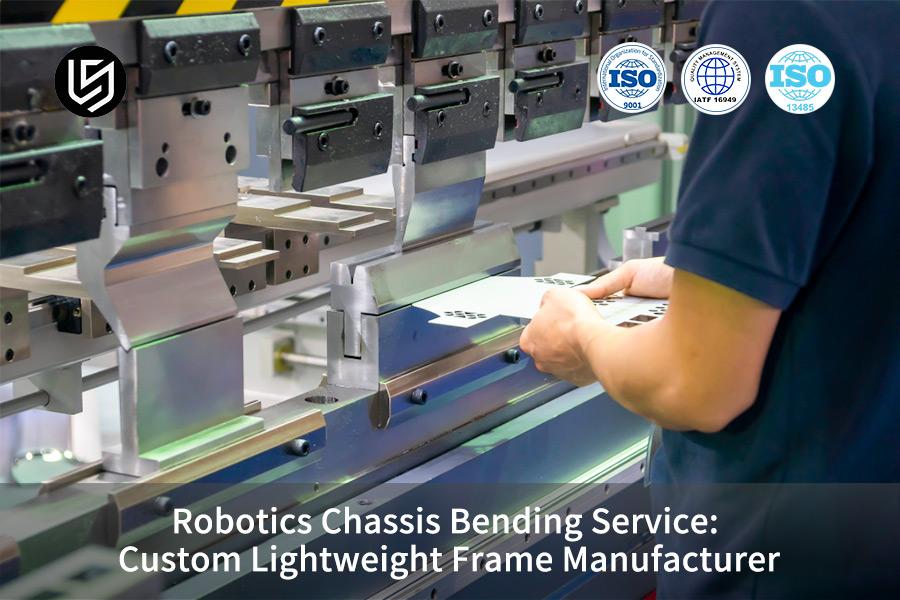
Robotics chassis bending service is a precision metal bending customized service which is suitable for AGV/ AMR and medical robots. It can effectively address industry-related difficulties such as bending cracks, uncontrollable springback and hole tolerances variations in thin-walled robot chassis. At present, in the light-weight robot process development, bending of 6061-T6 aluminum alloy and high-strength steel is easy to cause micro-cracking, uncontrollable springback, exceeding hole tolerance limits in heavy loading directly effects the stability of equipment operation. Standard process does not consider robot dynamic stress features, easily lead to chassis fatigue fracture, sensor axis deviation.
Based on 20-year mature process experience, LS Manufacturing can realize 0.05mm high precision tolerance control, and builds up the one-stop service from DFM design to small batch customized manufacturing. This guide discusses the related core process points of robot chassis bending.
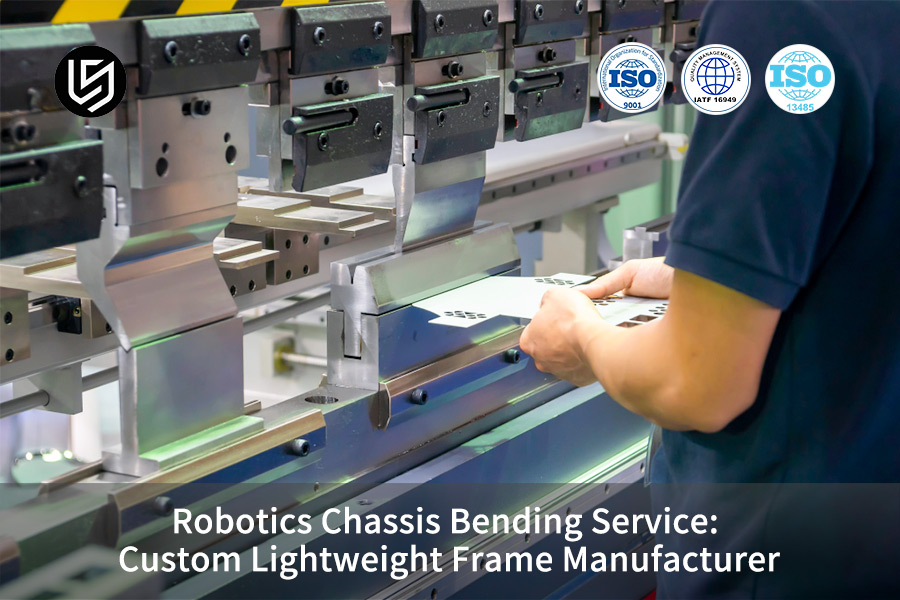
Quick Overview of Core Technologies in Robot Chassis Bending
We focus on summing up the essential technical norm and implementation requirements of the metal bending, guiding quickly to that of the precision machining key control points, delivering an intuitive reference to the robot chassis R&D and purchase, and avoiding the common process mistakes.
| Core Dimensions | Technical Standards | Application Value | Compliance Requirements |
| Material Bending Parameters | 6061-T6 minimum bending radius ≥2.5t, perpendicular grain bending. | Completely eliminates bending micro cracks and stress corrosion cracking. | Aerospace-grade material forming specifications |
| Springback Accuracy Control | Laser dynamic compensation, springback tolerance ≤±0.3°. | Ensures coaxiality of multi-axis holes, avoiding sensor misalignment. | IATF 16949 process standard |
| Overall Forming Tolerance | Cumulative tolerance of multiple bends ≤±0.05mm. | Eliminates assembly interference, adapting to high-precision equipment assembly. | Industrial robot manufacturing standards |
| Quality Inspection System | CMM 100% full inspection + 3D scanning inspection. | Full coverage control of form and position tolerances, achieving zero-defect delivery. | High-end precision machining access standards |
Key Takeaways:
- Material selection: for bending should be 6061 T-6 and the minimum bending radius should be 2.5t. The material should be heat treated to relieve the bending stress and prevent stress corrosion cracks.
- Precision Control: A real-time laser angle measurement system has been used to control the tolerance of springback is within 0.3° to guarantee the multi-axis holes counterality in chassis.
- Supplier screening: For high value procurement, when compared to other suppliers, be sure to check if that supplier has 100% CMM inspection, and if that supplier has IATF 16949 automotive grade registration.
Why Trust LS Manufacturing’s Precision Metal Bending Services and Expertise in Robotic Frames?
Mature on metal bending processing equipment and standard process is the key point to guarantee the stability of the robot chassis structure. For high-end robot mass production, a professional process system is necessary to avoid the processing risks. Various batches for cars chassis fatigue test proofed same results that many failure of chassis come from manufacturers' inertia of no time dynamic stress adaptation process for robots.
We implement strictly IATF 16949:2016 automotive-grade control standard, and all precise metal bending service processes comply with production operation documents. OEM manufacturing is only concerned with the visual appearance of the finished product rather than the long term deformation experienced by the work hardening of the material.
This is the biggest reason for a misalignment of the sensors in lightweight robot chassis after long term use. With more than 1000 adjustments on different bending parameters, we have customized a modular robotics chassis bending system for different load cases, while ensuring the strict quality control ISO 9001: 2015 in all aspects.
No need to manually do trial-and error anymore, we collapse the conventional manual method, by employing finite element simulation to anticipate the bending stress and springback deviations, so to eliminate the structure defect at its root.
20-year experience we accumulated at industry have enable us to turn out all the works successfully, including over thousands number of custom AGV and medical robot chassis, completely adherent to the strict cutting edge production requirements.
A standardized precision machining system takes the root cause of robot chassis bending failure away, customized to the prototyping or mass production demands of different kinds of light weight robot and guarantees the longlasting structural stability. Want to avoid process failures and keep product quality? Contact our professional precision metal bending service now, you will get the solutions for process problems and high-end case studies!

How Does Robotics Chassis Bending Service Eliminate Sensor Misalignment?
The precision robotics chassis bending service, which is controlled to be within 0.05mm of forming tolerances, solves the physical axis deviation of multi-sensor fusion system in essence, so that AMRs can operationalize high precision radar and camera auto-alignment under long-term high load conditions.
Core Causes of Sensor Deviation
AMR chassis Structural deformation is one of the long tail of sensor failure. Robot chassis must bear the dynamic torque and the maximum vertical load of 500kg. Traditional bending does not have deflection compensation design, it is easy to form the torsional deformation of fine degree.
Due to robotic chassis shaping craft, it can effectively avoid these hidden troubles. The residual stress inside the chassis of forming work will be released during long-time running, which suffer from the mounting surface fails to be aligned at last.
- Stress concentration problem: No congruency between the grain of the material and bending process will induce stress concentration at the bending point and micro-deformation under long-term load.
- Uncontrolled molding tolerances: Without the dynamic compensation technology, the total amount of a single bend error would surpass the standard, resulting in the parallel between the mounting face and the reference face.
- Inferior Structural stability: Residual stress due to cold work hardening cannot be relieved by any heat treatment and there is further increase in deformation occurs even after 1000 hours of operation.
Correction Principle of High-Precision Bending
Precision sensor calibration designed in the molding others can effectively preventaunreasonably large deformation of the chassis. Custom robotics chassis bending is not just a sheet metal processing, but is a micro-deformation metal forming process to precisely control themolding pressure, processing speed, grain alignment angle to offset the residual stress of the body, so that the micro-formation metal forming technology to be strictly controlled in areasonably small deformation deviation is achieved, ensure 10, 000 hours uninterrupted the robot work without deviation of sensor physical axis, arelux the basis for high precision equipment.
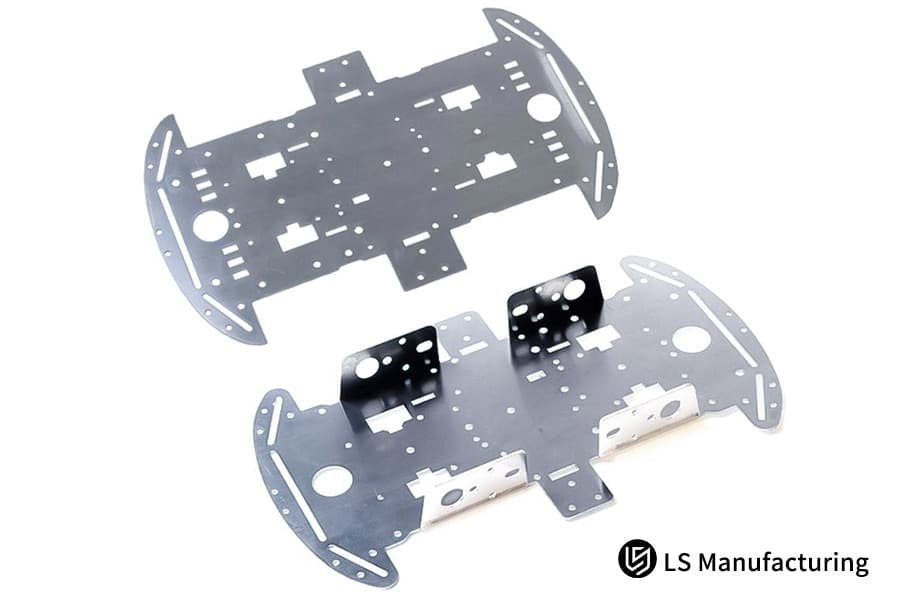
Figure 1: Precision-cut metal plates for a robotics chassis, featuring numerous holes and slots.
How to Choose Metal Bending for Robotics for Lightweight Design & Load?
On the balance of lightweight design and high load carrying ability, the suitable metal bending for robotics method should be of AL6061-T6 or Ti-6Al-4V. LS Manufacturing eliminates micro-cracks in materials by using customized R-angle molds and temperature controlled bending processes, achieving a 40% weight reduction while maintaining high tensile strength of over 500 MPa.
Performance Differences of Mainstream Robot Sheet Metal Materials
Lightweight load-bearing bending is directly to the performance of the whole robot. The various sheet metal materials have considerable differences in bending adaptation, and even the wrong material may result in the non-lightweighting as well as the insufficient load-bearing capacity. The load-adaptive metal bending can adapt to the different load conditions and forming requirements.
- 5052-H32 Al alloy: to effectively reduce the weight, light with the less of tensile strength, are only suitable for small robots load.
- 6061-T6 aluminum alloy: Highest overall performance, recommended for the plate thickness of 1.5-4.0mm, meeting lightweight and high load demands.
- Ti-6Al-4V Titanium Alloy: Ability of the highest strength and the most suitable weight reduction, it can be used in medical and high-end industrial robots.
Core Standards for Avoiding Pitfalls in Bending Processes
Material grain direction control is the fundamental key to effectively prevent bending cracks. Material grain controlling directions are, as the actual experience of custom made heavy duty AGV chassis, perpendicular to the bending lines and exact match of minimum bend radius and plate thickness and laser calibrated metal forming to approximate forming size, with the combination of stress simulation and heat treatment process. This way, can effectively eliminate the problem of plastics deformation during operating equipment.
Comparison Table of Mechanical Properties of Commonly Used Bending Materials for Robots
| Material Type | Yield Strength (MPa) | Tensile Strength (MPa) | Compatible Plate Thickness (mm) | Optimal Bending Radius | Weight Reduction |
| 6061-T6 Aluminum Alloy | 414 | 510 | 1.5-4.0 | 2.5t | 40% |
| 5052-H32 Aluminum Alloy | 193 | 331 | 2.0-3.5 | 2.0t | 32% |
| Ti-6Al-4V Titanium Alloy | 860 | 930 | 1.2-3.0 | 3.0t | 45% |
| Q355 High-Strength Steel | 355 | 800 | 3.0-4.0 | 1.8t | 15% |
| 304 Stainless Steel | 205 | 520 | 1.2-2.5 | 2.2t | 20% |
What Defines a Qualified Robotic Frame Bending Service for Medical Use?
The medical grade robotic frame bending service from LS Manufacturing follows demanding parameter defined quality level standards, following the application of high-end processing requirement such as 0.25 bending angle accuracy, Ra 0.4 surface roughness and 100% scratch free and indentation free.
Core Quality Inspection Parameters for Medical-Grade Bending
Surface accuracy of medical robot is a key basic entry criterion for high-end medical instrument. The conventional industrial bending standards can't adapt to the high precision and clean environment of medical instrument. That means, the micro-forming parameters must be tightly controlled.
Medical metal forming can meet the two basic components requirements of medical instrument.
- Structural parameters: Bending wall thick decreasing rate and other parameters 8%, the angle of bevels in order is uniformed, no microcracks.
- Surface parameters: surface roughness Ra0.4, completely scratch-free processing, no dents or scratches.
- Tolerance parameters: The angle tolerance has been fixed at 0.25, the full coverage of the spatial form and position tolerances.
Dedicated Process Solution for Medical Scenarios
The use of sterile surface bending processing is a way to best neutralize the danger accumulation that might be involved with medical machinery. Nylon and polyurethane made non-marking mold liners can be applied to safeguard the surface of special alloys, so inhibiting the colonization of bacteria, as well as electric magnetic shielding failure. In compliance with the procurement specifications of high end custom robotics chassis bending, it conforms to the difficult precision sheet metal forming manufacturing specifications.
Medical-Grade Robot Bending Quality Inspection Parameter Standard Table
| Testing Category | Industrial Standard | Medical Standard | Testing Method | Applicable Scenarios |
| Bending Angle Tolerance | ±0.5° | ±0.25° | Laser Real-Time Inspection | Surgical Robots, Companion Robots |
| Surface Roughness | Ra 1.6 | Ra 0.4 | Roughness Tester Full Inspection | Sterile Medical Equipment Housing |
| Wall Thickness Reduction Rate | ≤12% | ≤8% | Micrometer Caliper Spot Check | High-Load Medical Chassis |
| Surface Indentation Defects | Slight Indentation Allowed | Zero Indentation,Zero Scratches | Visual Inspection + Magnifying Glass Inspection | Sterile Medical Contact Surfaces |
| Microscopic Cracks | Fine Lines Allowed | Zero Microscopic Cracks | Metallurgical Microscope Inspection | Long-Term Implantable/Contact Equipment |
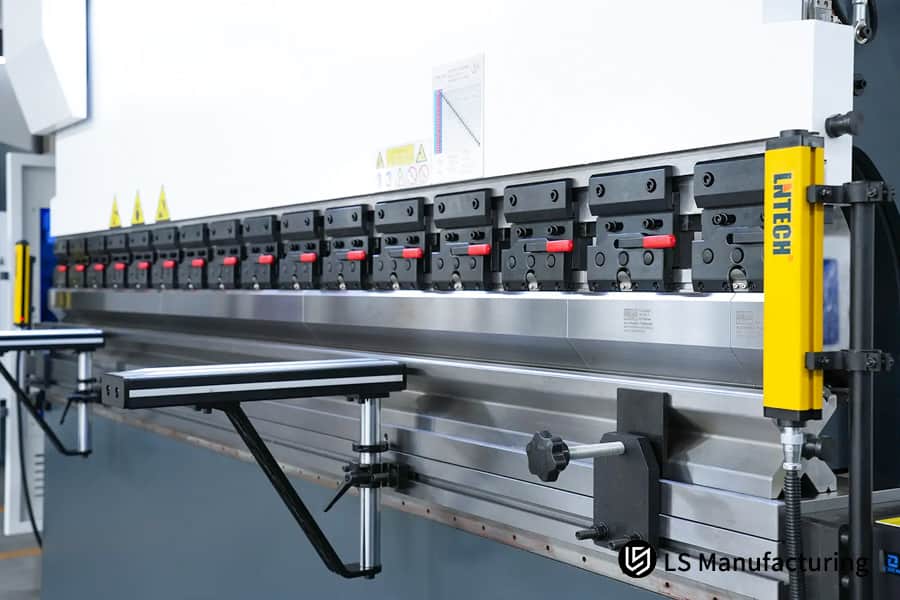
Figure 2: Detail of a bending machine's control panel with buttons and a yellow LNTech module.
How Does a Chassis Bending Manufacturer Resolve Springback in Thin Walls?
The key innovation adopted by professional chassis bending manufacturer for solving the springback in thin-walled structure is intelligent closed-loop control technology. LS Manufacturing, with the 650nm laser angle detection system, is able to realize the dynamic compensation, and totally eradicate the springback error during bending high-strength aluminum and stainless steel thin-walled sheet.
Key Factors Affecting Thin-Wall Bending Springback
The problem of thin-wall springback deviation is very common in thin-walled sheet metal forming. During the bending of 1.2-2.0mm stainless steel and thin-walled aluminum alloys, the springback deviation is easy to occur which will impact the assembly accuracy. Thin plate bending calibration can accurately compensate forming deviation.
- Material Properties: the increase of yield strength will lead to the increase of springback: the super high strength aluminum we used in this project will produce about 5% more springback than the normal aluminum.
- Equipment Parameters: It results in providing larger elastic deformation of the sheet metal by a broader mold V-groove and because of this fostering extensive springback.
- Processing Technology: Inappropriate processing rate and holding time will aggravate work-hardening and intensify the occurrences of springback error.
Intelligent Springback Compensation Solution
The modeling technology for FEA springback prediction is the definitive core of precision error control. We get rid of the manual trial-and-error process, and fast develop a kind of springback prediction model based on FEA, hydraulic dynamic compensation system for the stable batch precision of typical custom lightweight frames bending . The molding parameters are optimized and studied through finite element bending tuning. 68 constant temperature & pressure holding process achieved 15% reduction in the springback of thin-walled materials, it is a high-quality and practical optimization solution in the industry.
Table of Pure Data Comparison of Springback Parameters in Thin-Wall Bending
| Sheet Material | Thickness (mm) | Die V-Opening (mm) | Natural Springback Angle | Compensated Springback Angle | Accuracy Improvement Rate |
| 6061-T6 Aluminum Alloy | 1.5 | 12 | 1.8° | 0.22° | 87.8% |
| 6061-T6 Aluminum Alloy | 2.0 | 16 | 2.1° | 0.25° | 88.1% |
| 304 Stainless Steel | 1.2 | 10 | 2.5° | 0.28° | 88.8% |
| 304 Stainless Steel | 2.0 | 14 | 2.8° | 0.30° | 89.2% |
| Ti-6Al-4V Titanium Alloy | 1.5 | 12 | 3.2° | 0.32° | 90.0% |
Intelligent springback compensation and finite element simulation technology totally overcomes the setback problem in bending thin walled sheet, greatly enhances the forming precision and production efficiency of the thin walled robot chassis. Springback error give you headache? A professional chassis bending manufacturer can offer you free calculation of the parameters of the springback and takes out a tailor-made error control scheme for you!
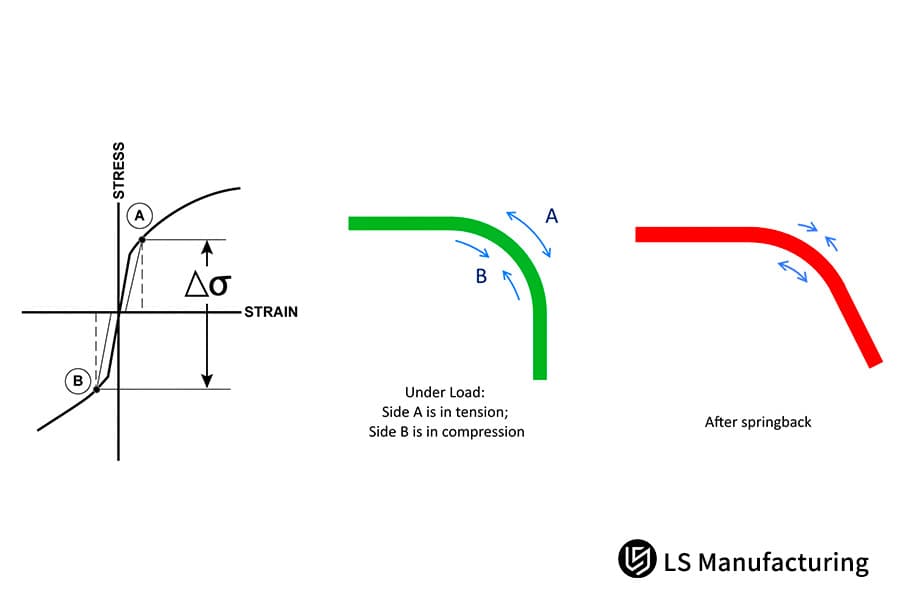
Figure 3: Diagram showing stress forces and material springback in a bent metal part.
How Does DFM Analysis Optimize Custom Lightweight Frame Bending?
Advanced DFM analysis can prevent 85% of design flaws by performing interference checks and limit radius correction before custom lightweight frame bending orders are run. LS Manufacturing can generate a free DFM report within 24 hours, greatly reduces the prototype production cycle time.
Core Review Dimensions of DFM Analysis
Bending structure interference check it itself can reduce trial-and-error losses from the source. large proportion of customer drawings has some hidden process defect, processed blindly is very likely to get the batch scrap, structural bending defect elimination can find in advance various forming hazards.
- Safety distance verificationa: Space between bending line and the hole edge must be kept no less than 2.5t+R strictly, minimizing hole stretching and deformation.
- Interference simulation detection: Simulations of multiple bending trajectories, detection of collision between tool and collision.
- Process gap optimization: Correct the corner process gap dimension to avoid the bending tearing and deformation.
Core Customer Benefits of DFM Process
Pre pre-control of the design defect project it can greatly reduce the project cycle. Free pre-process DFM analysis can prevent the buildup of failures in the making, rework costs, will much reduce the sample cycle number of an average of about 35 days, improve the entire multi-stage forming calibration process at each stage of the accuracy of the course and to suit various robotics chassis bending of service products customization needs.
How to Minimize Tolerance Stack in Lightweight Metal Bending Service?
In multi-stages of lightweight metal bending service process, a bunch of fixed process datum is used to control the tolerance stack-up as a key one. LS manufacturing, with multi-axis back gauge one time positioning technology, can stably control the half tolerance-stacks-up within 7 bends of 0.1mm.
Core Causes of Tolerance Stacking
Multi-process tolerance accumulation is a typical problem to complex chassis processing. Small error for all 5-9 bends will accumulate. The accumulated tolerance of traditional process is up to 0.8 mm and it will easily cause the assembly's failure. Standard process can be used effectively.
Precise Tolerance Control Process for Multi-Stage Bending
Single-datum positioning process can completely solve the problem of cumulative deviation. Through the use of 6 axis CNC high precision control system to plan the best bending sequence, multi-step single-clamping and positioning, effectively prevents the accumulation of tolerance caused by of the positioning and shear error. It will solve the normal assembly alignment problem for chassis bending manufactures, keeping the stable forming precision.
The consistent benchmark positioning process is able to remove accumulative tolerances caused by multi-cutting processes and greatly enhances light-weight chassis assembly versatile and accuracy. Want to resolve the problem of assembly misalignment and over-tolerance? Just come to apply for free DFM optimization and receive an accurate machining quotation today for the lightweight metal bending service!
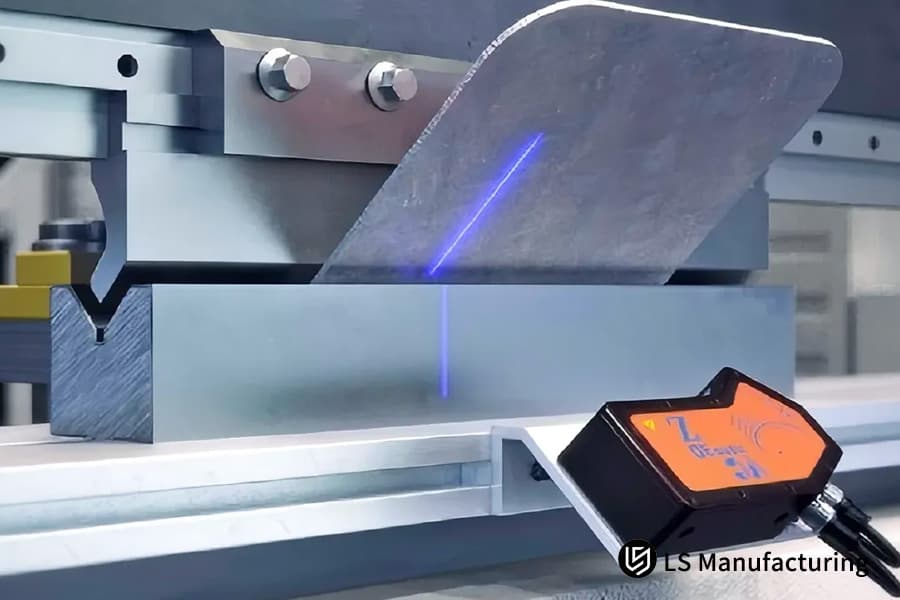
Figure 4: Metal sheet on a press brake with a red laser alignment line for accurate bending.
Why Is 100% CMM Inspection Vital For Evaluating Custom Robotics Chassis Bending Suppliers?
100% CMM inspection is the minimum standard for selecting quality custom robotics chassis bending supplier for LS Manufacturing. LS Manufacturing has the world most accurate CMM and blue light scanner with all the delivered chassis geometric tolerance inspection report completed and up to specification.
Limitations of Traditional Inspection Methods
Traditional measuring tools are unable to do tolerance measurement for high-end robotic chassis. Quantity measuring tools can only measure basic dimensions while can't measure spatial form and position tolerances like flatness and coaxality easily which may let lurking quality problems.High-end forming demands professional precision inspection process.
The Core Value of CMM Full Inspection
The 3D dimensional deviation detection assures the zero-defect product delivery of metal bending. We do the full inspection with 3D deviation heat maps and automated inspection tool and deliver with each batch the full QC report which assists our customers in sovereignly controlling the quality of the lightweight metal bending service supply chain. CMM verified metal shaping guarantees the accuracy is caught at the mechanical state of finished products.
How To Reduce The Total Procurement Cost Of Precision Metal Bending Service Without Compromising Quality?
The solution to minimize the head worth of the precision metal bending service without affecting the quality is to optimize the sheet metal layout with less rework waste. LS Manufacturing uses intelligent nesting software to boost sheet metal utilization by 18%.The whole process is a one-stop service starting from raw materials to surface treatment.
Core Components of Precision Bending Costs
Different costs of precision processing mainly includes four parts of material costs, factors of production time costs, amortization cost and surface treatment of molds. Adopt traditional OEM mode, the mold investment side has heavy losses, optimization forming process to make a great deal of ing effective production costs.
Core Solutions for High-Quality Cost Reduction
Integrated process optimization: Company can gain both saving and quality upgrading. Company adopts integrated bending structure to replace a separated welding structure, because of this saving 35% of the welding labor cost. Standard modular tool is employed without mold cost, which suits for metal bending for robotics customized projects.
Integrated process optimization model is to balance the processing quality with cost control, break the normal sheet metal processing high losses, and at the same time, onto different types of robot chassis customized production. Want to call for quality now cut costs and to enhance R&D and production costs? Check the field of metal bending for robotics, and get a free cost calculation and customize a cost reduction solution now!
LS Manufacturing Case Study: Custom Aluminum 6061-T6 AGV Chassis Bending Service for a Global Tier One Logistics Robotics Supplier
The chapter reproduces the solution and implementation result in high-end AGV robot chassis bending from a real project. It intuitively shows the practical value of precision bending technology and gives a quality reference for similar robot customization projects.
Client Challenge:
A world top logistics robots manufacturer, encountered a technical problem during 600kg load capacity four-way shuttle AGV development, the custom light weight (4.0mm 6061-T6) own designed chassis bent always get micro-fatigue crack at the bend position. uncontrollable spring back make Radar Mouting surface flatness deviation 0.75mm, false obstacle avoidance alarm, and trajectory deviation, put the project behind the schedule, highly in the need of chassis bending professional manufacturer to do the custom robotics chassis bending modification.
LS Manufacturing Solution:
- Once the customer brings the 3D drawings to the LS Manufacturing group, customer 3D drawings are downloaded and an individualized DFM optimization solution is delivered in 24 hours, customer original (overly) small Radius (R- angle) is taken out and corrected in a 3.0t bend radius which is more appropriate for 6061-T6 properties, preventing any potential cracks from happening early on.
- In processing stage, for CNC bending machine applied for AMADA with 650nm laser automatic calibration system and dynamic springback compensation, with the ultimate yield strength for this batch of (the different shapes) aluminum materials, with an air-cushioned mark free mold protecting sheet metal surface.
- Once the product is formed it is imparted to a high-temperature aging heat treatment process to fully relieve the residual stress within the product. Finally, 100% inspection of radar mounting holes is carried out with Hexagon CMM.
Results and Value:
The first in the project achieved much beyond the first: Chassis tolerances are precisely controlled within 0.05mm. The angle load tolerances are locked at 0.2°. The radar mounting surface flatness is improved to 0.12mm. All these enabled sensor malfunction to be resolved and be a thing of the past.
Equipment passed the 200,000 times full load fatigue tests, 22% reduced chassis weight, the project cycle shortened 35 days, the customer signed the 3 year exclusive mass production contract with us. This case study fully proved top quality, efficient custom robotics with the best quality, reliable and cost-effective chassis bending technology on the market can handle all these three important pain points.
This case shows that through this precision bending technology, all the three major problems, chassis cracking, accuracy deviation, and long cycle time, can be addressed all at the same time, and so it is willing for the high-end customized heavy-duty AGV application. Do you want to get the same high-quality application result? Have a try of the professional and reliable custom robotics chassis bending service, you can fast check a range of related project cases, submit drawings and get one attractive project quotation!

FAQs
Q1: As for robot chassis bending services, how about the bending radius of 6061-T6 aluminum alloy?
To avoid surface micro-cracks during bending 6061-T6 aluminium alloy sheet, the controlling the minimum bending radius of sheet metal is 2.0~2.5 times thickness of sheet at most. And the bending line should be in a right angle with the grain direction at the same time for fully avoiding stress cracking.
Q2: In what way does LS Manufacturing manage the tight angle tolerances for custom orders of bending lightweight frames?
For our CNC bending machines, we installed a 650nm wavelength axis measurement system from Laser technology. The CNC is capable of detecting any deviation automatically, it also compensates for the spring back in real time, this way keeping the robot chassis bending angle within the tolerance of 0.25°, ensuring the accuracy of forming.
Q3: Is your robotic metal bending department capable of converting welded complex assemblies into a single forming piece?
They can be optimized, strengthened. Engineers equipped with a pre-mounted DFM can turn multi-segment welded assemblies into single-piece multi-pass bending structures, as they can be more easily manufactured, being in turn capable of cutting down on the customer's welding labor costs by 35%.
Q4. What types of surface scratch resistance standards do you require for exterior car parts or medical grade robot frame bending?
It is high pressure nylon and polyurethane. Non-marking mold liner, R-angle urethane upper mould processing is mirror polishing, no hard contact friction throughout the process, and finished product has a high-end appearance requirement of on all of special alloy at 100% zero indentation & zero scratches.
Q5: LS Manufacturing In particular as a chassis Bending Manufacturer, how do LS Manufacturing measure the final Geometrical form, spatial form & position tolerances of robot chassis?
We have hexagon coordinate measurement machine and powerful blue light 3D laser scanner to carry out 100% inspection on important dimensions, e.g.chassis flatness, coaxiality etc. An all quality control inspection reports are always issued to every batch of products.
Q6: How long is the lead time required for SCML to purchase the small batch samples of precision metal bending services?
Once the drawings from our customers have been checked by DFM manufacturability, we slot the machine out quickly using universal combination molds, no more open the mold. 3-5 working days, standard high-precision chassis samples will be readily available. You can easily upload drawings, inquire into details, and rapidly secure accurate project quotations and customization schedules.
Q7: How do you protect your customers' sensitive and highly confidential research and development drawings (IP) used for bending custom robot chassis?
Before fetching the STEP / IG S R&D drawing, we sign the bilateral confidential agreement.Files are only kept on a local secure server.Total project management adopted by our production workshop ensures a complete protection of your customers' intellectual property.
Q8:Is Ltd strict about the minimum order quantities when becoming a high-end robot chassis bending service provider?
We implement a zero MOQ policy for high-tech R&D projects, which allows us to flexibly accept one scientific research-grade prototype prototyping order while simultaneously meeting the demand for thousands of automotive-grade annual mass production orders.
Summary
The robot chassis bending is a precision systems engineering that includes materials mechanics, CNC algorithms, closed loop quality inspection. Weighing in light weight load sharing, avoiding cracks, controlling of spring back and optimize tolerance are the essential factors to the success of the various robots operation stability. Proper material choice, standard process system and full quality inspection are the key utilization to solve chassis failure, and also bring the high-end robot hardware iteration.
The robust quality of robotics chasis bend services can alleviate equipment deformations, sensor misalignments and structural failure issues, which lower the risk of high-based maintenance expenses and offer the unique product advantage.
LS manufatureings gives zero MOQ orders to meet the demands for prototyping, pilot runs as well as mass production, including all robotic processing applications. Send us 3D models now, we will do the DFM report in 24 hours for you and offer personalized process and cost optimization. Using professional precision metal bending service and automotive grade process, we can make your project come into life.
📞Tel: +86 185 6675 9667
📧Email: info@lsrpf.com
🌐Website: https://lsrpf.com/
Disclaimer
The contents of this page are for informational purposes only. LS Manufacturing services There are no representations or warranties, express or implied, as to the accuracy, completeness or validity of the information. It should not be inferred that a third-party supplier or manufacturer will provide performance parameters, geometric tolerances, specific design characteristics, material quality and type or workmanship through the LS Manufacturing network. It's the buyer's responsibility. Require parts quotation Identify specific requirements for these sections.Please contact us for more information.
LS Manufacturing Team
LS Manufacturing is an industry-leading company. Focus on custom manufacturing solutions. We have over 20 years of experience with over 5,000 customers, and we focus on high precision CNC machining, Sheet metal manufacturing, 3D printing, Injection molding. Metal stamping,and other one-stop manufacturing services.
Our factory is equipped with over 100 state-of-the-art 5-axis machining centers, ISO 9001:2015 certified. We provide fast, efficient and high-quality manufacturing solutions to customers in more than 150 countries around the world. Whether it is small volume production or large-scale customization, we can meet your needs with the fastest delivery within 24 hours. choose LS Manufacturing. This means selection efficiency, quality and professionalism.
To learn more, visit our website:www.lsrpf.com.