English




Precision insert molding service directly faces the real-world discrepancy between the simplistic online definitions of what is insert molding and the tough application problems such as insert shift, flash, or bond failure in precision sensors. The key problem here is that of "position drift" owing to lack of mold pressure balance and thermal mismatch during injection molding.
The solution provided at LS Manufacturing that addresses all these problems involves zero-displacement control systems, optimized venting in molds, and accurate metal/plastic interface finishing to ensure that true zero-defects delivery is possible, and in what follows, this professional approach will be discussed from the technical side and on particular examples.
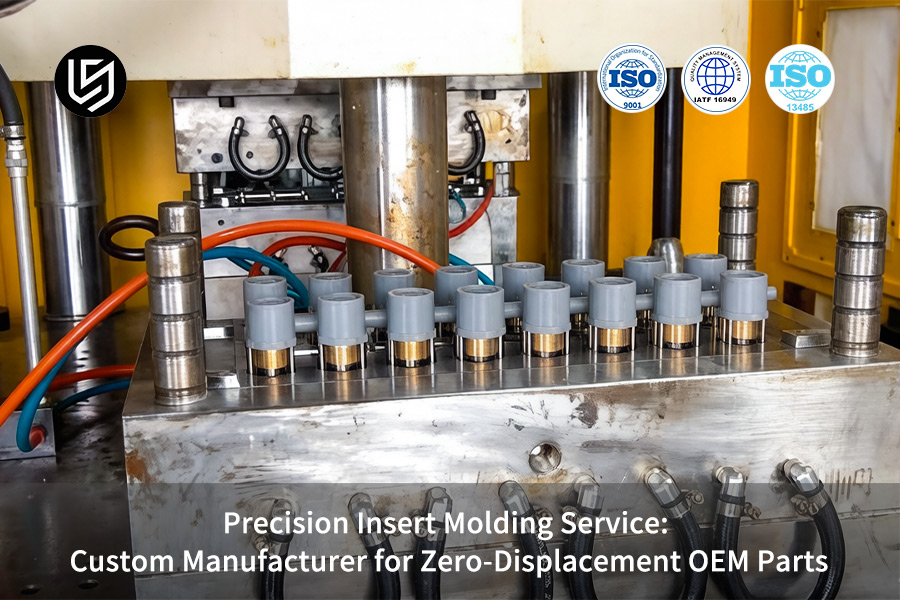
Precision Insert Molding: Zero-Displacement Quick-Reference
| Core Challenge | Engineering Solution for Zero Displacement | Result for OEM Assembly |
| Insert Positioning & Fixation | Accuracy-controlled mold cavities with mechanical/vacuum fixation devices for stabilization. | Micron precision in positioning of the insert within the molded plastic enclosure. |
| Thermal Stress Management | Compensation heat treating of the insert and mold temperature management. | Prevents thermal cracking of the insert during cooling due to differential shrinkage. |
| Material Flow & Weld Line Control |
Optimize the gate process and insert molding parameters to ensure complete encapsulation. |
Creates void-free encapsulation around the insert, necessary for electrical or fluidic components. |
| Bond Strength & Reliability | Insert surface preparation (plating, etching, etc.) and material selection for optimum adhesion. | Generates an unbeatable mechanical joint that resists vibrations and varying temperatures. |
| Our Automated Insert Handling | Robotic insertion of the inserts into the mold with vision system inspection at each cycle. | Prevents operator mistakes and achieves 100% insert accuracy rate. |
| Result: Net-Shape Functional Assembly | Creates a functional assembly wherein the insert has been encapsulated into its final position. | This eliminates any need for further positioning or bonding processes and simplifies the process of assembling your product. |
Key Takeaways:
- Precision is in the Fixturing: The ability of the mold to capture the insert comes first in this list of controllable variables.
- Thermal Management is Crucial: Mismatched temperatures create issues that can be avoided by proper engineering design.
- Automation Ensures Consistency: The only way to ensure insert molding tolerance without defect is automation and robot placing.
- The Output is an Assembly: The final product must be an assembly of the sub-assembly, not just the mold part with the insert attached to it.
Why Trust This Guide? Practical Experience From LS Manufacturing Experts
Whereas there can be many guides on the topic in general, our guide stands out in its approach to the topic. Indeed, we have put much thought into mastering the principles and practices of insert molding. As a result, we have decided to make our guide based on practical experiences of specialists working at LS manufacturing who comprehend the concept of National Institute of Standards and Technology (NIST).
Our components are absolutely critical; diagnostic microfluidics that cannot tolerate any micron of flash, aerospace sensors that must endure severe vibration without flaking off, automotive connectors that demand perfect insulation. To fulfill these tough criteria, our material selection and validation processes coincide with the exacting standards of SAE International, in particular the AMS family of materials.
This experience is gained through years of trial and error, knowing how to handle the thermal dynamics of the process to ensure that stress was not imposed on the inserts, mastering the special clamping methods that eliminate all micro movement, and knowing which mold finishes result in full adhesion. We teach you these hard-won lessons so that you can apply them to your advantage, preventing unnecessary trial and error and assuring that your first production run will provide no displacement bonds.
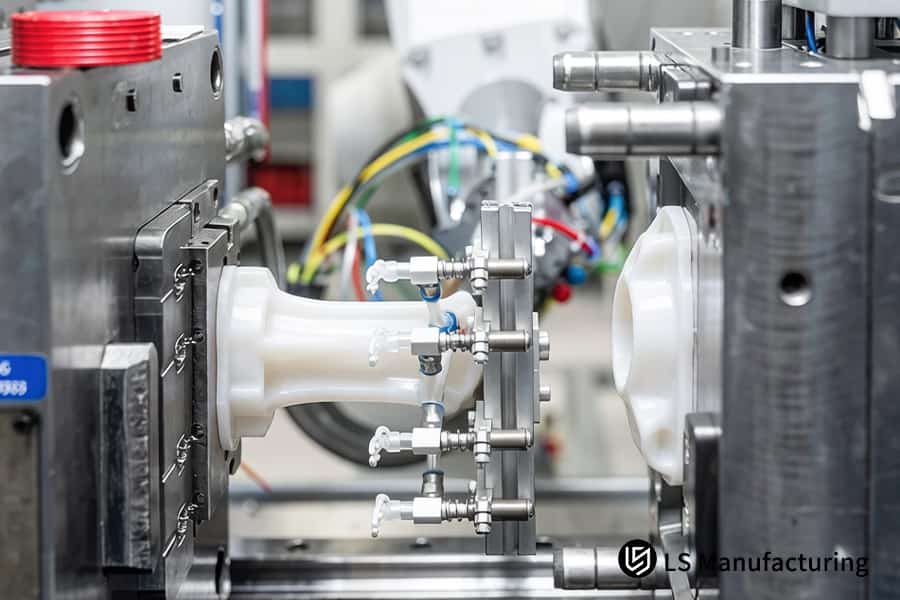
Figure 1: OEM insert molding service applies hydraulic pressure to bond plastic with metal inserts for industrial connectors in precision tooling.
Why Is Zero Displacement Critical For Your Precision Insert Molding Service Projects?
True zero displacement is very crucial when providing precision insert molding services because even a tiny amount of displacement during the injection stage impacts both mechanical and electrical functionality. In our approach, we consider the injection molding process being highly pressurized by utilizing a simulation and design process that will ensure that any movement will be less than 10µm. The following is the process that we follow:
Active Locking via Proprietary Pin Design
A dedicated thermally matched active locking pin was developed to apply physical restraints to the insert prior to resin injection with a known counter-pressure. In this method, the insert may be physically restrained within the mold cavity, which will help avoid the initial pressure pulse from the plastic. Such a method will address the problem from the very source, allowing for precise positioning of inserts in high-volume insert molding.
Gate Optimization Through Filling Simulation
Transient and asymmetric pressure wave simulation in the insert by advanced multiphase flow models helps identify areas of pressure wave imbalance at the insert-melt interface. The results obtained will provide direct input for determining optimal gate and runner placement to attain the desired pressure distribution profile. The goal is to reduce overall translational pressures as the cavities fill, which is essential for thermoset insert molding.
Process-Integrated Clamping & Validation
There is mechanical locking which is synchronized with the injection molding machine cycle using the specific clamping sequence. After the molding, an extremely precise CMM runs the first-article inspection where the accuracy of the insert position will be validated by the CMM to ensure the insert position to the CAD specifications. The close loop validation helps guarantee the manufacturing tolerance of less than 0.01mm for applications including medical device insert molding.
This article emphasizes how systems engineering makes the zero displacement principle applicable. Our OEM insert molding service will be showcased by means of our mechanical design, simulation, and clamp parameters. Due to our excellent problem-solving abilities, we are the perfect candidate for OEM automotive insert molding applications. To apply this zero-displacement engineering to your project, submit your assembly for a system review and receive a process-validated, production-ready quotation.

How Can Custom Insert Molding Manufacturer Ensure Zero Displacement In High Pressure Environments?
It is necessary for any custom insert molding manufacturer to prevent any displacement of the insert due to the high pressure used in the injection phase of molding. Displacement of the insert even by a few micrometers during injection is bound to influence the final outcome. The following are our innovative ways of solving the challenge in predictions, simulation, active control, and reinforcement in insert molding for zero displacement:
Multi-Point Synchronized Hydraulic Locking
- System Design: Our system involves placing several hydraulic cylinders in various places within the mold in support of the insert.
- Active Counter-Force: These hydraulic cylinders produce synchronized forces acting on the insert prior to the injection of plastic into the mold. This creates pre-stress.
- Result: This mechanism resists the incoming melt pressure wave, and thus prevents any form of “shock” displacement experienced by static inserts, critical for high-pressure insert molding.
In-Mold Sensing & Dynamic Process Adjustment
- Real-Time Monitoring: Pressure sensors can be installed behind the support pillars. This gives us live readings on the pressures exerted on the insert by the molten material.
- Closed-Loop Control: The pressure data can then be analyzed by the machine control software to make micro-second adjustments to injection pressure profile.
- Result: It helps eliminate any pressure imbalances at any point in real time and creates pressure equilibrium across the insert face, an essential technique for high precision insert molding.
Preemptive Drift Mitigation via Filling Analysis
- Simulation-Driven Design: Using advanced mold flow analysis software, we simulate the filling process under the same high injection pressures, such as 120 MPa.
- Targeted Reinforcement: The simulation provides us with the necessary data about drift vectors. Thus, the mold design is based on the number and diameter of support pillars.
- Result: This methodology allows us to proactively identify and address over 95% of the possible drift points prior to mold construction, an essential feature of micro-insert molding processes.
Our methodology describes a closed loop engineering process of prediction, control, and reinforcement. It proves our expertise as a custom insert molding manufacturer by illustrating the application of quantified information and control techniques to address high pressure displacement. This strategic and holistic method is our competitive edge, ensuring absolute stability in the manufacture of critical parts, like those for automotive sensor insert molding.
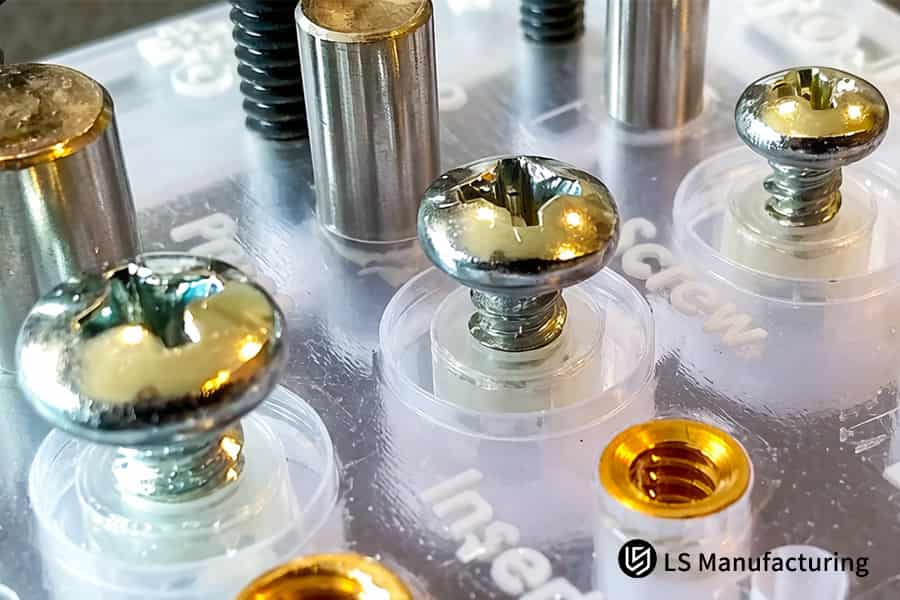
Figure 2: Custom insert molding manufacturer injects molten nylon around stainless steel screws for automotive electronic components at LS Manufacturing.
What Role Does DFM Play In Your Custom Precision Insert Molding Success?
With custom precision insert molding, part failure is already determined before manufacturing begins. Our Design for Manufacturability (DFM) process plays an essential role in engineering to prevent these failures before they happen. This paper highlights how we intervene in these instances to turn design intent into manufacturable parts through conflict resolution, an absolute requirement for high precision insert molding.
| DFM Focus Area | Technical Intervention & Quantifiable Outcome |
| Insert Pre-Treatment | Lowering insert pre-heat temperature minimizes thermal shock, key to successful high-temp insert molding. |
| Surface Engineering | Designating knurl/etch patterns maximizes bond surface area and improves pull-out strength by 25-40%. |
| CTE Management | Basing interference fits on material differences prevents cracking after molding. |
| Flow & Gate Design | Molding simulation achieves full encapsulation, and ensures no direct force applied to inserts. |
| Stress Mitigation | Geometric redesign (radii, ribs) dissipates stress, extending fatigue life in OEM insert molding service. |
Our DFM procedure takes likely problems and turns them into solutions, displaying our technical expertise. We overcome recurring problems such as de-bonding and stress fractures by making data-driven design adjustments. This problem-solving, preventive strategy represents our unique selling proposition for medical device insert molding and other critical applications. To avoid costly failure modes with a preventive strategy, submit your design for a DFM analysis and receive a quantified solution with a guaranteed quote.
How Do We Solve Metal To Plastic Bonding Challenges For Your OEM Insert Molded Parts?
Developing durable, strong bonding between metal inserts and plastic encapsulants is a major concern in insert molded OEM parts, which directly affects the sealing capability and mechanical properties of the component. We address this issue through a two-pronged strategy that not only improves bonding but makes the bonding area the best part of the component. Through our strategy, we assure long-term adhesion between metal inserts and the plastic component:
Plasma Surface Activation for Molecular Bonding
We employ low-pressure plasma treatment on metal inserts prior to molding. This process microscopically cleans and functionalizes the metal surface, increasing its surface energy and creating active molecular sites. This enables the molten plastic to form primary chemical bonds (vs. mere mechanical adhesion), significantly enhancing bond strength and resistance to fluid ingress, crucial for fluid-handling insert molding.
Mechanical Interlock Geometry Design
Aside from the surface chemistry aspect, our design for the insert is based on particular undercut patterns, such as knurled patterns or multi-angled grooves. Design of these patterns is done by stress simulation to determine their proper depth and spacing. In precision insert molding service, the plastic material will flow into these patterns, forming a strong mechanical grip to complement the bond created through chemistry.
Process Control for Optimal Interface Formation
The important process parameters include insert pre-heat temperature, mold temperature, and injection speed. Controlling these process parameters guarantees that the material flow of the plastic reaches the surface of the metal material, which was activated beforehand. This process is critical for high-strength insert molding services.
The methodology provides the technical expertise of a custom insert molding manufacturer in addressing the issues behind bond failures. Our proactive, integrated approach delivers verified, durable bonds for critical under-hood automotive insert molding applications, ensuring performance where failure is not an option.
LS Manufacturing Medical Sensor Housing: Custom high precision insert molding Success Story
The following case study highlights how LS Manufacturing was able to help solve the yield issue faced by a major medical device OEM. The situation entailed a miniaturized sensor housing made of polycarbonate, which required high precision insert molding that could accurately surround the fragile electrode assembly within. The problem was caused by displacement at the micron level, resulting in electrical malfunctions.
Client Challenge
The previous supplier had issues with insert movement beyond 0.15mm in their custom precision insert molding project. The miniature PC housing was designed to house a delicate ceramic electrode within its cavity. This movement resulted in interference on the capacitive signal, which increased the functional rejection rate by 35%+ during the project. This low output rate halted production and posed a threat to releasing the next-generation product.
LS Manufacturing Solution
The tool was re-engineered with a different parting line and a precision-controlled slide assembly for complete containment of the insert. An advanced mold temperature regulation system was employed to compensate for thermal expansion. The combination of mechanical and thermal control systems, which is mandatory for multi-cavity insert molding, effectively addressed the problem from its very roots, thus guaranteeing stability of the process, critical for medical device insert molding.
Results and Value
Insert position was consistently held within ±0.005mm tolerance levels, confirmed by vision CMM. The functional yield rate was increased to 99.8%. Moreover, the cost of each part was lowered by 22% due to improved efficiency. The solution provided fast-to-market capability, saving three months for our customer. LS Manufacturing was designated as the supplier for all insert molded OEM parts, including the development of novel micro-fluidic insert molding technology.
Our engineering strategy is embodied by the following project: identifying the origins of any malfunctions and applying a comprehensive, verified solution to fix them. It shows our expertise in offering high precision insert molding, which is characterized by micron-level precision. We offer guaranteed manufacturing stability, enabling us to convert difficult situations into practical manufacturing scenarios.
To secure ±0.005mm insert precision and 99.8% yield, submit your design for a validated overmolding process and a guaranteed, cost-saving production quotation.

How Does Automated Inspection Enhance Reliability For Zero Displacement Insert Molding?
Zero displacement insert molding in manufacturing cannot be accomplished without advancing from process design to automated inspection. We use an inspection ecosystem that offers 100% in-line inspection and process control. This helps ensure the consistency of the quality assurance process through data-driven monitoring, thus guaranteeing the precision insert molding service:
In-Line Vision for 100% Dimensional Verification
- Technology Applied: CCD cameras having telecentric lenses are installed on the press ejector side.
- Direct Measurement: After ejection, the part is scanned, capturing the vital dimension between the insert edges and housing edge, along with axial positioning.
- Instant Action: An out-of-tolerance part is automatically rejected, ensuring conformity, essential for high-volume insert molding.
Automated CMM for Sub-Micron Validation
- Scheduled Sampling: The robot picks up a representative sample of parts from each lot and places them into the touch-trigger CMM.
- 3D Datum Mapping: The probe determines the actual 3D position of the insert with respect to the main datums of the part.
- Data Foundation: This produces the measurement data that is credible and authentic for the SPC system, proving the capability of the process for custom precision insert molding.
Data-Driven Process Control (SPC)
- Trend Analysis: Vision and CMM data are streamed through a centralized SPC system, producing real-time control charts.
- Predictive Alerting: The system raises an alarm in case of measurements exhibiting a trend (e.g., 0.02mm drift), helping take preventive action before the limits are violated.
- Root Cause Correlation: It establishes the relationship between dimensional trends and machine variables, enabling corrective actions for automated insert molding stability.
Self-Correction Loop System
- Automatic Correction: The SPC system is able to alert the machine controller to undertake micro-corrections (e.g., insert temperature).
- Process Control: This produces a self-corrective production cell capable of maintaining the stringent process window by itself.
- Consistency Assured: This loop system guarantees the most reliable process control for mission-critical insert molding projects.
The ecosystem represents a proactive approach to engineering, which goes beyond detection into prediction and automation for correction. The zero displacement insert molding technology guarantees reliable operation by offering data-driven, verifiable results. The above mentioned technological implementation is the ultimate answer to the challenges related to in-line insert molding inspection and closed-loop insert molding applications, where consistency of parts is critical.
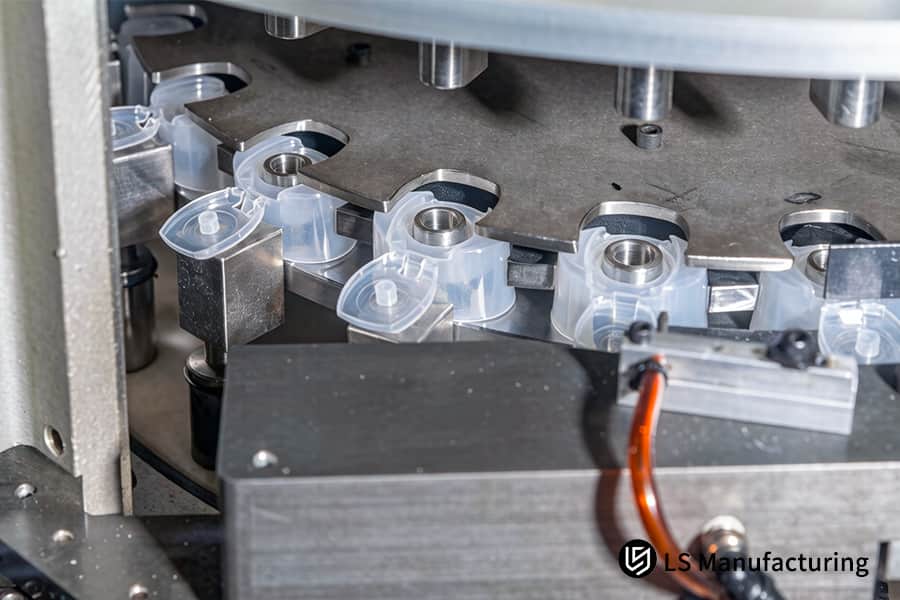
Figure 3: A robotic arm executes high precision insert molding by placing a stainless steel insert into a clear polycarbonate housing for medical devices.
What Are The Cost Drivers When Choosing An Expert OEM Insert Molding Service Provider?
Selection of an OEM insert molding service partner based solely on piece price is ignoring the major drivers of cost. The ability to optimize the entire process – tools, cycle times, and yield – will enable minimizing total cost of ownership. Following analysis offers a breakdown of major technical considerations that determine cost, allowing for evaluation of your partners according to the criteria:
| Cost Driver | Technical Specification & Financial Impact |
| Tool Steel & Construction | The use of higher grade steel (e.g., S136 to improve corrosion resistance) adds 20-30% cost to the tool initially but extends its life 2-3x times, thereby lowering the overall cost per piece in high-volume insert molding. |
| Cavitation Strategy | The right number of cavities will balance tooling costs and production capacity; the overuse of cavities may lead to poor quality and flexibility issues for custom insert molding manufacturer projects. |
| Cycle Time Optimization | Effective engineering improvements such as conformal cooling or reduced clamp tonnage can help reduce cycle time from 45 seconds to 30 seconds, increasing capacity by 33% and saving labor and equipment cost per part. |
| Quality Assurance Level | The full automation of AOI testing adds an overhead cost but prevents failures at the end of the line and potential recall/re-work issues that can cause enormous losses for medical device insert molding. |
| Material & Process Efficiency | Good design work for gating and runners reduces sprue sizes; saving only 5% of material is important, especially when using expensive engineering plastic materials for precision insert molding service. |
| Part Design Complexity | Complex designs with features such as deep undercuts and micro-precision tolerances need multi-step tools, and therefore take longer development periods and longer cycle times per part, thus affecting the overall cost of complex geometry insert molding. |
This discussion highlights the fact that the lowest cost producer frequently shifts the burden of risks associated with the utilization of tools or inefficient processes, resulting in higher future costs. At a custom insert molding manufacturer, we create value through the design out of those inefficiencies early in our products: optimal cycle time, durability, and built-in quality. This allows for consistent, lower total cost in automotive sensor insert molding and similar applications, as reliability becomes the bottom line of costs.
Why Choose LS Manufacturing As Your Trusted Partner For High Precision Insert Molding?
Choosing a high precision insert molding partner goes beyond simple manufacturing expertise to include shared risk mitigation and technical vision. The crux of the issue involves the guarantee of reliable performance over time, rather than mere acceptance in sample testing. It can be achieved using a method based on process control, validation, and collaboration from a design engineering perspective:
Proactive Risk Mitigation Through Legacy Learning
Our twenty years of expertise in the development of complex multi-material insert molding projects has been encapsulated into an internal Failure Mode Database. By leveraging this resource, our engineering team is able to evaluate new part designs in relation to previous failure modes such as stress cracking between plastic and metal or thermal fatigue and make necessary preventative design changes prior to any tooling.
Certified Process Control for Repeatable Precision
Our IATF 16949 certification requires a standardized process of Advanced Product Quality Planning (APQP). As part of each project, we create a detailed Control Plan specifying precise process settings, inspections, and actions to take in case of any deviations. Our ability to control all of these factors ensures that our high precision insert molding results remain accurate throughout millions of cycles, making it perfect for automotive connector insert molding applications.
Full Lifecycle Technical Partnership
We begin our relationship with engineering consulting, ensuring appropriate resins can meet the necessary thermal and chemical requirements. Throughout production, methods such as short-shot studies will help to confirm proper flow and encapsulation within the mold. After failure, the failure analysis in the lab will determine why the product failed through microscopy and mechanical testing, providing corrective measures beyond just replacement. This commitment is what makes a true custom insert molding manufacturer.
At LS Manufacturing, partnerships take place through engineered certainty, not simple components. LS Manufacturing prevents reliability issues through data-driven knowledge that avoids previously experienced problems, disciplined process control for consistency, and full ownership of technical responsibilities throughout the entire process. Only through this method will the desired level of reliability be obtained when performing medical device insert molding.
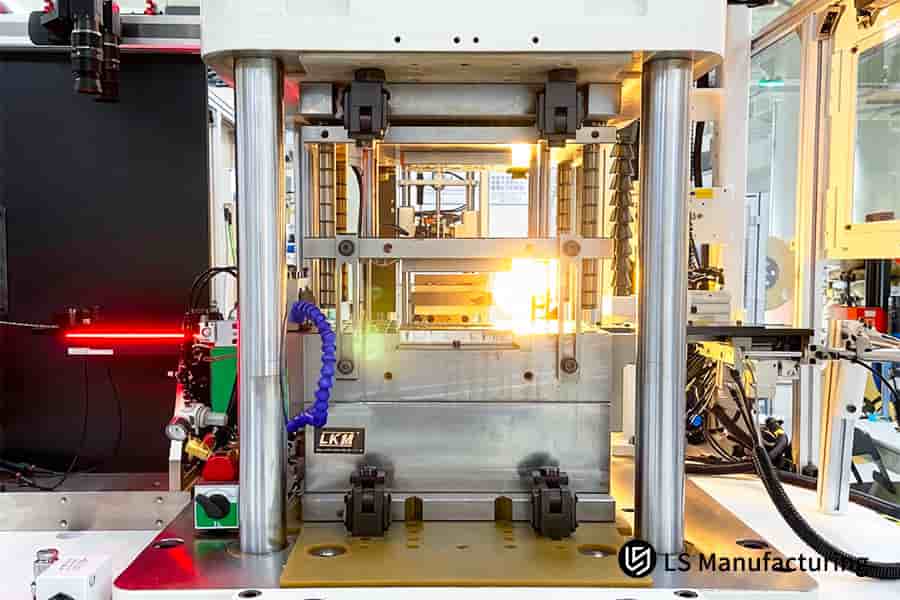
Figure 4: Precision insert molding service assembles metal inserts with cooling channels into LS Manufacturing molds for automotive sensors.
FAQs
1. What is the typical tolerance for your precision insert molding service?
LS Manufacturing maintains a tolerance of ±0.02mm for standard parts. For specialized precision components, we achieve ±0.005mm through advanced micron-level mold compensation, rigorous process controls, and in-line CMM verification to ensure consistent accuracy.
2. How does LS Manufacturing prevent flash on metal insert surfaces?
We prevent flash by precisely calculating the interference fit between inserts and the mold cavity using FEA simulation. This is combined with a mandatory ultrasonic cleaning process to ensure all insert surfaces are completely free of oil and microscopic contaminants prior to molding.
3. Can you handle low-volume custom precision insert molding orders?
Yes, we specialize in cost-effective, rapid aluminum or pre-hardened steel tooling solutions ideal for R&D phases. We support highly flexible Minimum Order Quantities (MOQs) to facilitate efficient and economical project validation and pilot production runs.
4. Which materials are best for zero-displacement insert molding projects?
For optimal dimensional stability, we recommend high-modulus, low-shrinkage engineering plastics like PPS or PEEK. These are combined with pre-treated (e.g., plasma cleaned or grit-blasted) stainless steel or copper inserts to ensure a superior, reliable bond.
5. How long is the lead time for a custom insert molding manufacturing quote?
Upon receiving your complete 3D drawings and specifications, our technical team provides detailed DFM feedback and a formal, itemized quotation within 24 hours. This rapid turnaround is facilitated by our automated quoting system and veteran engineering staff.
6. Do you offer secondary operations for insert-molded OEM parts?
Yes, we offer a comprehensive suite of secondary operations including precision laser marking, ultrasonic welding, and automated air-tightness testing. We also provide full assembly and packaging services, delivering a complete, one-stop integrated solution that ensures part readiness for your final production line.
7. How do you protect the intellectual property of my custom designs?
We protect your IP by executing strict, legally binding NDAs and implementing physically segregated, access-controlled production cells. This creates a secure data and manufacturing firewall to safeguard your proprietary designs and technological competitive advantage.
8. Does your OEM insert molding service support multi-material inserts?
Yes, we possess advanced process capabilities for multi-shot and overmolding. This allows us to simultaneously or sequentially inject different materials—such as rigid plastics, metals, and soft silicone—within a single mold to create complex, multi-functional integrated components.
Summary
The success of precision insert molding depends not only on tooling quality, but on deep expertise in "zero-displacement" control. Through science-based DFM intervention, data-driven parameter optimization, and rigorous automated inspection, LS Manufacturing converts complex manufacturing risks into stable, high-yield production. Partnering with a technically-deep manufacturer is the surest path to success, whether for intricate OEM parts or long-term cost efficiency.
Struggling with insert displacement or low yield rates? Click "Get a Free Quote" to upload your drawings. Our senior engineers will provide an in-depth technical assessment with targeted cost- and efficiency-improvement recommendations. Don’t let challenges slow your time-to-market—contact our experts to start your zero-defect journey today.
📞Tel: +86 185 6675 9667
📧Email: info@lsrpf.com
🌐Website: https://lsrpf.com/
Disclaimer
The contents of this page are for informational purposes only. LS Manufacturing services There are no representations or warranties, express or implied, as to the accuracy, completeness or validity of the information. It should not be inferred that a third-party supplier or manufacturer will provide performance parameters, geometric tolerances, specific design characteristics, material quality and type or workmanship through the LS Manufacturing network. It's the buyer's responsibility. Require parts quotation Identify specific requirements for these sections.Please contact us for more information.
LS Manufacturing Team
LS Manufacturing is an industry-leading company. Focus on custom manufacturing solutions. We have over 20 years of experience with over 5,000 customers, and we focus on high precision CNC machining, Sheet metal manufacturing, 3D printing, Injection molding. Metal stamping,and other one-stop manufacturing services.
Our factory is equipped with over 100 state-of-the-art 5-axis machining centers, ISO 9001:2015 certified. We provide fast, efficient and high-quality manufacturing solutions to customers in more than 150 countries around the world. Whether it is small volume production or large-scale customization, we can meet your needs with the fastest delivery within 24 hours. choose LS Manufacturing. This means selection efficiency, quality and professionalism.
To learn more, visit our website:www.lsrpf.com.